
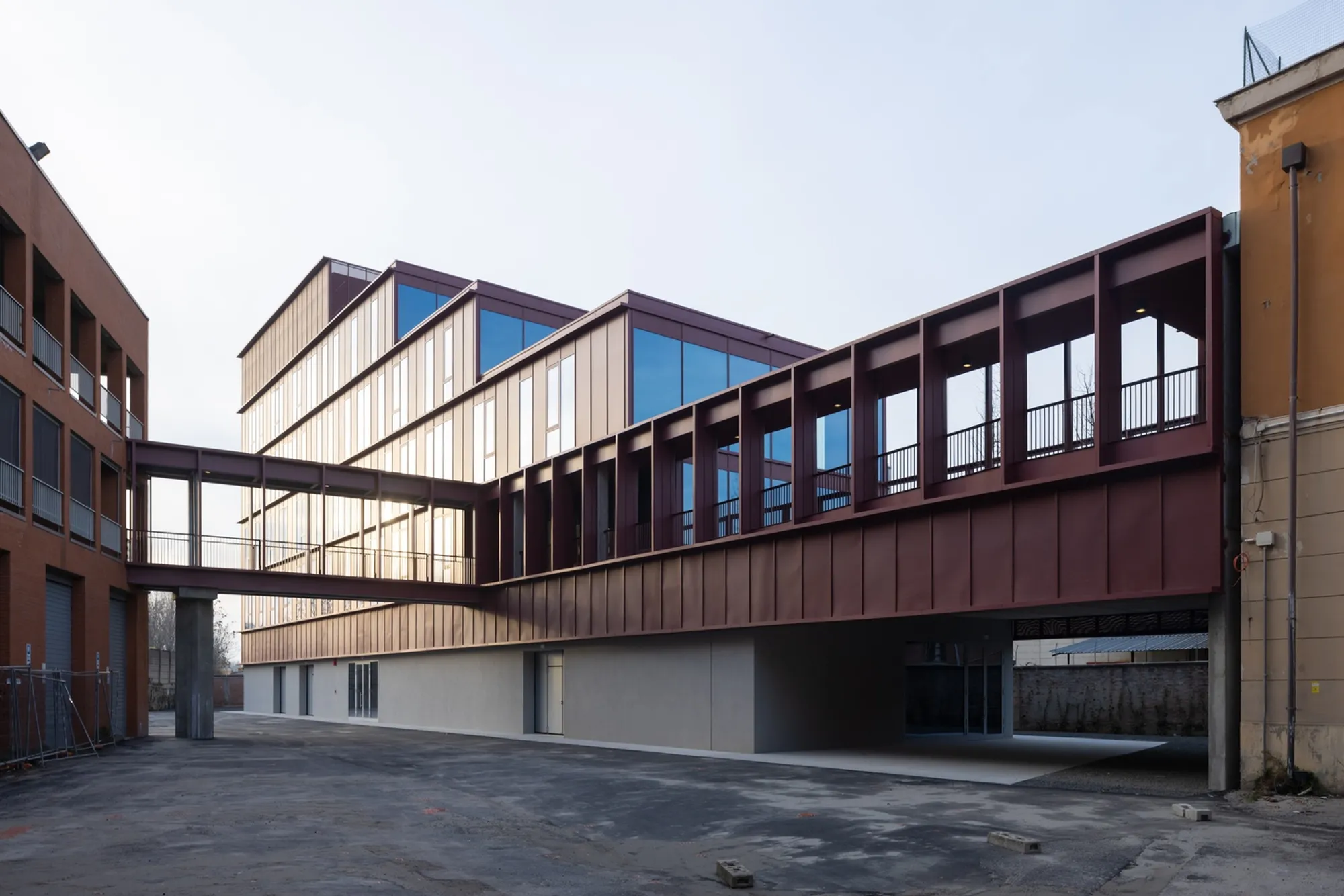
Guardia di Finanza Office Building by DEMOGO
Stepped institutional office in Bologna integrates terraces, red-toned facade, and linear staircase, reconnecting military complex with surrounding urban landscape.


The new regional headquarters of the Guardia di Finanza in Bologna represents a carefully calibrated architectural response to one of the city’s most complex urban margins. Designed by DEMOGO, the 2,700-square-metre office building is conceived as an instrument of urban mediation, transforming a formerly closed military perimeter into an active threshold capable of dialogue, permeability, and regeneration.
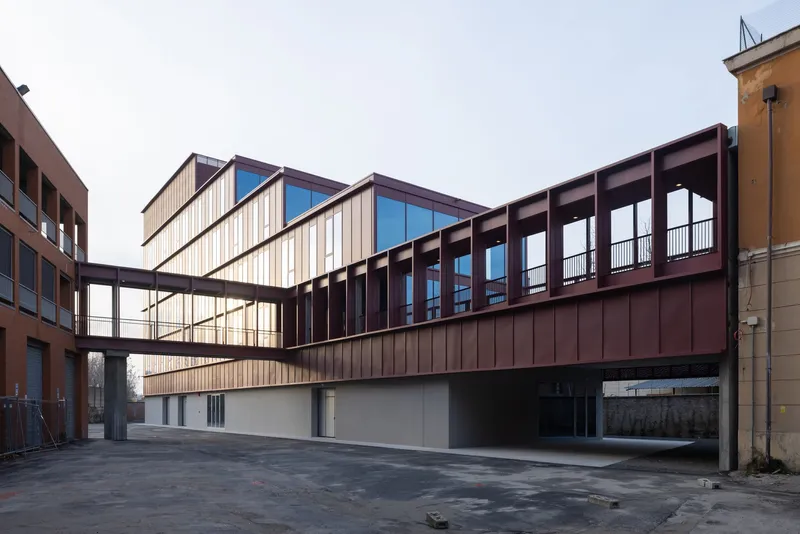
Located in Bologna, the project occupies a fragmented site shaped by infrastructural and social contrasts. To the north, the high-speed railway line and station form a dense infrastructural barrier; to the south lies the evolving cultural landscape of the DumBO Social Center; to the east, Via Tanari traces the layered edges of Bologna’s historic urban fabric. Rather than resisting this condition, the project embraces marginality as a design opportunity, reinterpreting it as a connective zone between institutional architecture and the city’s everyday life.
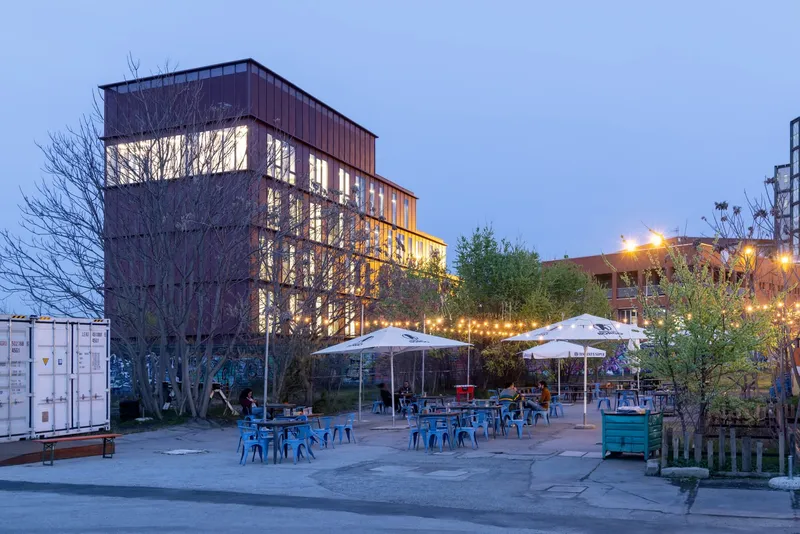
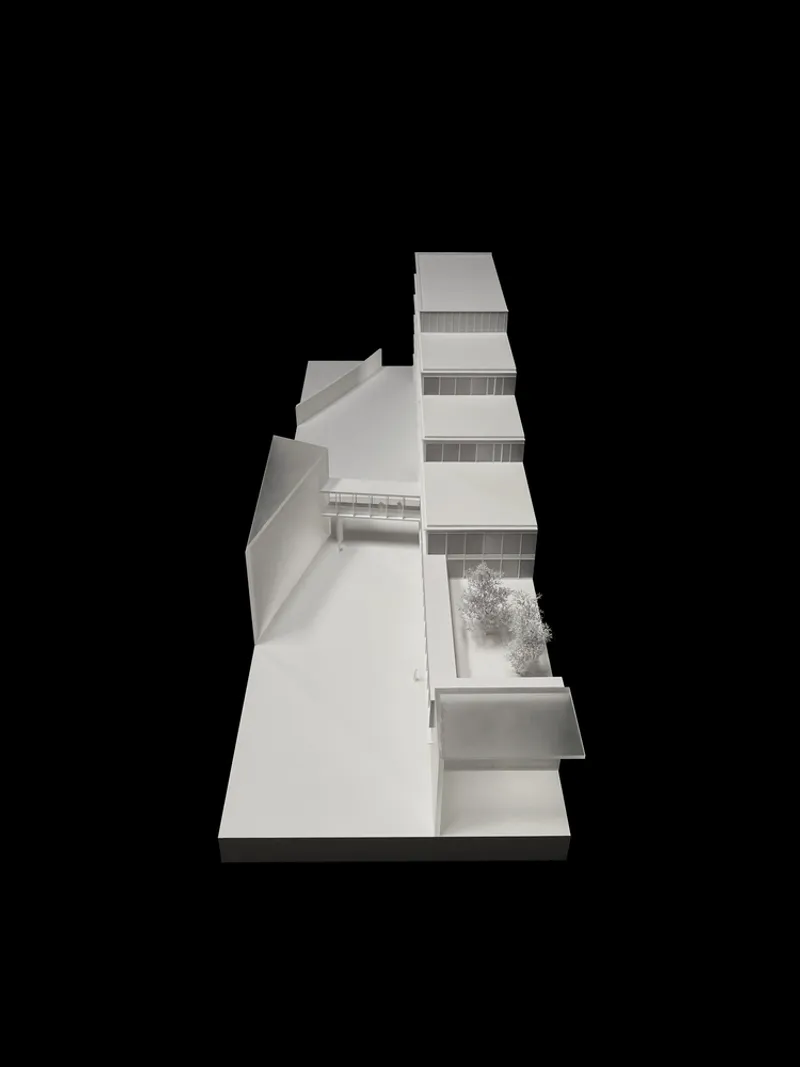
The new office volume is positioned perpendicular to Via Tanari and seamlessly integrated with the existing core of the Bertarini Barracks. Its compact massing is articulated through a sequence of stepped terraces that unfold across the five above-ground floors. These terraces function as elevated gardens and outdoor extensions of the office spaces, improving environmental comfort while establishing continuous visual relationships with the surrounding city. The descending profile softens the building’s presence and reinforces a horizontal dialogue with the urban landscape, allowing workspaces to remain visually and spatial connected to Bologna.
Despite its location within a secured military complex, the building actively negotiates openness and control. DEMOGO introduces the concept of the boundary as a “third space,” a transitional zone that encourages perception, movement, and visual exchange. On the southern façade, an elevated footbridge connects the new offices to existing barracks structures, reinforcing internal continuity. To the west, the building addresses the DumBO regeneration area, enabling moments of visual interaction between the institutional realm and the civic life unfolding beyond the perimeter.
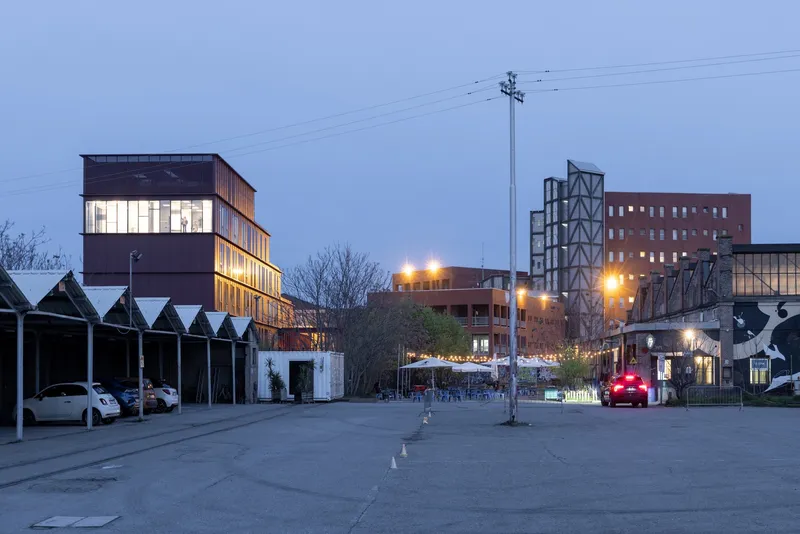
Architecturally, the project is defined by compositional rigor and subtle variation. The façades are structured through a precise system of horizontal string courses and modular panels, generating shallow reliefs that animate the elevations without excess. Chromatically, the envelope references Bologna’s characteristic red tones, grounding the contemporary intervention within the city’s material memory while maintaining a distinctly modern expression. This restrained yet expressive façade strategy reinforces themes of order, rhythm, and controlled transformation.
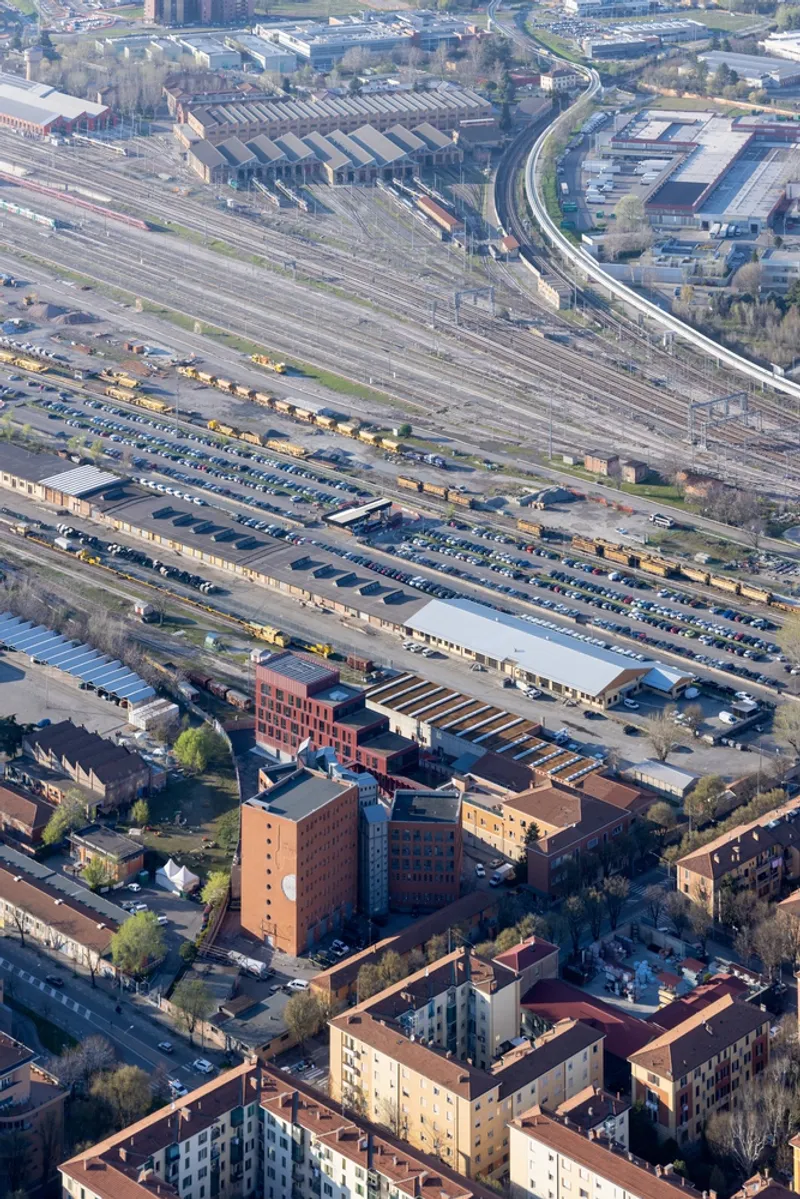
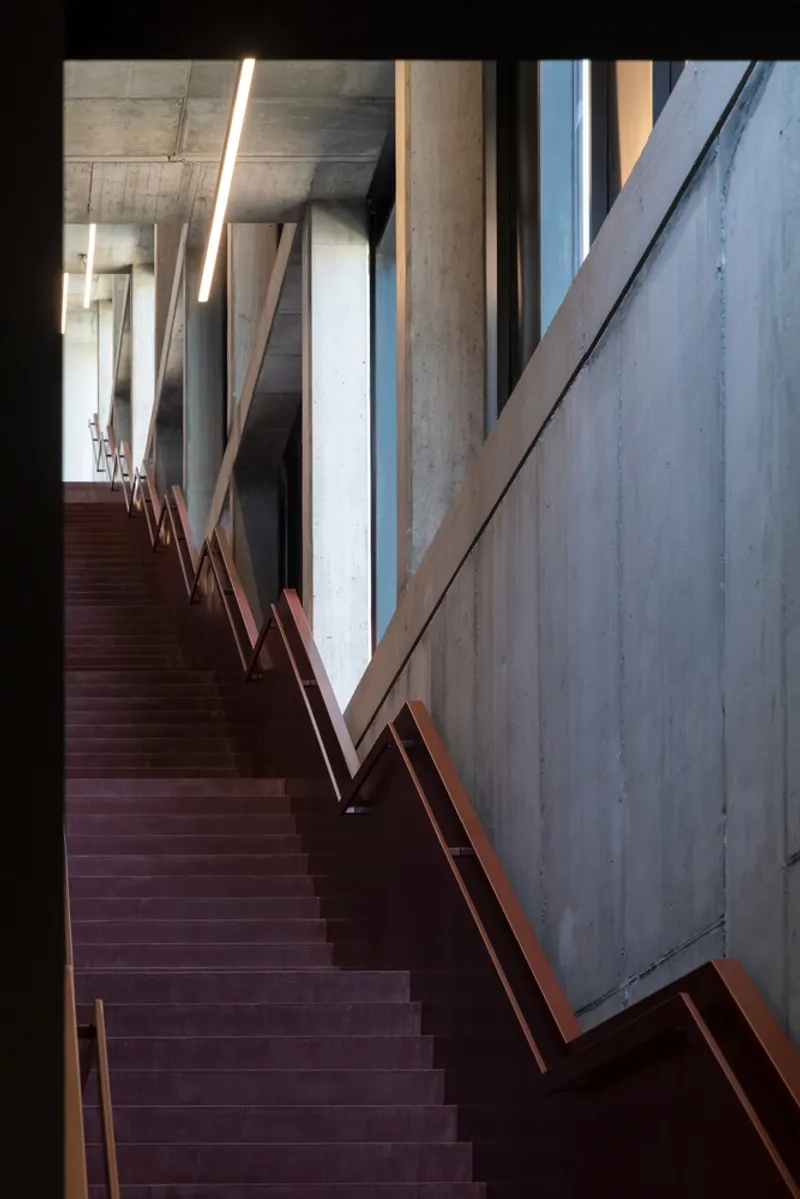
Internally, spatial experience is organized around a defining linear element: a long staircase that extends the full length of the building. Encountered immediately upon entry, this staircase becomes both a circulation spine and a perceptual device, visually linking all levels while guiding movement in a continuous architectural promenade. As one ascends, the relationship between interior spaces, terraces, and distant urban landmarks gradually unfolds, reinforcing a vertical narrative that mirrors the city’s layered condition.
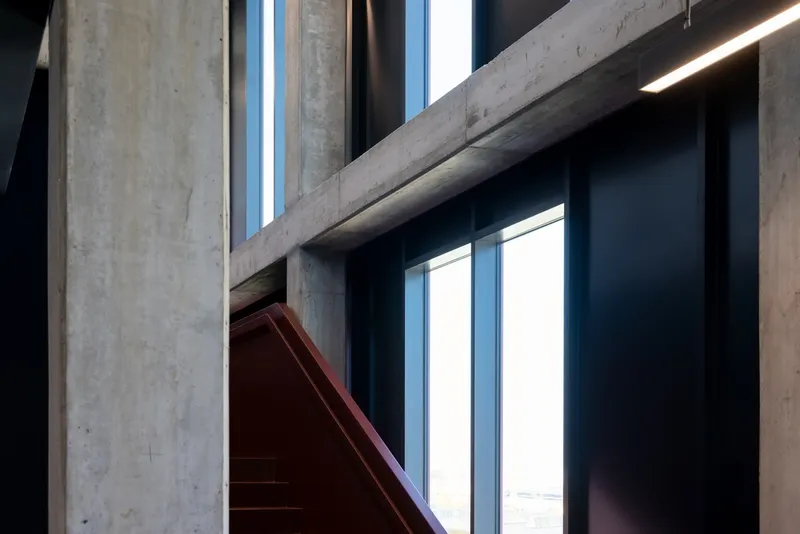
Through carefully framed views, the surrounding urban fabric becomes an integral part of the interior experience. According to the architects, landmarks such as San Luca and the Garisenda and Asinelli towers emerge as constant references, shaping a shared environmental context. In this way, the Guardia di Finanza Office Building transcends its functional role, positioning itself as a civic architecture that balances security, openness, and urban responsibility.
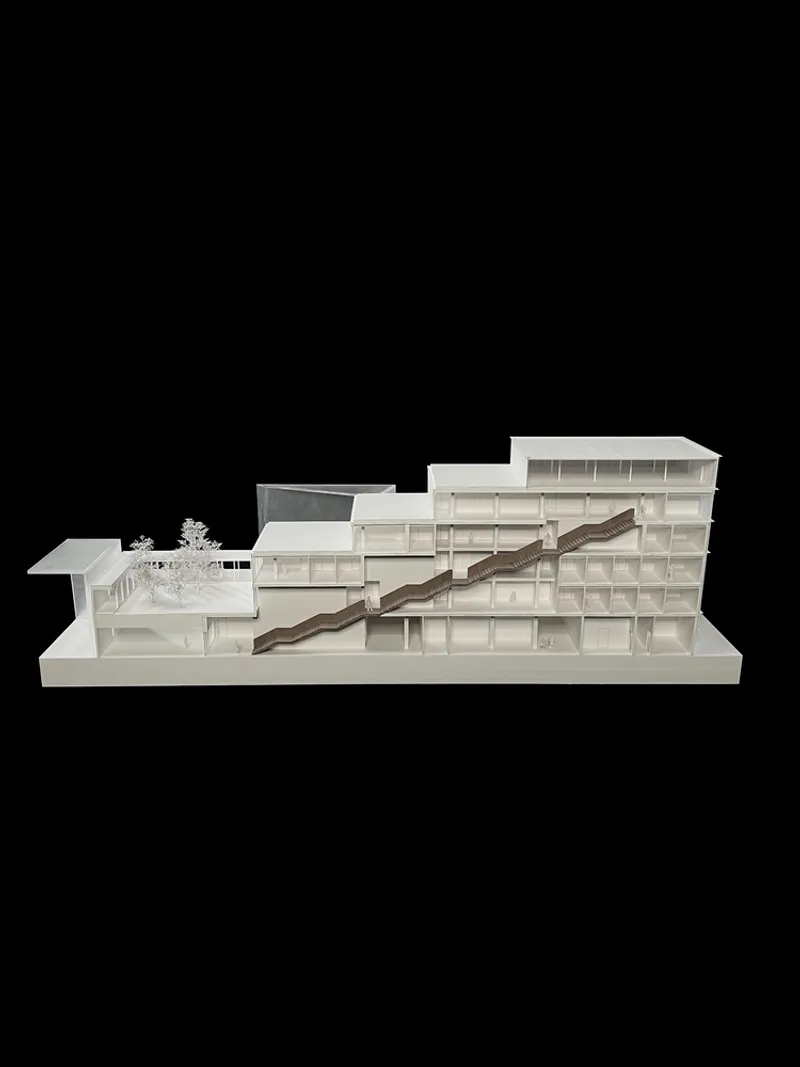
Completed in 2023 and documented through the lens of Iwan Baan, the project stands as a refined example of contemporary Italian office architecture: one that rethinks institutional boundaries and redefines the relationship between public authority, workplace design, and the evolving city.
All photographs are works of
Iwan Baan



Popular Articles
Popular articles from the community


Co-life: Sustainable Architecture for Age-Friendly Community Living
Co-life reimagines sustainable architecture for seniors through courtyards, rammed earth, shared gardens, and spaces designed for belonging.

The Ocean Hive: Sustainable Architecture for a Self-Sufficient Civilization at Sea
The Ocean Hive imagines sustainable architecture at sea, where modular habitats, algae, wave power and ocean waste sustain a growing colony.

Hill & Cross Opera: Sculptural Opera House Architecture Shaped by Tallinn’s Landscape and Identity
Hill & Cross Opera reimagines opera house architecture in Tallinn through its sculptural hill, civic plaza, glass wave and a luminous cross.

Co-Life: Senior Housing Design That Reconnects Older Adults With the City
Co-Life reimagines senior housing design through healing gardens, shared streets, workshops, and a sustainable community across generations.


Similar Reads
You might also enjoy these articles

FAMM Arquitectura Organizes Ten Villas Around Courtyards and Jungle in Nosara, Costa Rica
El Molino pairs two elongated volumes with deep overhangs and timber louvers to build a compact coastal community five minutes from the beach.
Oscar Niemeyer's Ibirapuera Park Pavilions Define São Paulo's Cultural Identity in Concrete and Curve
A constellation of modernist volumes set within São Paulo's most important urban park, conceived for the city's 400th anniversary in 1954.
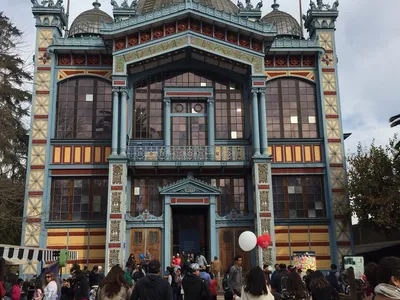
How Henri Picq's 1889 Paris Pavilion Traveled 11,000 Kilometers to Become Santiago's Artequín Museum
A prefabricated iron and glass pavilion built for the Paris Universal Exposition found a second life as a children's art museum in Chile.
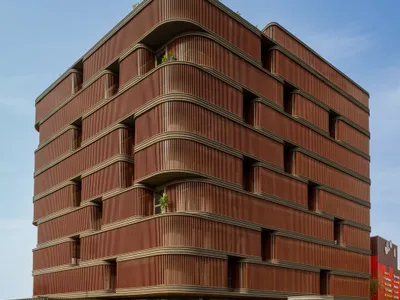
Sanjay Puri Architects Wraps a Jaipur Office Tower in Capsule-Shaped Green Buffers
A nine-level climate-responsive workplace near Jaipur Airport uses stacked planter terraces and aluminium screens to fight 40°C heat.


Explore Office Building Competitions
Discover active competitions in this discipline



Challenge to reimagine the Iron Throne


Photograph architecture without architects


Illustrate the lost glory of Angkor Wat - Render Challenge


Design challenge to reuse E-waste
Comments (0)
Please login or sign up to add comments
No comments yet. Be the first to comment!