

Habitat Solis
Urban living integrated with nature.

Habitat Solis
Goal
The main concept behind our project is to integrate urban living with nature. Before the design process begun, we had closely examined already existing projects which clash human invention with natural world. We wanted to envision an optimistic low-emission future. The best way to do it is to live in a city, as urban living creates the least carbon footprint (way smaller than suburban). The building not only need to be sustainable, but also relatively cheap, as it will provide housing for those who just entered the market.

Context
The southern part of Hackney, London is a thriving place full of cafes, clubs and cultural venues. As well as brilliant access to one of the best transport systems in the world. The triangular plot of land between Kingsland Rd and Enfield Rd is one of the last empty places in the whole area.
To create a living street one should create mixed-use development. Retail always brings life to a place and benefits entire neighborhood – creates job opportunities and attracts wealth. That’s why we propose to designate entire ground floor for commercial use. Small shops located along an arcade would be rented to artists and artisans as workshops.
The height of the building should be determined by the surroundings. At the corner we propose a dominant 6 stories height. Block situated along the Kingsland Rd varies in height between 4 and 6 floors. Calmer Enfield Rd has significantly lower buildings – between 3 and 5 floors.
Common space
At a core of the courtyard stands the social club, which houses amenities like sauna, gym, washing room, cinema room, preschool and large space for organizing parties with grand kitchen. The space explores the idea of cohabitation. It is way easier to maintain amenities when the cost is split. The club is easily accessible from every part of the building. Another important social space are the galleries, which provide additional gathering space. Along the railings vines are planted, which further enhance the atmosphere of a wild jungle.
Living units
There are 42 twin sharing units and 33 single studios. Most of those units are placed along the galleries, 20 are located in a standalone semi-circular structure at the corner. We decided to make mostly 2-storey apartments, because they provide the most efficient use of space and lessen the amount of needed corridors. Units come in variants – some have loggies, some other have winter gardens.
Ecology
The inner yard is meant to be a jungle. It should provide a scenic retreat from the urban noise. In the middle of it lies a pond, which serves microretention and captures the rainwater. During summer months water helps cool down the surrounding area. Reduction of height on western wall helps illuminate the space. Part of the roof is dedicated to an urban farm and a greenhouse. Obviously the amount of food produced there would not be sufficient to supply entire Habitat. Nevertheless, gardening is a beautiful hobby – it helps coping with stress and provides a meditative retreat for habitants. What’s more – the cooperation helps reinforce bounds between the residents.
As the plot is located in a well communicated area with an abundance of bicycle paths, we decided to provide parking spaces only for bikes.

Technology
The structure is based on prefabricated modules. It greatly accelerates the construction process, what is important in dense and expensive places like London. As the main building material we propose the hemp concrete, which is a new sustainable technology. Ceilings are made of poured concrete. Additional support is provided by steel beams.
Aesthetic
The idea for the design came from the philosophy of Arcology. Our design choices were inspired by the work of Paolo Soleri and Hundertwasser. We wanted to involve many colors and shapes. The facade is composed of vertical regular modules, each different in color. This is meant to diversify the facade and suggest associations with historic housing. The mosaique of irregular windows and loggies was meant to create a sense of organised chaos. The main corner – the semi-circular building - is lifted two stories above ground and supported by steel beams which are meant to recall victorian architecture. Along both streets are arcades supported by ornamented butresses.


Popular Articles
Popular articles from the community


Co-Life: Senior Housing Design That Reconnects Older Adults With the City
Co-Life reimagines senior housing design through healing gardens, shared streets, workshops, and a sustainable community across generations.

AL-JANNAH: Sustainable Architecture and Permaculture for Afghan Widows
AL-JANNAH uses sustainable architecture and permaculture to create resilient oasis of housing, learning, work and renewal for Afghan widows.
EW PARK: Sustainable Architecture Reimagines the Future of Urban Parking
EW PARK reimagines city parking as a modular wooden tower combining automation, solar energy, electric mobility, and adaptable urban design.

Co-life: Sustainable Architecture for Age-Friendly Community Living
Co-life reimagines sustainable architecture for seniors through courtyards, rammed earth, shared gardens, and spaces designed for belonging.

Similar Reads
You might also enjoy these articles

Day and Night Park: A Time-Based Urban Newsstand in Beijing
A temporary urban newsstand in Beijing blending travel, light, and reading through poetic colors, compact form, and community-focused design.

Modernist Patio Renovation in El Masnou, Barcelona by Oliver Segura Arquitectura + Cebrià Arquitectura
Modernist patio renovation blending tradition and innovation with a movable pool, leveled floors, and Catalan materials in El Masnou.

Alto Residencial Coop: Cooperative Housing Development in Santiago de Compostela by Carbajo Barrios Arquitectos
A linear cooperative housing complex blending white volumes and perforated metal façades, enhancing community living, natural light, privacy, and urban integration.
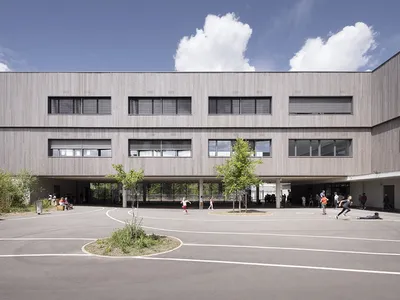
Vil Genis School by BPA ARCHITECTURE – Massy, France
Vil Genis School in Massy, France, features sustainable design, south-facing classrooms, community integration, accessible spaces, and modern educational architecture.


Comments (0)
Please login or sign up to add comments
No comments yet. Be the first to comment!