

ISON Architects Disguises an 18-Room Daycare as an Inhabitable Hillside in Incheon
Hana Daycare Center folds nursery rooms, courtyards, and rooftop terrain into a neighborhood microcosm on reclaimed land in Cheongna District.


Cheongna District is the kind of place that looks better on a masterplan than at eye level. Built on reclaimed land near Incheon, its wide roads, apartment blocks, and elevated highway overpasses leave little room for the human body to feel at ease, let alone a three-year-old's. When Hana Financial Group commissioned a daycare center for its employees' children here, ISON Architects saw a chance to push back against this vehicular urbanism with something radically child-scaled: a long, low building whose green roof warps into artificial hills, whose interior ceilings rise and fall like topography, and whose 18 nursery rooms open onto a constellation of courtyards that together read less like a single facility and more like a small village.
The most compelling move here is the refusal to treat a daycare as a decorated box. On a narrow 40m by 140m site, the architects organized every nursery room on a 9m structural module, oriented east to west, and threaded yards of varying sizes between them. The result is a concave-convex spatial rhythm where indoor and outdoor alternate in tight succession, giving children constant sensory variety without ever requiring them to leave a secure perimeter. A four-meter concrete wall along the western edge absorbs highway noise. A planted roofscape rolls over the entire building, converting structure into landscape. The children play on top of their own school.
A Landscape You Walk On
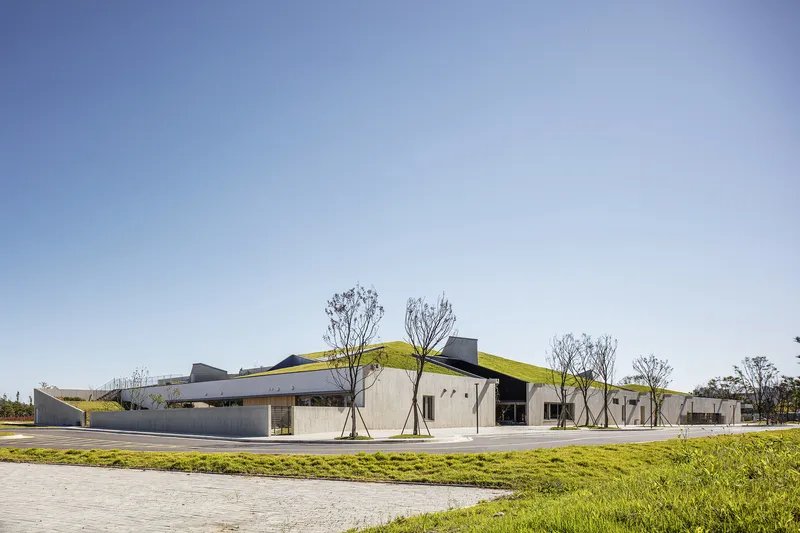
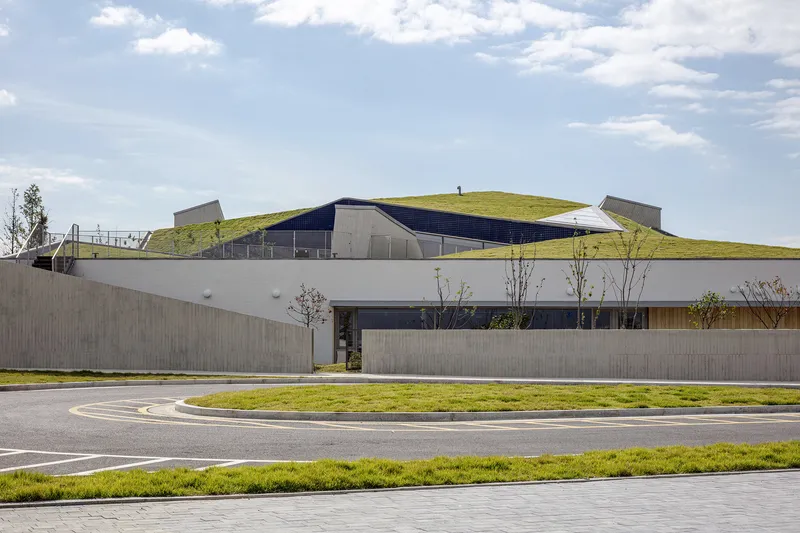
From the surrounding streets, Hana Daycare barely registers as a building. Its grass-covered roof undulates gently, sprouting young trees along a paved perimeter path, and the overall silhouette sits low enough to defer to the flat Cheongna plain while hinting at the distant hilly terrain the district obliterated during reclamation. The origami-fold geometry of the roof is not decorative: it generates the interior's varying ceiling heights, which range from 2.5 meters in intimate nap rooms to 6.6 meters in communal play halls.
Along the western edge, a solid concrete perimeter wall rises to meet the turf canopy, forming a continuous barrier against the noise of the overpass connecting Yeongjongdo, Incheon Airport, and Seoul. It is a pragmatic gesture that doubles as a formal one, giving the building a muscular civic presence on the highway side while keeping the interior courtyards sheltered and quiet.
The Rooftop as Playground
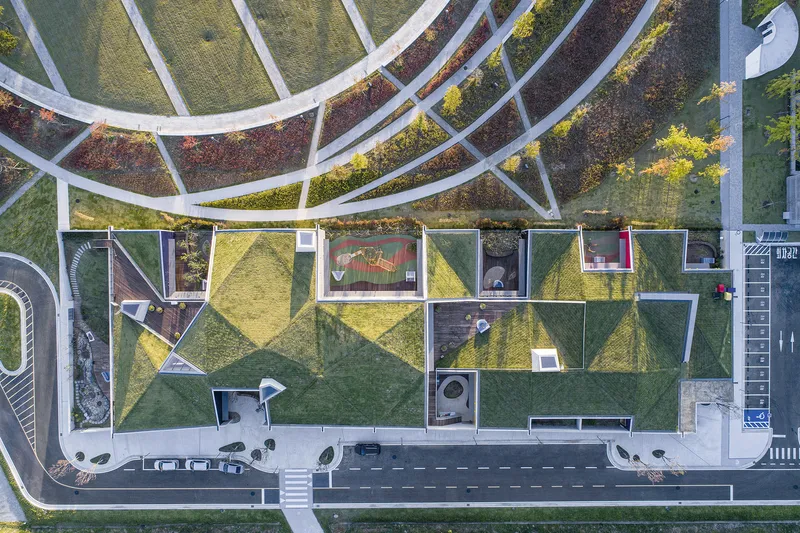
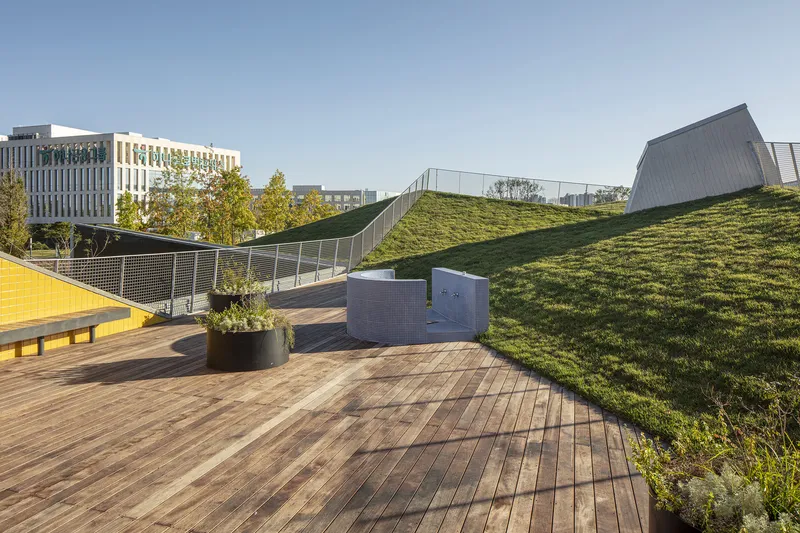
The aerial view reveals the full ambition of the roof strategy. White structural ribs radiate across planted zones and courtyards, organizing the green surface into legible sectors while channeling rainwater and defining paths. Some sections are designated play areas; others remain as untouched planting, giving children the experience of a landscape that is partially theirs to claim and partially wild. It is a quietly radical pedagogical statement: not every surface exists to be used.
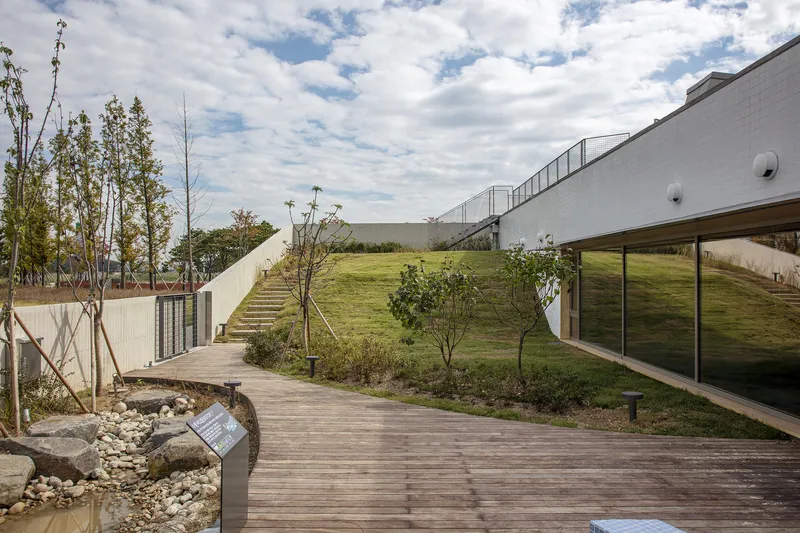
Timber deck terraces with planted beds and mesh railings provide safe transition zones between the flat ground level and the rising slopes. A curving boardwalk traces the hillside contour, and stairs cut directly into the planted berms let children ascend to upper levels under their own power. The protruding skylights, designed to bring natural light into rooms that courtyards cannot reach, read from above as rocky outcrops, reinforcing the illusion that this is terrain rather than architecture.
Colored Tiles and Concrete Grain
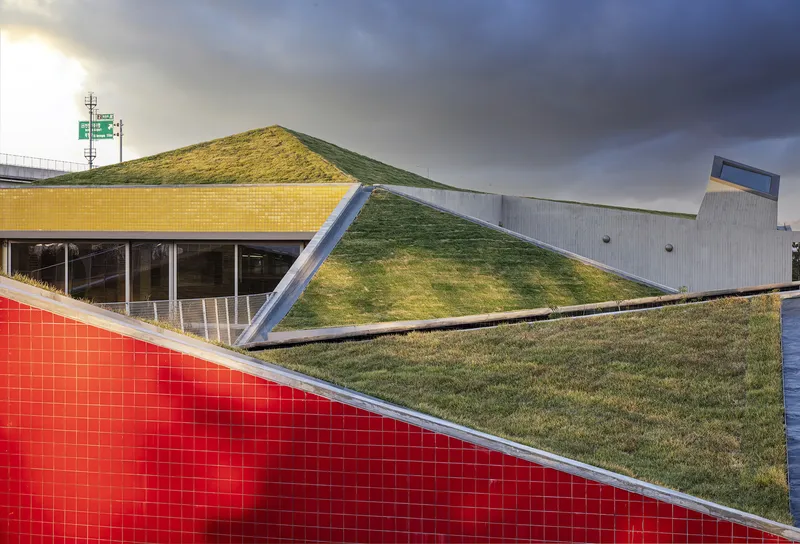
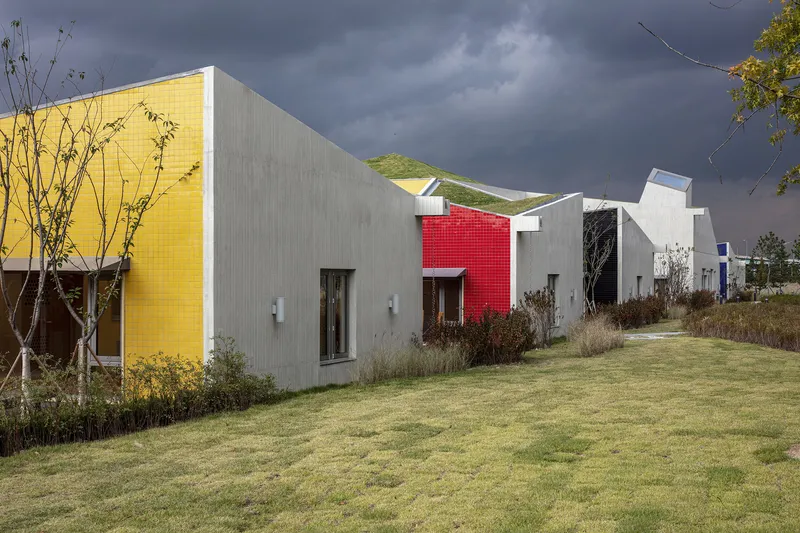
Material discipline holds the project together. The exterior walls are cast in polished wood-grain-effect concrete, a technique that transfers the warmth and texture of timber formwork onto a durable cementitious surface. It ages well, weathers gracefully, and sidesteps the problem of maintaining real wood in a coastal, reclaimed-land climate. Against this neutral palette, primary-colored tiles on the courtyard-facing walls land with real force. Red, yellow, and white facades identify individual pavilion units, turning each nursery room into a recognizable address within the village metaphor.
The tile pavilions photographed under stormy skies are among the project's most striking images. The saturated hues pop against the grey cloud cover and the muted green of the roof, and the individual volumes read almost like houses on a street. For a child learning to navigate space, that legibility matters: you know where your room is because it is the red one, or the yellow one. Architecture doing the cognitive work that signage cannot.
Threshold and Arrival
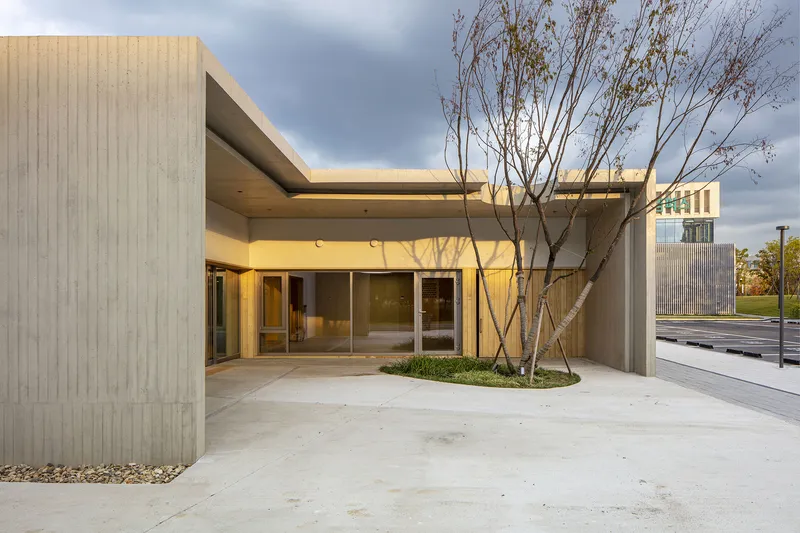
The covered entry courtyard at dusk reveals a careful handling of the daily drop-off ritual. Ribbed concrete walls frame a generous outdoor room paved simply and planted with young trees, giving parents and children a transitional space that is neither street nor classroom. Lighting washes up the textured walls, lending warmth to a material that might otherwise feel institutional. It is the kind of threshold architecture that signals, without words, that you are crossing from the adult city into a child's territory.
Inside, the 18 nursery rooms are separated by wooden frames measuring 0.6 meters deep, 2.2 meters tall, and 1.2 meters wide. These frames serve as partitions between nursery, game room, and office spaces while remaining transparent enough to allow visual connection. The infant section (ages zero to two) occupies the calmer southern end of the site; the toddler section (ages three to five) takes the more active northern zone. A 3.8-meter-wide staircase doubles as a book nook, and a central dining area anchors communal life.
Why This Project Matters
Hana Daycare Center is a persuasive argument that childcare architecture does not need to choose between durability and delight. ISON Architects deployed heavy infrastructure, concrete walls, acoustic barriers, and a sprawling green roof, to solve real problems of noise, climate, and density, then layered color, texture, and topographic play on top. The 9-meter modular logic keeps the construction rational and repeatable without producing monotony, because the courtyards, ceiling heights, and tile colors introduce enough variation to make each room feel specific.
More broadly, the project challenges the default approach to institutional buildings in new Korean satellite cities. Where most facilities in Cheongna sit behind parking lots and blank facades, this one buries itself in landscape and opens courtyards to the sky. It treats children as the primary users of the neighborhood, not an afterthought. In a district built for cars and capital, that inversion of priority is both the building's greatest provocation and its most generous gift.
Hana Daycare Center by ISON Architects. Located in Cheongna District, Incheon, South Korea. 3,161 m². Completed 2021. Photography by Kim Jong Oh.
About the Studio
Share Your Own Work on uni.xyz
If projects like this are the kind of work you want to make, uni.xyz is a place to publish your own, find collaborators, and enter design competitions.


Popular Articles
Popular articles from the community


Cloaked Colonization: A Mobile Underwater Habitat That Moves Like a Fish
Micah Abaya's shortlisted EHC Pacific entry reimagines ocean settlement as a dispersed network of self-sustaining architectural organisms.

Singing Woman: Contemporary Architecture Inspired by Estonia’s Voice and the Sea
Singing Woman turns Estonia’s song culture into flowing opera house architecture, blending public life, landscape, sea, and national memory.
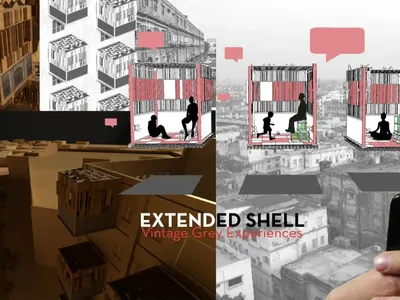
Extended Shell: Retrofitting Kolkata's Balconies as Living Urban Thresholds
A modular retrofit system recovers the social and environmental intelligence of Kolkata's historic verandas for contemporary Park Street residents.

Manzana Morphosis: Stretching Barcelona's Grid into a Living Landscape for 2050
A radical reworking of the Eixample manzana turns density into a tool for generous public space, vertical ecology, and environmental performance.

Similar Reads
You might also enjoy these articles


Hodi-Mandai Geram
Project Function: Preservation and revitalization of the Intangible heritage and socio-spatial identity of the Hodi by Housing, Cultural Memory Center, Sacred Grove, landscape, local tourism economy


Olio Towers: A Mid-Rise for Performers That Fuses Housing, Rehearsal, and Stage
Located blocks from Houston's Theater District, this modular tower stacks living units around a central performance atrium.

Oasis: Modular Green Housing Carved into Dhaka's Urban Fabric
A shortlisted Plugin Housing entry reclaims unauthorized settlements in Dhaka with stepped concrete volumes, green roofs, and ventilation-driven design.

Black Hole: A Floating Megastructure for the Post-Physical Era
Emiliano Mazzarotto envisions a spherical, self-scaling arena where e-sports, digital hotels, and holographic stadiums replace traditional public space.

Explore Childcare Center Competitions
Discover active competitions in this discipline

Challenge to reimagine the Iron Throne

Photograph architecture without architects

Illustrate the lost glory of Angkor Wat - Render Challenge

Design challenge to reuse E-waste
Comments (0)
Please login or sign up to add comments
No comments yet. Be the first to comment!