
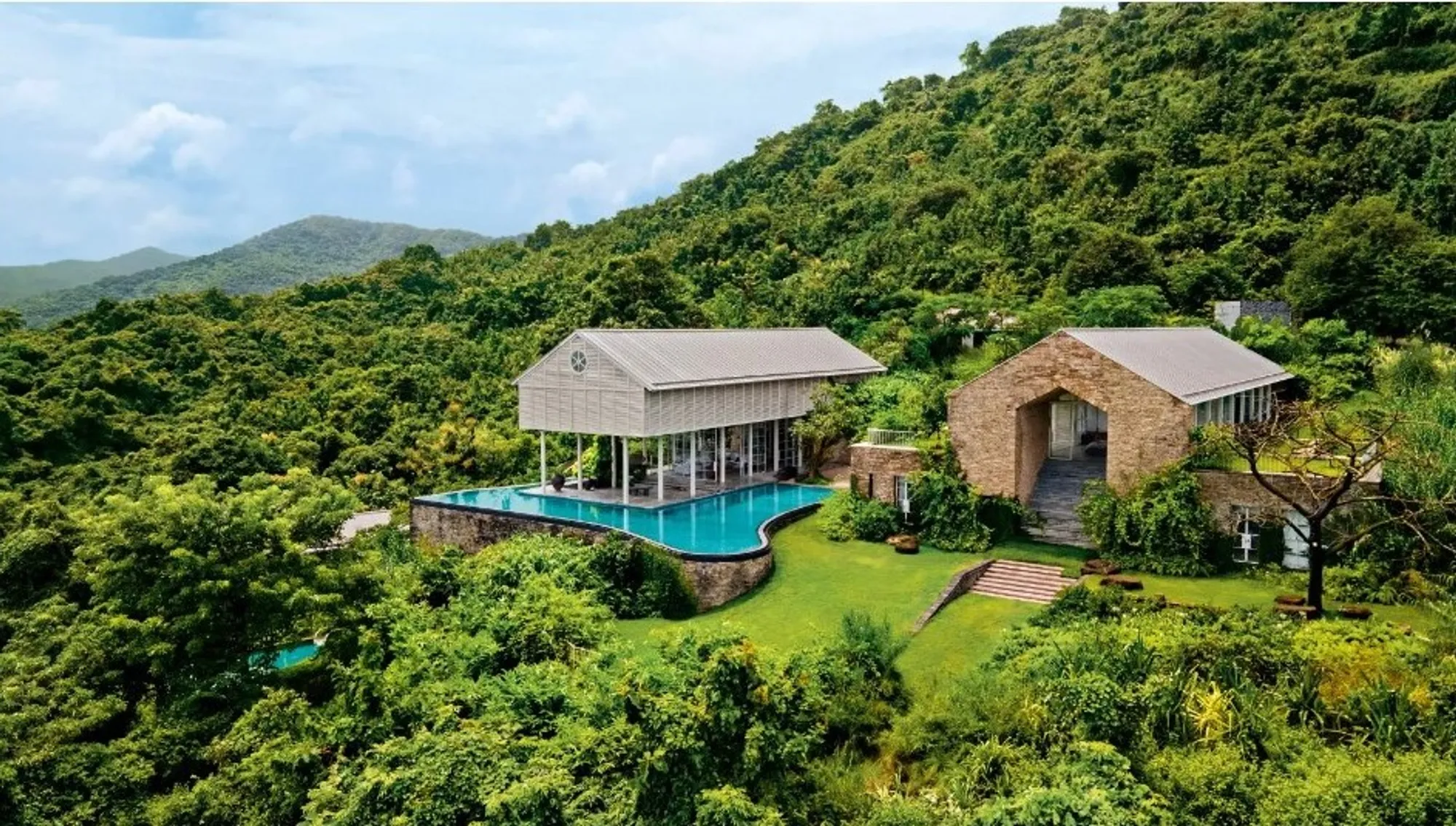
Home in Alibag is a perfect example of how architecture and landscape design can come together to create a stunning property.
This weekend home in Alibag was designed by AD100 firms Architecture Brio and Kunal Maniar Associates.

When we first visit the Bhojwanis' weekend home in Alibag, they are away on a trip. Later in the day, when we catch up with Ty over the phone, he admits to missing his pet Labrador acutely and requests a candid picture of his fur baby. The pampered canine in the living room seems too distracted to face the camera. She's trying to keep an eye on the iridescent garden skink slithering on the branches of the towering brassia, the posse of showy butterflies that have fluttered in to hover over the swimming pool, and the conspicuous clique of ladybirds ambling around the fantastic glass façade of the house.
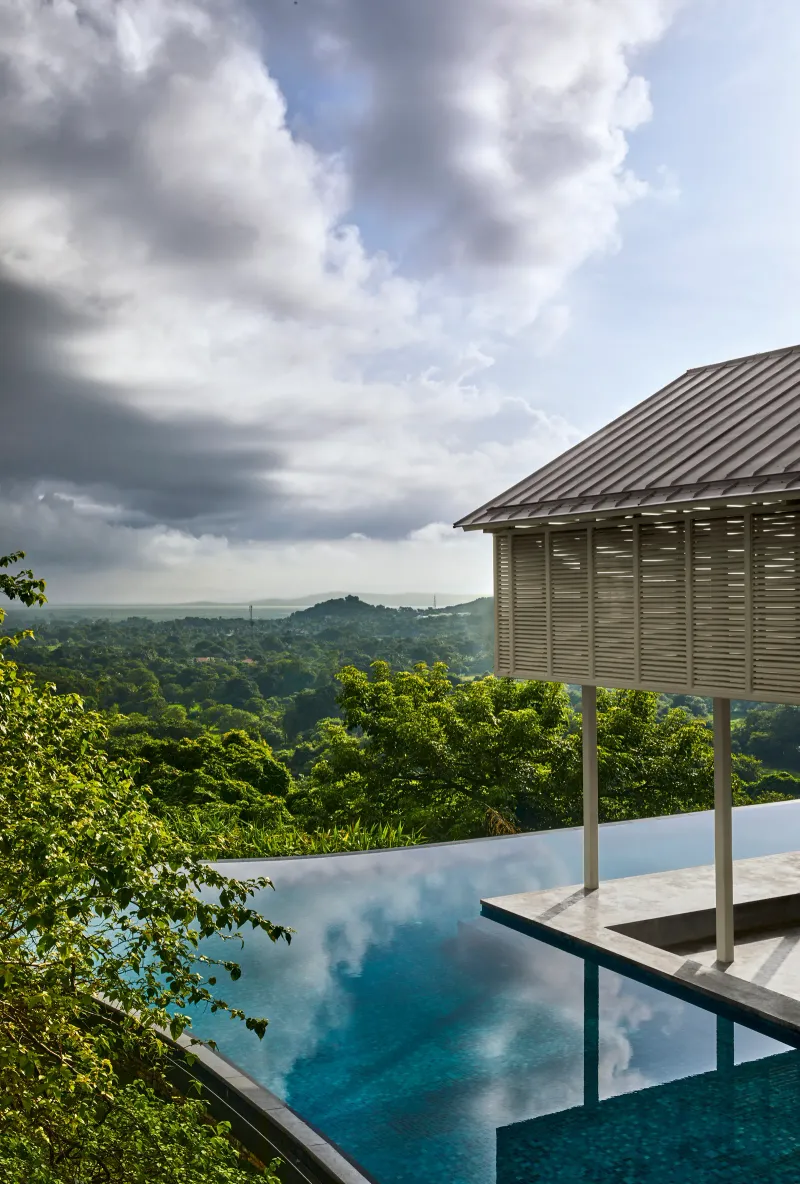
The veranda of ty Bhojwani’s Alibag home, edged by the infinity pool, offers a panoramic view of the bay. Covered with an aluminium standing-seam roof, it is suffused with outdoorsy vibes. Bhojwani entrusted the home’s creation to AD100 architects Shefali Balwani and Robert Verrijt of Architecture Brio, and its garden to AD100 landscape architect Kunal Maniar of Kunal Maniar & Associates. Ashish Sahi
In times like these, we can't help but notice how mother nature is so generous with her gifts. Throughout Bhojwani's 4.5-acre property, there are many delightful moments to enjoy. Every part of the house is designed to work with the landscape--a metaphor for the collaboration between Shefali Balwani and Robert Verrijt of Architecture Brio and landscape architect Kunal Maniar from Kunal Maniar & Associates.
"Robert and Shefali are very confident architects," Maniar says. It's not easy to find team members who you can work well with on a long-term project - but luckily, we found each other. We're all dedicated to the project and not our own egos, which makes for a much smoother workflow. This is the first time we've worked together on something like this and it's been a great experience so far.

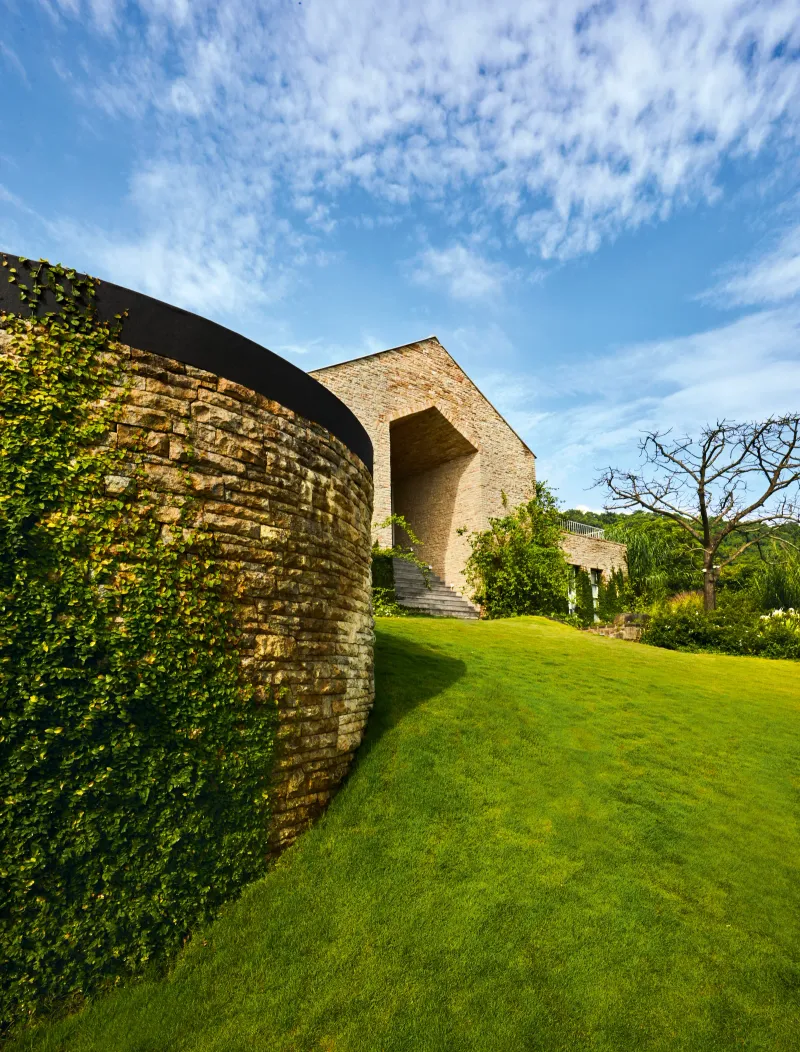
The natural elevation of the land under the pool, clad with limestone and a profusion of ivy, descends into one of the few lawn spaces on the property. Abutting the ivy are shrubs of Murraya Exotica for a fragrant whiff by the poolside. Ashish Sahi
 Boulders excavated during construction and specially made gravel minimize water consumption, as opposed to lawns, and accentuate the frangipani tree and bougainvillea on the left. Ashish Sahi
Bhojwani's brief was to create a modern take on a traditional white plantation home. The house's remote location - atop a hill with views of the bay - not only served as a privileged vantage point but also announced its prominence from a distance. "An all-white house on a hill could end up looking like an enormous mansion spoiling the scenery," says Balwani. "It was important to understand how it would be perceived from a distance." “An all-white house on a hill could also look like an enormous mansion that sticks out and ruins the scenery,” says Balwani. “It was important to understand how it will be perceived from a distance.” To summon a clear reference point, she and Verrijt worked on several models and decided to use the subtle white of the Dhrangadhra limestone for the overall cladding. “We imagined a building that would be humble but still have its own presence,” says Verrijt.
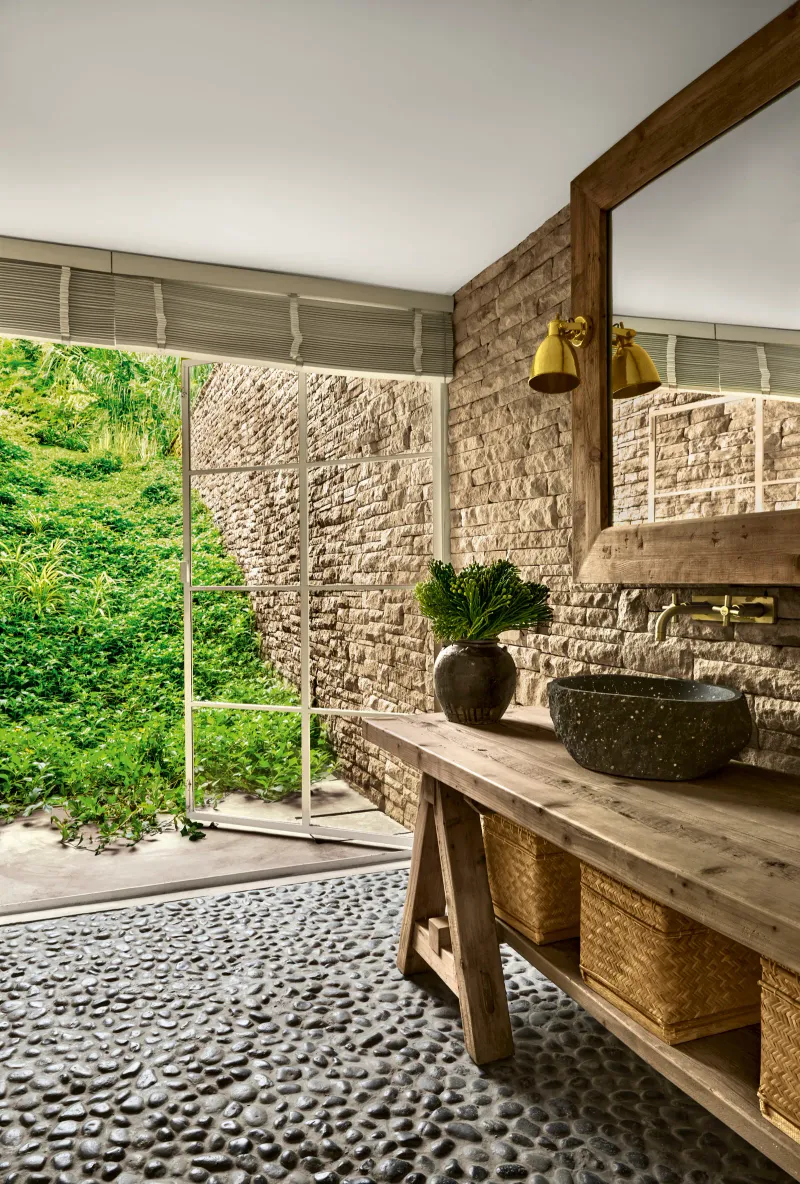 The natural slope of the land has been retained to form an unusual courtyard outside the guest bathroom. Ashish Sahi
 The amphitheatre-style steps at the entrance are composed of rammed earth, concrete blocks, and gravel specially made from the waste of limestone blocks. Cadillac Convertible (1947, Series 62): Courtesy of Amal Tanna. Ashish Sahi
 Dhrangadhra limestone walls set in a colonnade define the games room that surrounds the pool courtyard. Ashish Sahi
 The steel-barred window in the arrival forecourt, set in a random-rubble basalt wall, offers a view of the lush tropical landscape and a sliver of the Mumbai skyline. Ashish Sahi
The land's sloped and hilly surface area presented the team with their first challenge. Since Bhojwani wanted flat terrace spaces for parties and play areas, the team started by creating a retaining wall to encompass the raised terraces and depressions. “I really appreciate how Robert and Shefali have been so sensitive to the land's natural contours,” says Maniar. “ normally, the easier way to even out such unevenness would be to simply level it up with soil. But depleting soil by digging one part of the earth to fill up another is a rather thoughtless way to treat mother nature.” Fortunately, having worked on similar topographies earlier, Verrijt and Balwani were adept at tweaking odd contours into interesting architectural interventions. For example, the slopes facing the guest bathroom and kitchen have been designed to resemble inclined courtyards that flow into these spaces, adding both natural light and ventilation. Maniar took the elevation outside the kitchen and turned it into an aromatic garden, planting Brahmi (water hyssop), curry leaves, aloe vera, basil, turmeric, and ajwain (carom). This creates a peaceful and pleasant environment for customers as they wait to be seated.
 The sunken living room features a nest sectional sofa in white linen, set against a four-metre-long reclaimed coffee table, both configured below 28 handmade pendants of iridescent glass—all by Timothy Oulton Studio. The corten-steel planter—which holds a 15-foot-tall brassia tree—was made by Kunal Maniar & Associates. Ashish Sahi
 Ferns and alocasia cultivated in the timber louvred walls of the foyer spill onto the sides of the façade of the living room bringing the outdoors inside. AD100 architects Shefali Balwani, Kunal Maniar, and Robert Verrijt on the spiral steps made from cast concrete with a stunning faceted soffit that descend from the foyer. Ashish Sahi
Brio's team started by building two pavilions to be placed carefully at two key locations: a plateau for the main bedroom, game room, and guest bedrooms, and a lower level for the courtyard, infinity pool, and sunken living room. The latter has high ceilings supported by steel cables, louvred shutters, and slender metal columns, giving it an airy, ethereal feel like a chapel. The house is designed to wow visitors with its dramatic reveal. “When we were designing the castle, we wanted to make sure there were areas that would pique people's curiosity and not give away everything at first glance,” says Verrijt. The castle is full of surprises with a series of interconnected rooms and staircases leading to different levels. The breathtaking views of the bay and surrounding hills are not visible from the entrance or the foyer, but only when you reach the sit-out near the edge of the infinity pool. This allows for a moment of realization and understanding - much like the feeling you get when you finally solve a complicated puzzle.
 The custom-designed dining table from Timothy Oulton Studio was made using 100-year-old reclaimed timber and has a calcite crystal insert in the centre. Handmade rattan chairs and alabaster lights heighten the textural play of natural materials. “Batta Petite” and “Batta Magna” snack bowls, courtesy of Ikai Asai. Ashish Sahi
“The view from every part of the house is overwhelmingly beautiful. We wanted to ensure that we do not overplay nature. We chose foliage that does not compete with the structure.”
Kunal Maniar
 The pebbled floors of the guest bathroom make for an interesting play of textures, in sync with the limestone walls of the shower cubicle. Ashish Sahi
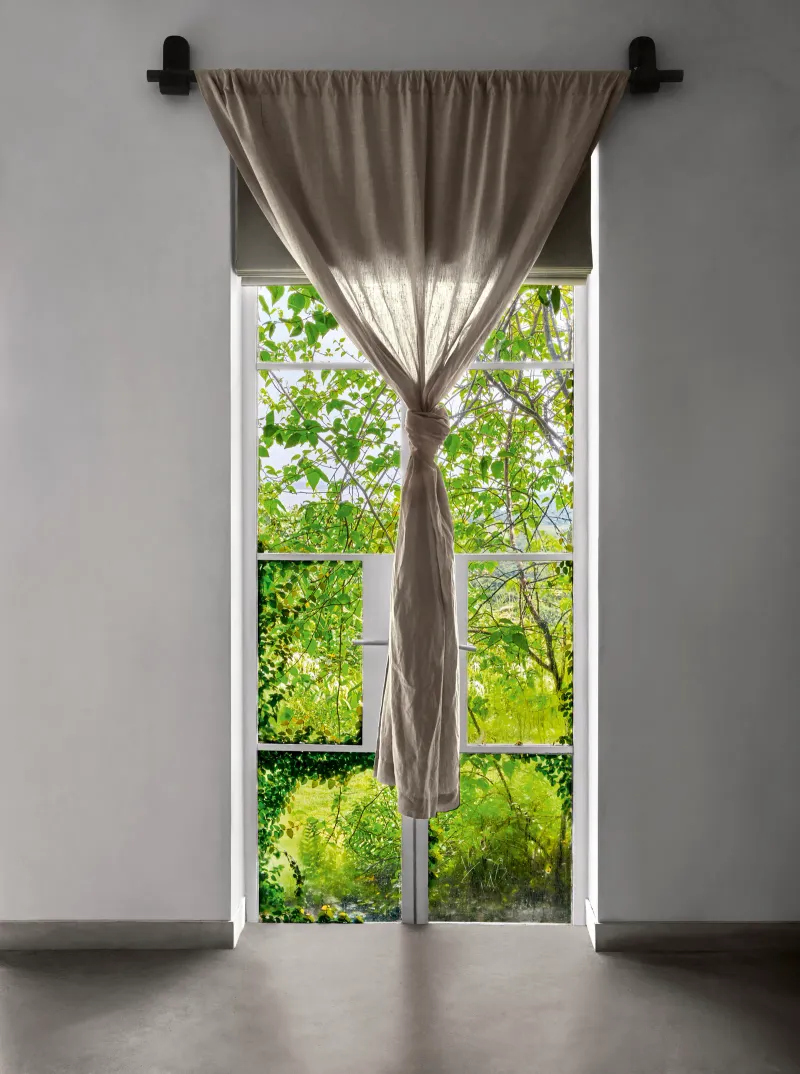 The walls and furnishings in every room represent a muted colour palette, as if to further emphasise the lush, green view outside. Ashish Sahi
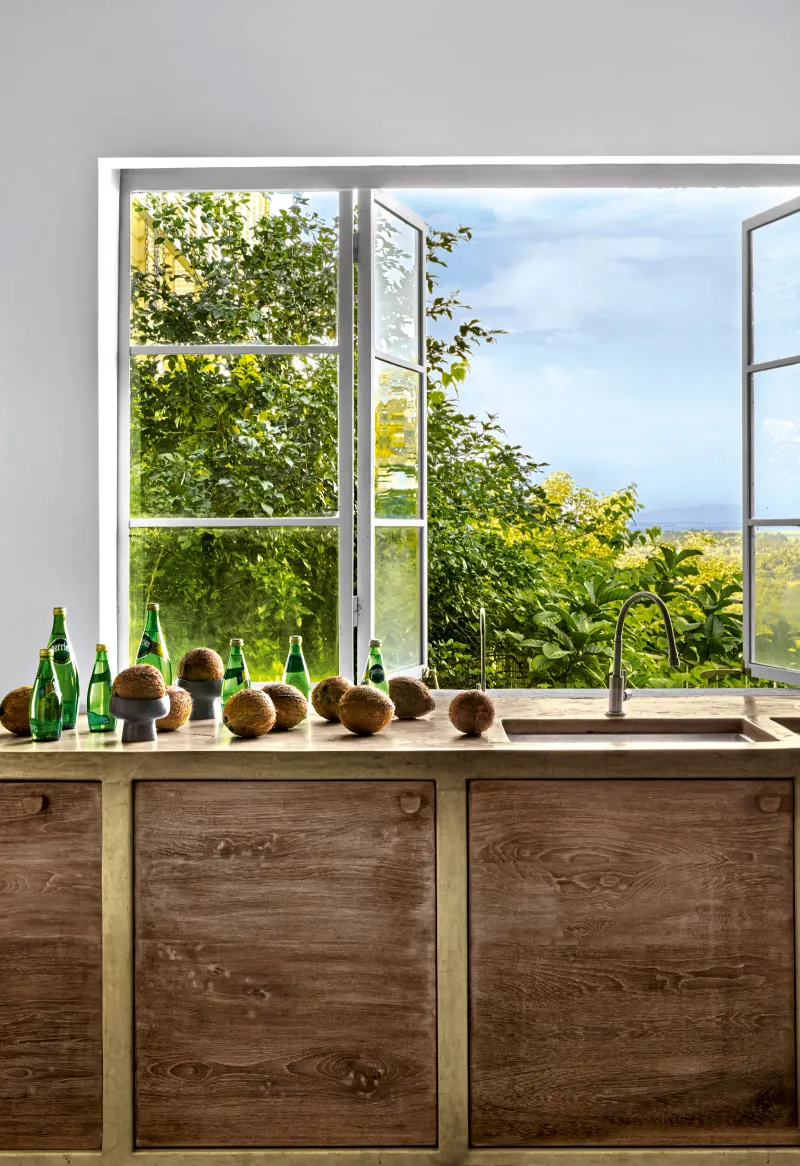 A lightly fragrant Kamini outside the kitchen window. Ashish Sahi
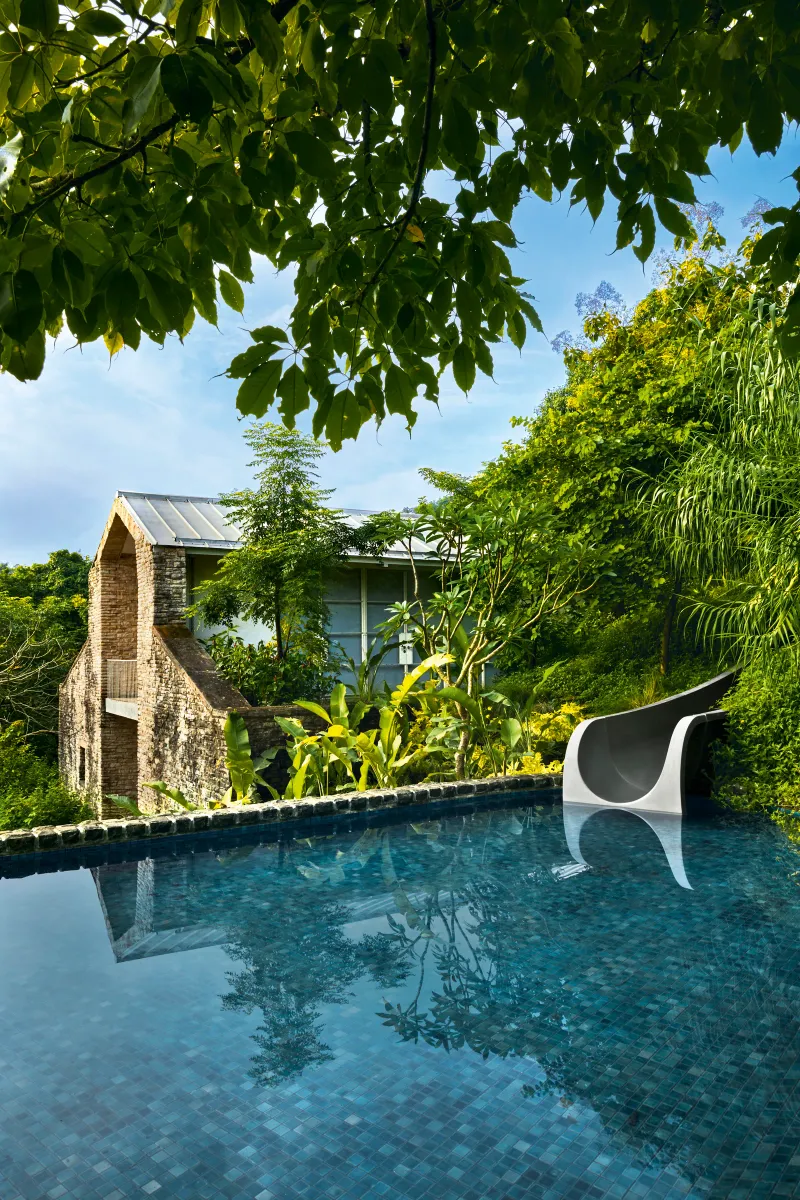
We even had a dialogue with Kunal about creating a lot of dense planting before we went into the parking space. I deeply admire how he is able to respond with interesting landscaping ideas that can be seamlessly integrated into the architecture—as if it always belonged there. This is not easy because the material he works with, organic matter, has a mind of its own. It takes amazing expertise to orchestrate its presence and growth. The foliage that covers the water slide helps to blend it in with the rest of the landscaping, making it less of a jarring sight. This is just one of the ways that careful landscaping can help to improve the look of a property.
The amphitheatre steps co-designed by Maniar and Brio are a perfect blend of smart sustainable design and a fun vibe. "We made those steps without using any cement," says Maniar. "Instead, we opted for rammed earth. Concrete blocks were placed on compact soil, and then the whole arrangement was interspersed with gravel to ensure that when it rains water percolates efficiently." The plants at the edge of these steps have been strategically chosen to soften the look of the hardscape, and the gravel is made from crushed bits of the cladding.
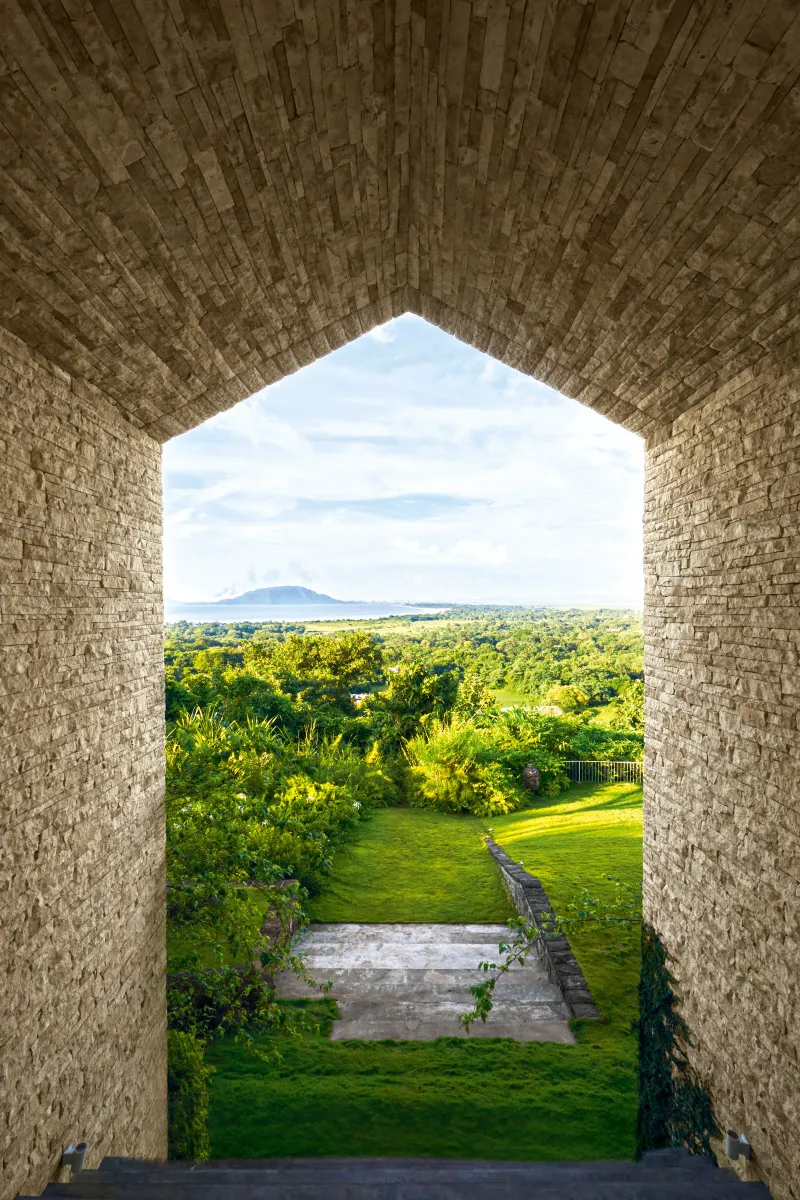 The lawn facing the main bedroom is bordered with wild tropical plants that blend into the surrounding landscape extending towards the horizon. Ashish Sahi
“A strong, bold architecture demands a careful approach to the landscape around it,” says Maniar. “The views from every part of the house are stunning. So, my team had to make sure that we did not upstage nature. We chose foliage that would complement the structure.” The scale of leaves on xerophytic trees is tiny to reduce water lost through transpiration (the process of water movement through a plant and its evaporation from aerial parts, such as from leaves, stems and flowers). Water scarcity is a major problem in the area, so Maniar chose to plant mostly xerophytic trees, which are better adapted to survive in dry conditions. They also opted for a lot of Gulmohar trees, as their smaller leaves require less water.
"What I deeply admire about [Kunal Maniar] is how he responds with interesting landscaping ideas that can be seamlessly integrated into the architecture.”
Robert Verrijt
One of the biggest challenges that Balwani, Verrijt, and Maniar faced during the excavation process was what to do with the large boulders they found at the site. “We knew that there had to be an integral part of the architecture, as such sculptural boulders are not easily found in all sites in Alibag,” says Verrijt. “In particular, what we hoped for came true. We, for example, found this obelisk-shaped rock that is now placed next to the pool like a bench.” As these were not accounted for in the original design, Bhojwani was initially unsure of retaining them. After a lot of convincing, today he thinks of them as some of the most interesting features on his property.
 The tub in the main bath underlines the simplicity that pervades the rest of the house Ashish Sahi
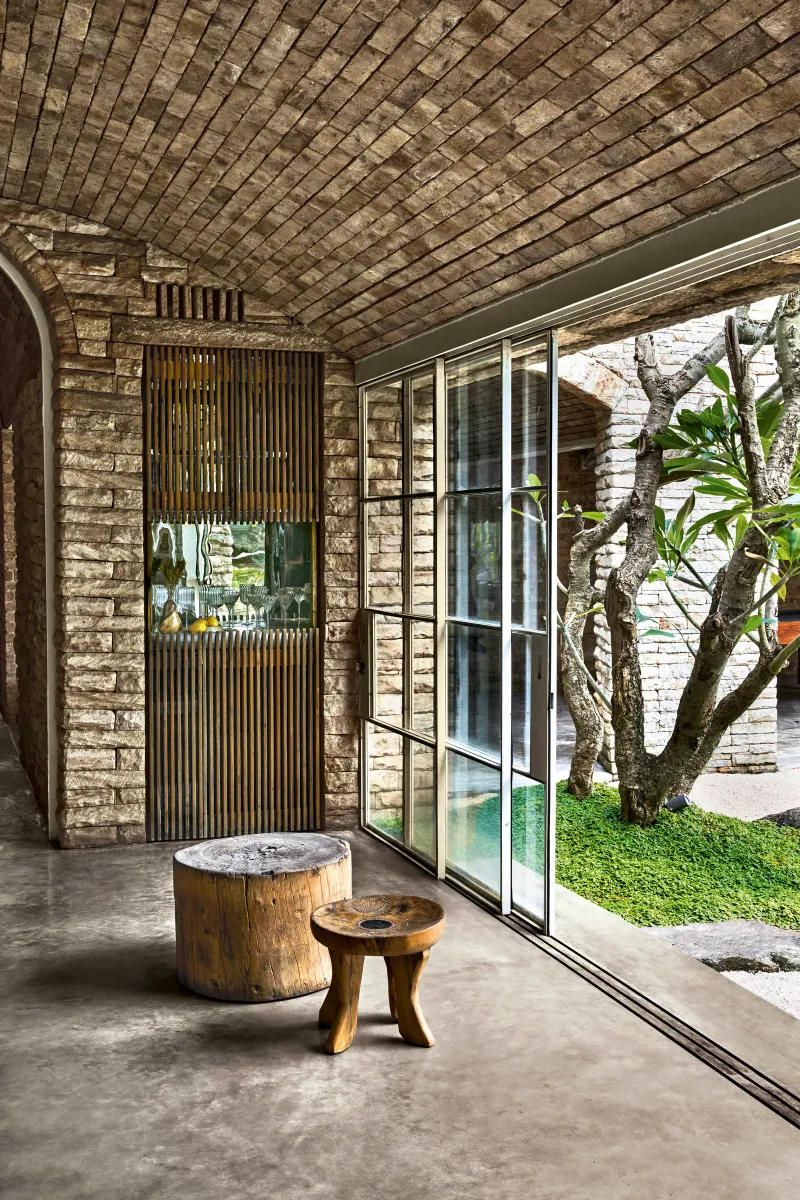 The exposed bar area in the connecting corridor between the two pavilions faces an old frangipani tree, foregrounding the infinity pool. The sliding doors alongside offer a sense of privacy as well as openness. Ashish Sahi
 Rocks excavated during construction have been seamlessly integrated into the architecture. Ashish Sahi
Bhojwani collaborated with Timothy Oulton Studio to furnish his home with pieces from the brand's Noble Souls collection. The collection celebrates natural materials like vegetable-dyed fabrics and reclaimed timber. For Bhojwani, sunrise is his magic hour. The coolness of dawn, the warmth of the first rays of the sun, and the rustling of the tall pampas grass edging the property as the sea breeze whispers through it—all create a moment of tranquillity. It’s the same breeze that brushes against the snakeskin shed by a nocturnal visitor under one of the shrubs on the property. For Bhojwani, it’s a moment defined by the joys of co-existence when it is easier to believe that all is well with the world.
References
2) AD100 firms Architecture Brio
References (1)



Popular Articles
Popular articles from the community


The Ocean Hive: Sustainable Architecture for a Self-Sufficient Civilization at Sea
The Ocean Hive imagines sustainable architecture at sea, where modular habitats, algae, wave power and ocean waste sustain a growing colony.

Lunar Spiral: Space Architecture Shaped by the Mathematics of the Universe
Lunar Spiral reimagines space architecture through Fibonacci geometry, lunar regolith, levitating habitats, and self-sustaining Moon living.

Co-life: Sustainable Architecture for Age-Friendly Community Living
Co-life reimagines sustainable architecture for seniors through courtyards, rammed earth, shared gardens, and spaces designed for belonging.

The Musturak Paradise: Senior Living Architecture for a Connected Future in Temara, Morocco
The Musturak Paradise reimagines senior living architecture in Temara via private homes, social spaces, culture, community, and shared care.


Similar Reads
You might also enjoy these articles


Creating evolutionary co-working spaces
Co-Design Milan Juror's interview
Enhancing the self-learning experience - Juror's opinion
A discussion on libraries of future

Plugin Housing Challenge - Jury panel interview
Future of Urban-Housing

Little Red Riding Hood: Architectural Design as a Journey Through Fear, Light, and Storytelling
Little Red Riding Hood reimagines the fairy tale through architectural design shaped by fear, light, scale, memory, uncertainty, and choice.


Explore Landscape Design Competitions
Discover active competitions in this discipline




Challenge to reimagine the Iron Throne


Photograph architecture without architects


Illustrate the lost glory of Angkor Wat - Render Challenge


Design challenge to reuse E-waste
Comments (0)
Please login or sign up to add comments
No comments yet. Be the first to comment!