
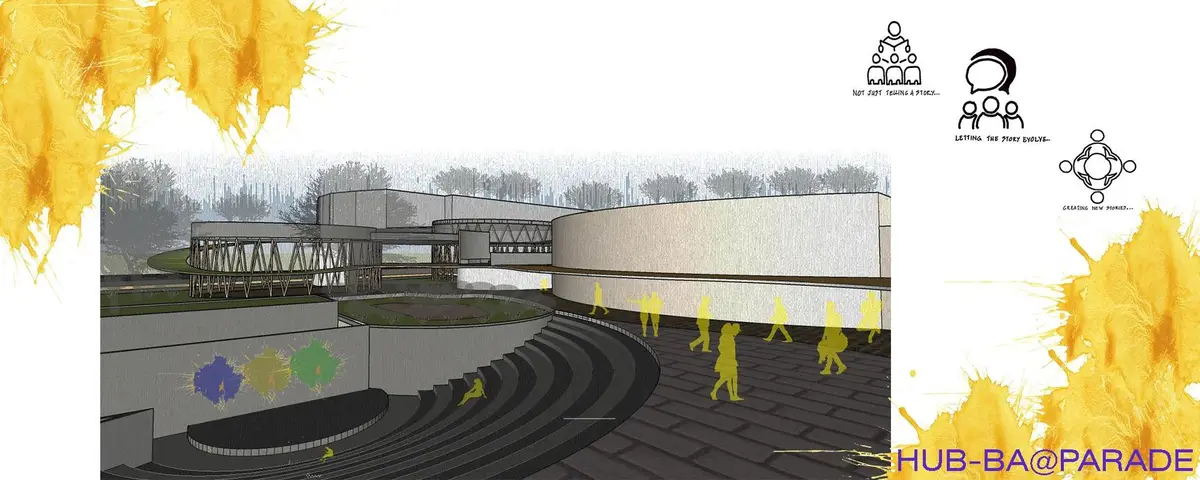
HUB-BA @ Parade: Turning a 13-Acre Military Ground into Bangalore's Living Cultural Hub
A porous urban fabric connecting the Parade Ground to MG Road, merging amphitheaters, VR zones, and street food into participatory culture.


What happens when you stop treating culture as something behind glass and start treating it as something you walk through, eat beside, and build with your hands? That is the provocation at the center of HUB-BA @ Parade, a proposal to carve a 4-acre cultural campus out of the 13-acre Parade Ground in Bangalore. Sitting at the intersection of MG Road and Cubbon Road, between Brigade Road and Commercial Street, the site connects directly to the MG Road Metro Station. Rather than designing another museum that accumulates artifacts, the project proposes a porous public fabric where workshops, amphitheaters, co-working spaces, VR zones, galleries, and street food stalls share a continuous ground plane.
Designed by Paromita Harsha and published on uni.xyz, HUB-BA @ Parade responds to a city where nearly half the population is under 35. Bangalore's cosmopolitan energy, its overlap of traditional Karnataka arts and startup-era digital culture, demands spaces that are neither frozen in the past nor oblivious to it. The project redefines Bharat Bhavan as a 21st-century cultural hub that merges traditional craft with contemporary media, layering auditoriums, exhibition halls, libraries, and planted terraces into a landscape that reads less like a building and more like a neighborhood.
A Circular Core Anchoring Public Life
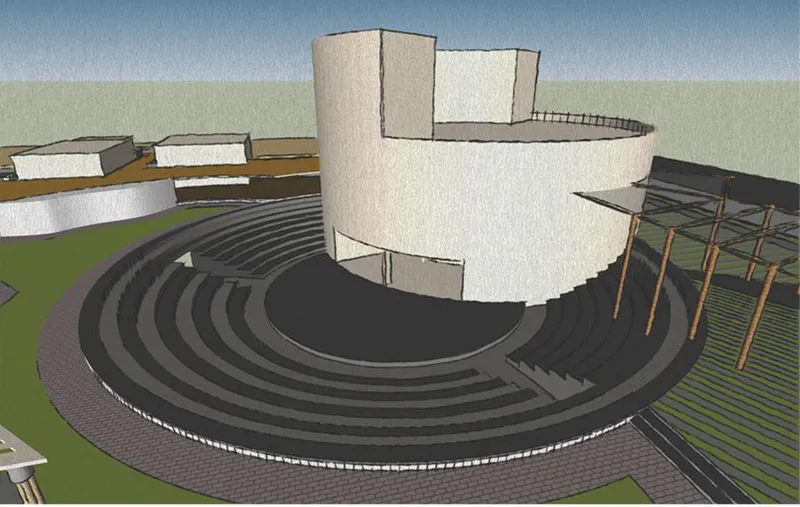

The axonometric rendering reveals the project's organizational logic: a circular amphitheater and a cylindrical tower act as twin gravitational centers, pulling visitors inward from the surrounding streets. Timber canopy structures extend outward from these volumes, creating shaded zones that blur the boundary between indoor program and open landscape. The site plan confirms how deliberately the campus stitches into its urban context. MG Road, Cubbon Road, and the adjacent metro station are not treated as edges but as entry sequences, with landscaped pathways and perspective vignettes indicating how pedestrians encounter the building from multiple directions.
Together, these two drawings establish the project's central argument: that cultural architecture should not present a single monumental facade but instead distribute its presence across a field of connected experiences. The auditorium and amphitheater accommodate up to 1,200 people collectively, forming the heart of public gathering, while the surrounding canopy structures host workshops, retail, and seminar areas that sustain daily foot traffic.
Stacking Program Around Circular Volumes
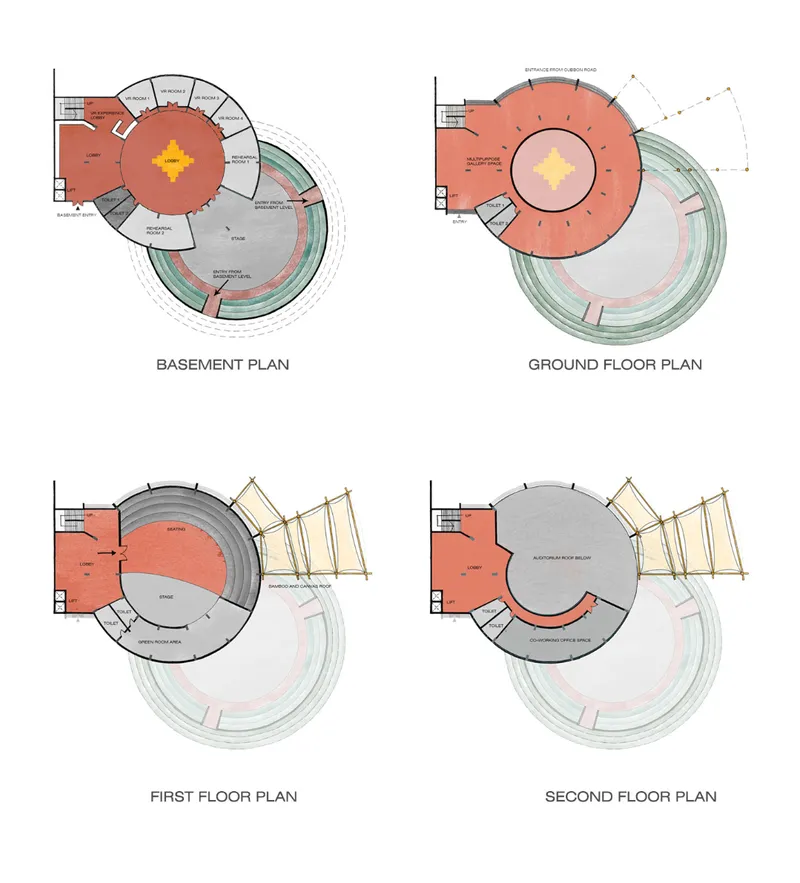

The floor plans, spanning basement through second floor, show how program radiates outward from the circular central volumes. Galleries, co-working areas, libraries, and VR zones are arranged in concentric rings, ensuring that movement across the site feels continuous rather than segmented. The three-level exhibition complex is designed for flexibility, accommodating pop-up installations, digital art fairs, and traditional craft displays without requiring wholesale spatial reconfiguration.
Adjacent to this vertical stacking, the sunken plaza introduces a counterpoint: a carved-out social space with stepped seating and murals on its perimeter walls. The rendering shows how this space operates as an open-air room, intimate enough for small performances yet connected to the larger ground plane through generous sight lines. It is the kind of space where a street food vendor and a mural artist coexist without friction, exactly the participatory culture the project champions.
Spiraling Ramps and Planted Terraces as Vertical Landscape

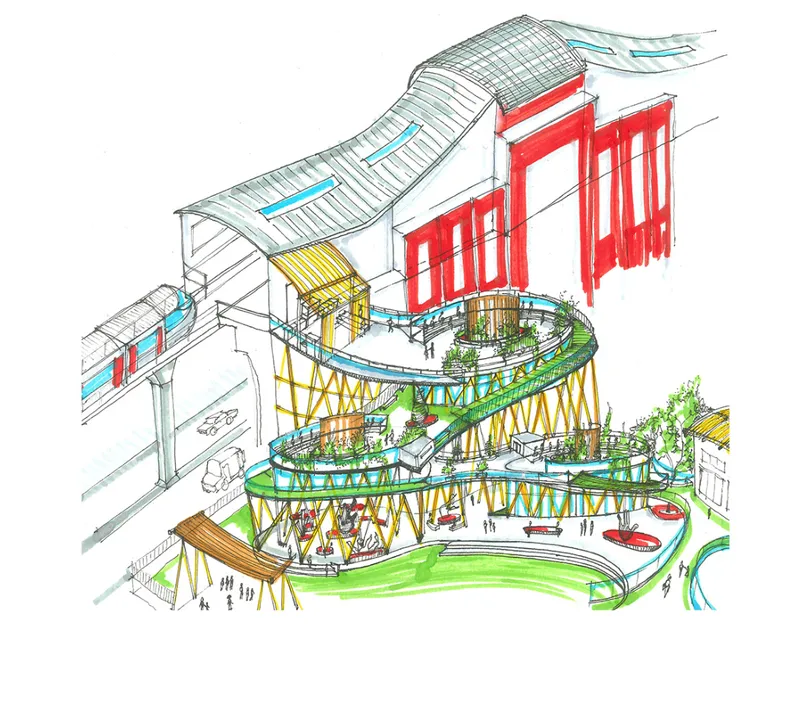
The diagram of three stacked levels with circular volumes and connecting ramps reveals the project's vertical circulation strategy. Rather than isolating floors behind elevator doors, HUB-BA uses spiraling ramps to link levels continuously. Visitors ascend through the building the way they might walk through a hillside park, with each turn offering a new view of the activity below. The sectional perspective makes this legible: an undulating roof canopy unifies the composition while red portals punctuate transitions between programmatic zones. Green ramps lined with planted terraces bring vegetation into the building's cross-section, reinforcing the idea that landscape and architecture are not separate disciplines here.
This approach to section is significant because it resists the typical museum hierarchy where ground-floor spectacle gives way to forgotten upper galleries. Every level in HUB-BA maintains a visual and physical connection to the public ground, ensuring that a workshop on the second floor feels as accessible as a cafe at grade.
A Curved Pavilion Where Structure Meets Gathering

The final perspective drawing shows a curved pavilion with diagonal bracing and planted terraces, where visitors gather in loose clusters beneath a generous overhang. The structural expression is honest: the diagonal members do real work, and the planting trays are integrated into the frame rather than applied as decoration. It is a building that invites you to lean against it, sit on its edges, and treat its thresholds as social space. In a city where public gathering often happens despite architecture rather than because of it, this pavilion suggests a different contract between building and citizen.
Why This Project Matters
HUB-BA @ Parade takes on a question that Indian cities increasingly face: how do you build cultural infrastructure for a population that is young, digitally fluent, and impatient with institutions that feel exclusionary? The answer Paromita Harsha proposes is architectural porosity. By dissolving the boundary between cultural program and everyday urban life, integrating street food with galleries, VR zones with craft workshops, and metro access with amphitheater seating, the project argues that culture is not a destination but a condition of the ground you walk on.
The strength of the proposal lies in its refusal to treat the 13-acre Parade Ground as a blank canvas for a landmark object. Instead, the 4-acre intervention operates as a connective tissue, stitching the Karnataka Land Army's historic land into the daily rhythms of MG Road, Commercial Street, and the metro network. If Bangalore is to develop cultural spaces worthy of its demographic energy, projects like HUB-BA suggest the path forward is not grander buildings but more generous ground.
View the Full Project
About the Designers
Designer: Paromita Harsha
Enter a Design Competition on uni.xyz
uni.xyz runs architecture and design competitions year-round that reward proposals with spatial conviction and real site intelligence.
Project credits: HUB-BA @ Parade by Paromita Harsha.


Popular Articles
Popular articles from the community


The Ocean Hive: Sustainable Architecture for a Self-Sufficient Civilization at Sea
The Ocean Hive imagines sustainable architecture at sea, where modular habitats, algae, wave power and ocean waste sustain a growing colony.

Hill & Cross Opera: Sculptural Opera House Architecture Shaped by Tallinn’s Landscape and Identity
Hill & Cross Opera reimagines opera house architecture in Tallinn through its sculptural hill, civic plaza, glass wave and a luminous cross.

Lunar Spiral: Space Architecture Shaped by the Mathematics of the Universe
Lunar Spiral reimagines space architecture through Fibonacci geometry, lunar regolith, levitating habitats, and self-sustaining Moon living.

Little Red Riding Hood: Architectural Design as a Journey Through Fear, Light, and Storytelling
Little Red Riding Hood reimagines the fairy tale through architectural design shaped by fear, light, scale, memory, uncertainty, and choice.

Similar Reads
You might also enjoy these articles

ALGAL REALM: A Bio-Integrated Lunar Habitat Design for Life Beyond Earth
ALGAL REALM reimagines lunar habitat design with algae-powered life support, 3D-printed regolith, and vertical living for a lunar future.

Cinema Futurismo: Futuristic Architecture Reimagining the Future of Cinema
Cinema Futurismo merges futuristic architecture, holographic projection, intimate seating, and landscape into a new social cinema.
Little Red Riding Hood: Architectural Design as a Journey Through Fear, Light, and Storytelling
Little Red Riding Hood reimagines the fairy tale through architectural design shaped by fear, light, scale, memory, uncertainty, and choice.
Playducation: Modular Architecture That Turns Play Into a Space for Learning
Playducation transforms modular architecture into a flexible world of play, learning, and healing for children in refugee settlements.


Comments (0)
Please login or sign up to add comments
No comments yet. Be the first to comment!