Hyde Park Renaissance: A Blueprint for Sustainable Urban Revival
Inspiring Design, Empowering Communities, Preserving Nature


Introduction
Our project set out on a meticulous path, exploring every aspect of Hyde Park's pedestrian flow and pinpointing possible points of interest. This thorough investigation produced an innovative design that seamlessly blends into the park's charming nature to improve the overall experience of visitors.
Architectural Marvels
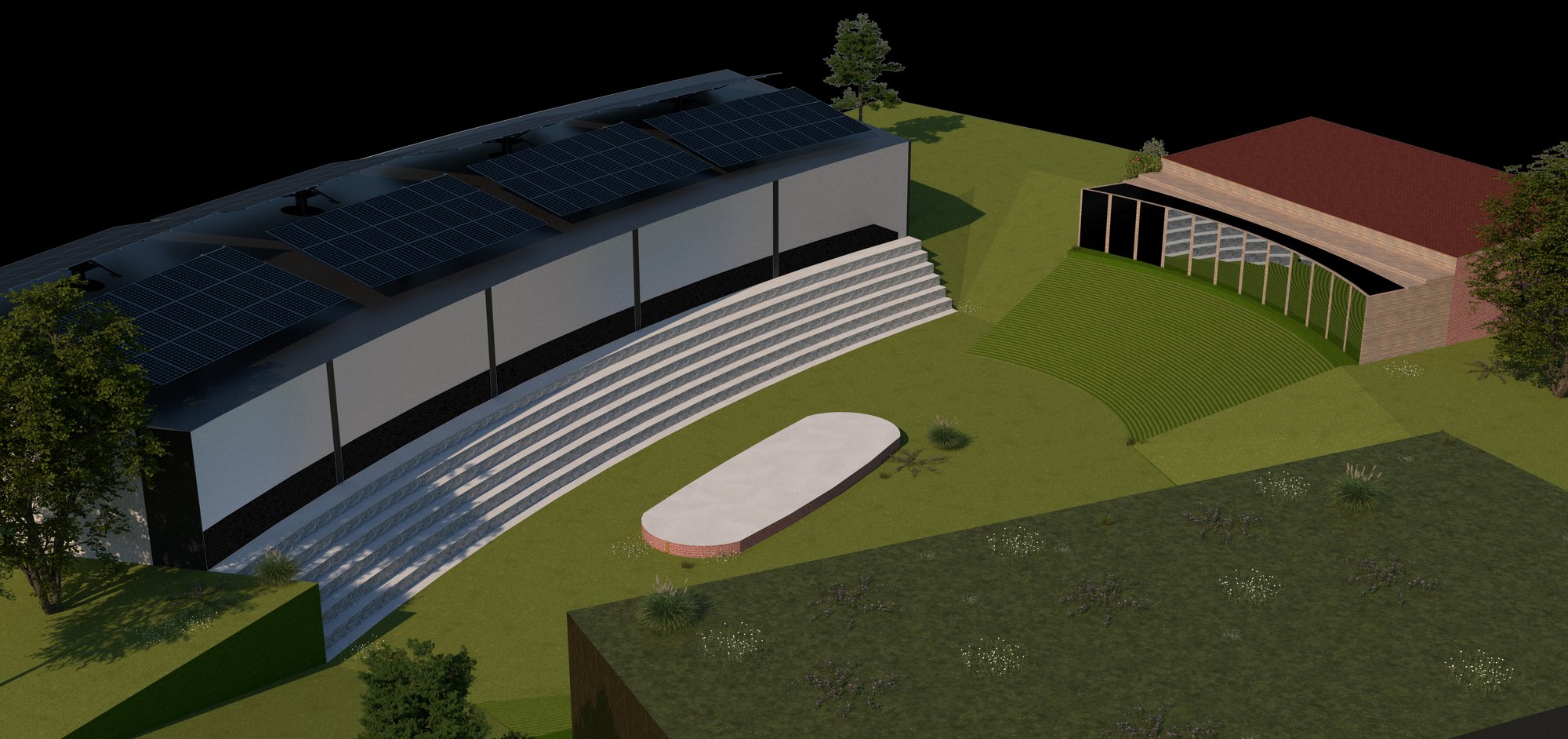
Situated on the right side, adjacent to the Speakers' Corner, stand two uniquely structured buildings. Drawing inspiration from the Playground Slope at the Risskov School in Denmark (Landezine, n.d.), one of these structures features a gently sloped side, serving as both a dynamic children's playground and versatile event seating. This thoughtful positioning creates open spaces, ensuring a seamless flow for individuals while paying homage to the park's inherent charm.
As one strolls between these structures, the eye is captivated by a sunken cylindrical amphitheater. This multifunctional centerpiece not only serves as a visual spectacle but also doubles as a stage for events, inspired by historical governmental structures, such as in Ancient Greece, and the communal use of a similar sunken amphitheater at the Anganwadi Primary School in Maharashtra is used for festivals, community gatherings and play area for children (Architecture Live, n.d.). Symbolizing a nexus of creativity, connection, and community engagement, this amphitheater stands as the heart of our design.
Sustainable Innovation
Beyond aesthetics, our project champions in sustainability. The sunken amphitheater serves a dual purpose as a rainwater collection system. The collected water, when unfiltered, can be directed for irrigation, flushing toilets, or maintaining green spaces within the park. Alternatively, with proper filtration, this resource can evolve into a community-driven initiative—a free potable water fountain, contributing to the overall well-being of the park's visitors.
Adaptable Structures
To optimize functionality, buildings facing the amphitheater boast curved sides, with most featuring walls that can be opened. This concept, gleaned from the Castelatto Pavilion in Brazil (ArchDaily, n.d.), facilitates easy access to the auditorium, fostering a dynamic interplay between indoor and outdoor spaces. Notably, the building housing the playground boasts openings on both sides, creating a covered terrace for seamless passage.
Innovative Auditorium
Nestled on the far left of the site is a moon-shaped structure housing a modular auditorium. This dynamic space seamlessly transforms from individual seating to a unified auditorium. Beneath the seats lies a hidden gem—a stylish study area with cubicles, catering to students and professionals seeking a private, yet, inspiring space for work or meetings.
Unique Architectural Features
Several buildings boast tilted roofs extending into grassy areas, mirroring the architectural ingenuity of the Grass Roofed Hypar Pavilion in New York (Inhabitat, n.d.). This design element creates an elevated haven for relaxation, family picnics, and children's play, introducing an interactive layer to our overall design.
Participation, Sustainability, and Flexibility
Participation, sustainability, and flexibility are key elements of our Hyde Park project, and each plays an important part in its success. Participation encourages community participation and ownership, ensuring that the facility meets the different needs and wants of its users. By including stakeholders in the design process, we give them the ability to alter their surroundings and create a sense of belonging. Sustainability is critical in reducing our environmental impact and preserving the park's natural resources for future generations. We seek to create a space that supports both people and the environment by making thoughtful design decisions such as green infrastructure, renewable energy integration, and waste reduction programmes. Flexibility enables adaptation and development throughout time, keeping the space current and responsive to changing demands and dynamics. By planning for multifunctional use and modular features, we enable seamless transitions between leisure, work, study, and social activities, increasing the park's value and long-term viability as a thriving urban retreat.
The Vision Unveiled
In essence, our unique outdoor living room goes beyond its physical form to become a symbol of contemporary urban design. It demonstrates the seamless integration of participation, flexibility, and circularity, as well as the concepts of inclusivity, adaptability, and sustainability. As the project progresses, it has the potential to transform Hyde Park into a lively and inclusive hub where individuals may rest while also actively engaging with their environment. By encouraging community engagement and cooperation, we hope to enable people to take ownership of local public spaces and contribute to their continuing growth. This revolutionary journey aims to inject modernity and purpose into London's beloved Hyde Park, reviving it as a thriving hub of social, cultural, and environmental innovation. Through this endeavour, we want to leave a legacy that will improve the lives of future generations while also preserving the park's rich historical and natural beauty.
References
Landezine. (n.d.). Playground Slope at the Risskov School. Retrieved from https://landezine.com/playground-slope-at-the-risskov-school/
Architecture Live. (n.d.). Rural Learning Network by APC Associates. Retrieved from https://architecture.live/rural-learning-network-by-apc-associates/
ArchDaily. (n.d.). Castelatto Pavilion by Biselli Katchborian Arquitetos Associados. Retrieved from https://www.archdaily.com/1010393/castelatto-pavilion-biselli-katchborian-arquitetos-associados