
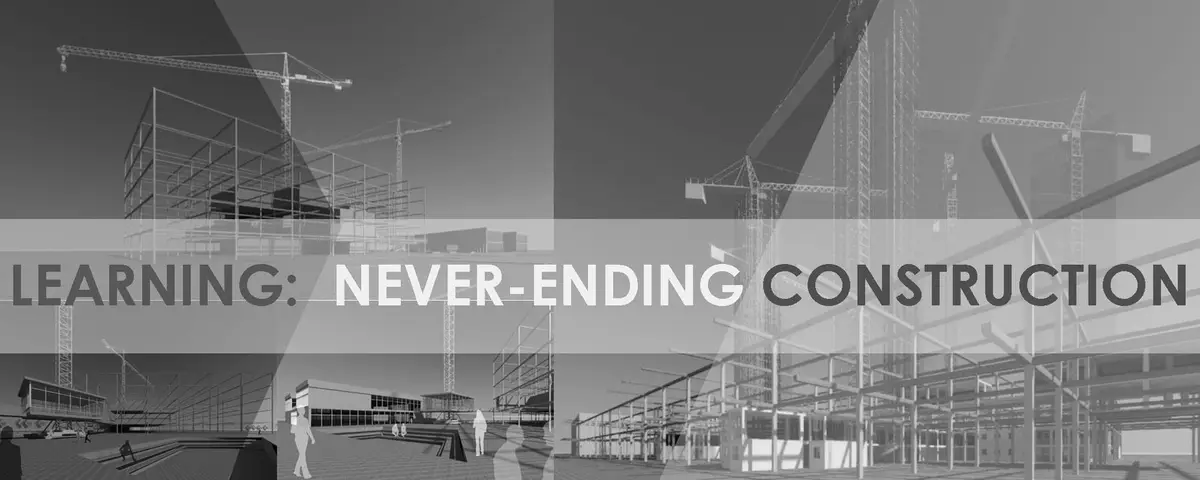
Learning: Never-Ending Construction: A Library That Treats the Building Site as Its Permanent State
A modular library of steel containers and permanent cranes that keeps assembling itself, treating the uncertain future of the book as its design brief.


Most library proposals try to settle the question of what a library is for. This one refuses. Learning: Never-Ending Construction starts from the premise that nobody knows what form books will take, or whether they will survive at all, and turns that uncertainty into architecture. The result is a library designed to behave like a construction site: always assembling, disassembling and reconfiguring itself, with cranes, steel frames and containers kept as permanent elements rather than packed away at handover.
Designed by Deniz Sahin and Gazihan Bakkalcioglu, the project addresses a familiar tension. Digital platforms, virtual reality and mobile technologies have made information available independent of place and time, yet physical libraries persist as frameworks for learning, interaction and collective memory. Rather than defending the library as a fixed program, the designers frame learning as a process that evolves alongside society, technology and culture, and they ask the building to evolve with it.
Tower Cranes as Architecture, Not Scaffolding
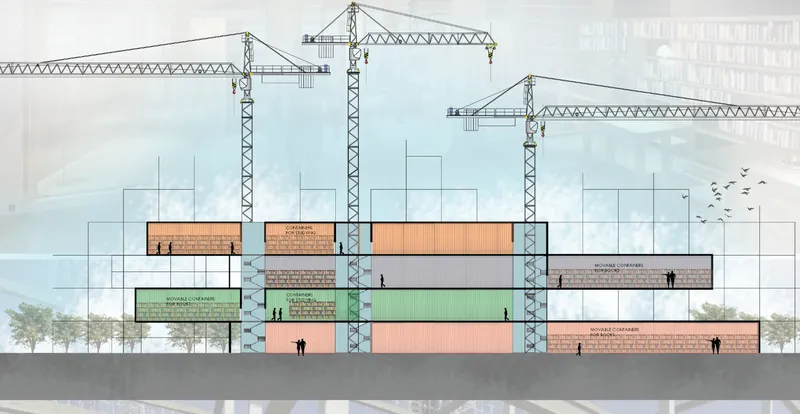
The section makes the argument plainly. Stacked shipping containers hold the book storage, and three tower cranes rise behind them as part of the building's permanent silhouette. In conventional practice, the crane signals that a building is unfinished; here it signals that the building is working. The designers borrow industrial and infrastructural logic so that the library remains an open system, able to absorb whatever comes next, whether books multiply, lose relevance, or give way to new forms of knowledge exchange.
This is the project's sharpest move. Instead of designing for a predicted future, it designs the mechanism of change itself. The library becomes a spatial metaphor for learning: never static, never finalized, and honest about the fact that its contents will keep shifting.
A Fixed Core and a Shifting Cloud of Containers
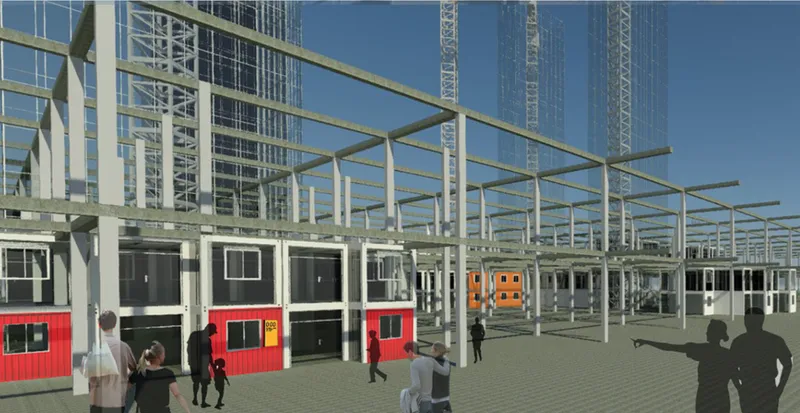
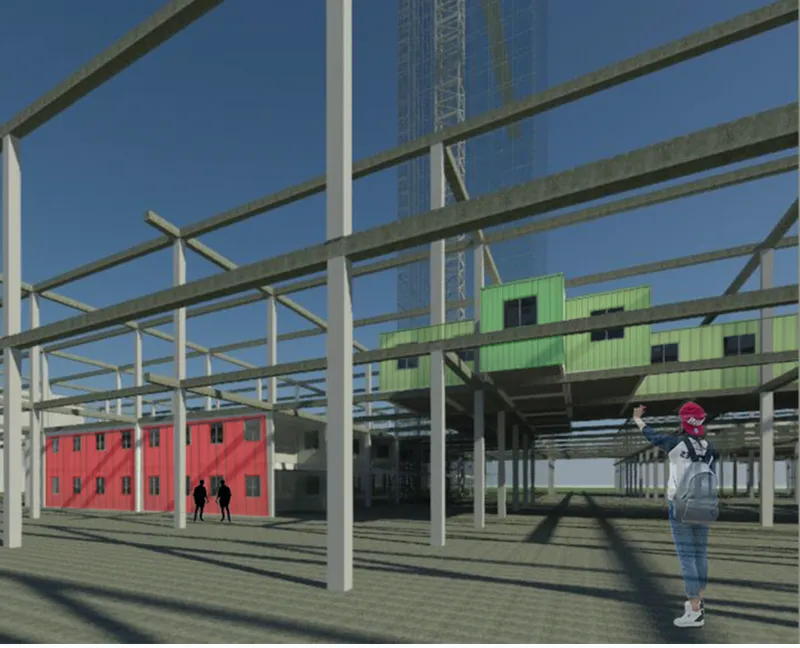
The renderings show the system at two moments. At ground level, red and orange container units sit within a bare steel and concrete frame while visitors walk beneath. Higher up, green containers cantilever into an open column grid beside a red container block. The frame is the constant; the containers are the variables. Steel container units can be mounted, removed and rearranged, allowing the library to grow vertically and horizontally and to change both its footprint and its internal organization over time.
Three typologies keep this flexibility legible. A Constant Container Block forms the stable core for essential services, administration and social space. A Dynamic Learning Block collects the movable containers that respond to changing learning demands. Service and Junction Towers, supported by cranes, handle circulation, transport and the installation of new units. The clarity of this division matters: it tells you which parts of the building are meant to stay and which are meant to move, a distinction many adaptive proposals leave vague.
Dewey Decimal Classes Spread Across the Section
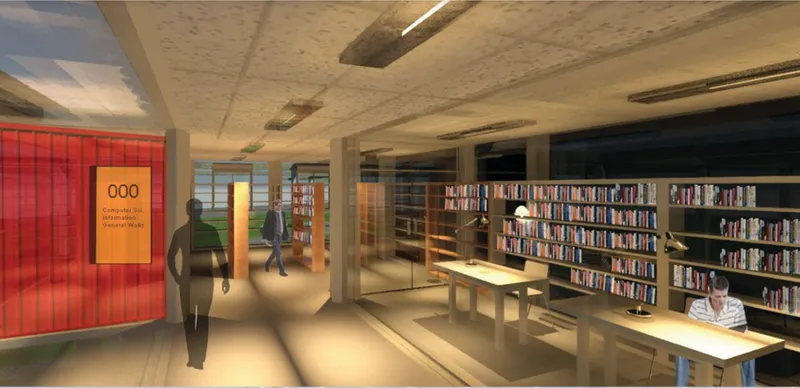
The red container labeled 000 in this reading room points to the organizing logic. Book containers follow the Dewey Decimal Classification System, grouping knowledge into four primary departments, each placed at a different elevation. Finding a subject means moving up, down and across the structure, so navigation itself becomes exploratory. Crane-tower junctions link the levels and container clusters, while tubular corridors formed from merged containers serve as both circulation and informal social space.
Those corridors house Container Studying Rooms, shared learning spaces placed to produce chance encounters between people with different interests. Here the project moves from mechanism to social intent. Scattering subjects across the section, then threading study rooms along the paths between them, creates overlap rather than isolation, and treats the library as a collective learning ecosystem rather than a set of quiet silos.
Warm Reading Rooms Inside an Industrial Shell
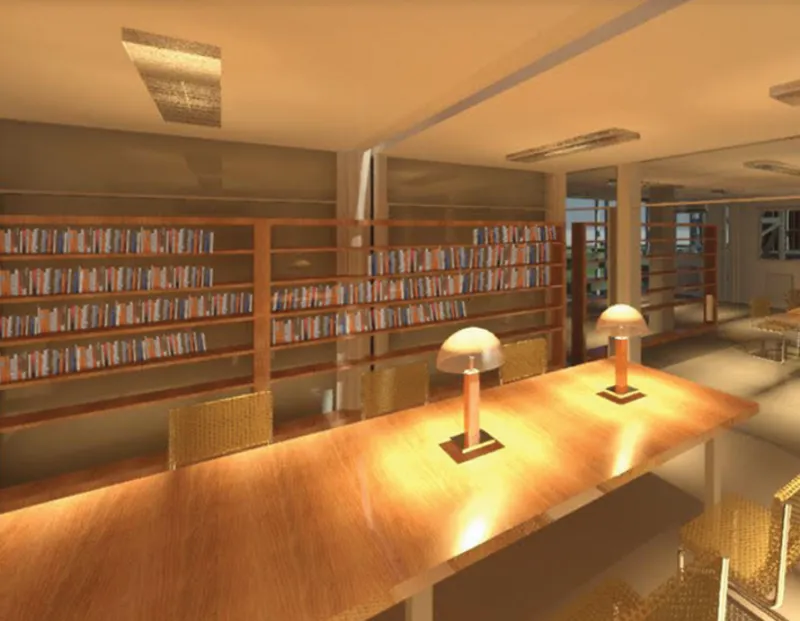
Beneath the exposed steel and crane towers, the interior turns intimate. A long timber reading table, two mushroom-shaped lamps and walls of shelving catch warm evening light. The contrast is deliberate: the project merges industrial aesthetics with academic functions, and the raw language of containers and structure frames rooms that still feel made for sitting with a book for hours.
This balance is what keeps the concept from tipping into spectacle. A permanently changing building could easily feel unsettled to occupy. By pairing the machinery outside with tactile, lamp-lit rooms inside, the designers suggest that adaptability at the scale of the building can coexist with stability at the scale of the reader.
Why This Project Matters
Debates about the future of libraries often stall between nostalgia for the book and enthusiasm for the screen. Sahin and Bakkalcioglu sidestep that argument by declining to predict the outcome. Their library does not bet on a single future; it builds in the cranes, frames and container logic needed to respond to any of them. That shift, from designing a finished object to designing an ongoing process, aligns the project with adaptive architecture that responds to change instead of resisting it.
What makes the proposal convincing is that its flexibility is organized. A constant core, a dynamic learning zone and crane-supported junction towers give the system rules, while Dewey-based distribution and encounter-driven corridors give it a social purpose. The building may never be complete, but its idea is clear: learning is a construction that keeps going, and the library should look and work like one.
View the Full Project
About the Designers
Designers: Deniz Sahin, Gazihan Bakkalcioglu
Enter a Design Competition on uni.xyz
uni.xyz runs architecture and design competitions year-round that reward proposals with spatial conviction and real site intelligence.
Project credits: Learning: Never-Ending Construction by Deniz Sahin, Gazihan Bakkalcioglu.


Popular Articles
Popular articles from the community


Faces of the Soviet Avant-Garde: Turning Moscow's Street Names into an Open-Air Museum
A network of sculptural installations across a Moscow residential district transforms forgotten architect names into spatial encounters with cultural memor

The Amber Palace Opera: A Geological Fiction Surfaces on Tallinn's Baltic Waterfront
Pierre Brillard reimagines a Baltic legend as a public landscape, opera house, and waterfront promenade rooted in Tallinn's coastal identity.

Opera by the Sea Estonia: Three Shells Dissolving Architecture into Tallinn's Coastline
A winning opera house proposal replaces monumental form with interconnected shells that blur the boundary between building, park and Baltic Sea.

Opera on the Sea: Driftwood Logic Shapes a Timber Opera House on Estonia's Coast
Trevor Orgill's opera house translates the entangled drift of floating timber into a civic building where wood, water, and music converge.

Similar Reads
You might also enjoy these articles

Healing Façade: A Modular Chapel System That Restores Ethiopia's Sacred Forests
Winner of the Eco-Chapel competition, this circular timber façade collects water from air to rebuild soil and reforest degraded Ethiopian landscapes.
Kaffeebühnen: Where Coffee Shop Architecture Becomes a Civic Stage in Vienna
A linear sequence of timber boxes, transparent shells, and open yards turns the Viennese café tradition into a public performance space.
Eco Chapel: A Modular Forest Pavilion That Grows Like the Landscape It Protects
Hexagonal timber modules weave through existing trees, turning a chapel into a living system for prayer, education, and reforestation.


Urban Forest: A Vertical Ecosystem for 5,000 Workers in Singapore's Changi Business Park
Radially stacked pods and layered green decks turn a 7-acre plot into 47 acres of ecological workspace projected for 2040.


Comments (0)
Please login or sign up to add comments
No comments yet. Be the first to comment!