

Through History: A Moontrip Media Space Where Architecture Never Sits Still
Vitali Matevosian's shortlisted Moontrip entry fuses cylindrical time-loop forms with VR, holograms, and projection mapping into a single adaptive campus.


What happens when a building refuses to hold a single shape? When the walls themselves become screens, the floors become simulations, and the program shifts from planetarium to workshop to concert hall within the same afternoon? Vitali Matevosian answers with a campus that treats architecture as a live, programmable medium. His project, "Through History" Moontrip Media Space, stacks cylindrical volumes into a time-loop form that channels visitors from humanity's past straight into speculative futures of space exploration.
Shortlisted in the Moontrip 2019 competition, the proposal responds to the 50th anniversary of a defining moment in space science by building a memorial that is anything but static. The site integrates indoor and outdoor functions across a mixed-use complex of museums, labs, exhibition halls, VR zones, classrooms, outdoor parks, and cafes. Media facades, AR/VR/MR environments, drone installations, projection mapping, and holograms layer virtual content onto physical surfaces, turning the entire campus into what Matevosian calls a "media space."
Cylinders and Spheres Floating on Reflected Light
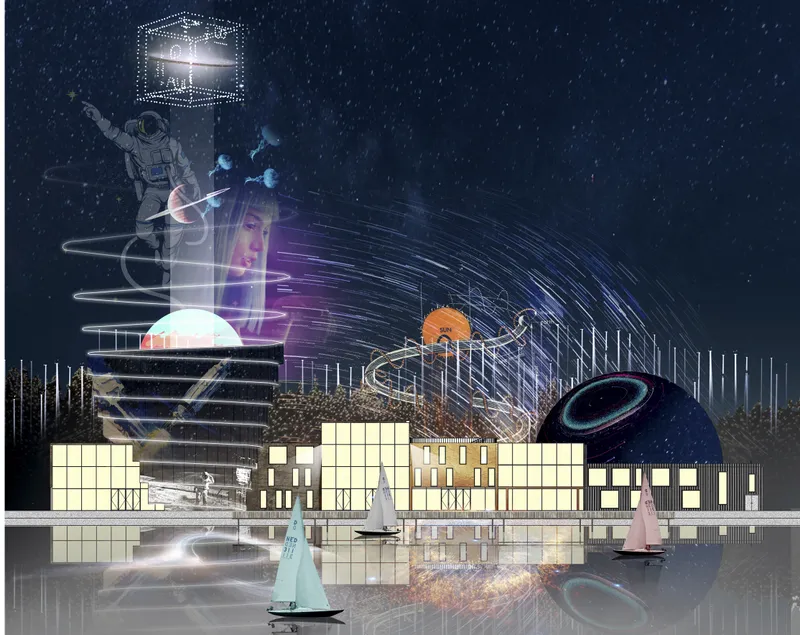
The night rendering reveals the project's defining gesture: a cluster of cylindrical and spherical volumes hovering above a still water body, their illuminated skins doubled in the reflection. Sailboats drift in the foreground, grounding this futuristic assembly in an approachable waterfront landscape. The glow from media facades dissolves the boundary between structure and projection, hinting at the building's capacity to shift its appearance with programming, events, or time of day. Nothing about this envelope is permanent; it is designed to be rewritten.
A Site Plan Shaped by Topography, Not by Grids
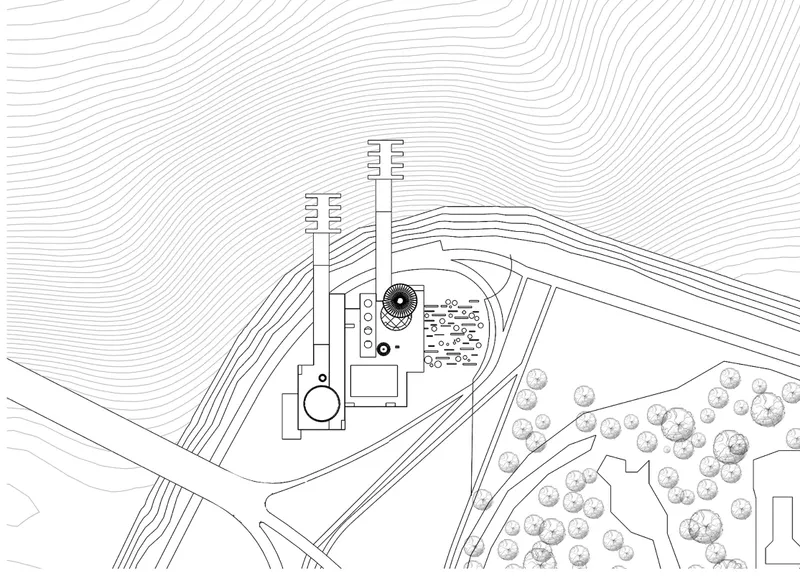
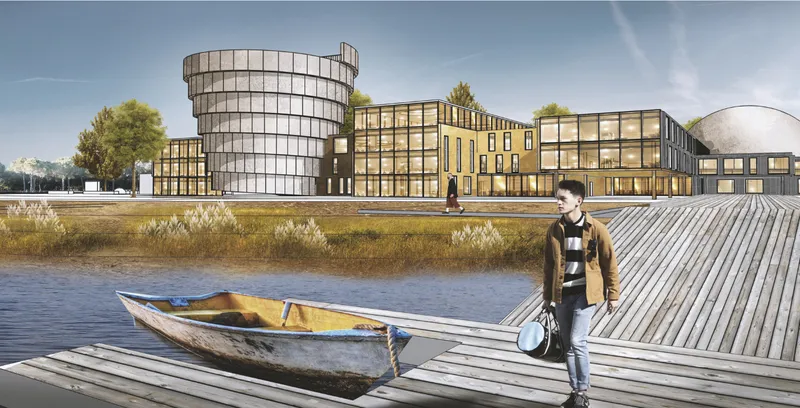
The site plan reveals how Matevosian nests the clustered buildings within contoured topography and dense tree groupings rather than imposing a rigid orthogonal layout. Pathways meander between program blocks, connecting the cylindrical glass tower, horizontal wings, and waterfront edges through landscape rather than corridors. From a timber boardwalk across the pond, the tower reads as a lighthouse of sorts: transparent, stacked, and anchored to low-slung volumes that spread the campus program outward into parks and open-air terraces.
The relationship between built form and water is critical. The pond acts as both a reflective surface that amplifies the media facade effects at night and a buffer that creates distance, letting visitors approach the complex gradually. Outdoor cafes and event spaces ring the perimeter, ensuring the campus stays active even when the interior program is closed.
Hanging Rings and Curved Walkways Inside the Time Loop
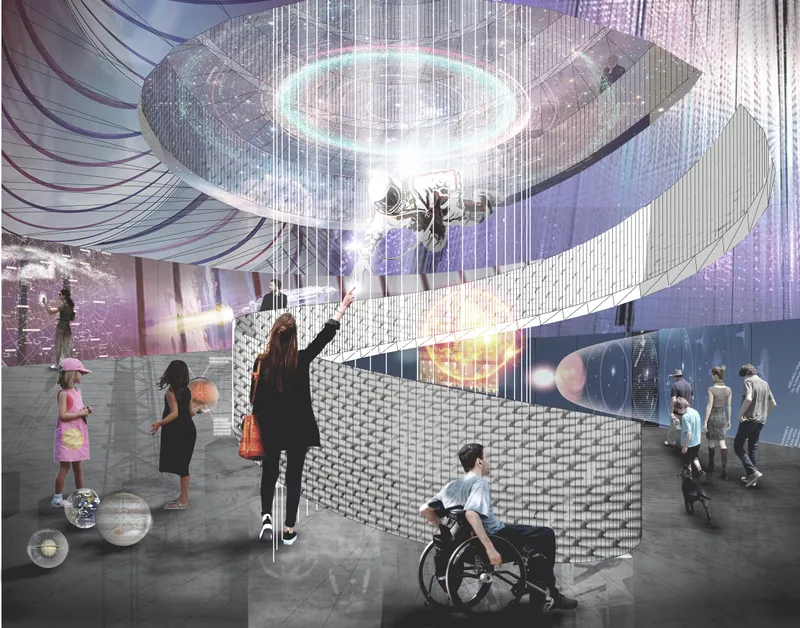
The interior atrium is the spatial heart of the time-loop concept. Hanging light rings descend through a tall void while curved suspended walkways spiral visitors upward through the cylindrical volume. The effect is deliberate: you are meant to feel as though you are moving through layers of time, from the origins of space exploration at ground level toward speculative futures overhead. Matevosian's "learning by doing" philosophy manifests here. Visitors do not passively observe exhibits; they step into simulations of space travel, planetary environments, and scientific research, taking on the roles of engineers or astronauts within programmable MR environments embedded along the walkway route.
A Forested Threshold That Slows You Down Before Entry
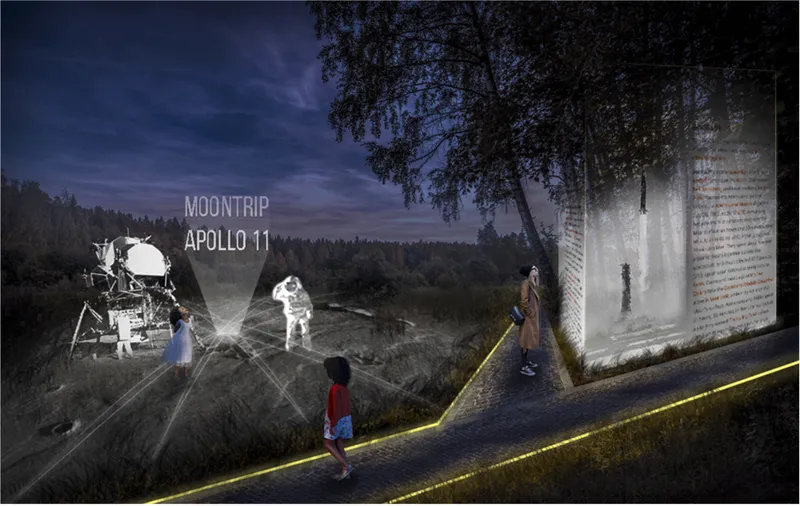
The dusk rendering captures a quieter moment in the project's sequence: an illuminated pathway threading through a forested landscape toward a concrete pavilion. Before visitors encounter the high-tech interior, they pass through nature. The contrast is intentional. Forest canopy and soft ground-level lighting create a contemplative buffer between the city and the campus, preparing visitors psychologically for immersion in virtual and augmented realities. The pavilion at the end of the path acts as a gatehouse, a threshold structure that frames the transition from the organic to the technological.
Why This Project Matters
Matevosian's proposal treats architecture as a medium that can be reprogrammed, projected upon, and physically reconfigured. That ambition is not new in theory, but the specificity here is valuable: media facades operate alongside VR zones, holograms coexist with timber boardwalks, and a planetarium shares a campus with hands-on labs and outdoor parks. The building does not choose between spectacle and pedagogy; it insists on both simultaneously, arguing that wonder and rigorous learning are not opposites but partners.
More importantly, the project addresses a gap in how we communicate space science to the public. By wrapping immersive simulation, interactive exhibition, and contemplative landscape into a single adaptive campus, Matevosian makes a case that forgetting the excitement of outer space is a cultural failure architecture can help prevent. The cylindrical time-loop form is a fitting metaphor: we keep circling back to the same questions about our place in the cosmos, but each pass brings new technologies, new media, and new ways to engage.
View the Full Project
About the Designers
Designer: Vitali Matevosian
Enter a Design Competition on uni.xyz
uni.xyz runs architecture and design competitions year-round that reward proposals with spatial conviction and real site intelligence.
Project credits: Through history by Vitali Matevosian Moontrip 2019 (uni.xyz).


Popular Articles
Popular articles from the community


U.GA Architects Wraps an Oval Rooftop Pool in Curved Board-Formed Concrete on Busan's Jeollidan-gil
In Busan's Jeonpo-dong, a 454 m² mixed-use block stacks a neighborhood facility, guest rooms and an oval rooftop pool inside spiraling concrete walls.

LT2A and OPEN Architectes Thread a Brick and Glass High School Through a Wooded Belgian Campus
In Braine-l'Alleud, a 3,000 m² wing for Collège Cardinal Mercier pairs pale brick with a glazed colonnade, deferring to a small chapel and a dense wood.

Jaramillo Van Sluys Arquitectura and Urbanismo Turn a Demolished Registry Lot in Quito into an Orchard Plaza
In Quito's Centro Histórico, a 2,800 m² plaza exposes the San Agustín convent wall and redraws its lost Augustinian orchard in volcanic stone.

David Ortega Stacks a Two-Story Mexico City Penthouse Around a Steel Stair and a Pergola-Shaded Roof Terrace
In Colonia Roma, a 300 m² penthouse uses oak joinery, a planted steel stair and a slatted roof pergola to make a new-build apartment feel like a house.

Similar Reads
You might also enjoy these articles

Gil Mello Arquitetura Tilts a Single Roof Toward the Waterfalls on a Plateau Above Aiuruoca, Brazil
In Aiuruoca, Minas Gerais, a 200 m² house of local labor and reclaimed poles pairs a low valley veranda with a tall mountain one.
U.GA Architects Wraps an Oval Rooftop Pool in Curved Board-Formed Concrete on Busan's Jeollidan-gil
In Busan's Jeonpo-dong, a 454 m² mixed-use block stacks a neighborhood facility, guest rooms and an oval rooftop pool inside spiraling concrete walls.

Felipe Hess Arquitetos Turns a Blind Stone Wall to the Street and Opens a Brazilian House onto a Courtyard and Canal
A canal-front house in Brazil hides behind painted stone and planting, then opens to an olive-tree courtyard, a reed-ceilinged porch and a curving pool.

David Macias Steps a Doorless Stone and Plaster House Down a Tropical Colombian Hillside
In the humid hills of Colombia, Threshold House replaces the front door with an open void and terraces its 850 m² down the slope instead of fighting it.

Explore Visionary Architecture Competitions
Discover active competitions in this discipline

Challenge to imagine architecture inspired by fiction

Challenge to reimagine the Iron Throne

Photograph architecture without architects

Illustrate the lost glory of Angkor Wat - Render Challenge
Comments (0)
Please login or sign up to add comments
No comments yet. Be the first to comment!