
MOONWARTS
A project about an utopian approach on how to establish life in outer space

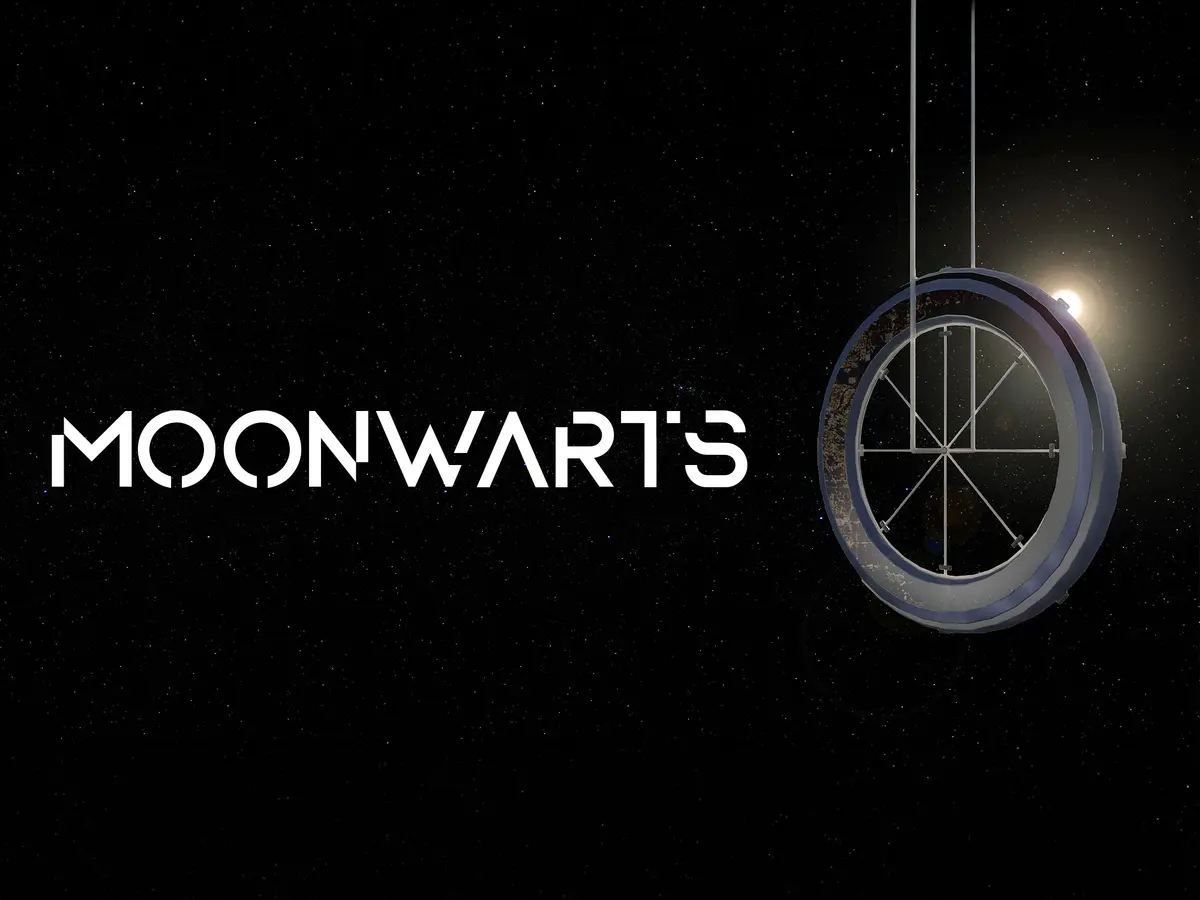
MOONWARTS is a futuristic attempt on creating a sustainable and long-term opportunity of living on the moon's surface. The goal is to create a moon base that not only serves as the main base for outer space traffic and the extraction of rare elements but also offers a long-term living opportunity for its inhabitants.
Thus, it was extremely important to create as close to earth-like living conditions as possible. The main factor that needed to be considered is the force that would equal gravity since it is essential for humans when it comes to long-term living in outer space. The most efficient way to create artificial gravity in space is to substitute it with centrifugal force. That is why it was clear from the beginning that our design would consist of a rotating ring of any kind. We learned pretty quickly that the ring must be big in size, with a diameter of about 7,150 meters, because of the coriolis force. Since this is something humans could not investigate up to this point, it is simply assumed that with a certain diameter, walking in the opposite direction that the ring is turning in does not become a problem any longer. The first designs were then all placed horizontally on or under the moon's surface. With the rapidly turning ring came a lot more questions that needed to be answered, though. The most relevant ones were how to power its movement and how to create a way to enter. The designs went from rail systems to centrally placed electric motors until we realized that friction could be reduced easily by lifting the ring from the moon's surface up into space. We decided on simple electric rocket engines since there is not much power needed to keep the ring turning once it has been set into motion. To not lose the connection to the moon, however, we planned on having an external moon base without artificial gravity connected to the ring by flexibly jointed tubes. The goal was to offer an earth-like lifestyle with a quick connection to outer space work places on the moon. Therefore, while living compartments as well as food production and organizational as well as touristic areas are placed in the gravity-containing ring, laboratories and moon mining sectors can be found in the moon base on the moon's surface. For a way to easily access the constantly turning ring, we also had different design approaches. The most efficient one turned out to be a smaller ring on the inside of the main one that could be accelerated and decelerated when needed. From the center of the ring, spokes are needed for connection. Splitting up the different areas needed also made sense considering the fact that this kind of extremely large ring can probably not be built on earth and then transported. Instead, it makes much more sense to build it on the moon, not only since it is easier to put it in place but also since lunar materials can be used. Therefore, the moon base could be built first and then used as a production site for materials needed for the ring. It can be assumed that moon dust can actually be pressed into form just like a 3D-printing method since this has been tested with earthly sand before.
Once we had thought the basic concept through, there were a few questions left on how to actually make the ring inhabitable. One of the main concerns consisted of the origin of electricity, not only to power the engines needed but also to supply the inhabitants. The most obvious answer to that is photovoltaic. Thus, we had to make sure not only to include this in our design but also to maintain the exposure to the sun throughout the whole year. Since the MOONWARTS facility is attached to the moon’s South Pole, it is almost constantly exposed to the sun's rays. Darkness occurs only when the earth is located between the moon and the sun. However, this only happens a few days a month. This also results in easy regulation of a day/ night cycle since this can be simulated by shading elements attached to the windows. Considering the topic of water, food, and air supply, we were aiming for a rather self-regulated cycle in the long run. To set this in motion and to help regulate, however, there should be supportive technology.

Popular Articles
Popular articles from the community


David Ortega Stacks a Two-Story Mexico City Penthouse Around a Steel Stair and a Pergola-Shaded Roof Terrace
In Colonia Roma, a 300 m² penthouse uses oak joinery, a planted steel stair and a slatted roof pergola to make a new-build apartment feel like a house.


Aquadapt: An Underwater Habitat That Rewrites Its Rooms by the Hour
Curved modules ring the seabed while one shell shifts from breakfast room to cinema, farm and football pitch as residents' needs change.

Singing Woman: An Opera House That Performs Before the Curtain Rises
Ovidiu Cristian Pavel's conceptual opera house translates Estonia's choral identity into a sculpted waterfront landmark facing the Baltic Sea.

LT2A and OPEN Architectes Thread a Brick and Glass High School Through a Wooded Belgian Campus
In Braine-l'Alleud, a 3,000 m² wing for Collège Cardinal Mercier pairs pale brick with a glazed colonnade, deferring to a small chapel and a dense wood.

Similar Reads
You might also enjoy these articles

The Rhythm of Seasons
A Farmers' Market Connecting Nature and the City


More Than a Building-Designing a Living System
More Than a Building-Designing a Living System
Base Beyond
DESERT COMPOUND ARID: TOURISM OF ABSENCE AND ABUNDANCE

Explore Space Architecture Competitions
Discover active competitions in this discipline


Challenge to reimagine the Iron Throne

Photograph architecture without architects

Illustrate the lost glory of Angkor Wat - Render Challenge

Design challenge to reuse E-waste
Comments (0)
Please login or sign up to add comments
No comments yet. Be the first to comment!