
1+1>2 Architects Build a Mountain School from 80,000 River Stones in Rural Vietnam
At the foot of Pa Han Mountain in Son La province, a community of 300 households shaped Na Pan School with their own hands and local stone.


A school built from 80,000 river stones carried by hand, one load of 30 pebbles at a time, by nearly 300 households over four months. Na Pan School, designed by 1+1>2 Architects in Son La province, Vietnam, is not merely a building project. It is a collective act of will. Situated at the foot of Pa Han Mountain in the commune of Chieng Dong, the school sits between an inter-village road and the Nam Vat Stream, with rice fields stretching behind it. The program is modest: 204 students, six classrooms. But the ambition goes far beyond the brief.
What makes Na Pan School worth studying is not its scale but its method. The project had to reconcile three pre-existing structures of wildly different ages and conditions: a nearly 30-year-old wooden building, a 20-year-old brick block, and a newly funded construction. Rather than demolish and start fresh, 1+1>2 chose to stitch the campus together using local materials, community labor, and a formal language drawn from the region's own craft traditions. The result is a school that feels grown rather than imposed, with woven brick walls, cobblestone courtyards, and bamboo ceilings that carry the fingerprints of the people who made them.
A Courtyard That Holds the Campus Together
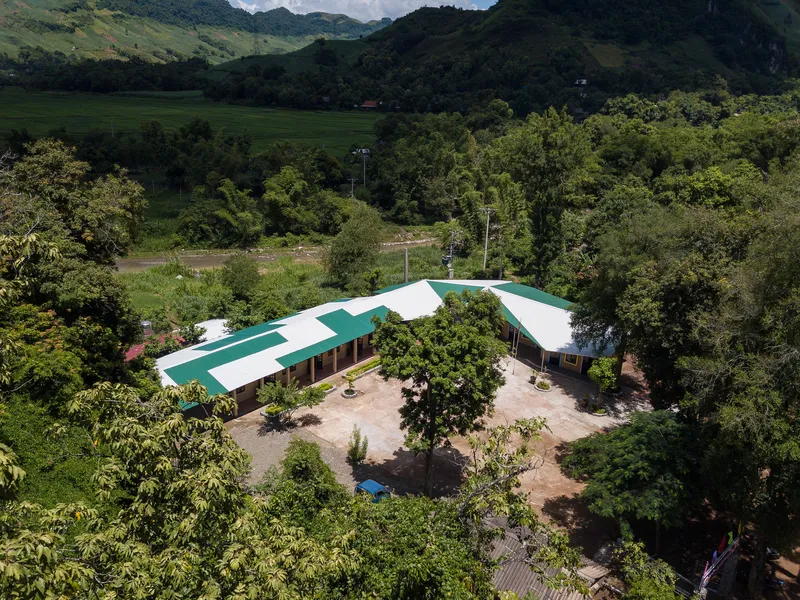
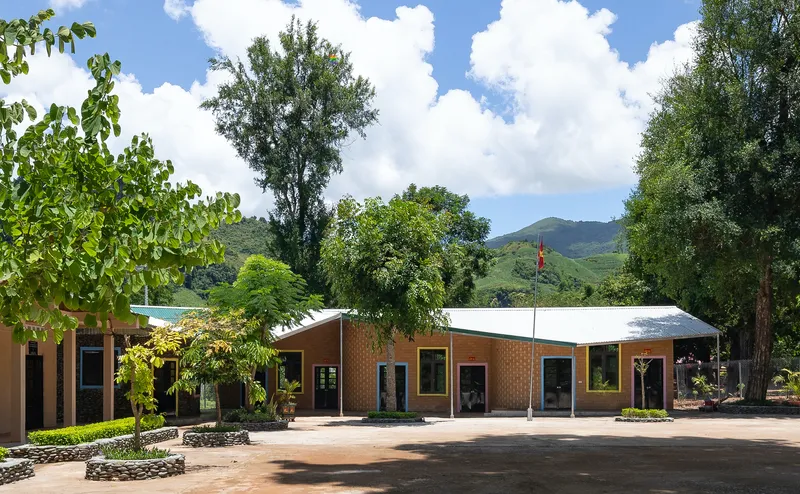
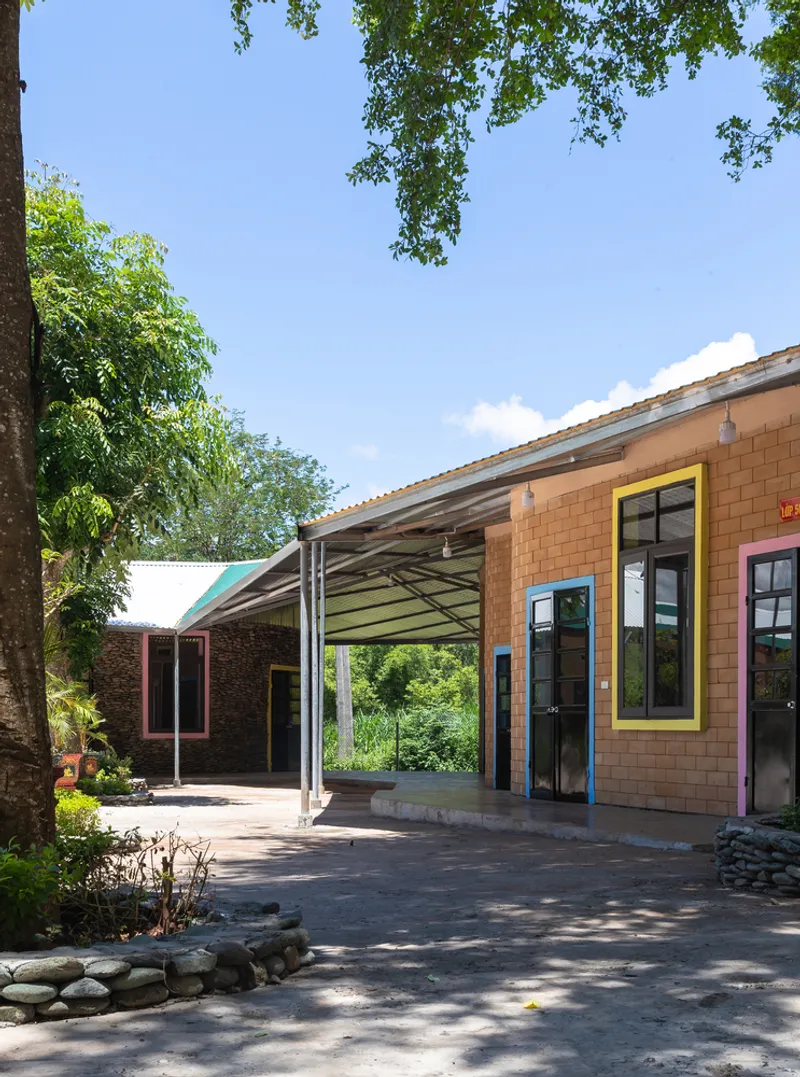
From above, the school reads as a three-winged structure wrapped around a central courtyard, an organizational move that is simple and effective. The courtyard does the heavy lifting of unifying the old and new buildings into a single campus. It provides protected outdoor space for play and gathering while also channeling breezes through the complex. The facades facing this courtyard are the most expressive: woven brick patterns punctuated by windows in bright yellow and blue frames that stand out against the warm earth tones of the masonry.
Covered walkways connect the wings, keeping students dry during the rainy season while maintaining visual continuity between the structures. The overhanging corrugated roofs along these corridors are functional rather than decorative, creating deep shade and directing rainwater away from the building edges. The landscaping within the courtyard is equally deliberate, with trees providing canopy shade that will only improve as they mature.
Stone, Brick, and the Logic of What Is Available
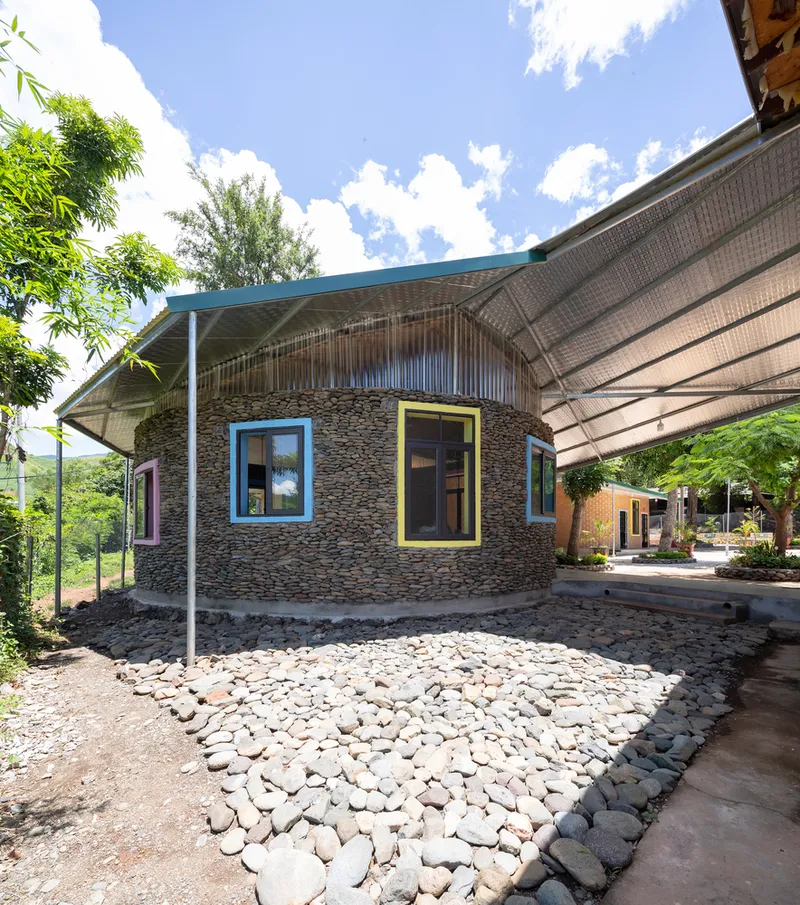
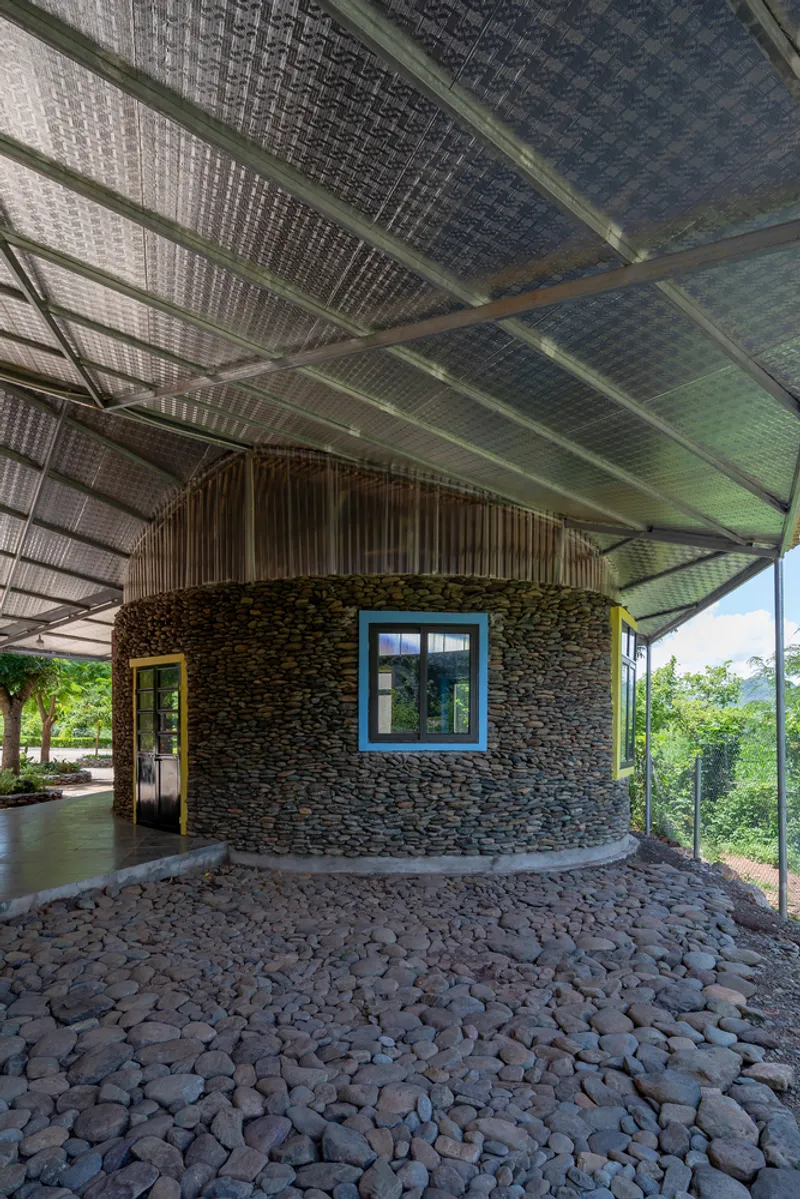
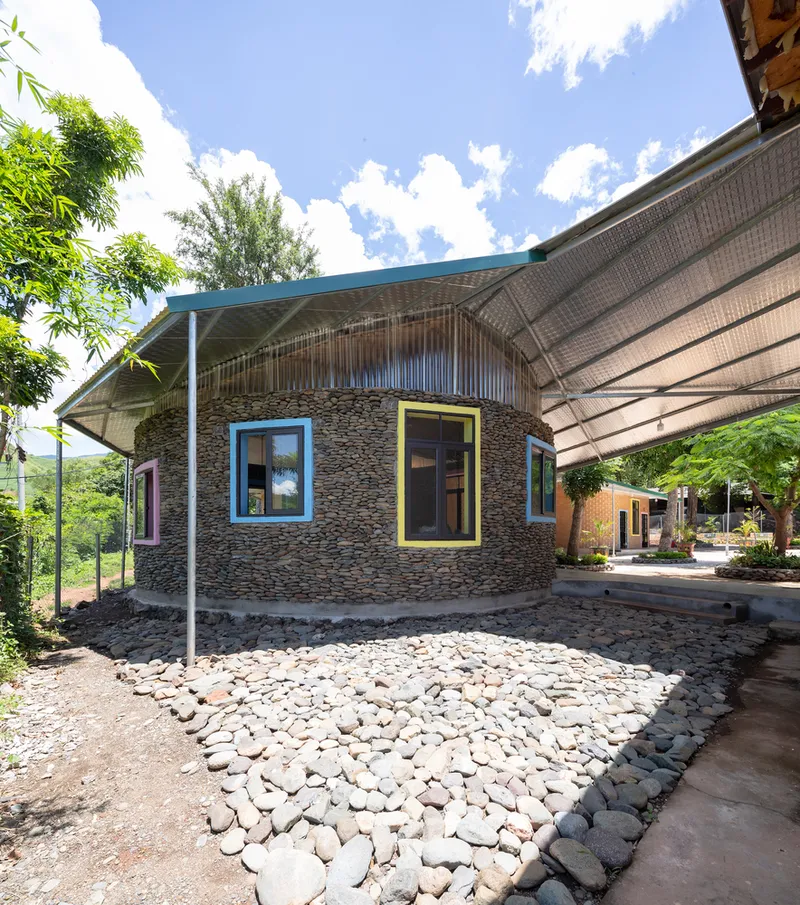
The material palette at Na Pan is defined by proximity. River stones from the Nam Vat Stream form the curved walls of the school's most distinctive volumes. Adobe bricks, manufactured on-site using clay brick machines that 1+1>2 brings to their rural projects, compose the classroom walls with a woven pattern that provides both texture and structural interest. The combination of these two materials, one gathered and one fabricated on the spot, gives the school a tectonic honesty that no imported finish could achieve.
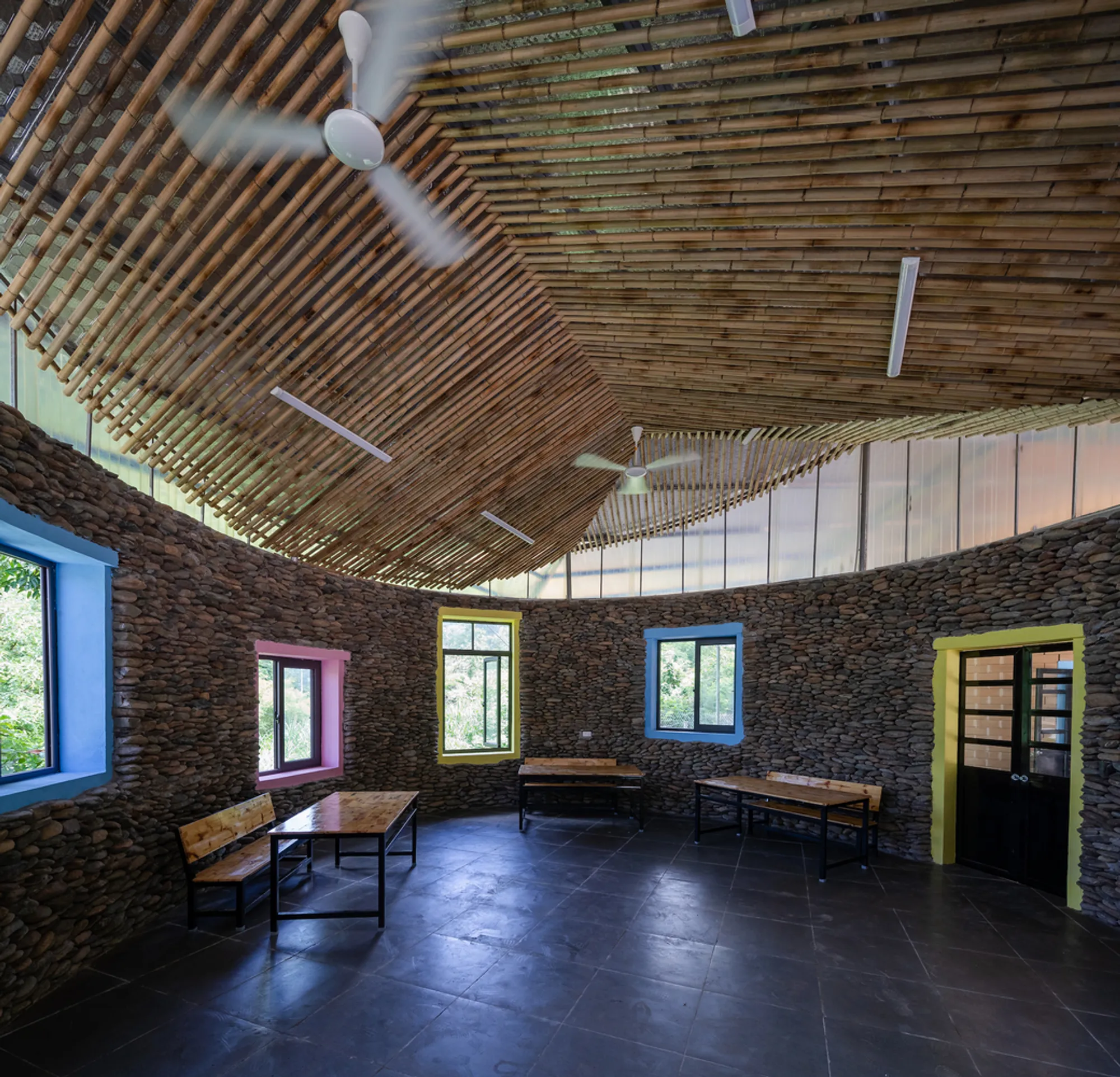
The rounded stone volumes, visible in several of the school's key gathering spaces, recall the form of traditional lowland pottery kilns. Their curved geometry is not arbitrary. It allows the stone walls to be self-supporting without heavy reinforcement, and the circular plan creates generous interior volumes from relatively compact footprints. Blue and yellow window frames punch through the stone walls with a playful directness that reads clearly from across the courtyard.
Bamboo Canopies and the Quality of Interior Light
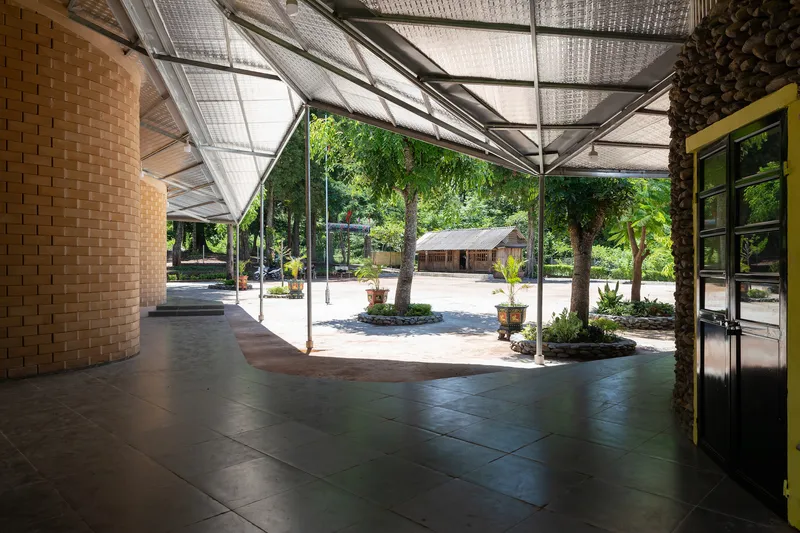
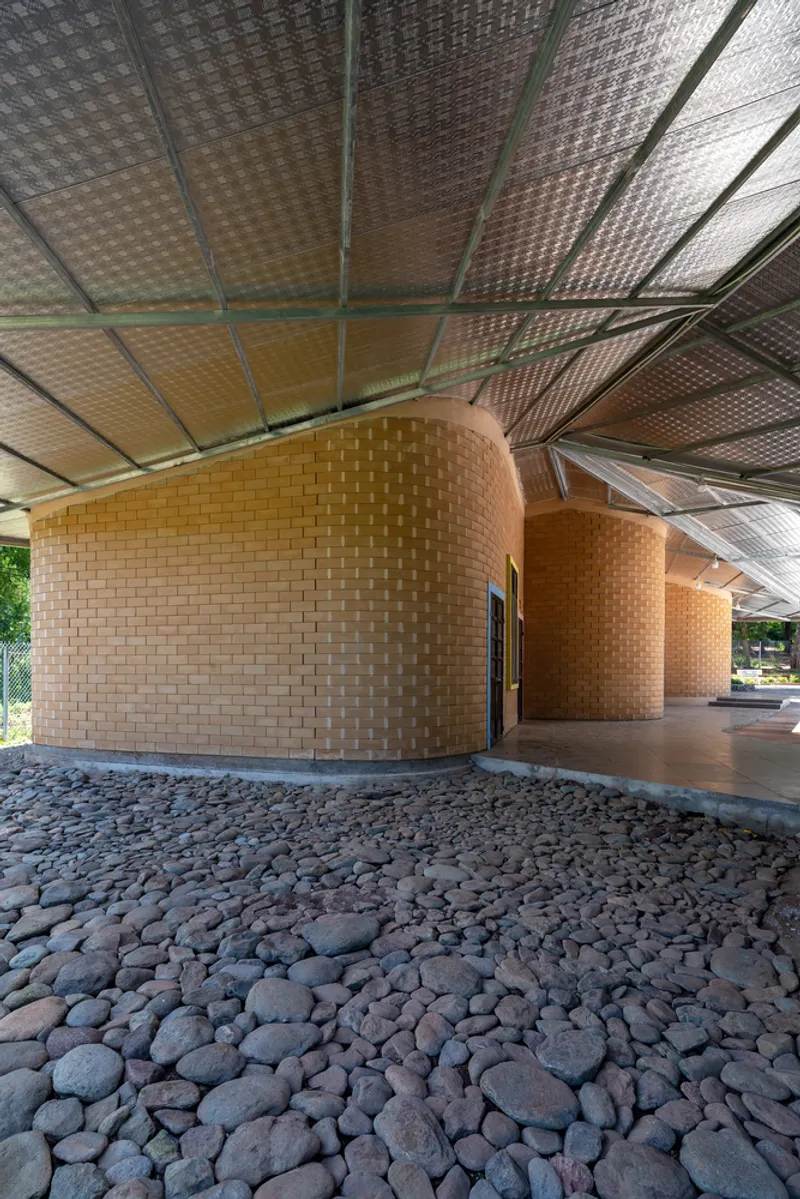
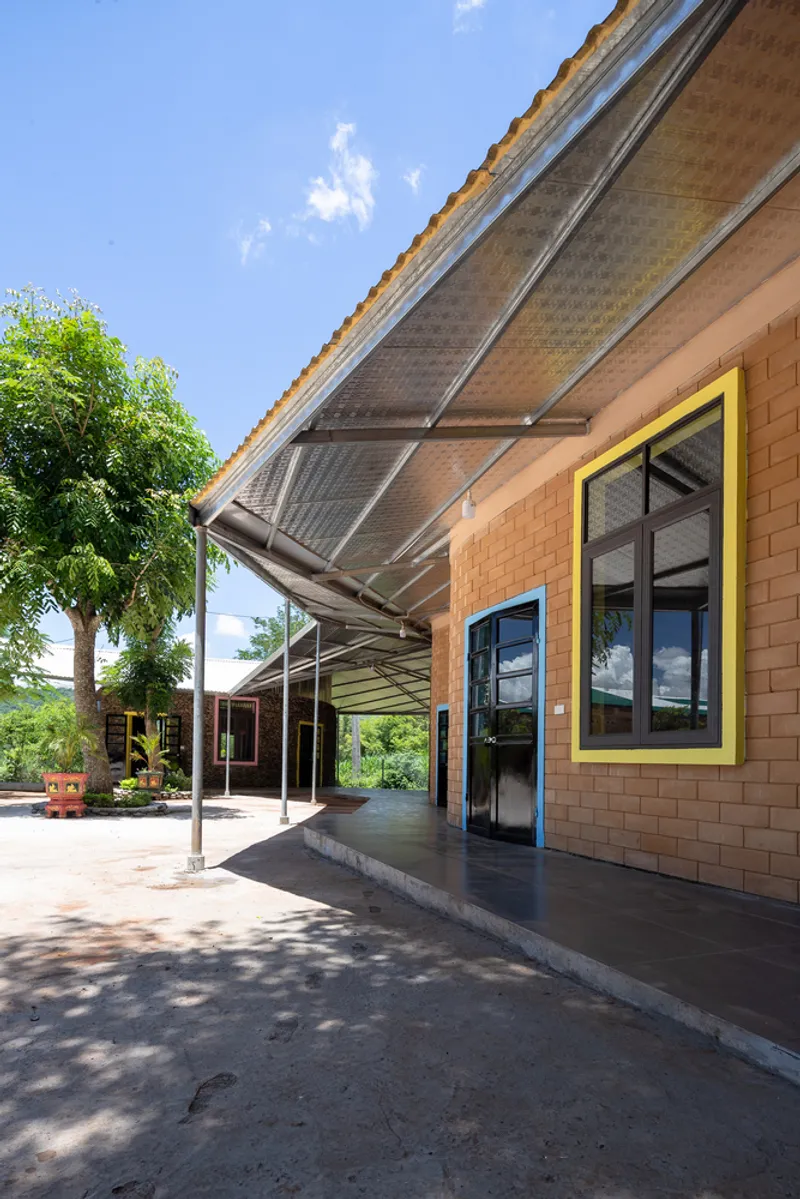
The translucent corrugated canopy that shelters much of the school's circulation and gathering space is one of the project's smartest moves. Supported by slender steel columns, it filters sunlight into a soft, diffused glow rather than blocking it outright. This creates covered outdoor rooms that feel bright without the glare and heat that direct tropical sun would bring. Beneath this canopy, the cylindrical woven brick volumes sit on cobblestone ground cover, a composition that feels almost village-like in its informality.
Inside the curved spaces, woven bamboo vaults form the ceiling, layering another locally sourced material into the architectural language. The effect is warm and acoustically forgiving, a marked improvement over the bare concrete ceilings common in rural Vietnamese schools. The covered walkway connecting the classroom wings features similar woven ceiling panels, establishing a consistent material rhythm that ties the entire campus together.
Classrooms Built for Ventilation and Daylight
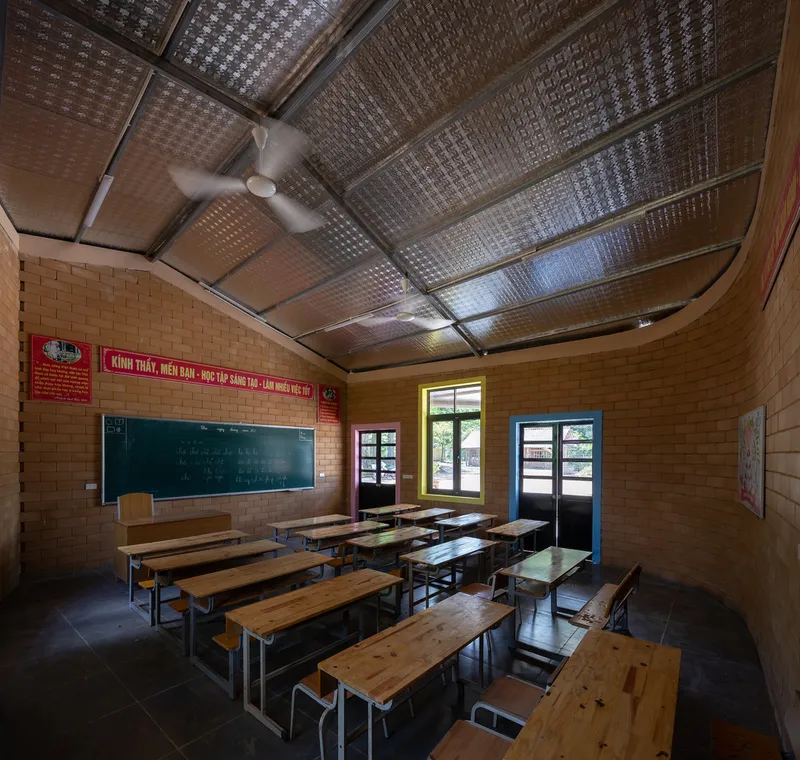
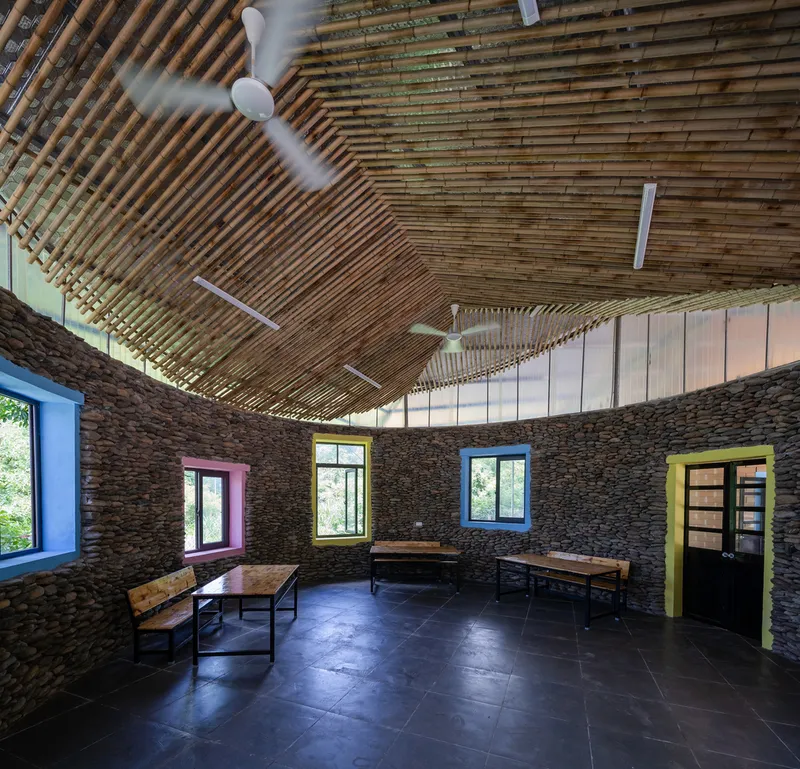
The classroom interiors are straightforward: exposed brick walls, wooden desks, ceiling fans, and perforated translucent panels overhead that admit natural light while reducing solar heat gain. There is nothing superfluous here, but the essentials are handled with care. The rhythmic arrangement of windows along the classroom facades provides cross-ventilation and brings in daylight from multiple directions, reducing dependence on artificial lighting during school hours.
In the circular multi-functional room, the approach shifts. Layered stone walls rise to a woven bamboo vaulted ceiling, and the colorfully framed windows become the primary light source, casting warm pools of color across the interior. This room, built entirely with stones collected by the villagers, functions as a communal hub that bridges the gap between the school's older structures and its new additions. The space works for assembly, group activity, and informal gathering, a flexibility that reflects the school's broader ambition to serve as a community resource rather than just a classroom block.
3,000 Working Days: Construction as Community Building
The construction numbers tell a story that the photographs cannot fully capture. Nearly 300 households contributed more than 3,000 working days to build the school. Each family carried 30 pebbles from the river, a task repeated until 80,000 stones had been collected for the multi-functional room, courtyard paving, and decorative features. The on-site brick making machines that 1+1>2 deployed meant that even the masonry was produced by local hands, using local soil.
This participatory model is central to 1+1>2's practice. It is also what separates Na Pan from projects that merely look vernacular. When villagers build the walls themselves, the school becomes theirs in a way that a contractor-delivered building never can. The four-month construction timeline, remarkably fast for this level of community involvement, suggests a high degree of organization and motivation on both sides. The result is a building that has already earned the investment of its users before the first class begins.
Plans and Drawings
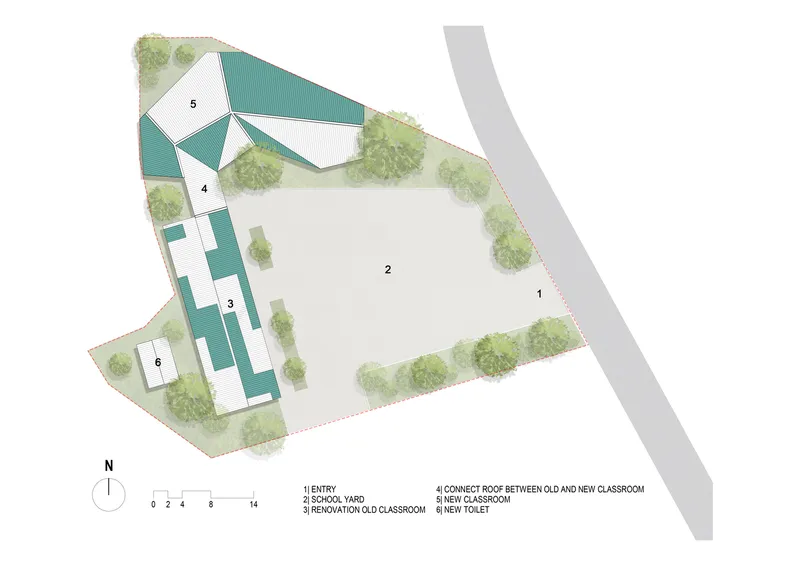
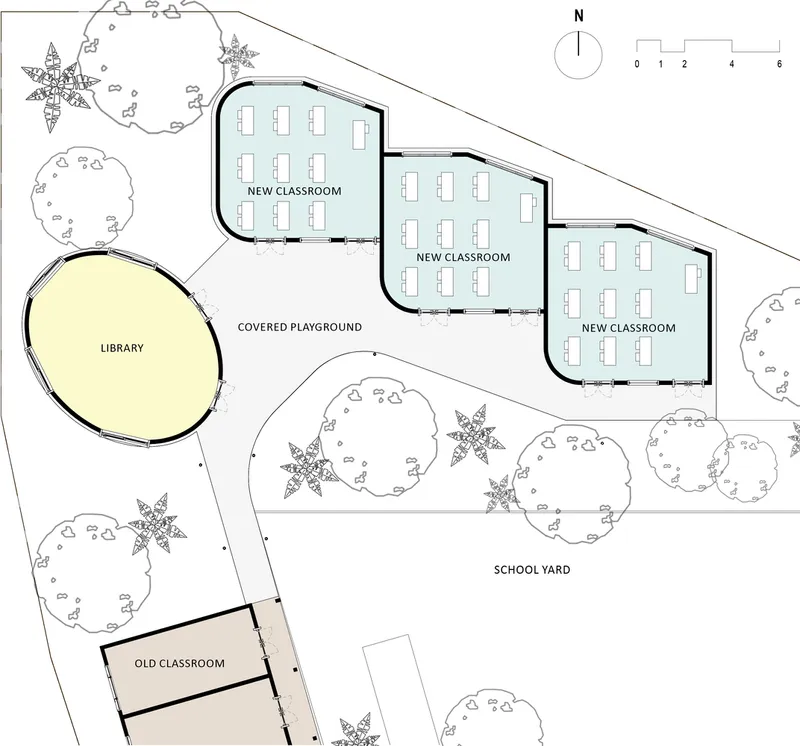
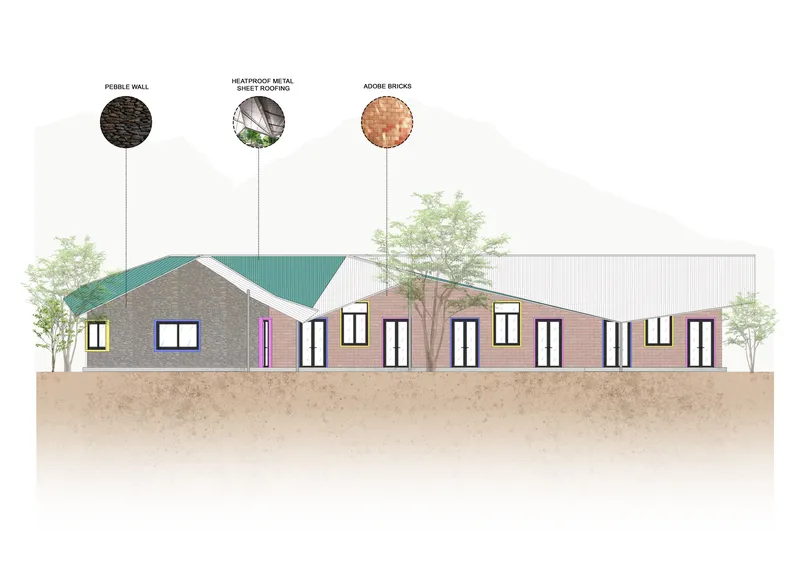
The site plans reveal the organizational clarity behind the project. The school's gate faces the inter-village road, with the three wings arranged around the central courtyard and the circular library positioned as a hinge between old and new structures. The stepped classroom blocks, covered playground, and landscaped schoolyard are visible in the more detailed plan, showing how every square meter of the compact site has been activated. The elevation drawing confirms the varied rooflines and material transitions, with callouts identifying the different construction systems. These drawings demonstrate that even with community-driven construction and local materials, the architectural planning behind Na Pan is rigorous and precise.
Why This Project Matters
Na Pan School matters because it refuses the false choice between community participation and architectural quality. Too many rural school projects in Southeast Asia settle for utilitarian boxes delivered by outside contractors, or alternatively, for romantic vernacular gestures that lack spatial sophistication. 1+1>2 Architects demonstrate that it is possible to mobilize an entire village, build with river stones and on-site bricks, and still produce a campus with spatial variety, controlled light, and a legible organizational logic. The circular stone room alone would be a notable piece of architecture in any context. That it was built by the families of the students who use it makes it extraordinary.
For architects working in resource-limited contexts, Na Pan offers a replicable framework: unify existing structures through landscape and circulation, deploy on-site fabrication to reduce material transport costs, and treat construction itself as a form of community engagement. The 80,000 stones carried from the Nam Vat Stream are not just a building material. They are a measure of collective commitment, embedded permanently in the walls of a school that will serve children for decades. That is sustainable architecture in the fullest sense of the word.
Na Pan School, designed by 1+1>2 Architects. Located in Chieng Dong, Son La province, Vietnam, at the foot of Pa Han Mountain. The school serves 204 students across six classrooms.
About the Studio
Share Your Own Work on uni.xyz
If projects like this are the kind of work you want to make, uni.xyz is a place to publish your own, find collaborators, and enter design competitions.



Popular Articles
Popular articles from the community


Conexión: Biophilic Design Reimagines High-Rise Living in Hong Kong
Conexión reimagines high-rise living in Hong Kong through biophilic design, green facades, shared spaces, daylight, water and nature within.

Riyadh For All: Intergenerational Urban Design for Active Aging in Rabat
Riyadh For All reimagines urban design in Rabat with intergenerational co-living, adaptive courtyards, and Moroccan cultural exchange today.

Co-life: Sustainable Architecture for Age-Friendly Community Living
Co-life reimagines sustainable architecture for seniors through courtyards, rammed earth, shared gardens, and spaces designed for belonging.

Hill & Cross Opera: Sculptural Opera House Architecture Shaped by Tallinn’s Landscape and Identity
Hill & Cross Opera reimagines opera house architecture in Tallinn through its sculptural hill, civic plaza, glass wave and a luminous cross.

Similar Reads
You might also enjoy these articles

Bamboo Housing Challenge 2026: Design Affordable, Sustainable Homes Using Bamboo
An international design competition by Bamboo U and IBUKU inviting architects and designers to reimagine affordable housing using bamboo — with the winning design built full-scale in Bali.

Computational Design & Education: Beegraphy Design Awards Introduces 7th Category (Featuring Jiyun's Innovative Approach)
Dive into Beegraphy’s 7th Design Awards category, where computational design meets education to create immersive, interactive learning tools, inspired by Jiyun’s work.
From Parametric Lighting to Urban Furniture: Join the 2nd Workshop in Beegraphy’s Computational Design Series
Dive into Cutting-Edge Design Techniques and Practical Applications with Industry Experts

Last Call: Unleash Your Architectural Genius in SHAK's Kindergarten Design Competition
Urgent call for architects to join SHAK's kindergarten design competition before the looming deadline

Explore Pont-Aven School Competitions
Discover active competitions in this discipline



Challenge to design public laboratory


Challenge to reimagine the Iron Throne


Photograph architecture without architects


Illustrate the lost glory of Angkor Wat - Render Challenge
Comments (0)
Please login or sign up to add comments
No comments yet. Be the first to comment!