NESTLED ABODE
Fostering Human-Bird Connection

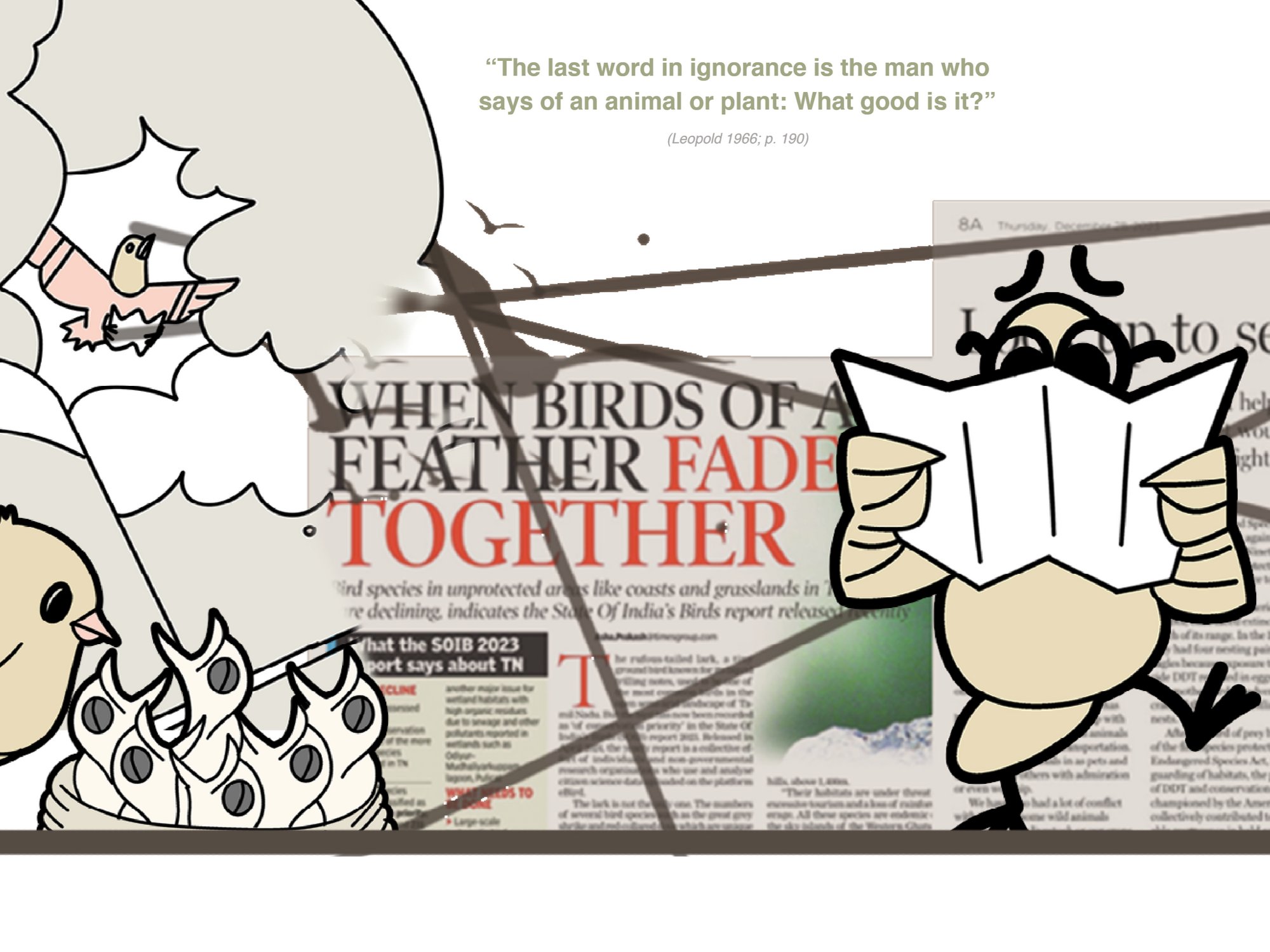
Environmental challenges we face now are peaking at the vulnerable state, yet we often ignore the subtle changes. This decline impacts not only human lives but also the species we share it with. Among the most vulnerable are birds. Birds, as indicators of environmental health, highlight broader issues through population trends. Protecting them is, therefore, fundamental to preserving the ecosystem as a whole.
Ornithology, the branch of science dedicated to the study of birds, plays a critical role in understanding and addressing these challenges. Their research offers answers to crucial questions, providing valuable data that can guide conservation strategies and mitigate the impacts of environmental changes.
The thesis focuses on ways to support and enhance the work of ornithologists. By integrating research facilities, education
spaces, and public awareness programs, the centre will serve as a hub for conservation efforts, promoting the protection of birds
while raising awareness about their importance to the planet.
Taking the case of the Western Ghats, a region recognized as one of the world’s biodiversity hotspots, houses a remarkable variety of bird species. However, the northern part of Western Ghats faces significant challenges due to anthropogenic threats, including deforestation, urbanization, and climate change, which threaten the delicate balance of biodiversity in the area. The decline in bird populations due to habitat destruction and environmental changes underlines the urgent need for conservation efforts.
This thesis delves into the activities of ornithologists and their critical role in conservation, exploring how architecture can contribute to and facilitate their work that supports bird conservation and help protect one of the world’s most precious biodiversity hotspots.
The structure is strategically sited in zones of low tree density, while areas with higher canopy cover are accessed solely through elevated walkways. This approach minimizes disruption to the forest floor and safeguards existing vegetation and topsoil.
The built form is compactly organized to reduce its footprint, thereby retaining extensive open spaces for natural ecosystems to thrive.
A clear zoning strategy governs circulation: researchers have unrestricted access to dedicated work areas, whereas visitors are excluded from sensitive research zones yet allowed controlled visual access to ongoing activities.
Encircling the structure, a continuous aviary functions as a protective buffer between the forest and the built environment. It simultaneously provides refuge for birds and creates an observation arena for birdwatchers, fostering both conservation and public engagement.
The sloped roof is designed to optimize natural ventilation, enabling wind to enter from the lower side and exit at the higher opening, creating a stack effect that enhances indoor air circulation. Its extended overhang and angled form provide effective shading, reducing solar heat gain while allowing diffused natural light. With a 40-degree slope, the roof also directs rainwater away from the main structure, offering potential for collection and reuse. At ground level, vegetation and permeable surfaces minimize heat accumulation, ensuring cooler microclimates. Together, these strategies promote passive cooling, reduce reliance on mechanical systems, and create a design that works in harmony with the surrounding ecosystem.
The structure is conceived with a strong emphasis on sustainability and regional identity, making use exclusively of natural, locally available materials. This not only reduces the ecological footprint of construction but also allows the built form to merge harmoniously with its surrounding landscape.
The Konkan region, where the project is situated, is traditionally known for its laterite stone architecture. In keeping with this vernacular practice, laterite stone is employed as the primary material for the walls. Its thermal properties help maintain cooler interiors, while its earthy texture strengthens the connection between the structure and the local terrain.
For the roof, bamboo has been utilized as the framing material owing to its flexibility, renewability, and structural efficiency. The roof covering itself is composed of thatch, selected not only for its natural insulation and rustic character but also for its ecological role. The thatch provides opportunities for birds to repurpose it as nesting material, allowing the architecture to become an active contributor to the avian ecosystem.
In this way, the material palette transcends functionality, embodying both cultural continuity and ecological sensitivity, while creating a built environment that supports, rather than disrupts, the life of the forest.
The second part of the structure features an elevated walkway that meanders through the denser forested portions of the site. This design strategy minimizes ground disturbance and preserves the integrity of the forest floor, allowing the natural ecosystem to remain largely untouched.
The walkway is thoughtfully divided into distinct zones, each corresponding to different bird species and their habitats. Along its length, a series of carefully placed viewing decks provide opportunities for birdwatchers and visitors to pause, observe, and engage with the avian life of the forest from multiple perspectives. At the entrance, an interpretation center introduces visitors to the ecological significance of the area, offering educational material and contextual information that enrich their experience.
Functionally, the elevated walkway is also directly linked to the main research center, enabling ornithologists to access it seamlessly for observation, monitoring, and fieldwork without disturbing sensitive habitats.
In terms of materiality, the structure employs bamboo for its primary framework, chosen for its sustainability, lightness, and ability to blend with the forest environment. The walkway rests on stone rubble footings, ensuring stability while maintaining a low-impact foundation system. Together, these design choices create a structure that is both ecologically sensitive and experientially engaging, fostering a deeper connection between people, birds, and their shared environment.