
Nilai, the city that feels like home
Envisioning a sustainable floating city: bridging the gap between new and familiar, modern and vernacular.

Climate change is a persistent battle that has been at the forefront of our global priorities for many years now. In the context of Semarang, it translates to yearly tidal floods that affect thousands of individuals’ lives and leave their city and houses susceptible to damage. With no intervention, the studied site is predicted to be completely sunk by 2100 as shown by credible stimulations. Thus, to combat this, we present our vision for Nilai, the city that feels like home.
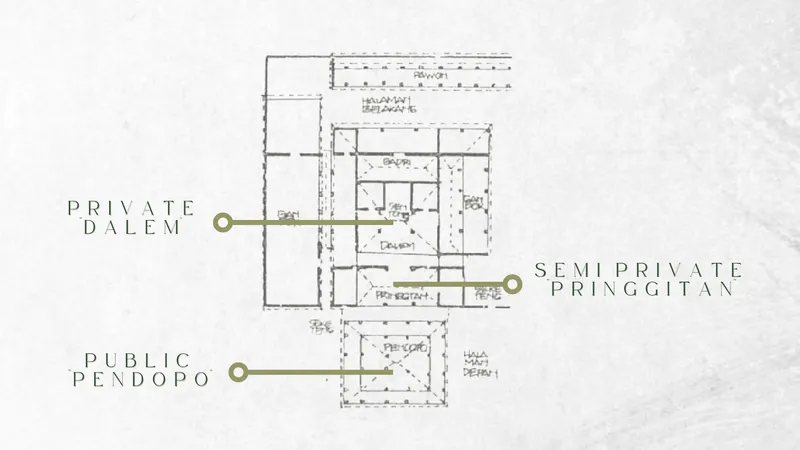
A city can be an overwhelming place. It can feel strange, uncomfortable, and foreign. Contextually, a city on the verge of being submerged will particularly evoke feelings of fear and uneasiness. These concerns were at the core of the emergence of Nilai City. Nilai is a floating city designed to defy climate change, erasure of culture, and conventional barriers. The name "Nilai" means value in Javanese, and denotes a city that holds substantial value, just like a home does to its owners. The concept behind the design dates back to Semarang’s colonial history. During the Dutch colonization, Semarang’s traditional architecture started to become lost and replaced with the colonial architecture. The architecture now is a blend of two different styles and influences. This, in turn, weakens Semarang’s identity. Hence, the concept stems from reinforcing Semarang’s identity and designing a city that truly feels like home. The whole city is modular, from the floating platforms to the urban modules, connections, structures and even the housing units. The urban module is inspired by the traditional Joglo house, which holds a culturally and philosophically significant value to the Javanese community. The modules consist of 3 main zones: public, semi – private, and private. These are correlated with the similar zones found in a typical Joglo house: Pendopo, Pringgitan, and Dalem (Figure 1). The private zone, "dalem", represents the residential units, the semi - private zone, "pringgitan", represents shared green spaces between the units, and the public zone, "pendopo", represents a gathering place. Fundamentally integral to Nilai, we wanted the residents of this futuristic floating city to feel like one entity in this new, floating urban context. We did this through using familiar terms to the Javanese community and Semarang residents like “Pendopo” to denote public gathering points for neighbors. Not only will this encourage the residents to socialize and form genuine connections, but the familiar terms will also make them feel comfortable and one with their culture and heritage. The intent behind this layout was to ensure that for every small neighborhood, there is access to services, gathering settings and social spaces, and enough units to house the residents. We emphasize the great need for a floating city, perceived as new and strange, to still feel familiar to the users.
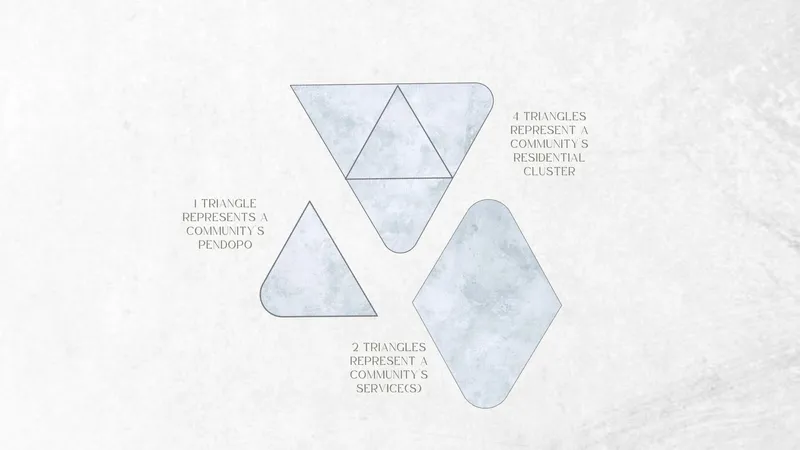
The extensive modularity is inclusive of all components that make up a city. 1 curved triangle represents a Pendopo, while 2 modules represent a service, and 4 modules represent a residential cluster (Figure 2). This guarantees fast and easy expansion in case of other regions in the city or country getting affected. Moreover, Nilai is a responsive city that can be customized to suit its residents’ needs. If the residents wish to have more gathering places, also known as “Pendopo”, they can conveniently add one module. If the city needs extra services to accommodate the residents, then service platforms which constitute 2 modules, can be easily introduced to the city. The services are made up of a wide array of activities and accommodations, and they include administrative offices, a park, a healthcare center, markets, a fishermen’s hub, a farm, and a library. This list is prone to change as more services can be easily provided according to the residents’ needs.
Offering a harmonious blend of modernity and vernacularity, Nilai’s architecture is diverse and consistent simultaneously. It presents as a modern take on the Joglo house typical roof style, showcasing variety, simplicity, and beauty. We made sure that all income groups experience beautiful and comfortable architecture, whilst providing more luxury and façade finishes for the higher income groups. The architecture goes hand in hand with the modular structure and construction processes. The housing structure is composed of 4m x 4m grid boxes that are made up of reinforced concrete slabs, reinforced bamboo columns and steel beams. This ensures durable structures that can withstand concurrent natural forces like earthquakes and floods. Additionally, utilizing local sustainable materials like bamboo for the columns, and wood for the finishes plays a vital role in strengthening Semarang’s identity. In line with creating a structurally sound city, the curved triangle module was chosen for its resilient shape properties. Besides the structural aspect, Nilai adopts many elements and features that serve each income group. These include solar panels that harness solar energy, louvres and shading elements for Indonesia’s humid climate, green roofs to foster a self-sufficient community, passive design techniques like cross ventilation, and much more.
To advocate for sustainability and conservation, we implemented various ideologies on different spectrums. First, we promoted a car-free environment and opted for the utilization of electric golf carts, bicycles, and a pedestrian-oriented city. Second, we introduced mangrove forests that act as a natural barrier against floods, provide exquisite views, and protect the endangered indigenous Indonesian trees.
In conclusion, to bridge the gap between modern and vernacular and between new and familiar, Nilai emerged. Prioritizing mitigating climate change’s inevitable devastating consequences, the residents’ needs, Semarang’s culture and identity, and making a new urban context feel like home are some of the prominent elements of this city. We hope to expand this concept on a larger scale and reap the benefits of resilient and comfortable cities.



Popular Articles
Popular articles from the community


Riyadh For All: Intergenerational Urban Design for Active Aging in Rabat
Riyadh For All reimagines urban design in Rabat with intergenerational co-living, adaptive courtyards, and Moroccan cultural exchange today.

Conexión: Biophilic Design Reimagines High-Rise Living in Hong Kong
Conexión reimagines high-rise living in Hong Kong through biophilic design, green facades, shared spaces, daylight, water and nature within.

The Ocean Hive: Sustainable Architecture for a Self-Sufficient Civilization at Sea
The Ocean Hive imagines sustainable architecture at sea, where modular habitats, algae, wave power and ocean waste sustain a growing colony.

Co-Life: Senior Housing Design That Reconnects Older Adults With the City
Co-Life reimagines senior housing design through healing gardens, shared streets, workshops, and a sustainable community across generations.


Similar Reads
You might also enjoy these articles

The Rhythm of Seasons
A Farmers' Market Connecting Nature and the City

More Than a Building-Designing a Living System
More Than a Building-Designing a Living System
Base Beyond
DESERT COMPOUND ARID: TOURISM OF ABSENCE AND ABUNDANCE


Explore Floating City Competitions
Discover active competitions in this discipline




Challenge to reimagine the Iron Throne


Photograph architecture without architects


Illustrate the lost glory of Angkor Wat - Render Challenge


Design challenge to reuse E-waste
Comments (0)
Please login or sign up to add comments
No comments yet. Be the first to comment!