
OAK PLAYGROUND
A playgroud ispired by the myths and stories of Hyde Park

RESEARCH
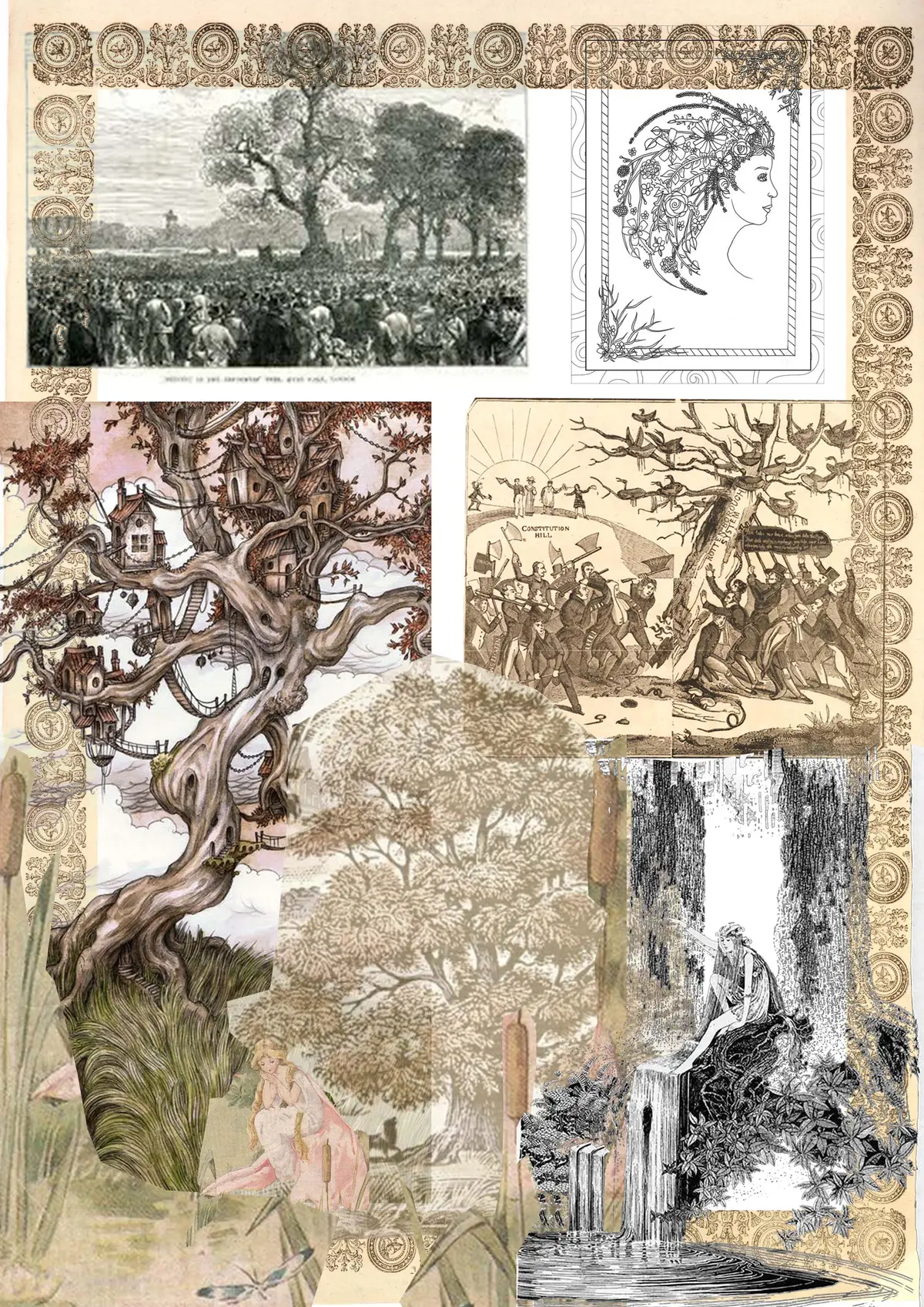
The exploration of Hyde Park in London began with a story. Observing through the narrative offered by the park's rich history, I attempted to uncover details or hidden messages behind the famous landmarks to better understand it and to grasp the context of the location we received. The park is a true oasis, abundant in greenery, unencumbered by large structures and excessive commercial content. The events taking place here are of a temporary nature, allowing the park to remain spacious, surrendered to citizens and nature.
English parks are romantic and regal, evolving to become more liberated over the centuries. In form, they mimic natural shapes and blend into their surroundings, unlike the symmetrical French gardens. Most parks originated as enclosed forests, dwindling due to rapid urbanization, shrinking and becoming part of the land owned by aristocrats, mainly rulers or feudal lords, or as royal gardens. Hyde Park, among many others, was once a hunting ground and at one point even an execution site. Later in history, it became a place for political gatherings.
Hyde Park is the largest green space in London. According to some studies, London is considered a forest. It is so densely vegetated that it can technically be called a forest. More than a fifth of the capital is made up of trees, meeting the United Nations' definition of a forest as an area where at least 20 percent of it is covered by trees. London boasts a respectable 21 percent. To explain further, the UN defines a forest as 'land spanning more than 0.5 hectares with trees higher than 5 meters and a canopy cover of more than 10 percent, or trees that can reach these thresholds in situ.'
The idea for designing a playground arose from the many facts and stories about Hyde park and its greenery. The first narrative that caught my attention was the story of the Elfin Oak, stump of an oak tree, located in Kensington Gardens. Despite being distant from the location, it was a fascinating part of the park for me.
The Elfin Oak is a 900-year-old stump originally from Richmond Park, where it stood for 800 years until it was relocated to Hyde Park on the orders of George Lansbury, becoming a valuable attraction. This artistic sculpture dates back to the 19th century, created by artist Ivor Innes. He painted and adorned the small oak to turn it into a real fairy tale for park visitors. The Elfin Oak is adorned with various sculptures of fairies, gnomes, and other mythical creatures. Each figure has its own story and appears to be part of a fairy tale.
The tree was originally donated to Hyde Park in 1928 and underwent restoration to preserve its beauty. Today, the Elfin Oak is accessible to park visitors and serves as an attractive spot for all ages, evoking a sense of wonder and magic, especially for children. Families often visit to explore its unique beauty.
The next narrative pertained to an article from old newspapers from the 19th century, depicting an oak tree attacked in protest during the English Reformation.
What is the Reformers’ Tree? It is known for its beautiful mosaic on the eastern side of Hyde Park. The circular artwork made from black and white gravel supposedly marks the place where the original oak tree once stood, at the junction of nine different footpaths through the Royal Park. In a park filled with trees, why was this particular tree so special?
In the late 19th century, Hyde Park became the epicenter of political protests. Worker rights, control of public spaces, and voting laws were all pressing issues. During a specific protest in 1866, it is believed that the Reform League stormed the area, and in the ensuing chaos, the oak tree - the Reformers' Tree - was set on fire. By morning, only a charred stump remained. The burnt tree soon became a symbol of discontent and was used as a gathering point for future Reform League meetings. This tradition contributed to the establishment of the nearby Speakers' Corner as a stronghold of free speech.
Interestingly, the inscription around the mosaic raises some questions. Engraved spirally on the outer sandstone ring, the monument reads: 'This mosaic is designed to commemorate the 'Reformers' Tree,' an ancient tree that was burnt during the riot of the Reform League in 1866. The remaining stump became a platform for political demonstrations and a gathering place for meetings of the Reform League.
After researching the Elfin Oak, I explored the park's connection to supernatural beings and mythology, as well as the symbolism of the oak in myths. Fairies living around the Serpentine Lake, who aided Peter Pan in learning to fly (some scenes from the movie 'Finding Neverland' were filmed in the park), are mentioned. In Celtic and English mythology, the oak is associated with druids, a priestly class whose name likely comes from the word 'druid,' probably originating from early Indo-European languages and signifying 'oak/strong' and 'knowledge,' although some believe it to be even older.
PROJECT
Inspired by these narratives, I thought about the need to revive the Reformer's Tree (which was an oak) and somehow create a story around it, which would be much brighter and more playful, similar to the idea of elves and myths around the Elfin Oak, as there aren’t many activities for the youngest in the park.
The idea evolved into a whole playground for children, imaginative and secluded, resembling a fairy tale playground, nestled in the woods, where fairies, wizards, and other mythical creatures reside. The sense of seclusion and confinement that the appearance of the Elfin Oak provided, with little wizards housed in tree holes, gave me the idea of hiding and a confined space, a kind of labyrinth formed by the forest. I achieved this by installing a wooden canopy, made of semi-processed wood, with holes/openings representing zenithal lighting where visitors can walk on certain parts. Creating a small 'forest' within the park is a response to today's issues with preserving greenery, raising awareness and caring for trees and forests. We plant an oak tree that will protect the environment, just as that environment, us people, will protect it. The project is viewed over a time span, today-future. How will the project look today when we plant the oak, and in a hundred years when it becomes a symbol and guardian of the entire location? Below it, debates like the ‘The Knights of the Round Table’ will be held, and similar events.
As the idea of the Speakers' Corner emerged as a memory of the Reformers' Tree, it plays a significant role in connecting with the oak. The paths leading to it and the canopy moving over the path (as the main connection to the road next to the park) create a rounded story about the oak, debates, as a new idea of something that already existed.
The project consists of several small 'islands' or parts bounded by paths with their narratives. In form, they resemble tree stumps' growth rings.
At each entrance to the pavilion, there is an interactive map where you can check which activities are currently active and what events are happening during the week at the pavilion. There are also small ticket sales receptions at each entrance on the ground floor, while accommodations for children camping or staying during the summer course of wizardry or chivalry are above.
There is a part with a cafe and a small playground, which leads to the canopy.
Then there is a section with wood workshops for making toys and small wooden sculptures, beside which stalls selling these products are placed. The workshop with woodworking machines is designed for parents, with the help of an expert, while the assembly part is for children, allowing them to create their own creations through play and storytelling.
There is also a section for writing stories. In the central part of the building is the storyteller's place, with chairs placed around, and depending on people's interest, they take them and gather around. There are also tree trunks for those who want to feel completely in the woods. The spaces for writing stories are more intimate and acoustically isolated so that anyone inspired by the content provided in the pavilion can sit and write, preventing the thought from leaving their mind, as creative thoughts often do. Literary evenings, recitations, oratorical competitions, and other literary competitions will also be held there. Next to it is the library, specifically small book kiosks that open in the summer and become an open-air library. Above the workshops, towards the oak, is the 'Merlin's Freedom Forest' (according to the myth, Merlin was trapped in the oak).
The scenic area consists of three parts: an open-air theater/amphitheater, an indoor stage, and a room for reading myths. The outdoor stage will mainly serve for small performances in summer, children's events, choir performances, small concerts, and the like. The indoor part of the stage will be used for seasonal children's performances, where shows prepared by children at the summer camp within the pavilion will be held.
At the bottom of the location is the music area, which has a room with a piano and a small space for acoustic concerts. Next to the hall, on its right side, is the 'Peter Pan's Garden.'
The right side of the centrally positioned oak, the center from which all paths emanate, is a multifunctional space housing offices and journalism workshops, working on a quarterly newspaper. There is also a small restaurant/canteen that can be used for birthday parties, parties, or similar events.
Materialization is in natural materials, mostly wood, some stone, but also glass. The columns are minimally processed to fit into the forest ambiance, to achieve a natural look and create the impression of real trees rather than columns. The construction of the buildings on the site is steel, while the wooden canopy rests on wooden columns with steel connections. The walls are partly concrete covered with wooden linings, some rustic and imitating tree bark.

Popular Articles
Popular articles from the community


Opera on the Sea: Driftwood Logic Shapes a Timber Opera House on Estonia's Coast
Trevor Orgill's opera house translates the entangled drift of floating timber into a civic building where wood, water, and music converge.

Tsunami Convergenics: Turning Catastrophic Ocean Forces into Underwater Housing Infrastructure
A speculative underwater settlement off the coast of Onagawa, Japan, treats tsunamis and typhoons as energy sources rather than threats.

Opera by the Sea Estonia: Three Shells Dissolving Architecture into Tallinn's Coastline
A winning opera house proposal replaces monumental form with interconnected shells that blur the boundary between building, park and Baltic Sea.

Singing Woman: Contemporary Architecture Inspired by Estonia’s Voice and the Sea
Singing Woman turns Estonia’s song culture into flowing opera house architecture, blending public life, landscape, sea, and national memory.

Similar Reads
You might also enjoy these articles

Day and Night Park: A Time-Based Urban Newsstand in Beijing
A temporary urban newsstand in Beijing blending travel, light, and reading through poetic colors, compact form, and community-focused design.

Modernist Patio Renovation in El Masnou, Barcelona by Oliver Segura Arquitectura + Cebrià Arquitectura
Modernist patio renovation blending tradition and innovation with a movable pool, leveled floors, and Catalan materials in El Masnou.

Alto Residencial Coop: Cooperative Housing Development in Santiago de Compostela by Carbajo Barrios Arquitectos
A linear cooperative housing complex blending white volumes and perforated metal façades, enhancing community living, natural light, privacy, and urban integration.
Vil Genis School by BPA ARCHITECTURE – Massy, France
Vil Genis School in Massy, France, features sustainable design, south-facing classrooms, community integration, accessible spaces, and modern educational architecture.

Explore Playground Competitions
Discover active competitions in this discipline


Challenge to reimagine the Iron Throne

Photograph architecture without architects

Illustrate the lost glory of Angkor Wat - Render Challenge

Design challenge to reuse E-waste
Comments (0)
Please login or sign up to add comments
No comments yet. Be the first to comment!