
Plugin House
affordable modular house


Housing is a basic human need. But a lack of affordable housing to buy or rent is fuelling a global housing crisis.By 2025, 1.6 billion people are expected to be affected by the global housing shortage, according to the World Bank.
In most countries, the cost of housing has grown faster than incomes, data from the International Monetary Fund shows.
In a study of 200 cities globally, 90% were found to be unaffordable to live in, with the average home costing more than three times the average income.
House prices globally have risen at their fastest rate for 40 years as demand has outstripped supply, according to research from financial services firm JP Morgan.
Iran is a country in West Asia and its capital city is Tehran. The population of this city is large and a large number of people from different provinces migrate to this city for work and live in overcrowded and poor-quality housing. The cost of renting and buying housing is very high, so people have to commute for long hours to get to their workplace. Therefore, in this plan, attention has been paid to providing housing for low-income groups by providing favorable living conditions.This design is an affordable, flexible model, with minimal material waste and minimal damage to the environment, which is suitable for the lifestyle of the future.
Site selection
The site was selected in Iran, in District 17 of Tehran. Because Tehran is the capital city of Iran, many people from different parts of the country immigrate to this city for educational purposes and job seeking.
In order to design housing for low-income groups, this area of the city has been selected, because most of the low-income people live in this area. However, there is no vacant land available in this area, so we have selected a part of the worn-out fabric of this area, which is capable of being destroyed, to establish our plan.
Challenges of the selected site
The chosen site is trapezoidal and there is a riding track on all four sides of it and the site is slightly turned towards the east.
The process of reaching the final concept:
The initial concept was designed in an L shape, which due to the high contact surface with the outside environment, caused dissipation of energy. Also, due to the small width, this module did not have a good internal arrangement. In addition, due to the large number of modules on the site and the small scale of the site, which increases the density, the arrangement of this module on the site did not create proper courtyards and communal spaces.
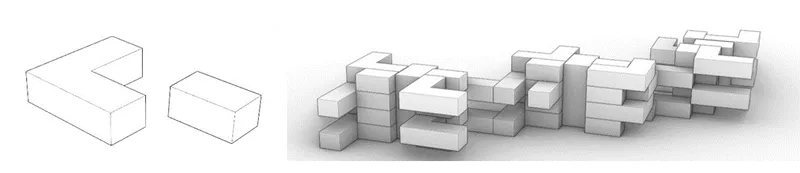
Second module: This module does not have the problems of the previous module due to its rectangular cube shape and increased depth. Consequently, it has been tried to achieve proper layout in this site by carrying out different layouts and taking into account parameters such as: user, natural ventilation, use of spaces from daylight, optimal dimensions in the module to prevent the production of construction debris and etc.
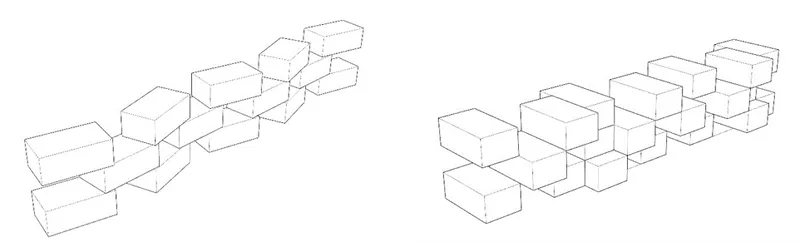

Competition challenges and design solutions
In order to reduce the costs in the construction process, the modules of the units are pre-fabricated with concrete, which are placed on a metal structure. At first, this construction method may seem expensive, but it should be considered that the presented plan does not require facade and joinery layers, which is very costly and time-consuming. As a result, this method is more economical than traditional construction on a mass scale. It has even been tried to design the interior spaces in a modular way so that the waste of materials is reduced to a minimum (e.g., the design of the cabinets and the dimensions of the interior spaces).
Regarding the lighting of the units, it has been tried to direct the daylight to the depth of the spaces by designing LIGHT SHELF for the windows and prevent glare. This idea also saves electricity. And finally, the amount of light received by the spaces has been simulated in the Design Builder software, and the designed building has won 3 points from the LEED standard.
It has been attempted to consider interactive spaces in different scales and floors in the plan which has finally led to the creation of interactive spaces for recreation and relaxation of residents.
In order to reduce the cost of electricity consumed in the complex, photovoltaic panels (pv cells) have been installed on the roof of the complex, so that it can supply a certain amount of electricity from the network.
A greenhouse is installed in front of the window of some units to provide heat and prevent its fritter in cold seasons. Moreover, in hot seasons, the windows of the greenhouses can be opened, which will cause air conditioning.
In the final concept, an effort has been made to make the design not only dedicated to individual living spaces, but attention has also been paid to lighting the corridors by creating an atrium to reduce energy consumption.


Popular Articles
Popular articles from the community


Conexión: Biophilic Design Reimagines High-Rise Living in Hong Kong
Conexión reimagines high-rise living in Hong Kong through biophilic design, green facades, shared spaces, daylight, water and nature within.

ALGAL REALM: A Bio-Integrated Lunar Habitat Design for Life Beyond Earth
ALGAL REALM reimagines lunar habitat design with algae-powered life support, 3D-printed regolith, and vertical living for a lunar future.

Play: Fragments of Their World
Familiar architecture becomes modular playground design, creating safe spaces where displaced children can learn, connect, imagine and play.

The Musturak Paradise: Senior Living Architecture for a Connected Future in Temara, Morocco
The Musturak Paradise reimagines senior living architecture in Temara via private homes, social spaces, culture, community, and shared care.

Similar Reads
You might also enjoy these articles

The Rhythm of Seasons
A Farmers' Market Connecting Nature and the City

More Than a Building-Designing a Living System
More Than a Building-Designing a Living System
Base Beyond
DESERT COMPOUND ARID: TOURISM OF ABSENCE AND ABUNDANCE

Explore Modular Housing Competitions
Discover active competitions in this discipline


Challenge to reimagine the Iron Throne

Photograph architecture without architects

Illustrate the lost glory of Angkor Wat - Render Challenge

Design challenge to reuse E-waste
Comments (0)
Please login or sign up to add comments
No comments yet. Be the first to comment!