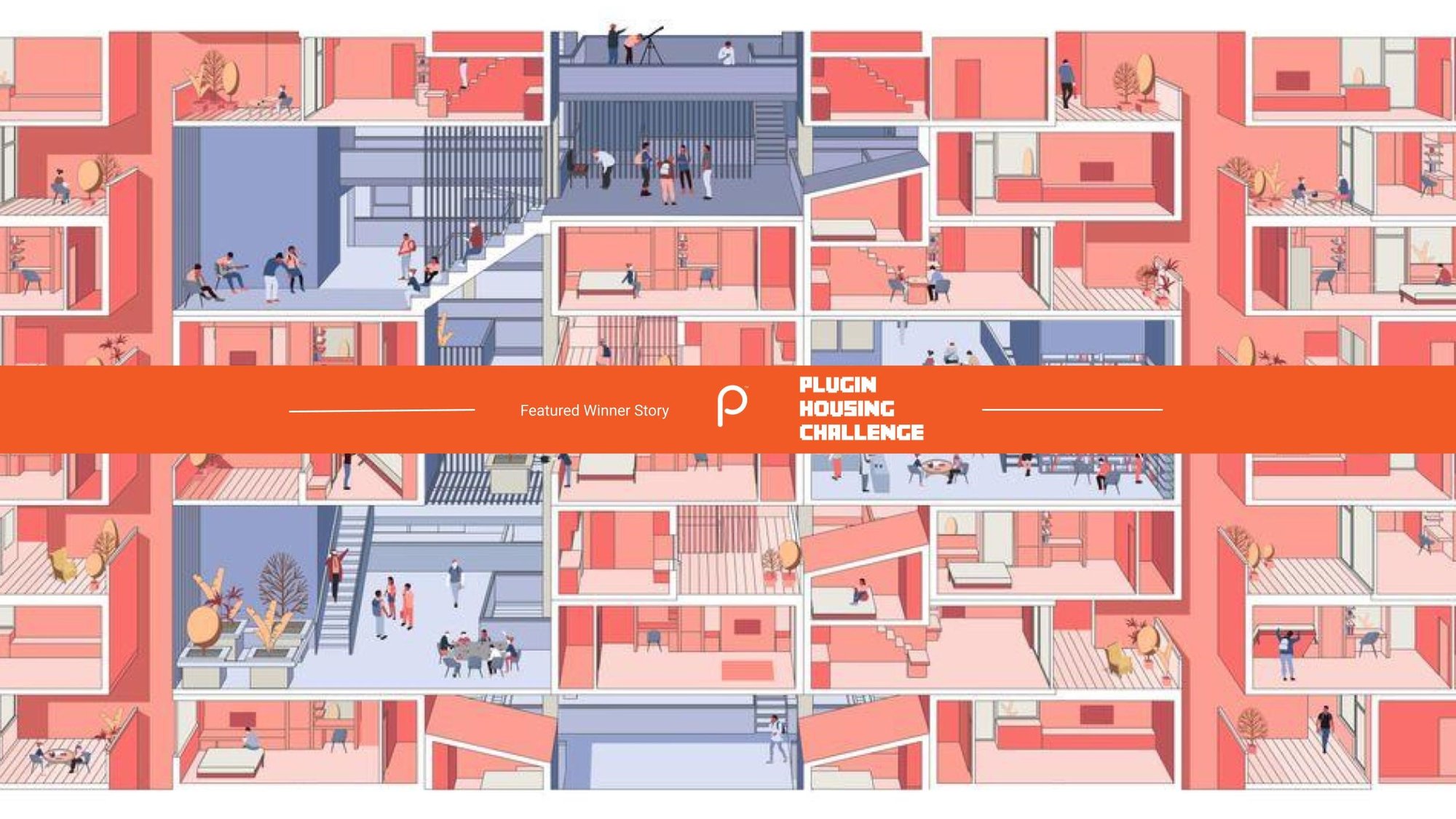
Towards a more efficient future of housing
Plugin to Micro Housing


Background
Humankind has lived and worked primarily in rural areas. But now, more than half of the globe's population will be living in towns and cities. The number of urban dwellers is rising, reaching almost 32% of the total world population, and 68% by 2050. It is estimated that 900 million urban dwellers and over one billion rural people now live in overcrowded and poor quality housing without adequate provision for water, sanitation, drainage or the collection of household waste.
A remedy for such conditions is required on a large scale that tackles the issue of housing for low-income groups residing in urban areas. In the coming decades, the cost of constructible land will increase, making the situation worse.
Even renting affordable houses in the world's largest cities is impossible and people have to resort to long commute hours to reach their workplace. A remedy for such conditions is required on a large scale that tackles the issue of housing for low-income groups residing in urban areas.
Plugging In
Working individuals and young migrants who move into big cities are constantly in search of affordable living options in the vicinity of their workplace or institution. They often stay for a temporary basis and hence rent a house.
A possible long-term solution would be to design compact housing units that are affordable for construction as well as usage. Compact Housing can also be referred to as micro or capsule housing. This concept has been derived from the necessity of providing shelter along with basic facilities for its users. It is a small, self-contained, single or double occupancy unit, typically in urban crowded areas.
Challenge
Micro Housing aims to compose these basic necessities by optimizing space usage and creating common interactive spaces for the communication and recreation of the residents. These common areas included recreation as well as break out spaces for the users.
The challenge was to design micro/compact housing units of single and double occupancy that can be plugged in together depending on the demand of the urban locality.
These units were modular in nature ready to be plugged in together to form blocks of not more than 100 units each. The participants were expected to conceptualize complete functional blocks which would include interactive areas/common service areas and corridors for circulation. The units could be technology-driven and added or subtracted from one block to another depending on the demand of the locality.
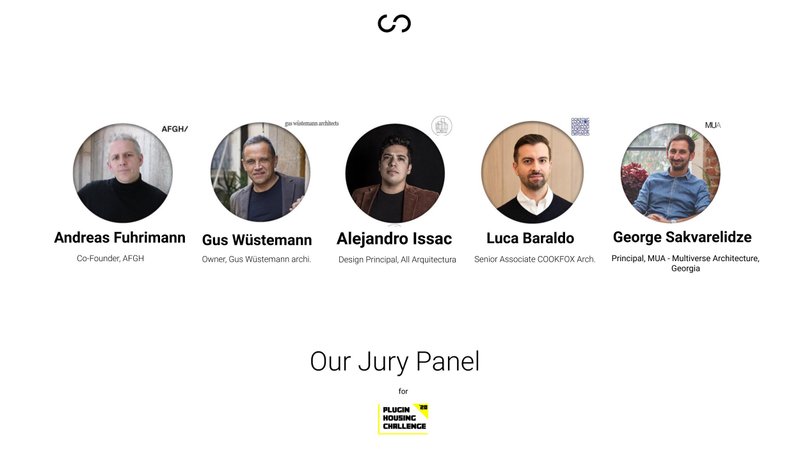
The jury for the competition consisted of esteemed designers, professionals and academicians from around the world. The Lead Jurors for the competitions were as follows:
Gus Wüstemann, Owner, Gus wüstemann architects, Switzerland
Alejandro Isaac Guardado Martínez, Design Principal, ALL ARQUITECTURA, Mexico
George Sakvarelidze, Principal, MUA - Multiverse Architecture, Georgia
Luca Baraldo, Senior Associate, COOKFOX Architects, United States
Andreas Fuhrimann, Co-founder, Andreas Fuhrimann Gabrielle Hächler Architects, Switzerland
"Some of the Best of competition projects are:"
Winning Project: Serendipity
By: Amirhossein Zarei & Rana Zarei 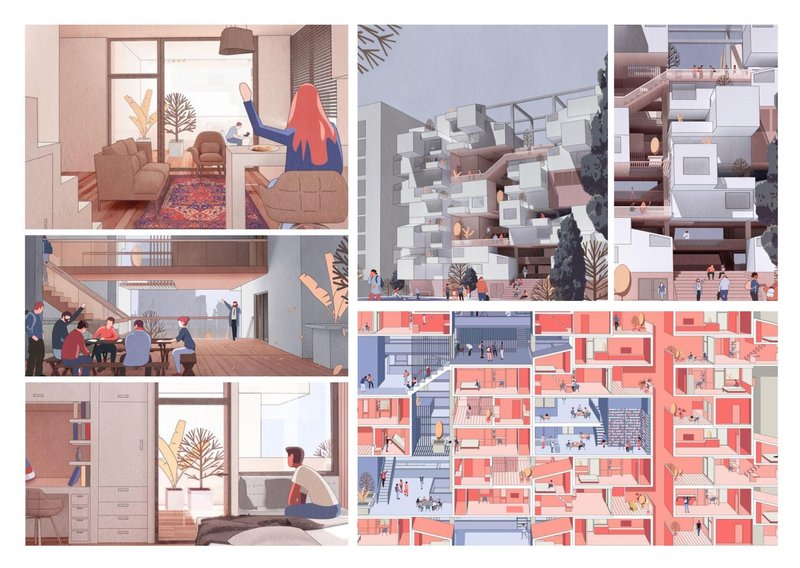
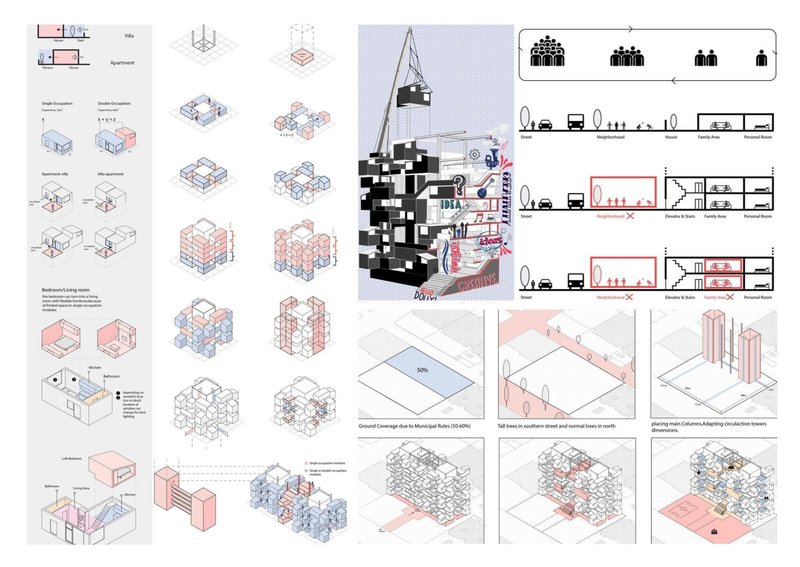
Description: Every house must answer all fundamental needs of a human. Before overgrowing cities and residential towers, houses were connected to the street with smaller streets giving the dwellers an opportunity to interact with people of the neighbourhood. today apartments connect units by stairs and elevators which are in lack Serendipity. When it comes to terms of designing micro houses, it is usual that because of lacking space the areas that are supposed to go under the category of Others such as spaces for micro-scale social interaction will be diminished. Referencing so many unsuccessful capsule housings which are inhabitable lacking the high qualities of living, we are designing plugin housing with consideration of revival of In-Between spaces.
-----------------
Runner-Up: ALTERNATE HOME
By: Yufeng Zheng, Rowan Sosa, Stephany Coleman, Rory Nash & Israel Barrera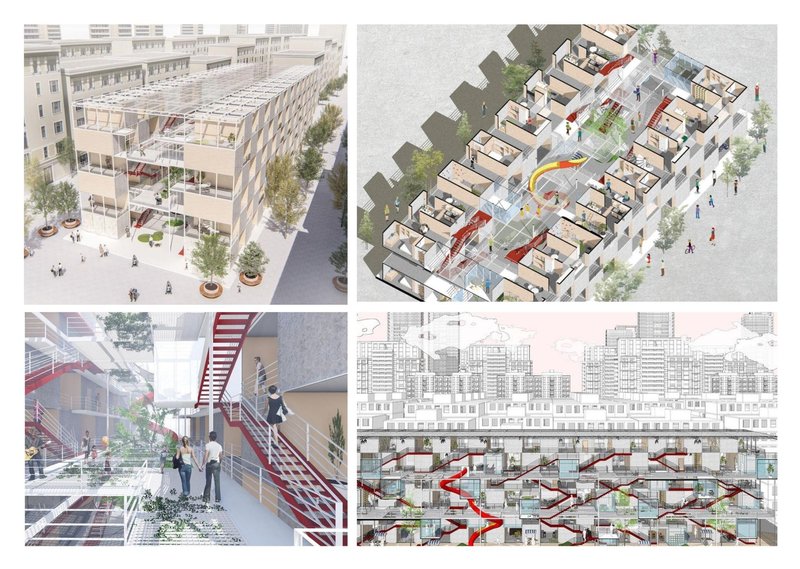
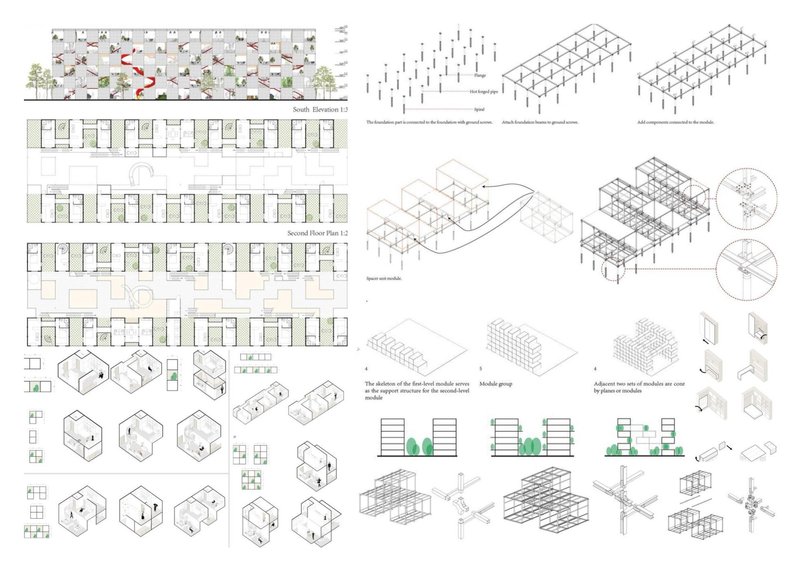
Description: We hope to design a new prefabricated module to propose a solution to inferior daylight, ventilation and sanitation for low-rent Communities. Alternate overlapped modules can save half the amount of materials, thereby reducing construction costs and making it affordable for low-income people. Variable units can be inhabited by different owners alternatively. The Nanotube community was originally a demolition and resettlement housing. Because it is located in the centre of the city, Nanyaotou has attracted a large number of young office workers to live here with its low rent. The community has a rich and dynamic business format. It is called "Nanyao International ''. However, due to the increase in the number of occupants and illegal construction, the Daylighting and ventilation of the residence is damaged, and the quality of the public space in the community is deteriorating. We hope to design a new prefabricated module to propose a Solution.
People’s Choice: OUD'LAJAN RESIDENTIAL COMPLEX
By: Kurosh Mohammadi, Mohammadd Ali Izadi, Ali Zahaki & Sara Maleki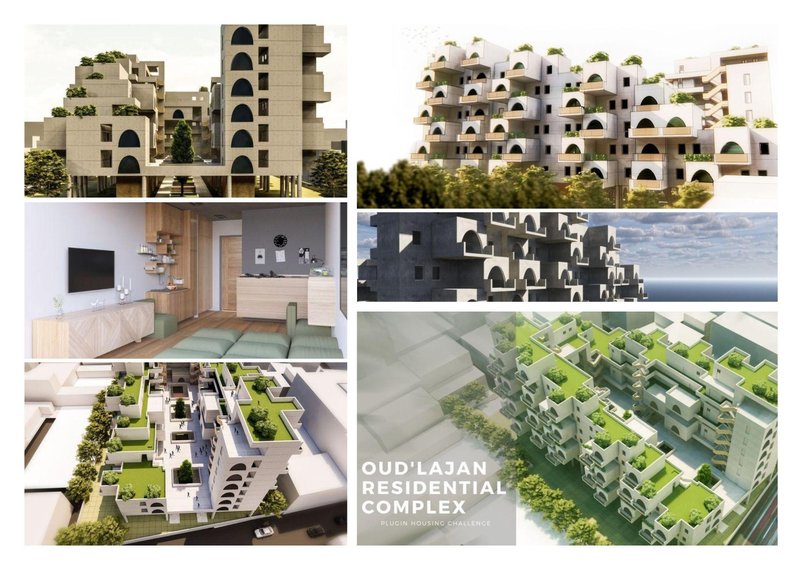
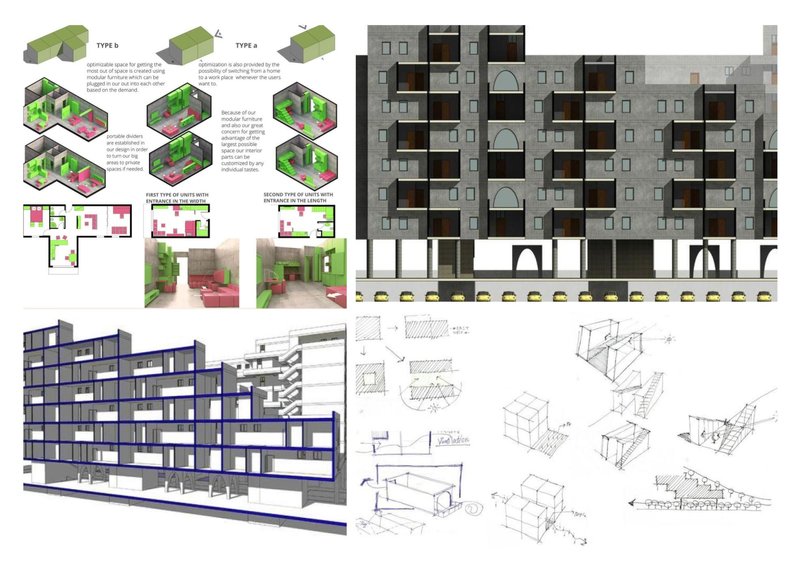
Description: This project focuses on creating prefabricated compact and modular houses which can be affordable to the greatest number of people. Not only providing all the basic needs in the best way possible but also devoting the whole concentration to the enhancement of common and private areas by taking sustainability, customization and optimization into account. Designing the main modules by combining which we can achieve both of the different required dimensions of units (single and double occupancies) started with the calculation of the most possible efficient area of the modules. It has led us to a 14-square meter module that by plugging two of them we can reach the 28-square-meter single occupancy and by just plugging 5 of them together the double occupancy with a carpet area of the 70 square meters will be created.
-----------------
Honorable Mention: Residual spaces
By: Javier Burgos & Amadis Sanchez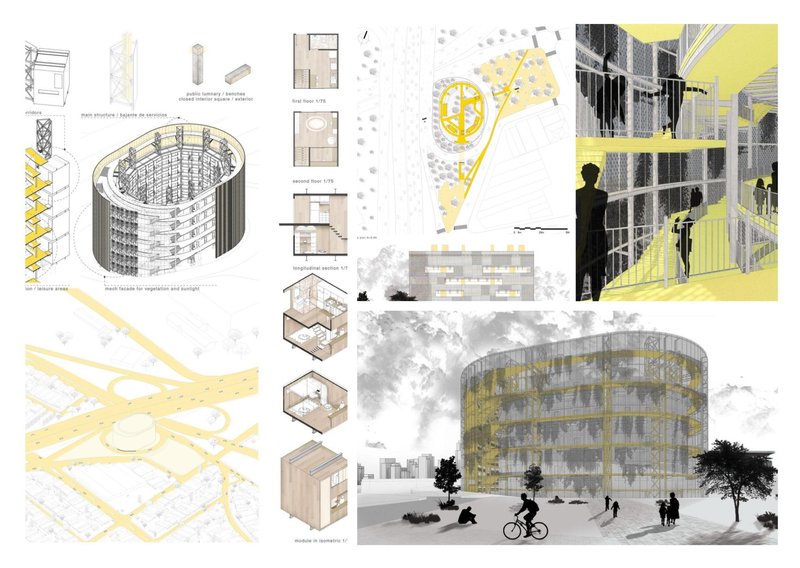
Description: The project proposal is about the appropriation of the residual spaces that are currently the result of the existing turns between the crossings of two avenues. A geometric adaptation in the implantation space will allow the building to be adapted to different terrain cases. Because of the densification of cities, new problems appear, such as mobility through urban highways and the residual spaces they leave. These unused spaces have a low land value due to the complicated communication they have with the rest of the city, noise pollution and the surrounding urban landscape.
------------------------
Honourable Mention: New Babylon II
By: Jiajie Wang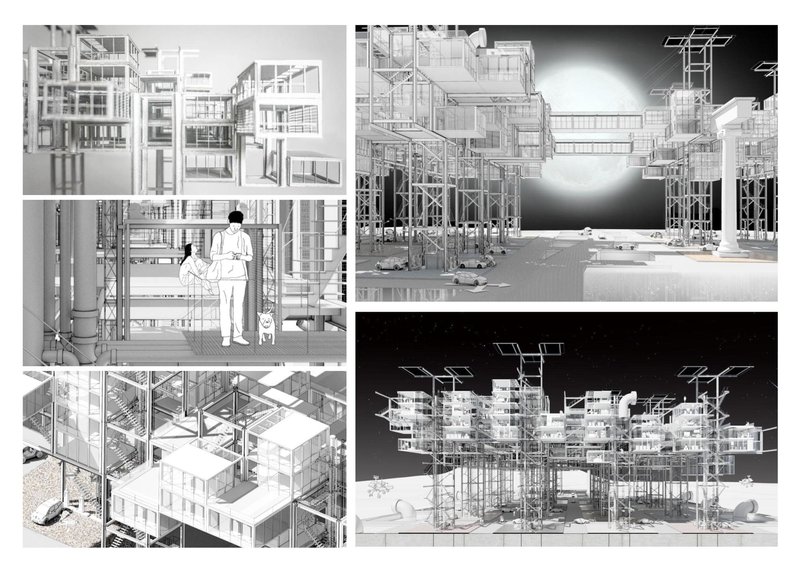
Description: New Babylon II aims to develop a highly circuitry plugin housing network of a miniature and autonomous city with machine tectonics. It discusses a technological utopia of how human beings, ecology and technology can come together to reject the housing shortage and social inequality.
---------------------
Honorable Mention: OCTA-TOWER
By: Weston Hanisch, Josh Weinand, Emma Young & Charlotte Wortmann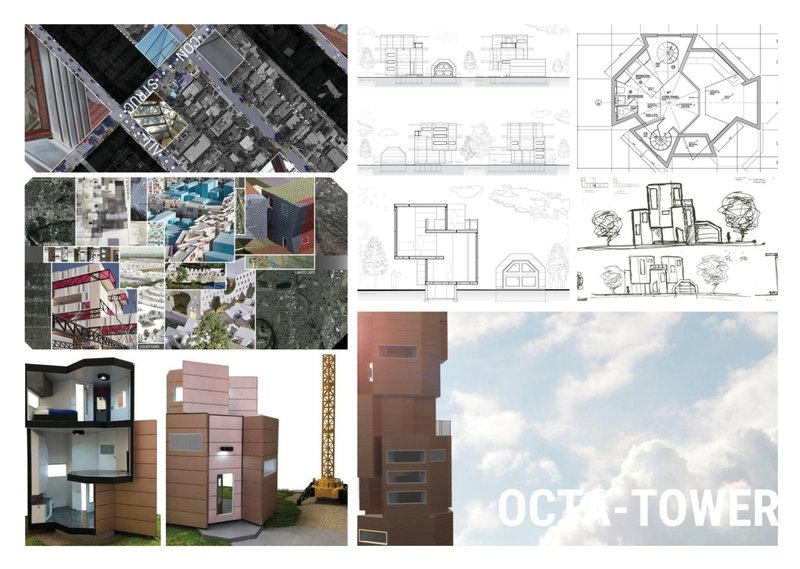
Description: Our proposal focuses on the prevention of expiration in architecture. Through the arrangement of modular slices, we have created dwelling units that can be updated or replaced individually throughout time. These units can be connected and stacked to adapt and grow into a large structure. We have fully designed one unit in detail to represent our proposal. The concept behind our design is the prevention of expiration. Through the use of modulated slices, units are formed. These slices can be removed and updated or replaced to adapt to the desired use of the dwelling. Updating these modules allows for customization unlike housing options in the contemporary world and also allows the dwelling to evolve over time, preventing expiration. The use of materials, as well as the construction methods, create a design that outlives the resident.
------------------------
Honourable Mention: HAH - Hexagonal Affordable Housing
By: Andrea Wan, Anurag Jadhav, Katelyn Anderson & William Ingram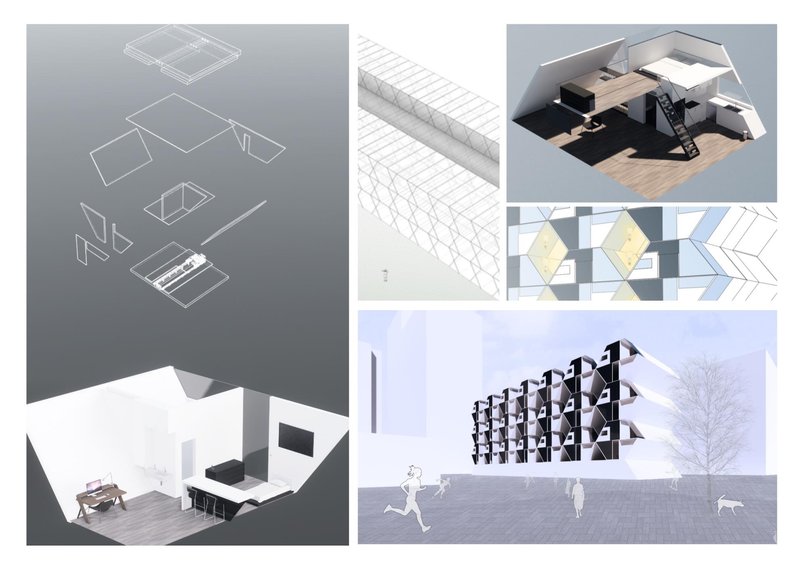
Description: Abbreviated as HAH for 'hexagonal affordable housing', the design is for a mid-rise residential building comprised of 84 trapezoidal housing cells that are attached to a structural grid and slide in and out, much like drawers in a dresser. It explores various lighting concepts and the Japanese shin chan Taisha movement through a modern, technological lens.
--------------
Honourable Mention: Monsoon
By: Yen-Tzu Chang, Meng-Chin Lu, Yu-Heng Ding & Chao Lin Cheng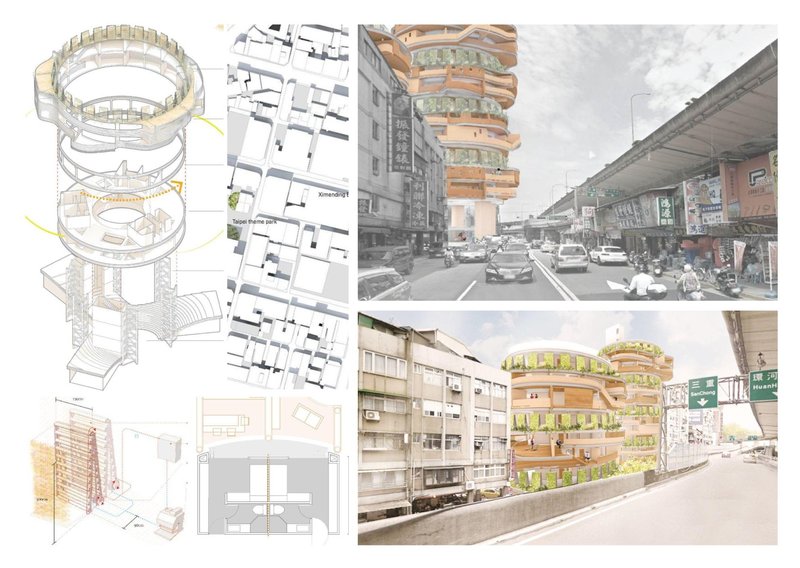
Description: The traditional housing type can't fulfil people's needs with a diversified lifestyle. As a result, we propose a concept, "Dynamics Social Infrastructure." It means that besides the basic necessary space in every living unit, there will be dynamic share space attached outside the basic living unit. So that we can create a multi-function housing in constraints.
--------------------
Honourable Mention: Innovation of Kunming steel
By: Wingkei Zuo & Jihong Xiang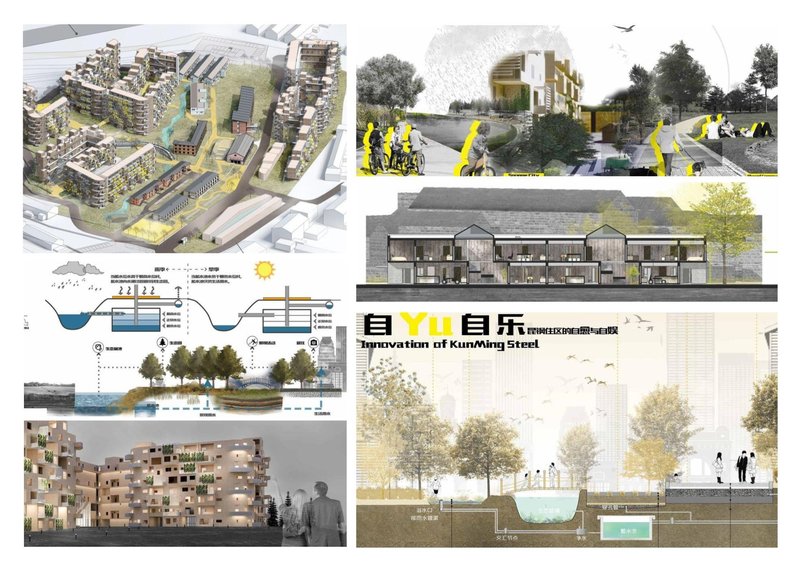
Description: Our design is the renovation and ecological planning of the old industrial plant, with the aim of creating a green life, connecting the community with the outside world and renewing the vitality of the old residential area.
------------------------------------
Institutional Excellence Award: TERRAZAS
By: Santiago Zendejas Urquiza & Alejandro Emiliano Domínguez Yáñez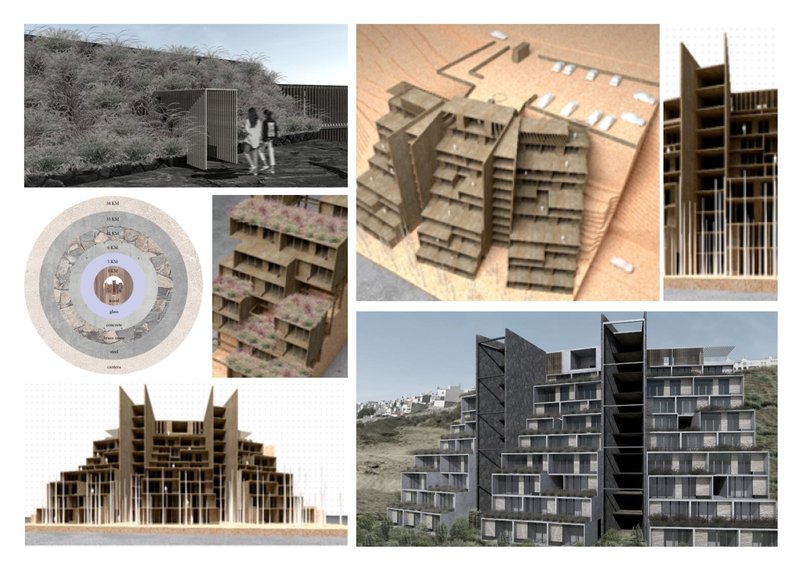
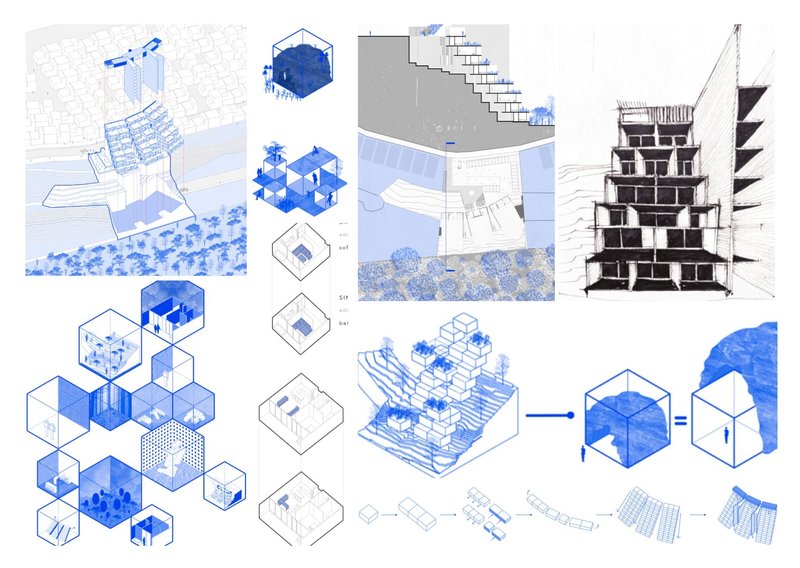
Description: Humanity needs to rethink to inhabit, what is needed for a good-dwelling? Will a large space be necessary to enjoy a home? Over time, the world was adding spaces to the house that met needs that were no longer basic. Our project seeks to return the essence of living, provide men with comfort and respond to their needs, always in connection with nature. Since the beginning of time, having shelter, a home, has been a basic need for men. At first the homo-sapiens lived in caves. Since those times to the present, the house has served us as a protective barrier that disconnects us from the exterior: from storms, rains and winds, to traffic, noise and movement.
------------------
Institutional Excellence Award: HEXAQUA
By: Onuralp Zengin & İldem Çınar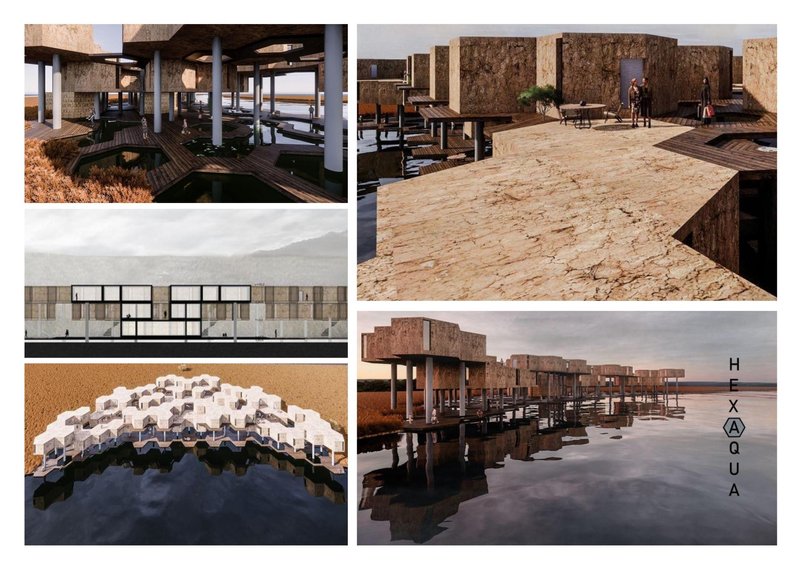
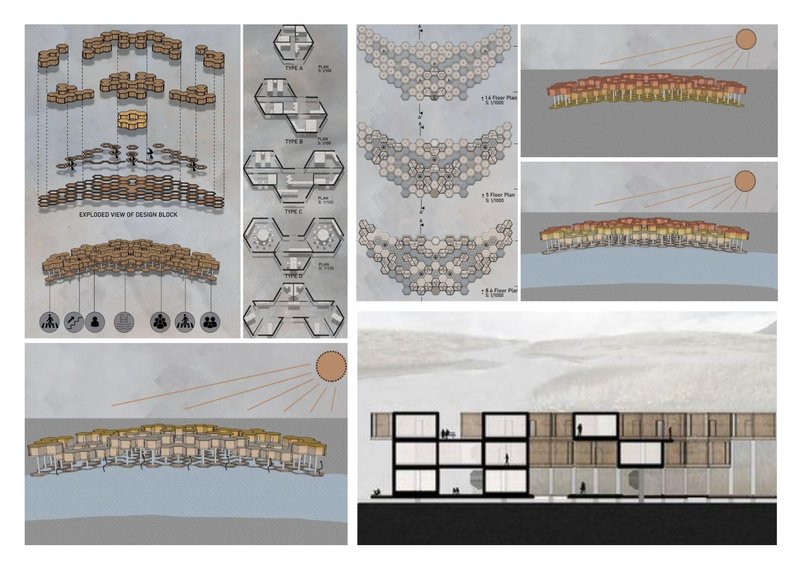
Description: The Hexaqua is a design complex that offers a better life to the refugees and seasonal agricultural workers who have to stay in poor and inadequate conditions, with hexagons that are best surround the region and intense water contact in and where the human population is the highest. Our project is aimed, the people who have suffered from intensive urbanization and who have been unemployed have to do seasonal agricultural labour; for poor and refugee people whose housing, cleaning and food needs are failing. We wanted to create a better shelter and living space than tents. In addition, we have added training areas to our design block so that people can get training and find jobs. We have also added health fields to combat diseases. We made our design to the Şanlıurfa region, where our target group is most abundant.
--------------------
Discover the full results here: https://uni.xyz/competitions/plugin-housing-challenge/entries
Discover the design brief here: https://uni.xyz/competitions/plugin-housing-challenge/info/about
Follow us on social media: Facebook | Instagram | LinkedIn | Twitter | Youtube
Discover other design competitions to participate here: https://uni.xyz/competitions