
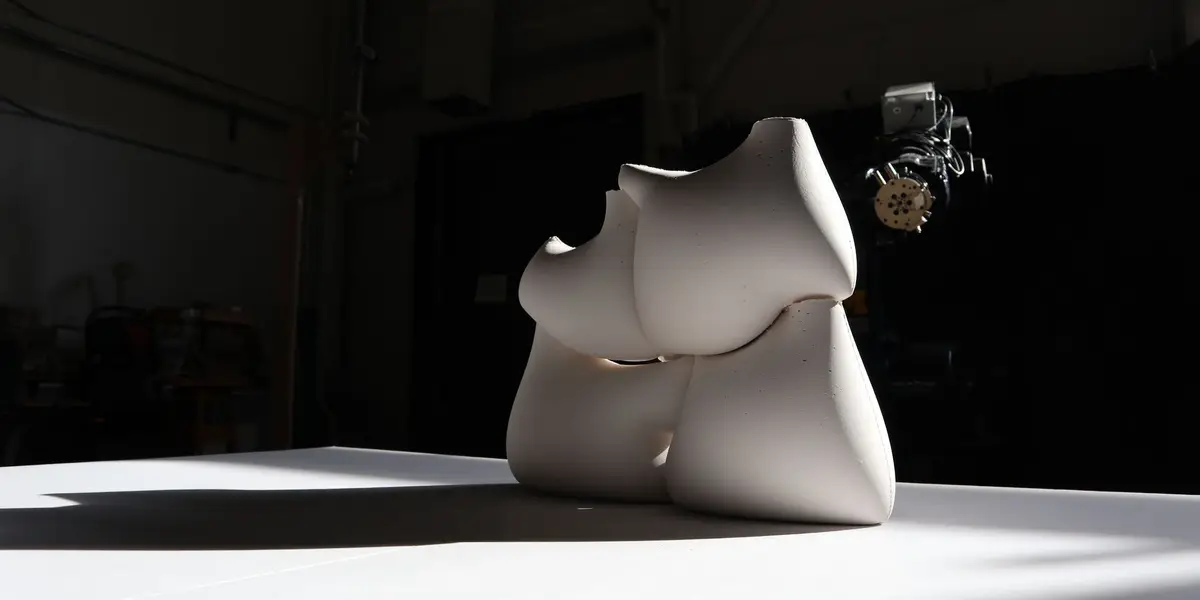
Precise Imprecision: Where Robotic Arms Meet Fabric Molds
A hybrid fabrication method using KUKA robots and stack-cast fabric formwork to challenge what precision means in architecture.


What happens when you hand a KUKA industrial robot a piece of fabric and ask it to be imprecise? You get architecture that is simultaneously controlled and unpredictable, a construction logic where soft materials absorb the rigidity of computation and return something richer than either discipline could produce alone. Precise Imprecision proposes a robotic fabrication workflow built around stack casting with fabric molds, producing complex geometries that no conventional formwork could achieve with the same material economy.
Designed by Yi-Liang Ko and Ester Lo, the project received a Special Mention in the Tactile competition on uni.xyz and a Citation Entry in Architecture on the Clock. The work sits at the intersection of computational design, robotics, and material craft, arguing that the most productive territory in digital fabrication is the zone where automated precision deliberately yields to material behavior.
From Robot to Sewing Table: A Fabrication Chain in Four Steps
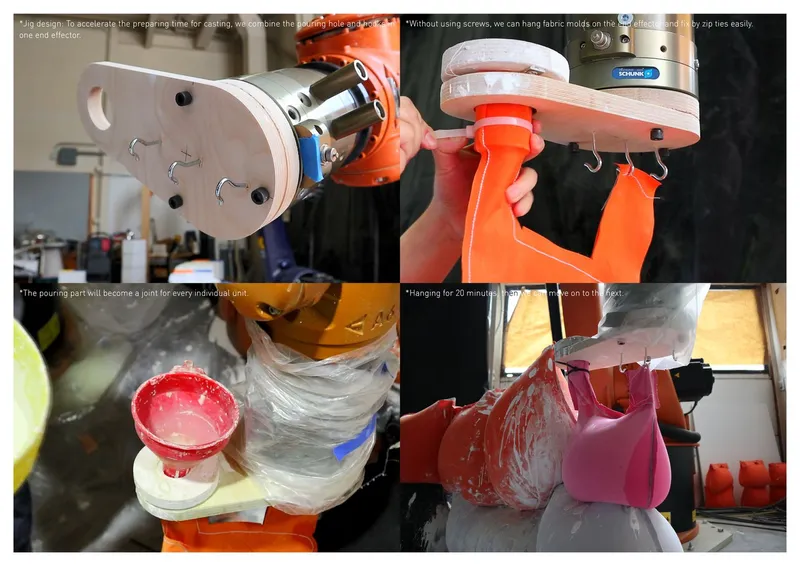
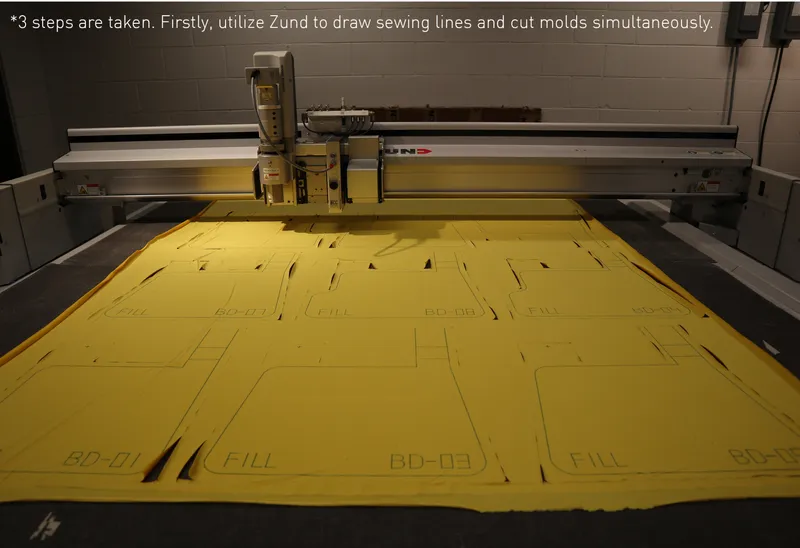
The process begins with a KUKA robotic arm outfitted with a circular metal plate and pneumatic tooling, calibrated to handle fabric molds with mechanical consistency. Alongside the robot, a CNC cutting machine scores pattern lines into foam sheets, generating the precise two-dimensional templates from which three-dimensional fabric forms will emerge. The juxtaposition of these two machines sets the tone for the entire project: heavy industrial hardware enlisted in service of a decidedly soft material system.
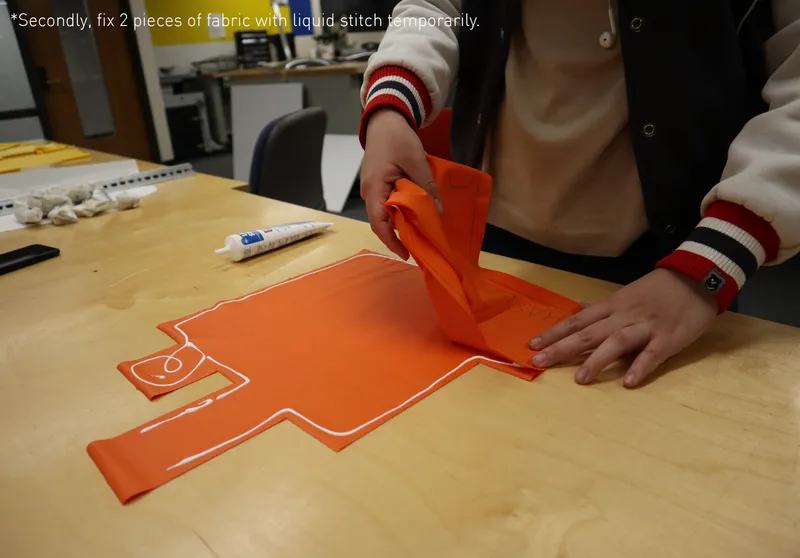
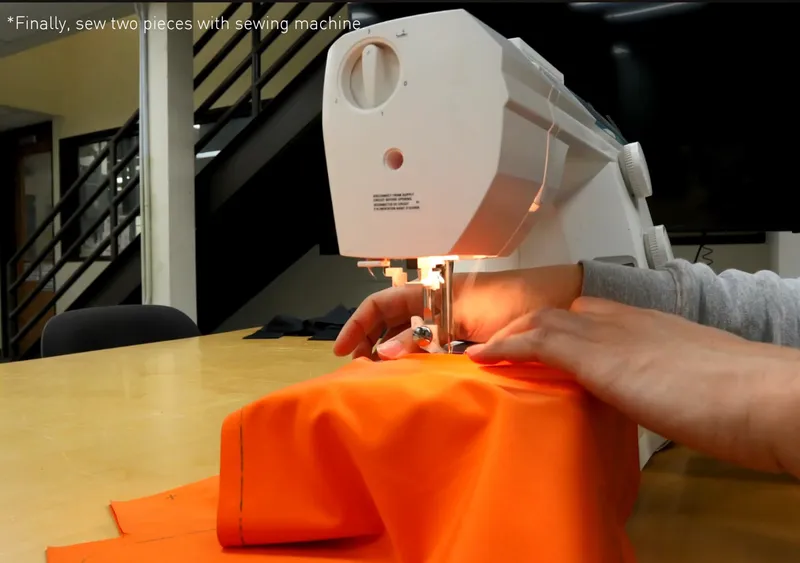
The digital chain then hands off to human hands. Liquid adhesive is applied to orange fabric pattern pieces on a wooden worktable, and a sewing machine stitches the components into volumetric enclosures. This is where the "imprecision" enters the process with intent: fabric stretches, adhesive bleeds slightly, seams gather in ways that no parametric model fully predicts. Rather than treating these deviations as errors, Ko and Lo frame them as generative, a designed looseness that gives each module its own character while remaining structurally coherent within the larger assembly.
Inflatable Modules as Architectural Units
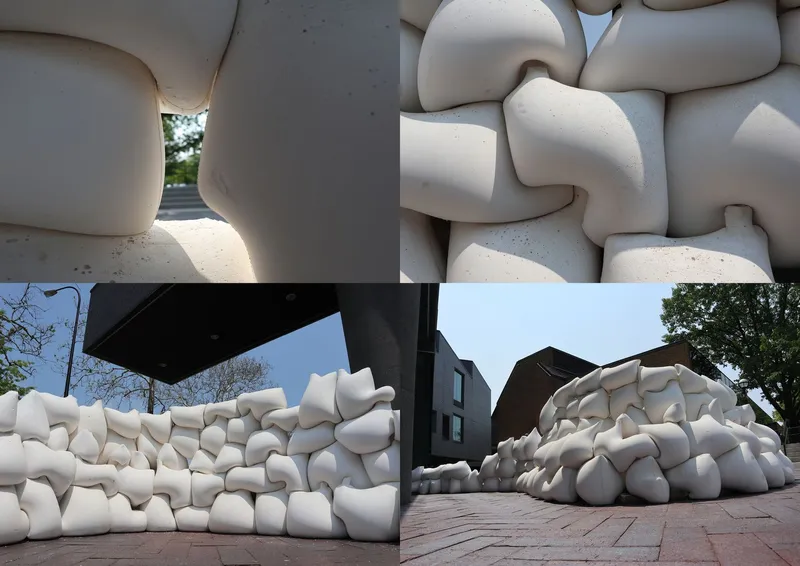

Once sewn and sealed, the fabric forms become inflatable pillow modules that can be stacked, arrayed, and configured into spatial installations. A serpentine wall of white inflatable units occupies an outdoor courtyard, demonstrating how the soft geometries negotiate with hard ground surfaces and open air. The assembly sequence reveals multicolored modules being positioned by robotic arms on a workshop floor, each unit locking into its neighbor through form-fit edge conditions that the stack casting technique produces. No mechanical fasteners, no adhesive joints between modules: the geometry itself provides the connection logic.
From Physical Model to Full-Scale Occupation

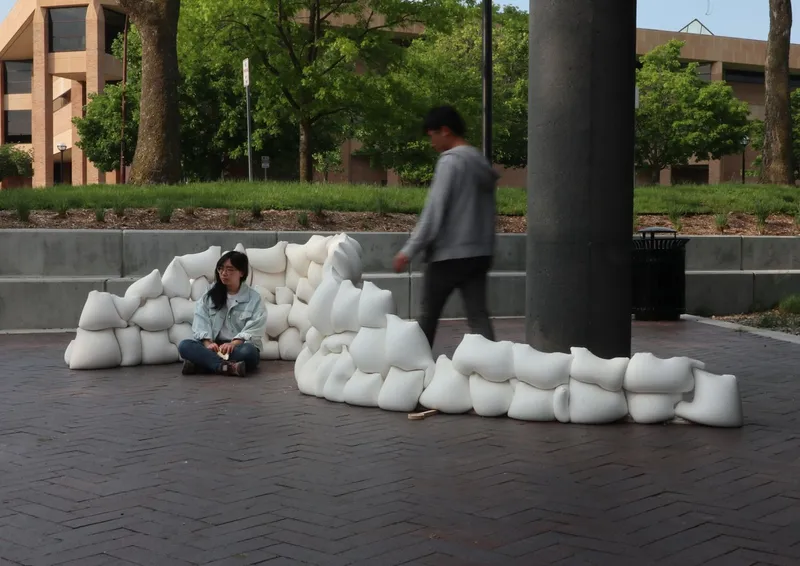
A layered white paperboard model captures the volumetric stacking logic in miniature, displayed alongside construction photographs of the colored inflatable modules at working scale. The model makes legible what the full-scale installation sometimes obscures: that each layer's geometry is slightly different, calibrated so that the stack produces curvature and cantilever without any internal structure. At full scale, the white modular seating installation lands on brick pavers, occupied casually by passersby. Two figures and a row of trees provide the scale reference that confirms these modules are furniture-sized, not building-sized, but the fabrication logic is explicitly scalable.
Public Space as Testing Ground
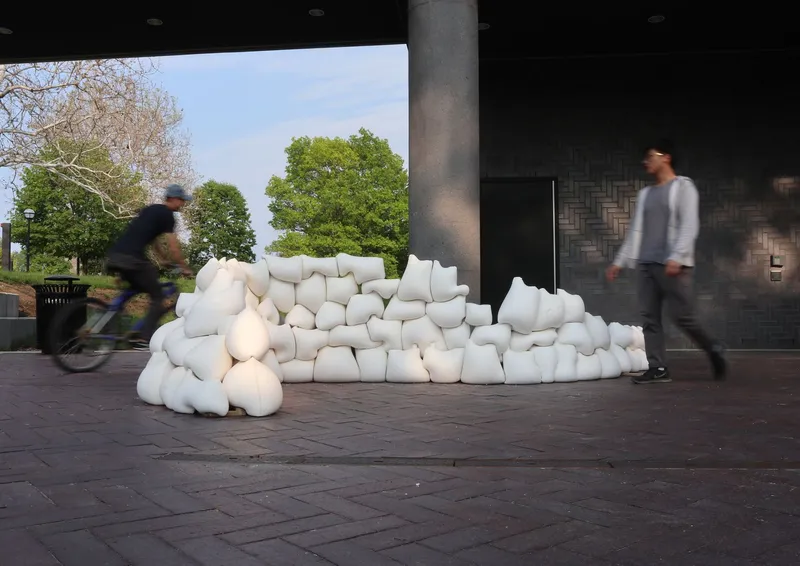

Beneath a covered pavilion with a concrete column, a cyclist and a pedestrian pass the white inflatable seating without breaking stride. The installation reads as urban furniture, approachable and unintimidating, which is precisely the point. An overhead view reveals someone lying across the curved bench, their body confirming that the soft geometry of the modules accommodates a range of postures the designers never explicitly programmed. The fabric formwork absorbed human variability at the fabrication stage, and the resulting forms return the favor at the occupation stage.
Why This Project Matters
Digital fabrication in architecture has spent the last two decades chasing ever-tighter tolerances, treating precision as an end in itself. Precise Imprecision makes a compelling counterargument: that the most interesting design space lies in the controlled relaxation of precision, where robotic consistency and material softness produce outcomes that neither could generate independently. The stack casting fabric mold technique is not a workaround for the limitations of rigid formwork. It is a fundamentally different material logic, one that treats flexibility as a structural asset.
Ko and Lo demonstrate a hybrid fabrication workflow that refuses to choose between automation and craft. The KUKA robot cuts and positions; human hands sew and glue; inflatable modules self-organize through form-fit geometry. Each step in the chain contributes a different kind of intelligence to the final assembly. For a field increasingly anxious about the role of the human hand in a robotic future, this project offers a practical and poetic resolution: the robot and the sewing machine are not competitors. They are collaborators.
View the Full Project
About the Designers
Designers: Yi-Liang Ko, Ester Lo
Enter a Design Competition on uni.xyz
uni.xyz runs architecture and design competitions year-round that reward proposals with spatial conviction and real site intelligence.
Project credits: Precise Imprecision by Yi-Liang Ko, Ester Lo Tactile (uni.xyz).


Popular Articles
Popular articles from the community


FCC Arquitectura Expands a Portuguese Granite House with a Board-Marked Concrete Wing
In Portugal, JV House pairs a cleaned-up whitewashed and granite dwelling with a timber-shuttered concrete extension, courtyards and a garden pool.


Singing Woman: An Opera House That Performs Before the Curtain Rises
Ovidiu Cristian Pavel's conceptual opera house translates Estonia's choral identity into a sculpted waterfront landmark facing the Baltic Sea.

David Ortega Stacks a Two-Story Mexico City Penthouse Around a Steel Stair and a Pergola-Shaded Roof Terrace
In Colonia Roma, a 300 m² penthouse uses oak joinery, a planted steel stair and a slatted roof pergola to make a new-build apartment feel like a house.

Opera on the Sea: Driftwood Logic Shapes a Timber Opera House on Estonia's Coast
Trevor Orgill's opera house translates the entangled drift of floating timber into a civic building where wood, water, and music converge.

Similar Reads
You might also enjoy these articles

Vereda Arquitetos Renovates a 40-Square-Meter Apartment Inside Niemeyer's Copan Building
A compact unit in São Paulo's most iconic residential tower gets a material overhaul that pairs exposed concrete with bold blue Formica.

Shakur's House: Exposed Brick as an Interior Organiser in a 168 m² Mashhad Residence
Brick moves indoors in this Mashhad residence, where masonry walls, glass partitions and teal planes sequence a compact home without closing it off.

Day and Night Park: A Time-Based Urban Newsstand in Beijing
A temporary urban newsstand in Beijing blending travel, light, and reading through poetic colors, compact form, and community-focused design.

Modernist Patio Renovation in El Masnou, Barcelona by Oliver Segura Arquitectura + Cebrià Arquitectura
Modernist patio renovation blending tradition and innovation with a movable pool, leveled floors, and Catalan materials in El Masnou.

Explore Robotic Fabrication Competitions
Discover active competitions in this discipline

Challenge to design a portable theatre

Challenge to design a portable music platform

Challenge to design an open learning module for the elderly
Comments (0)
Please login or sign up to add comments
No comments yet. Be the first to comment!