

Pulse: A Sculptural Bench That Turns Strangers Into Neighbors
Danielle Aspitz's wave-form seating structure brings spontaneous social encounters back to the urban streetscape.


A bench should never be just a bench. At its best, a piece of street furniture can recalibrate the social dynamics of an entire block, turning a stretch of sidewalk into a site of exchange, rest, and unplanned encounter. Pulse, a bold red-and-white sculptural seating installation, does exactly that: it takes the most mundane element of public infrastructure and reimagines it as a catalyst for human connection.
Designed by Danielle Aspitz, Pulse was developed for the Market Street Prototyping Festival, where designers are invited to test new models of urban furniture directly on the streets. The structure's continuous, ribbon-like form draws from the flowing curves of the human body and the ceaseless rhythm of city life, producing a piece that reads as public art, functional seating, and social experiment all at once.
One Continuous Curve, Multiple Ways to Sit
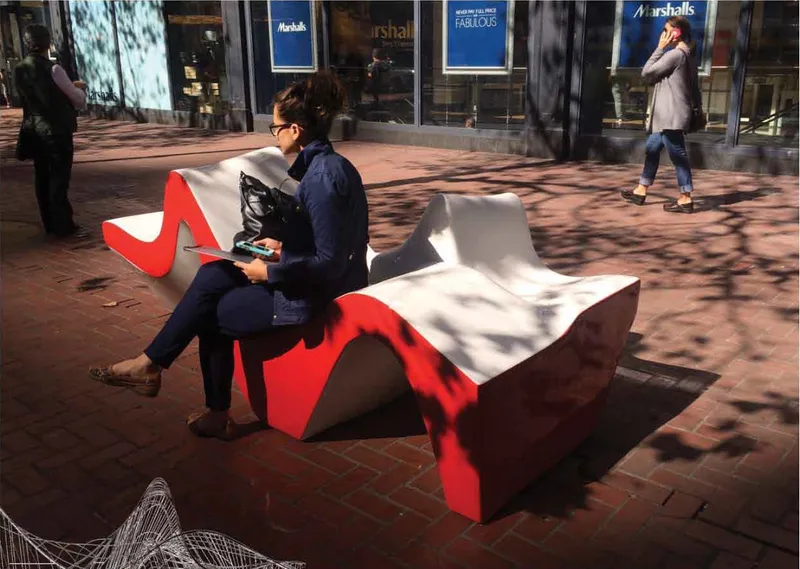
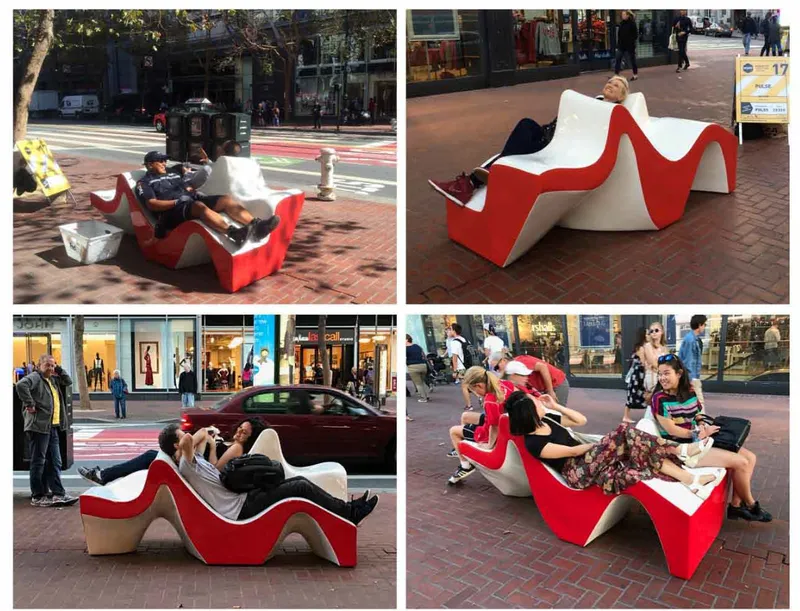
The first thing you notice is the form: an undulating wave of red and white that rises, dips, and curves back on itself, creating a series of subtly defined seats without hard divisions. There are no armrests marking off individual territories, no rigid backs enforcing a single posture. Instead, the sculptural surface accommodates sitting upright, reclining, lounging, and stretching, all within a single continuous structure. The result is a piece that can host a solo reader, a group of friends, or a cluster of strangers, each finding their own comfortable posture while remaining visually and physically linked to everyone else on the bench.
This is the critical design insight: the interconnected curves encourage proximity without forcing it. Each occupant has a sense of personal space, yet the flowing geometry gently pulls people into shared territory. It is a physical manifestation of how healthy public spaces actually work, offering just enough closeness to make spontaneous conversation possible and just enough separation to let solitude feel natural.
From Laminated Foam to Street-Ready Sculpture
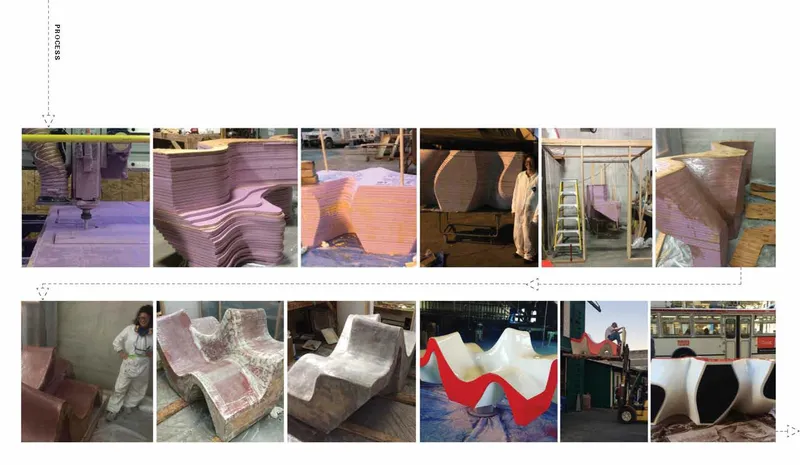
The fabrication process behind Pulse is as deliberate as its social ambitions. A contact sheet of workshop images reveals layers of material being sculpted, refined, and finished by hand: laminated foam shaped into the undulating profile, then sanded smooth and painted to achieve the glossy, tactile surface that invites touch. Every stage, from digital modeling to full-scale fabrication, was oriented toward producing a structure that could endure outdoor urban use while retaining the sensory qualities of a gallery-grade sculpture. The smooth finish is not merely cosmetic; it signals approachability. People are far more likely to sit on, lean against, and engage with a surface that feels deliberately crafted rather than industrially extruded.
Children Recline, Adults Linger
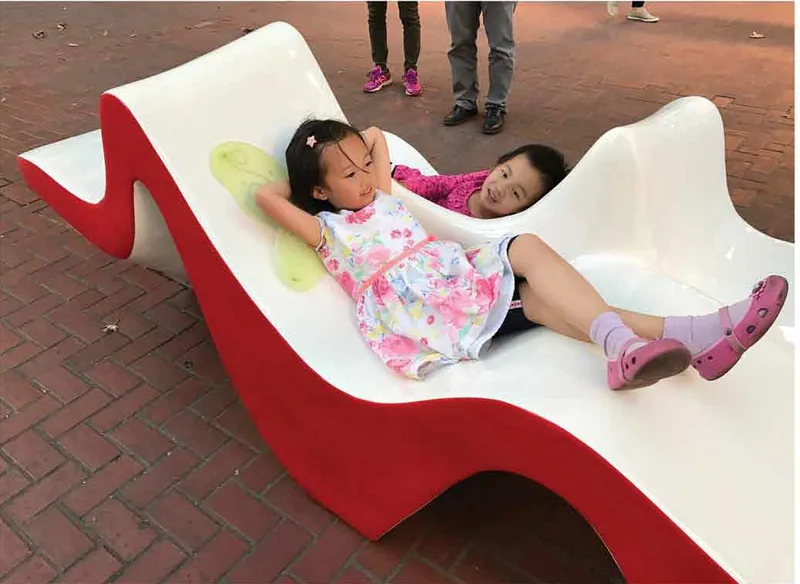
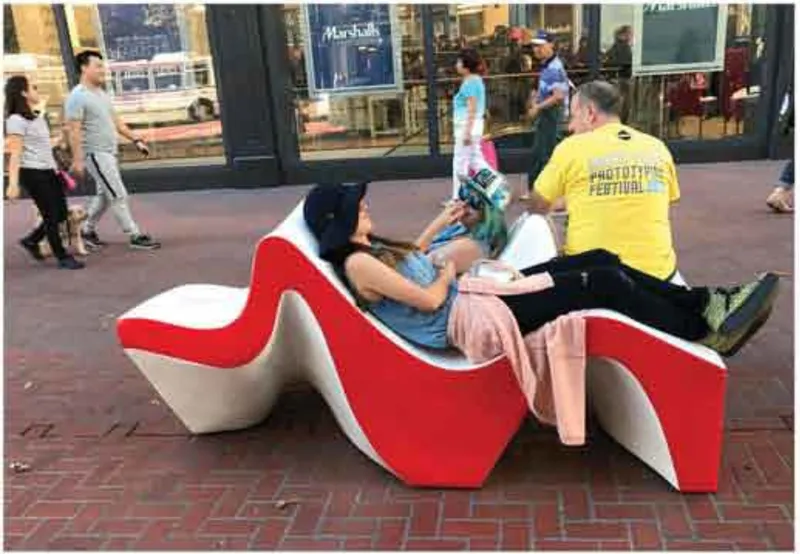
The real test of any piece of public furniture is how people actually use it, and Pulse passes convincingly. Two children sprawl across the white crest of the wave, their bodies relaxed in postures no conventional bench could accommodate. Nearby, adults sit reading beside retail storefronts, the sinuous form framing them as participants in a shared urban scene rather than isolated commuters killing time. The structure blurs the boundary between playground, art installation, and seating, inviting playful engagement from kids and comfortable rest for adults in a single gesture.
What emerges on the street is something closer to a micro-landscape than a bench. The varied heights and angles of the wave create distinct zones of activity along a single continuous surface, so that a child stretching out at one end and a couple chatting at the other are both using the piece exactly as intended. The modular logic means the form could, in theory, extend or repeat to fill larger plazas, scaling the social effect along with the physical footprint.
Why This Project Matters
In an era when public space design often defaults to hostile architecture, anti-loitering armrests, and surfaces engineered to repel rather than welcome, Pulse stands as a counter-argument. It demonstrates that even the smallest element of the streetscape, a bench, can be designed as social infrastructure: a place that fosters inclusivity, encourages face-to-face encounters, and gives people a reason to pause rather than pass through.
Danielle Aspitz's project is a reminder that architecture does not need to be monumental to be transformative. A single sculptural form on a brick plaza can redefine how strangers relate to one another, how children experience a city block, and how a street becomes a place of belonging. Pulse reaffirms a simple, powerful idea: the most radical thing a piece of urban furniture can do is make people want to stay.
View the Full Project
About the Designers
Designer: Danielle Aspitz
Enter a Design Competition on uni.xyz
uni.xyz runs architecture and design competitions year-round that reward proposals with spatial conviction and real site intelligence.
Project credits: Pulse social seating structure by Danielle Aspitz.


Popular Articles
Popular articles from the community


LT2A and OPEN Architectes Thread a Brick and Glass High School Through a Wooded Belgian Campus
In Braine-l'Alleud, a 3,000 m² wing for Collège Cardinal Mercier pairs pale brick with a glazed colonnade, deferring to a small chapel and a dense wood.

Cube Design Draws an Ecological Corridor Between Two Shenzhen Hills with the Nankai Building
Beside Shenzhen's container docks, the Nankai Building pairs stacked balconies with a climbing green screen to connect two hillsides across its height.

longwave studio Reorganizes a 112 m² Tainan Apartment Around the Daily Routines of a Family and Two Cats
In Tainan, Taiwan, birch plywood, rust-red furniture and a freestanding plaster wall link arrival, storage, work and family life in one apartment.

U.GA Architects Wraps an Oval Rooftop Pool in Curved Board-Formed Concrete on Busan's Jeollidan-gil
In Busan's Jeonpo-dong, a 454 m² mixed-use block stacks a neighborhood facility, guest rooms and an oval rooftop pool inside spiraling concrete walls.

Similar Reads
You might also enjoy these articles

Gil Mello Arquitetura Tilts a Single Roof Toward the Waterfalls on a Plateau Above Aiuruoca, Brazil
In Aiuruoca, Minas Gerais, a 200 m² house of local labor and reclaimed poles pairs a low valley veranda with a tall mountain one.
U.GA Architects Wraps an Oval Rooftop Pool in Curved Board-Formed Concrete on Busan's Jeollidan-gil
In Busan's Jeonpo-dong, a 454 m² mixed-use block stacks a neighborhood facility, guest rooms and an oval rooftop pool inside spiraling concrete walls.

Felipe Hess Arquitetos Turns a Blind Stone Wall to the Street and Opens a Brazilian House onto a Courtyard and Canal
A canal-front house in Brazil hides behind painted stone and planting, then opens to an olive-tree courtyard, a reed-ceilinged porch and a curving pool.

David Macias Steps a Doorless Stone and Plaster House Down a Tropical Colombian Hillside
In the humid hills of Colombia, Threshold House replaces the front door with an open void and terraces its 850 m² down the slope instead of fighting it.

Explore Flexible Seating Competitions
Discover active competitions in this discipline

Design challenge to equip cities with modern furniture

Competition to design a workstation for architects

Packaging challenge - Design meets sustainability
Comments (0)
Please login or sign up to add comments
No comments yet. Be the first to comment!