

RainFlow Tower: A Skyscraper That Harvests Singapore's Rain as Its Lifeblood
A biomimetic tower near Marina Bay channels tropical rainfall through its entire structure, merging water self-sufficiency with vertical urbanism.


What if a skyscraper could drink? RainFlow Tower treats tropical downpours not as drainage problems but as the building's primary resource, routing collected rainfall through every floor, cooling facades on the way down, and storing surplus in a massive reservoir that doubles as a structural damper. It is a closed-loop hydrological machine disguised as a mixed-use tower, and it lands in precisely the city that needs it most.
Designed by 대찬 김, 문규 배, SH C, and 원, RainFlow Tower is a winner entry of Alter. Sited near Marina Bay in Singapore, the project responds to a ticking clock: the nation's water agreement with Malaysia expires in 2061, intensifying pressure on a city-state already pursuing radical water self-sufficiency. The designers propose that architecture itself can become infrastructure, absorbing, filtering, and redistributing rainwater at the scale of a supertall building.
Petal Roofs and Flowing Facades
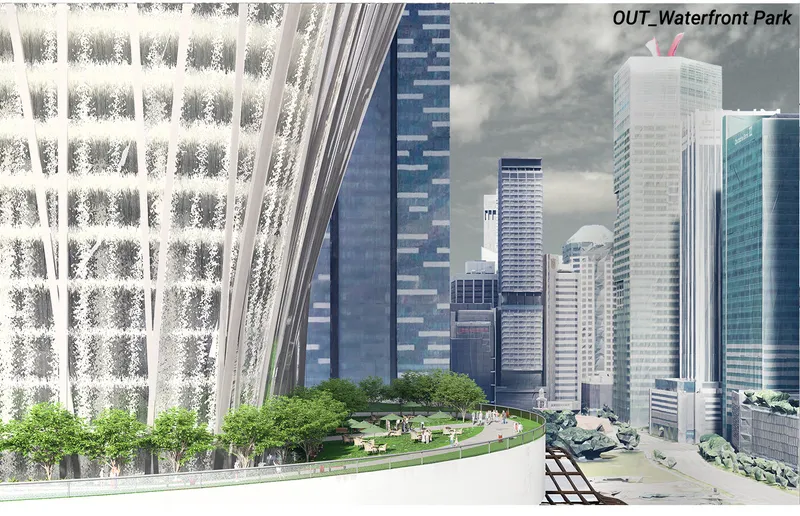

The tower's crown is shaped like a set of curved petals that funnel rainfall toward a central collection point, an overtly biomimetic gesture that also reads as a convincing piece of tropical skyline. Below, planted roof terraces with mature trees and garden beds cascade outward, offering residents and visitors elevated green space overlooking Singapore's dense high-rise fabric. The rooftop is not ornamental; it is the first stage of the water cycle that defines the entire building.
Inside, the atrium reveals where all that water ends up. A sculptural glass tank is suspended above ground-level seating areas, visible through multilevel balconies that wrap the interior void. The tank is both spectacle and system: it stores filtered rainwater while serving as the visual centerpiece of communal life. Visitors seated beneath it experience water not as hidden plumbing but as an architectural event, a constant reminder of the building's metabolic logic.
A Cluster of Transparent Towers
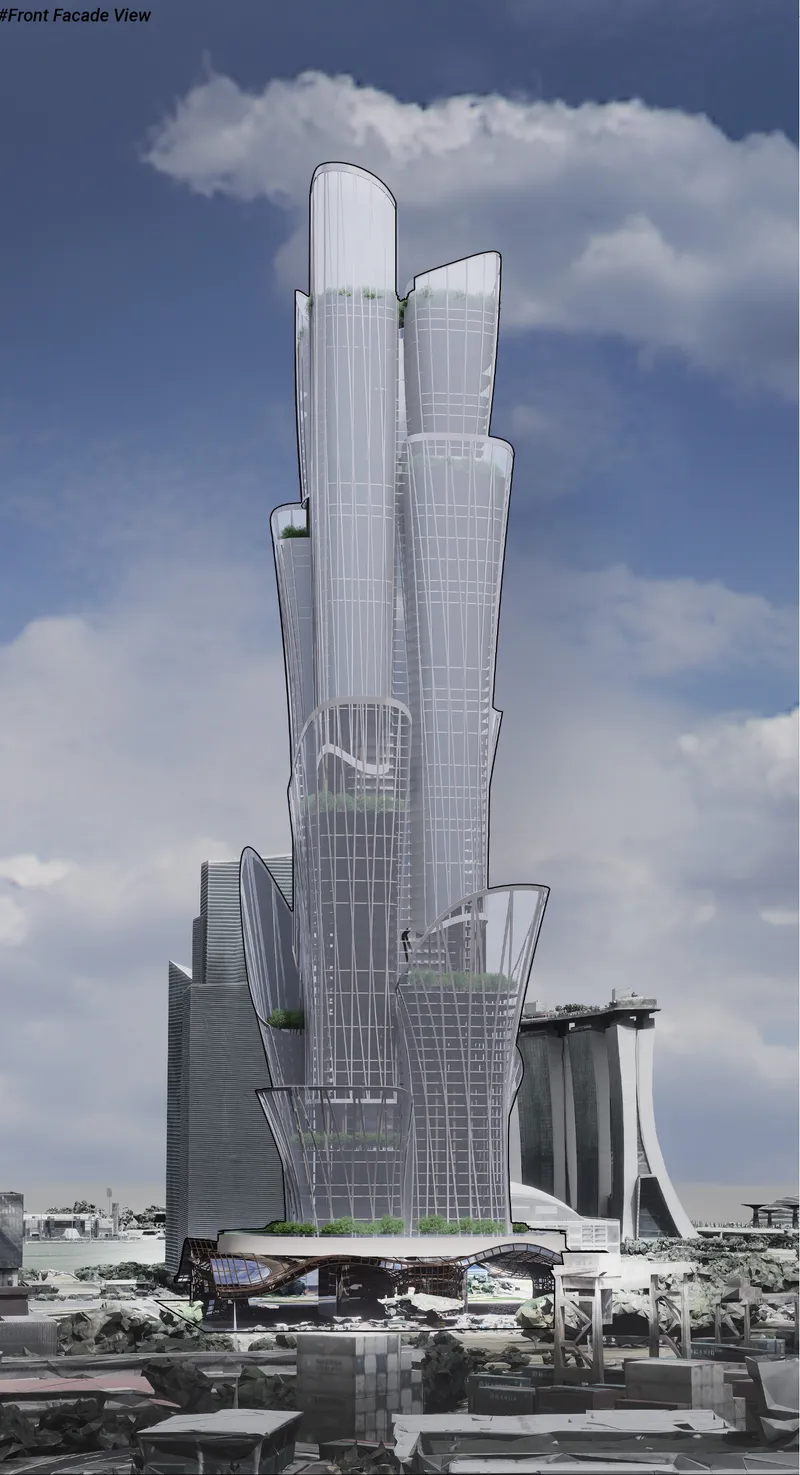
Seen from outside, RainFlow Tower reads as a cluster of transparent volumes rather than a single monolith. Vertical louvers and flowing glass forms break the facade into layered surfaces that mimic tropical foliage. Rainwater guided along these angled surfaces cools the building passively while creating a shimmering curtain effect, reducing dependence on mechanical cooling systems. The facade is simultaneously climate filter, water collector, and shading device, performing three roles with a single material strategy.
The clustering strategy also fragments the tower's mass, allowing wind and light to penetrate between volumes. For a building near Marina Bay, where the skyline is already assertive, this porosity helps the tower coexist with its context rather than bulldoze it. The transparency signals openness: you can see the water moving, the gardens growing, the structure working.
Stacking Programs Around a Central Water Core

The section drawing makes the building's organizational logic explicit. Lower levels house public community areas, shaded green plazas, and commercial zones where pedestrians engage with water-sensitive urban design at grade. Mid levels contain residential units and residence hotels interspersed with nature terraces and sky parks. Upper levels shift to exhibition spaces, observation decks, and rooftop gardens. Throughout this stack, vertical shafts carry harvested rainwater downward through filtration stages, feeding each programmatic zone along the way.
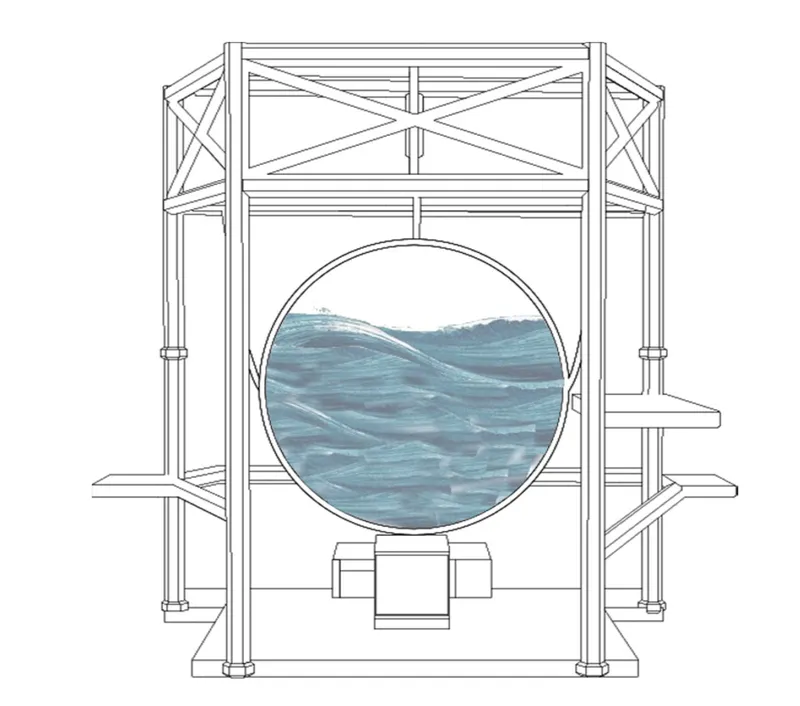
At the tower's structural heart sits a Tuned Mass Damper combined with a central water reservoir. The elevation drawing reveals this element clearly: a circular tank suspended within a steel frame braced by diagonal members. It is an elegant convergence of engineering needs. The stored water mass counteracts lateral forces on the supertall structure while holding the building's most critical resource. Every liter serves double duty, stabilizing the building and sustaining its inhabitants. The closed-loop system ensures that water collected at the top circulates through the entire section before being reused, making the tower function, as the designers describe it, like a living organism.
Why This Project Matters
Supertall buildings are often monuments to energy consumption and resource extraction. RainFlow Tower inverts that relationship by making the skyscraper a net contributor to its city's most pressing infrastructural challenge: water security. The 2061 deadline for Singapore's Malaysian water agreement is not a distant abstraction; it is a policy reality shaping investment and research today. Proposals like this one demonstrate that architecture can engage meaningfully with resource crises rather than merely gesture toward sustainability with rooftop solar panels.
What distinguishes the work of 대찬 김, 문규 배, SH C, and 원 is the coherence between concept and detail. The petal roof, the angled facade, the TMD reservoir, and the programmatic stacking all serve the same thesis: that a building's form should emerge from its environmental performance. The result is a tower that does not merely sit in a tropical climate but actively participates in it, catching rain, cooling air, storing water, and returning it to the urban cycle. As a prototype for water-sensitive vertical urbanism, RainFlow Tower offers a compelling model for Singapore and for any dense, rain-rich city confronting its resource future.
View the Full Project
About the Designers
Designers: 대찬 김, 문규 배, SH C, 원
Enter a Design Competition on uni.xyz
uni.xyz runs architecture and design competitions year-round that reward proposals with spatial conviction and real site intelligence.
Project credits: RainFlowTower_Urban Water Circulation Skyscraper by 대찬 김, 문규 배, SH C, 원 Alter (uni.xyz).


Popular Articles
Popular articles from the community


The Amber Palace Opera: A Geological Fiction Surfaces on Tallinn's Baltic Waterfront
Pierre Brillard reimagines a Baltic legend as a public landscape, opera house, and waterfront promenade rooted in Tallinn's coastal identity.

Faces of the Soviet Avant-Garde: Turning Moscow's Street Names into an Open-Air Museum
A network of sculptural installations across a Moscow residential district transforms forgotten architect names into spatial encounters with cultural memor

Singing Woman: An Opera House That Performs Before the Curtain Rises
Ovidiu Cristian Pavel's conceptual opera house translates Estonia's choral identity into a sculpted waterfront landmark facing the Baltic Sea.

Opera by the Sea Estonia: Three Shells Dissolving Architecture into Tallinn's Coastline
A winning opera house proposal replaces monumental form with interconnected shells that blur the boundary between building, park and Baltic Sea.

Similar Reads
You might also enjoy these articles

Play: Fragments of Their World: Remembered Architecture Rebuilt as a Modular Playground for Refugee Camps
Tom Gardner abstracts domes, arches and towers from the homelands of displaced families into a kit of child-scaled play parts for camp settlements.
REBIRTH: A Circular Settlement Where Afghan Widows and Their Children Rebuild Life Together
A shortlisted Resile entry turns the circle into a protective ring of timber and brick, gathering homes, classrooms and gardens around a shared landscape.
The Main Dream: A Recycled Plastic Kit That Lets Refugee Children Build Their Own Playground
Thirty-centimetre interlocking cubes that connect on three axes turn play into construction, letting children author the spaces they occupy.

Lunar Spiral: A Fibonacci-Driven Moon Settlement Rising from Shackleton Crater
Golden-spiral geometry organises buried infrastructure and orbiting habitable spheres into a lunar base designed to grow as life on the Moon expands.

Comments (0)
Please login or sign up to add comments
No comments yet. Be the first to comment!