
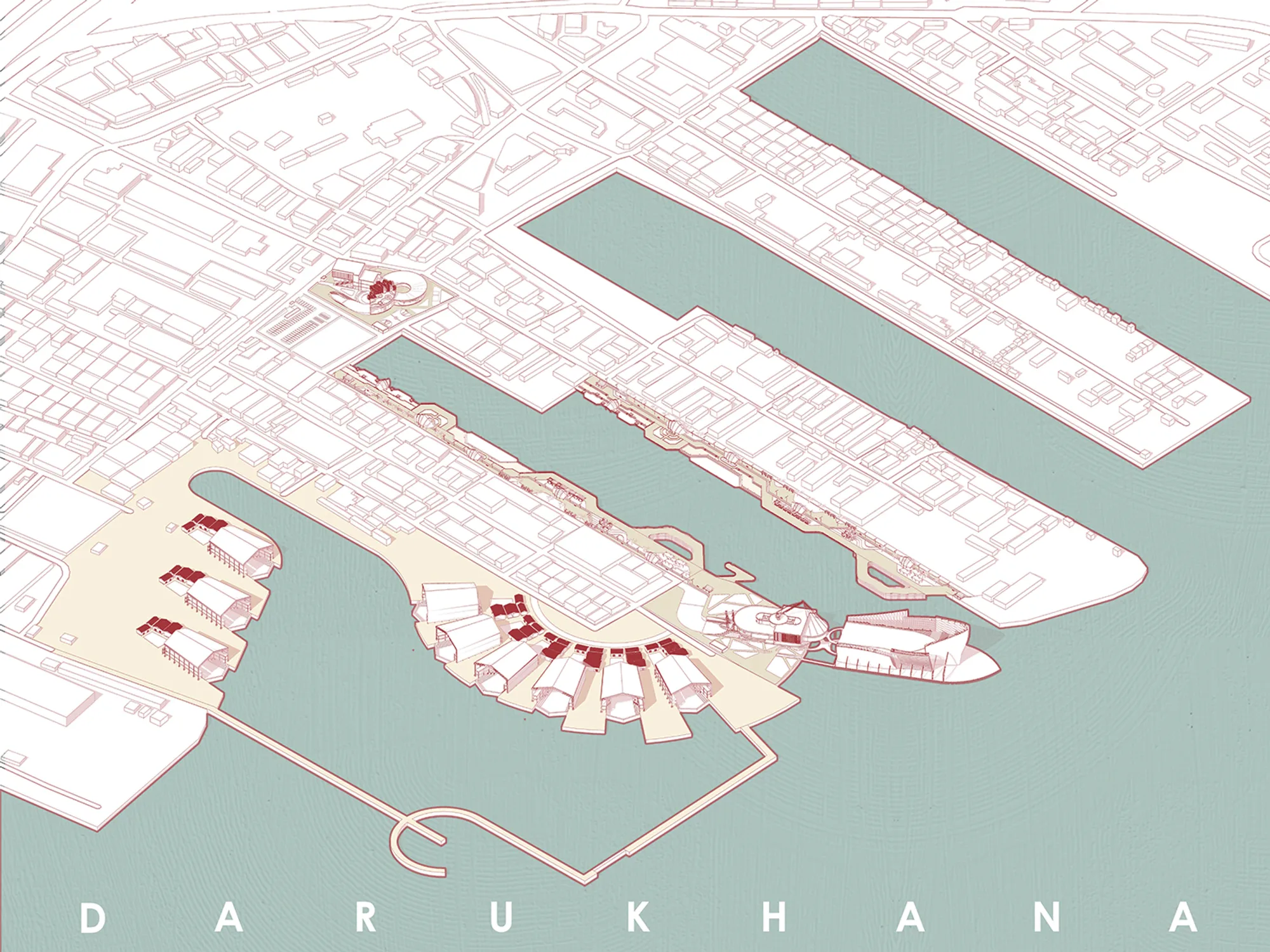
REIMAGINING DARUKHANA
From Industrial Periphery to Inclusive Urban Core

Darukhana, nestled along Mumbai’s Eastern Waterfront, is a place of grit, resilience, and quiet endurance. As one of India’s oldest and most active shipbreaking hubs, it holds the weight of industrial history on its shoulders—where ships meet their end and thousands of workers carve livelihoods from steel. Yet, despite its economic contributions, Darukhana remains largely invisible, both socially and spatially. It is a space shaped by labor but burdened by neglect: unsafe working conditions, environmental pollution, fragile infrastructure, and an ever-present threat of displacement shadow the lives of its people.
This thesis project proposes a transformative, context-driven intervention that does not erase Darukhana’s identity but rather strengthens it—reframing it as a dignified, inclusive, and functional part of Mumbai’s urban future. Instead of displacing its industrial character or communities, the proposal embraces them—rethinking how industry, heritage, ecology, and community life can coexist in meaningful balance.
A Layered Urban Strategy
The design framework unfolds across four key interventions, each responding to a different layer of Darukhana’s condition: livelihood, memory, environment, and connectivity. Together, these layers form a cohesive ecosystem that empowers the local community, enhances industrial processes, and opens up Darukhana to the wider public through shared experiences and sustainable growth.
1. The Community and Training Center: Rebuilding with Care
The proposal begins at the very core of Darukhana’s social fabric—with its people. The Community and Training Center is designed as a multi-functional, ascending terraced structure that symbolizes hope, growth, and collective strength. Drawing inspiration from ship hulls and industrial materials, the building wraps around public courtyards and includes a wide range of essential facilities: a healthcare unit, skill-development workshops, anganwadi and childcare spaces, open classrooms, and shaded gathering zones.
Here, community-building is not a metaphor; it’s embedded in every brick. From informal vendors to young learners and skilled laborers, the center becomes a civic anchor—offering dignity, services, and empowerment to the people who have kept Darukhana alive for generations.
The roofscape hosts solar panels that meet the building’s energy needs, while integrated vermicomposting and rainwater harvesting systems support sustainable living. The architecture does not impose—it emerges organically from the needs and character of its context.
2. The Promenade: Reclaiming the Industrial Edge
Running parallel to the coastline, the waterfront promenade transforms the harsh, inaccessible industrial edge into a vibrant, active public spine. It’s not just a pathway—it’s a sensory journey designed for pause, play, and connection. The promenade weaves together floating decks, shaded seating pockets, small kiosks, open performance zones, and viewing balconies that offer glimpses of the sea, the shipyard, and the surrounding skyline.
This stretch becomes a democratic urban interface—where residents, visitors, and workers can coexist. The industrial past isn’t erased but reframed, with repurposed ship parts and marine elements used as design inserts. Interactive installations and play zones spark curiosity without didactic messaging, creating a space that invites engagement across ages.
The promenade also plays a critical role in clean energy generation: a tidal turbine embedded in the wet basin harnesses marine currents; piezoelectric tiles in high-footfall areas convert footsteps into electricity; and solar elements on kiosks and poles make the entire edge energy-efficient. Together, these technologies power the promenade and contribute to the larger energy demands of the site.
3. The Shipyard Museum: Preserving Memory through Immersion
Where most of Mumbai has forgotten Darukhana, the Shipyard Museum aims to remember. Not through static displays, but through immersive storytelling and spatial experience. Housed within and around a decommissioned ship, the museum becomes a walkthrough narrative—chronicling the layered histories of this coast: maritime trade, labor migration, shipbreaking evolution, environmental consequences, and community struggles.
Visitors walk through the belly of the ship, moving through rooms reimagined as exhibit galleries, audio-visual pods, reconstructed workspaces, and AR-based storytelling zones. Repurposed steel panels, navigation tools, rope systems, and found ship parts serve both as content and construction.
The museum doesn’t glorify the past—it presents it in its raw complexity, giving voice to the workers and communities who have long remained on the periphery of the city’s consciousness. It becomes a space of education, reflection, and empathy—a cultural landmark embedded in industrial memory.
4. Structured Shipbreaking Yard: From Chaos to Clean Operation
The final layer of intervention addresses the core of Darukhana’s economy—the shipbreaking yards themselves. Currently, the industry operates in unregulated conditions, with poor environmental safeguards and dangerous practices. The proposal reimagines the yard with enclosed dry docks, pollution control systems, organized circulation, safety protocols, and designated zones for dismantling, segregation, and storage.
Through spatial clarity and infrastructural upgrade, the shipbreaking process is optimized—not only making it safer and cleaner but also more visible and dignified. This is not about gentrification, but about regenerative industry—where productivity and responsibility go hand-in-hand.
A Model for Participatory Urbanism
Collectively, these interventions are more than architectural solutions—they are catalysts. They initiate a long-overdue process of acknowledging, empowering, and integrating Darukhana into Mumbai’s broader urban imagination. They position Darukhana not as a leftover zone, but as a prototype—a living example of how post-industrial areas can evolve through community-centric, environmentally-conscious, and historically-sensitive urban design.
The project challenges conventional planning paradigms that seek to sanitize or displace informal economies. Instead, it advocates for inclusive development that works with the existing urban fabric rather than against it. By elevating both place and people, the proposal offers a hopeful vision of what our waterfronts—and cities—can be when designed with empathy, context, and care.
Conclusion: A New Map for Darukhana
This thesis does not aim to perfect Darukhana—it aims to reposition it. Through architecture, public space, infrastructure, and storytelling, the proposal weaves Darukhana back into the map—not just as a point of industrial labor, but as a shared urban future.
It is a call to see what lies behind the fences and steel, to recognize the potential of the ignored, and to design cities that leave no community behind.
In doing so, it transforms Darukhana from a city’s margin into one of its most powerful and poetic cores.




Popular Articles
Popular articles from the community


The Musturak Paradise: Senior Living Architecture for a Connected Future in Temara, Morocco
The Musturak Paradise reimagines senior living architecture in Temara via private homes, social spaces, culture, community, and shared care.

Co-life: Sustainable Architecture for Age-Friendly Community Living
Co-life reimagines sustainable architecture for seniors through courtyards, rammed earth, shared gardens, and spaces designed for belonging.

Riyadh For All: Intergenerational Urban Design for Active Aging in Rabat
Riyadh For All reimagines urban design in Rabat with intergenerational co-living, adaptive courtyards, and Moroccan cultural exchange today.

Lunar Spiral: Space Architecture Shaped by the Mathematics of the Universe
Lunar Spiral reimagines space architecture through Fibonacci geometry, lunar regolith, levitating habitats, and self-sustaining Moon living.


Similar Reads
You might also enjoy these articles

Day and Night Park: A Time-Based Urban Newsstand in Beijing
A temporary urban newsstand in Beijing blending travel, light, and reading through poetic colors, compact form, and community-focused design.

Modernist Patio Renovation in El Masnou, Barcelona by Oliver Segura Arquitectura + Cebrià Arquitectura
Modernist patio renovation blending tradition and innovation with a movable pool, leveled floors, and Catalan materials in El Masnou.
Alto Residencial Coop: Cooperative Housing Development in Santiago de Compostela by Carbajo Barrios Arquitectos
A linear cooperative housing complex blending white volumes and perforated metal façades, enhancing community living, natural light, privacy, and urban integration.
Vil Genis School by BPA ARCHITECTURE – Massy, France
Vil Genis School in Massy, France, features sustainable design, south-facing classrooms, community integration, accessible spaces, and modern educational architecture.

Explore Reimagining Competitions
Discover active competitions in this discipline




Challenge to reimagine the Iron Throne


Photograph architecture without architects


Illustrate the lost glory of Angkor Wat - Render Challenge


Design challenge to reuse E-waste
Comments (0)
Please login or sign up to add comments
No comments yet. Be the first to comment!