
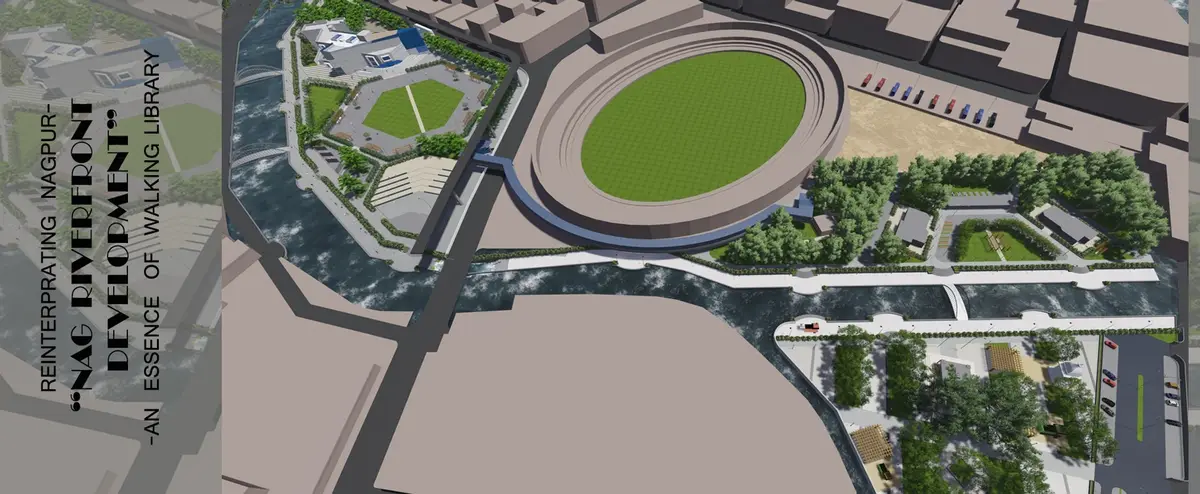
Nag Riverfront Walking Library: Turning Nagpur's Neglected River Edge into a Learning Promenade
Prakrati Jain's riverfront proposal threads a library, heritage steps, pergolas and a footbridge along the Nag River as one continuous civic walk.


Most riverfront schemes in Indian cities sell the water as scenery: a railing, a jogging track, a view. This proposal for the Nag River argues for something more demanding. It treats the edge as a Walking Library, a route where reading, exhibitions, heritage and public life are strung together so that moving along the river becomes the act of learning itself. The idea is simple, and that clarity gives the project its strength.
Titled Reinterpreting Nagpur through Nag Riverfront Development, An Essence of Walking Library, the project by Prakrati Jain targets an underutilised stretch of river edge in Nagpur. The site sits near stadium infrastructure and existing public roads. Jain sets out to reverse a familiar pattern in which rivers become the neglected backyards of urban growth, and instead positions the Nag as a living urban spine. The strategy puts pedestrian movement, ecological restoration and community programming ahead of spectacle.
A Broad Stepped Edge That Brings the City Down to the Water
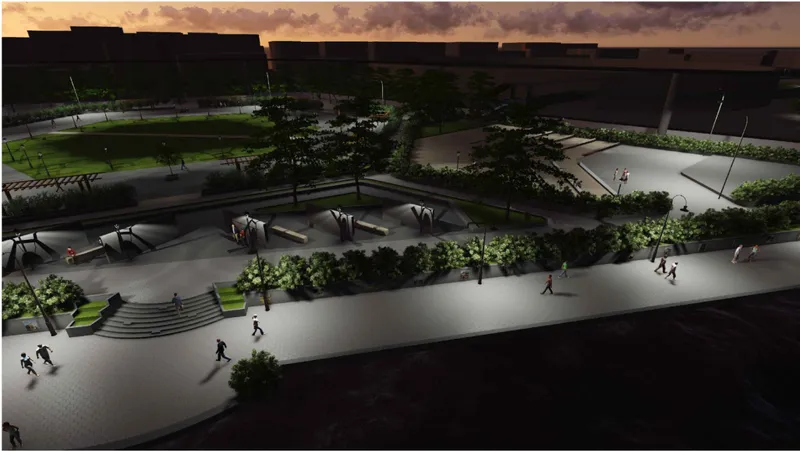
The dusk rendering sets out the project's basic move. A wide band of stepped seating meets the river, edged by clipped hedges, with a paved plaza where pedestrians cross freely. This is not a wall that holds the city back from the water. It is a gradient, and every step works as a place to sit, pause or watch. The section of the riverbank becomes inhabited ground rather than a barrier.
Steps of this kind carry particular weight in the Indian context, where the ghat has long served as a civic room. Jain borrows that logic without nostalgia. The brief calls for an edge that is accessible, safe and socially inclusive, and the generous, low gradient of the steps serves all three aims more directly than any single building could.
The Library Plants Itself Between River and Stadium Ground
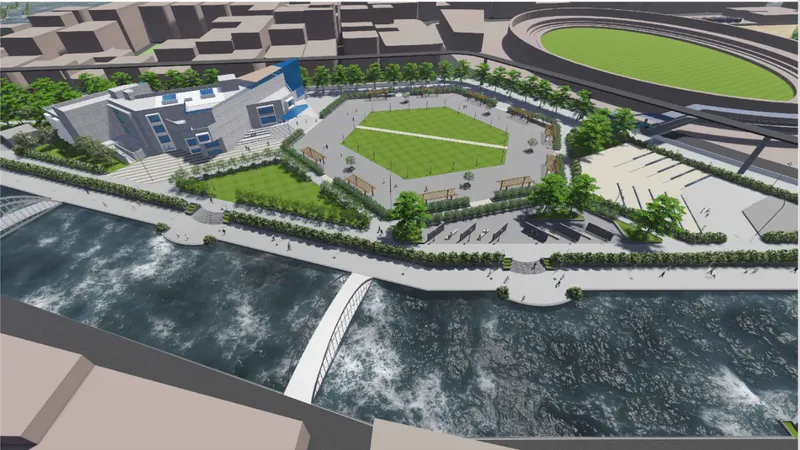
The aerial view places the Walking Library in its setting. A grey-clad building sits beside a hexagonal lawn plaza, and a footbridge spans the churning river. The massing follows the site geometry while keeping sightlines open to both the water and the adjacent stadium grounds. Jain uses an angular form to produce terraces, shaded edges and spill-out zones, so the boundary between inside and outside is deliberately unclear.
The bridge matters as much as the building. Described as a sculptural crossing that reconnects both banks, it recasts the river as a civic connector rather than a dividing line. The circular stadium ground, linked through landscape transitions and the bridge, stops being an isolated landmark and joins the same network of walking routes. In this way the library operates as a hinge between several public spaces rather than as a standalone object.
Night Routes Through Pergolas, Pavilions and Heritage Steps
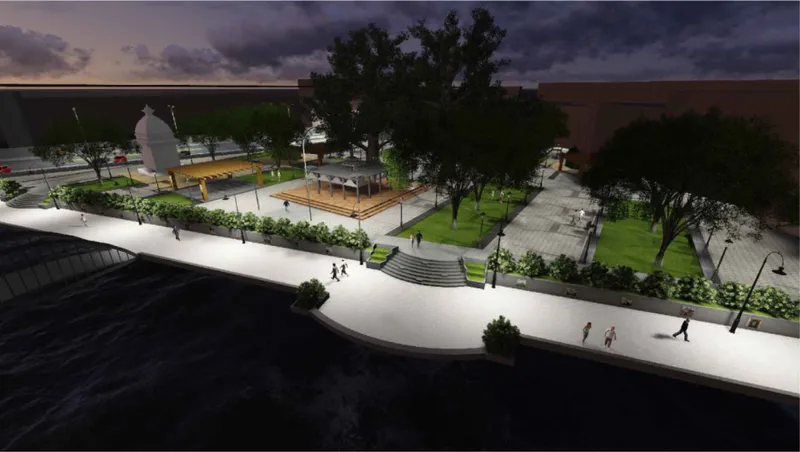
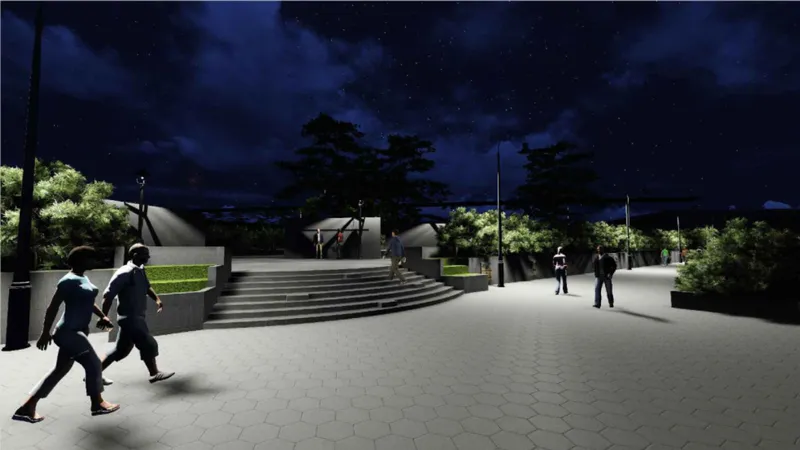
After dark, the scheme shows its secondary layer: a set of micro-programmed nodes that keep the edge active beyond the main building. A lit walkway leads to a timber pergola and a pavilion on a wooden deck beneath large shade trees. This matches the proposal's lightweight cafeteria and shaded seating, which are meant to encourage informal gathering and longer stays along the river. Lighting here does real work. A riverfront that feels safe at night is a riverfront that actually gets used.
The curved flight of steps and hexagonal paving connect to the temple precinct, where stepped promenades build historical narratives into the circulation paths. This is the most literal reading of the Walking Library idea: heritage is not displayed behind glass but placed underfoot, along the routes people already take. The hexagonal paving pattern, repeated from the lawn plaza, ties these scattered nodes into one recognisable landscape.
Elevations and Sections That Stack Learning in Layers
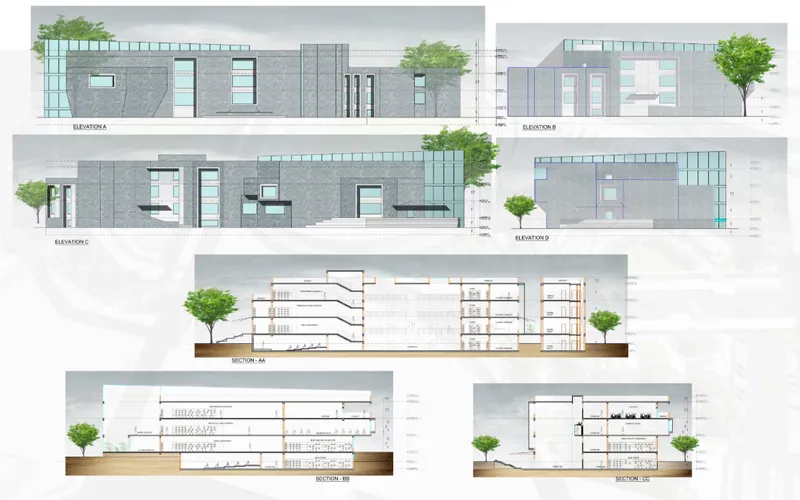
The drawing sheet sets four elevations alongside three sections, and together they show how the promenade continues inside the building. Jain describes the library as a layered journey through reading zones, exhibition spaces, digital archives and collaborative areas, organised both vertically and horizontally. The stepped relationship between floors visible in section turns that description into built form: learning becomes a continuous climb rather than a series of closed rooms.
The facades keep things restrained. Solid surfaces are cut by framed openings and glazed vertical bands, which control daylight and protect thermal performance in a hot climate. The balance between mass and opening suits the programme well. A library needs quiet, shaded interiors, and this one also needs to stay visually connected to the river it serves. The elevations manage both without resorting to a fully glazed shell.
Small Shade Structures Doing Large Civic Work
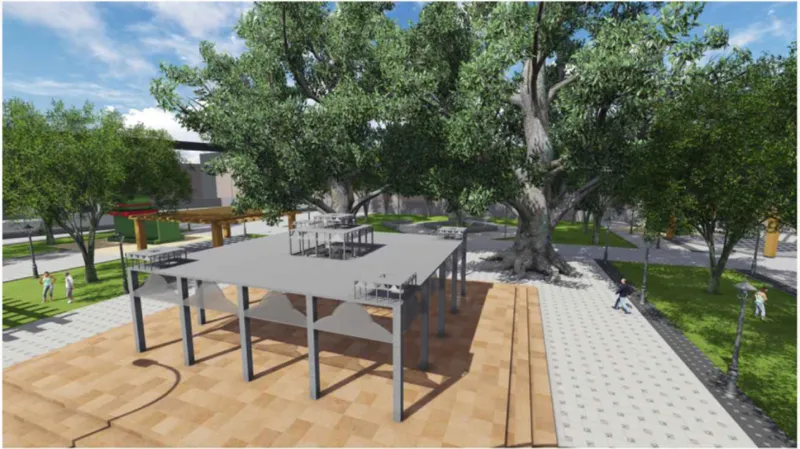
The final image moves to the smallest scale: a steel-framed canopy with a square opening, set on a terracotta-paved deck beneath a large spreading tree. It is a modest object, and that modesty is the point. Together with the timber pergolas and shaded platforms described in the proposal, structures like this improve microclimatic comfort and make it possible to linger outdoors during the day.
The square cut in the canopy frames the tree canopy above, letting the existing landscape share the shading role. It is a quiet gesture of respect for what is already on site, consistent with the project's emphasis on ecological restoration over wholesale replacement.
Why This Project Matters
The Walking Library proposal reframes a common urban problem with a single, workable concept. Rather than adding one landmark to a neglected riverbank, Jain distributes programme along the edge: library, temple steps, cafeteria, pergolas and bridge each take on part of the civic load. The result reads as an urban spine instead of a collection of objects, and the idea of learning as movement gives that spine a purpose beyond recreation.
For Indian cities still deciding what their rivers should become, the project makes a persuasive case that the answer lies in pedestrian scale, shade, heritage and connection, not in hard embankments and decorative railings. The renderings and drawings show an architecture willing to remain secondary to the walk itself. That restraint is the project's most valuable lesson.
View the Full Project
About the Designers
Designer: Prakrati Jain
Enter a Design Competition on uni.xyz
uni.xyz runs architecture and design competitions year-round that reward proposals with spatial conviction and real site intelligence.
Project credits: Reinterpreting Nagpur through Nag Riverfront Development, An Essence of Walking Library by Prakrati Jain.


Popular Articles
Popular articles from the community


Singing Woman: An Opera House That Performs Before the Curtain Rises
Ovidiu Cristian Pavel's conceptual opera house translates Estonia's choral identity into a sculpted waterfront landmark facing the Baltic Sea.


FCC Arquitectura Expands a Portuguese Granite House with a Board-Marked Concrete Wing
In Portugal, JV House pairs a cleaned-up whitewashed and granite dwelling with a timber-shuttered concrete extension, courtyards and a garden pool.

David Ortega Stacks a Two-Story Mexico City Penthouse Around a Steel Stair and a Pergola-Shaded Roof Terrace
In Colonia Roma, a 300 m² penthouse uses oak joinery, a planted steel stair and a slatted roof pergola to make a new-build apartment feel like a house.

Cube Design Draws an Ecological Corridor Between Two Shenzhen Hills with the Nankai Building
Beside Shenzhen's container docks, the Nankai Building pairs stacked balconies with a climbing green screen to connect two hillsides across its height.

Similar Reads
You might also enjoy these articles
Healing Façade: A Modular Chapel System That Restores Ethiopia's Sacred Forests
Winner of the Eco-Chapel competition, this circular timber façade collects water from air to rebuild soil and reforest degraded Ethiopian landscapes.
Kaffeebühnen: Where Coffee Shop Architecture Becomes a Civic Stage in Vienna
A linear sequence of timber boxes, transparent shells, and open yards turns the Viennese café tradition into a public performance space.
Eco Chapel: A Modular Forest Pavilion That Grows Like the Landscape It Protects
Hexagonal timber modules weave through existing trees, turning a chapel into a living system for prayer, education, and reforestation.


Urban Forest: A Vertical Ecosystem for 5,000 Workers in Singapore's Changi Business Park
Radially stacked pods and layered green decks turn a 7-acre plot into 47 acres of ecological workspace projected for 2040.

Comments (0)
Please login or sign up to add comments
No comments yet. Be the first to comment!