

Future Prison: Circular Architecture That Treats Incarceration as a Rehabilitation Loop
A shortlisted competition entry layers private, public, and semi-public zones into a cyber-integrated correctional facility built for reintegration.


What if a prison operated like a processing loop, routing people through stages of introspection, skill-building, and social reconnection before returning them to the world? Future Prison takes that premise literally. The design organizes a correctional facility as a circular, vertically stratified system where underground dark rooms, a ground-level cybersecurity training center, and upper-floor residential and public exhibition spaces stack into a single continuous sequence. It is not a metaphor for rehabilitation; it is an architecture that mechanizes it.
Designed by Haotong Xia and 策楷 翁, the project was shortlisted in the Switching Prisons competition. The concept drew pointed commentary from jurors. Michael Spight, Director at TAG Architects, called it "a competent scheme well explained, taking an old model to a new level," while Adrian Iredale of Iredale Pedersen Hook Architects acknowledged the clarity of the presentation but cautioned that "the tyranny of the circle is difficult to avoid." That tension between formal ambition and practical critique sits at the heart of the project's appeal.
Dramatic Light as a Tool of Transition
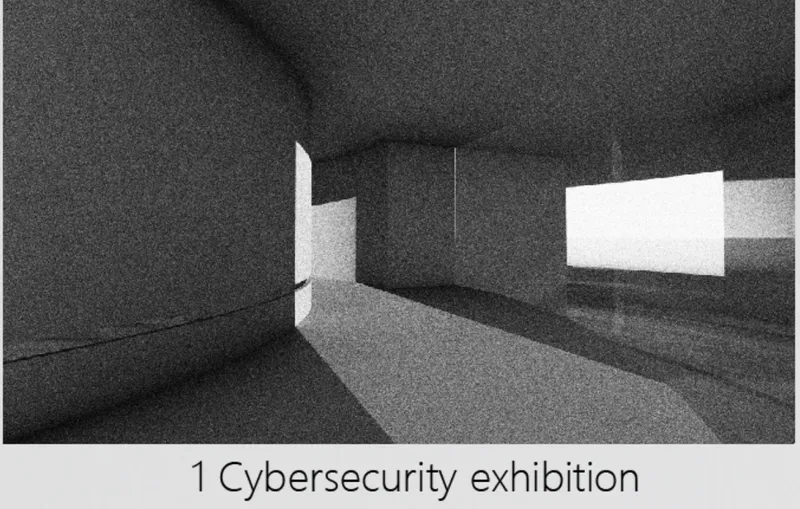
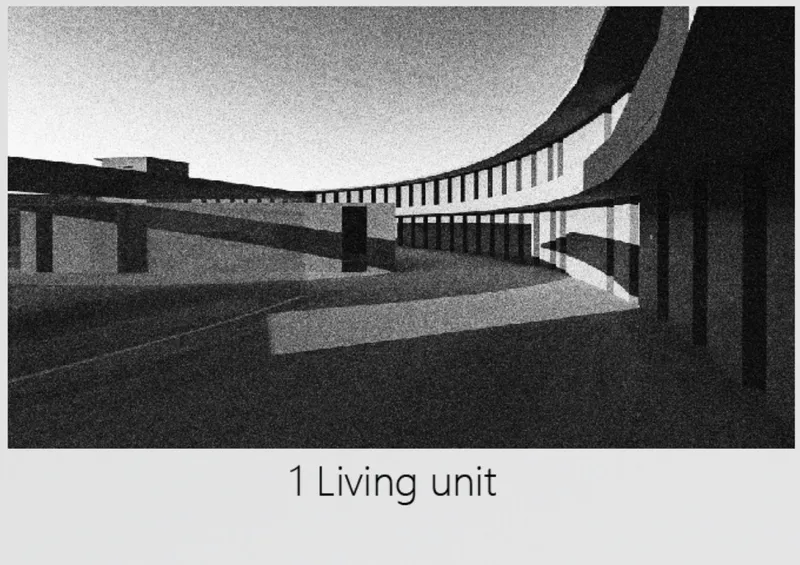
The underground Private Zone is where an inmate's journey begins: dark rooms, meditation spaces, and silence. The rendered gallery captures this atmosphere precisely. Dark textured walls absorb sound and attention, while horizontal window openings cut thin bands of light across the floor, controlling exactly how much of the outside world filters in. It is architecture as sensory calibration, designed to force introspection before any other programming begins.
Moving upward, the curved colonnade introduces a different register entirely. Rhythmic vertical openings beneath an overhanging roof plane create a transitional space that is neither fully enclosed nor fully open. The repetition of structural bays suggests order and routine, qualities the designers embed into every stage of the inmate's progression. Light here is generous but filtered, marking the shift from isolation toward structured engagement.
Curving Corridors That Direct the Body and the Programme


The circular plan is not ornamental. It generates corridors that curve continuously, eliminating the dead-end logic of conventional prison cellblocks. A narrow ceiling slot runs the length of one corridor, casting a controlled line of illumination onto dark textured walls that compress the space and focus forward movement. The architecture literally channels people through its programme without the need for aggressive wayfinding or surveillance geometry.
At the center of the scheme, a sunken circular plaza opens to the sky, surrounded by colonnaded walls and anchored by a central tower. The courtyard functions as the spatial heart of the facility: it is where the semi-public zone meets the public one, where exhibitions can draw visitors in and where inmates encounter society in a controlled, dignified setting. The grey sky in the rendering reinforces the project's tonal restraint. Nothing here is flashy. The architecture earns its presence through proportion and sequence, not spectacle.
A Rehabilitation Sequence Mapped as a Spatial Diagram

The spatial sequence diagram lays out the full loop: interrogation and confession in the dark room, assessment, work and study at the cybersecurity center, victim dialogue, and community exposure leading to reintegration. Six illustrated zones connect through directional arrows, making explicit what the architecture implies. The comparison to a computer's processing loop is deliberate. Each stage feeds data (emotional readiness, vocational skill, social confidence) into the next, and the circular plan ensures there is always forward momentum.
The cybersecurity training hub deserves particular attention. By embedding a working tech education facility at ground level, the designers create a dual-purpose engine. Inmates develop vocational skills in one of the fastest-growing global industries, while the facility itself generates income through its publicly accessible lab and exhibitions. The prison funds its own operation. It is a pragmatic move that transforms the correctional model from a fiscal drain into something closer to a self-sustaining institution.
Why This Project Matters
Future Prison succeeds not because it resolves every complexity of carceral design but because it insists that architecture can do more than contain. The three-zone stratification, from underground silence to upper-floor socialization, gives physical form to a rehabilitative philosophy that most correctional facilities only gesture toward in policy documents. The cybersecurity programme adds economic logic to that philosophy, which is essential for any proposal that hopes to move beyond the competition board.
The jurors' ambivalence about the circular form is fair. Circles impose their own constraints, and the project would benefit from further development of how irregular programmatic needs fit within that geometry. But as a conceptual framework, the loop is powerful. It rejects the linear, terminal logic of punishment and replaces it with a spatial argument for transformation. That argument, clearly presented and architecturally committed, is what earned the project its shortlist position and what makes it worth studying.
View the Full Project
About the Designers
Designers: Haotong Xia, 策楷 翁
Enter a Design Competition on uni.xyz
uni.xyz runs architecture and design competitions year-round that reward proposals with spatial conviction and real site intelligence.
Project credits: Future Prison by Haotong Xia, 策楷 翁 Switching Prisons (uni.xyz).


Popular Articles
Popular articles from the community


Jaramillo Van Sluys Arquitectura and Urbanismo Turn a Demolished Registry Lot in Quito into an Orchard Plaza
In Quito's Centro Histórico, a 2,800 m² plaza exposes the San Agustín convent wall and redraws its lost Augustinian orchard in volcanic stone.

Juan García Correa, John González and Claudia Rueda Sink a Circular Amphitheater into a Manizales Engineering Building
On the La Nubia campus in Manizales, Colombia, the S1 Building folds labs and offices into a hillside of ramped lawns that double as a campus route.

Cube Design Draws an Ecological Corridor Between Two Shenzhen Hills with the Nankai Building
Beside Shenzhen's container docks, the Nankai Building pairs stacked balconies with a climbing green screen to connect two hillsides across its height.

David Macias Steps a Doorless Stone and Plaster House Down a Tropical Colombian Hillside
In the humid hills of Colombia, Threshold House replaces the front door with an open void and terraces its 850 m² down the slope instead of fighting it.

Similar Reads
You might also enjoy these articles

Gil Mello Arquitetura Tilts a Single Roof Toward the Waterfalls on a Plateau Above Aiuruoca, Brazil
In Aiuruoca, Minas Gerais, a 200 m² house of local labor and reclaimed poles pairs a low valley veranda with a tall mountain one.

U.GA Architects Wraps an Oval Rooftop Pool in Curved Board-Formed Concrete on Busan's Jeollidan-gil
In Busan's Jeonpo-dong, a 454 m² mixed-use block stacks a neighborhood facility, guest rooms and an oval rooftop pool inside spiraling concrete walls.

Felipe Hess Arquitetos Turns a Blind Stone Wall to the Street and Opens a Brazilian House onto a Courtyard and Canal
A canal-front house in Brazil hides behind painted stone and planting, then opens to an olive-tree courtyard, a reed-ceilinged porch and a curving pool.
David Macias Steps a Doorless Stone and Plaster House Down a Tropical Colombian Hillside
In the humid hills of Colombia, Threshold House replaces the front door with an open void and terraces its 850 m² down the slope instead of fighting it.


Comments (0)
Please login or sign up to add comments
No comments yet. Be the first to comment!