

Shell: A Library as Landscape in Warsaw's Layered Urban Memory
Beyza Ayaz reimagines the library as a porous, partially sunken shell that dissolves boundaries between reading, reflection, and urban life.


What if a library refused to be a container? "Shell" takes that question literally, proposing a curving, partially sunken structure in Warsaw that treats knowledge as terrain rather than inventory. The building wraps around a historically charged site adjacent to the ruins of the Warsaw Ghetto, forming a landscape where topography, memory, and learning merge into a single architectural experience. Rather than stacking floors of shelving behind a monumental facade, the design pulls users into a ground-hugging organism of interconnected modules: self-education zones, performance nooks, green courtyards, and multipurpose halls, all linked by the logic of a continuous shell.
Designed by Beyza Ayaz, Shell was shortlisted in Libgen 2019, a competition that asked entrants to rethink the library typology for a future shaped by digital culture, self-directed learning, and shifting public life. Ayaz's response roots itself in the specific conditions of Warsaw: a city whose layered history of destruction and reconstruction provides both metaphor and material for an architecture of openness. The site, flanked by emerging green zones and shadowed by the ghetto's memory, becomes a place where past traumas and future possibilities intersect in physical form.
A Grid Shell Roof Over a Multilevel Interior
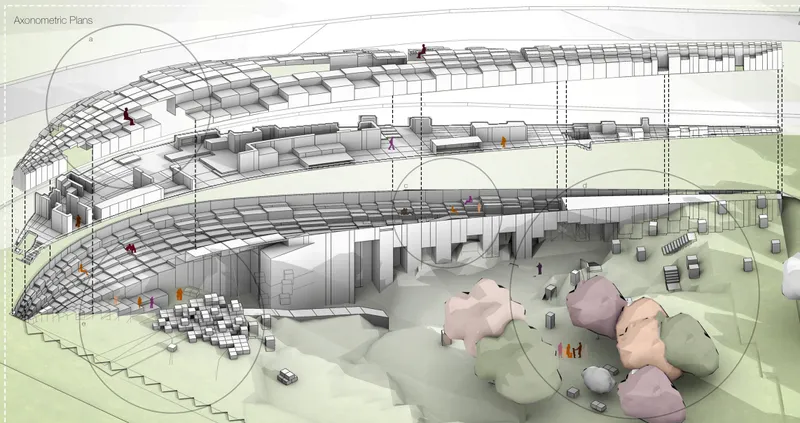
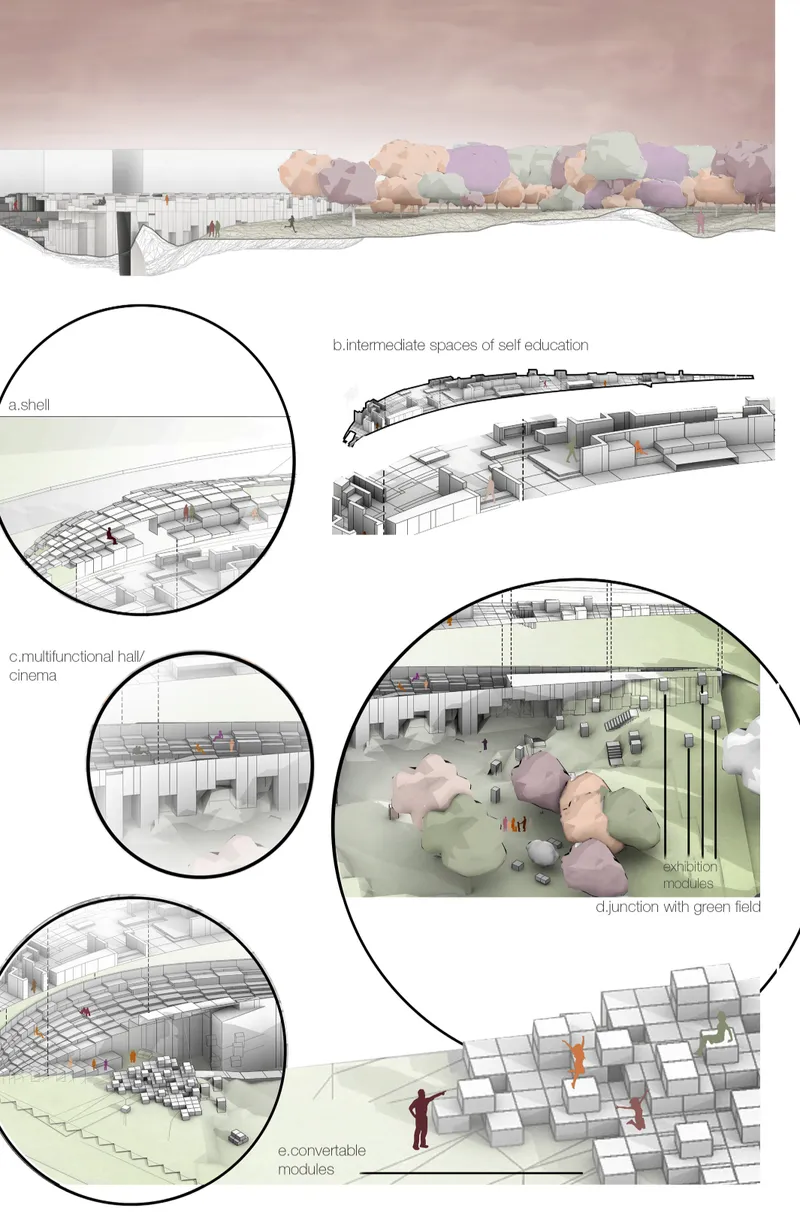
The axonometric drawing reveals the project's structural ambition: a vaulted grid shell roof arcs over multilevel interior spaces punctuated by sculptural forms that serve as both furniture and spatial dividers. The shell is not decorative. It organizes circulation, modulates light, and creates a legible hierarchy between collective gathering areas and intimate reading alcoves. Beneath its curve, the architecture reads less like a building and more like a carved hillside, with users occupying different elevations as they move between programs.
The composite sectional diagrams reinforce this reading. Arched spaces hold modular furniture arrangements, while organic sculptural elements emerge from a green field, blurring the threshold between interior rooms and exterior landscape. These sections make clear that Ayaz is working with a typological evolution: the rigid square plan of the traditional library gives way to something modular and responsive, where spaces shift in size and function depending on whether a user seeks solitude, collective discussion, or active engagement.
The White Panel Facade and Its Dark Openings
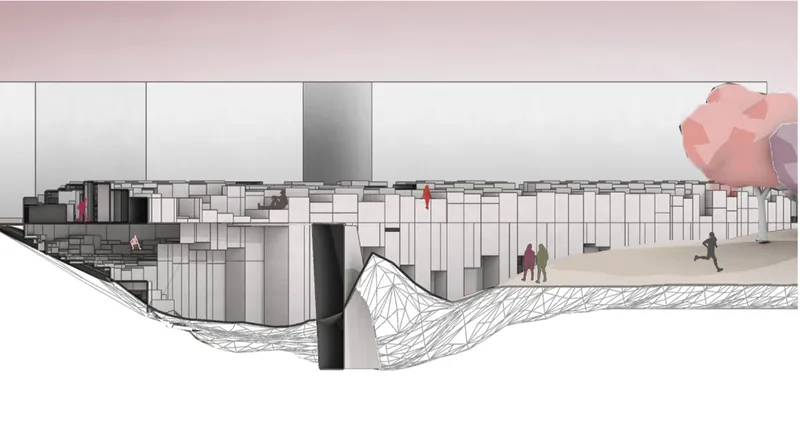

From the street, the library presents a white modular facade with geometric entries and dark apertures that hint at the depth below. The section drawing shows a wireframe mesh structure extending beneath ground level, confirming the building's partially sunken strategy. Visitors approach across earthen mounds that rise and fall with the topography, so the act of entering the library already feels like descending into a landscape rather than crossing a conventional threshold. The facade panels, with their restrained rhythm of openings, reference the protective quality of city walls while maintaining visual porosity.
The exterior perspective under an overcast Warsaw sky captures the building's deliberate understatement. It does not announce itself with glass curtain walls or monumental columns. Instead, it sits low and wide, letting the ground do the work of drawing people in. The dark openings create a tension between concealment and invitation, a duality that echoes the shell metaphor: protection and exposure held in balance.
Concrete, Coffered Ceilings, and the Weight of Quiet
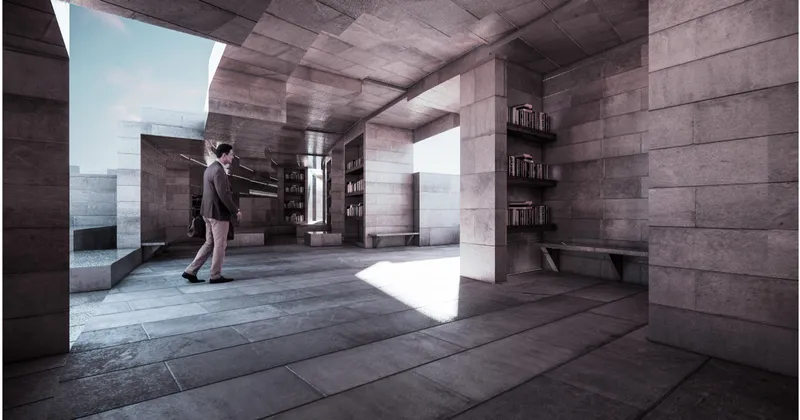
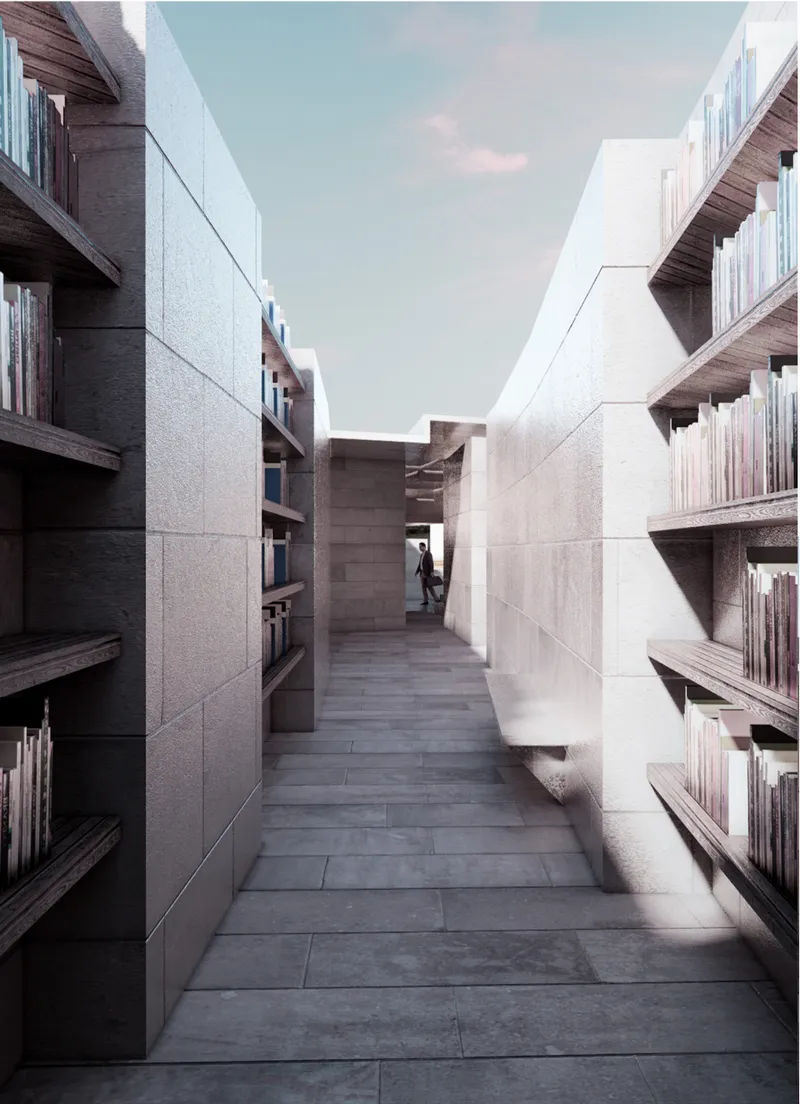
Inside, the material language shifts to exposed concrete with coffered ceilings that modulate overhead light. One view shows a solitary figure walking through a sunlit opening between built-in bookshelves, the coffers casting a rhythmic pattern of shadow across the floor. The space communicates seriousness without severity. Bookshelves are recessed into the concrete walls, making them part of the architecture rather than afterthoughts. A corridor view reinforces this integration: soft overhead lighting washes the ceiling while shelving lines both flanking walls, creating a passage that is simultaneously circulation and collection.
These interiors succeed because they resist the temptation to over-program. The concrete volumes feel open enough to accommodate changing use, yet specific enough in their material presence to anchor the experience of reading. The weight of the material palette, all cast concrete and recessed light, creates the kind of acoustic and psychological quietness that self-directed learning demands.
Staircases as Reading Rooms, Thresholds as Social Spaces
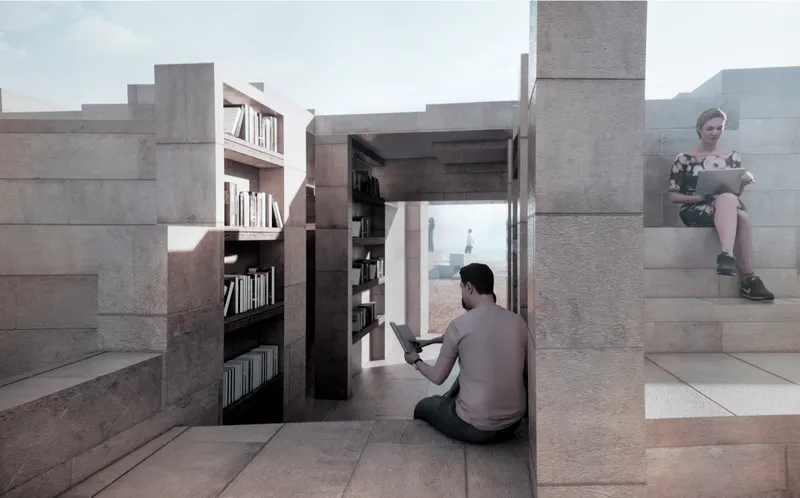
One of the project's strongest spatial moves is the integration of bookshelves into staircases and transitional zones. An interior view captures two readers sitting in daylight within framed openings along a staircase lined with books. The stair is no longer a utilitarian connector between floors; it becomes a reading room in its own right, a space where pause is designed into movement. Users can settle at any point along the vertical circulation and claim a moment of solitude within the building's continuous flow.
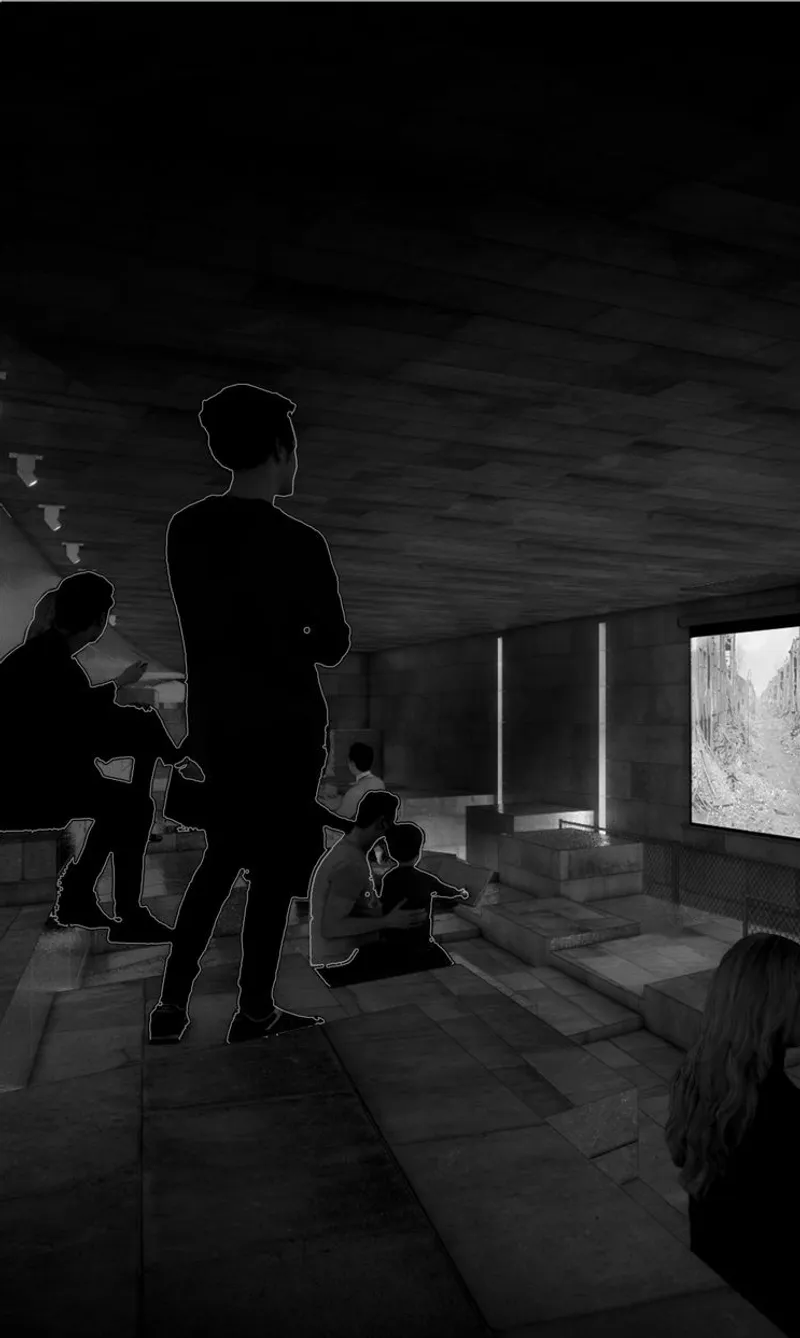
The final image, rendered in black and white, strips the interior to its essentials: silhouetted visitors beneath the coffered ceiling, the architecture reduced to geometry and light. It is a fitting summary of the project's philosophical stance. Knowledge cannot be confined, and therefore neither can the spaces that support it. The library becomes an open system where voices intersect, ideas take root, and the boundary between individual discovery and collective participation dissolves.
Why This Project Matters
Shell matters because it takes the library brief beyond formalism and into the realm of lived experience. By partially burying the building, dissolving its edges into landscape, and treating every surface as a potential site for learning, Ayaz proposes a typology that can genuinely evolve. The modular spatial logic, the porosity of the shell, and the integration of green courtyards with performance and reading spaces all point toward a library that adapts to its users rather than dictating their behavior.
Siting this project in Warsaw adds a layer of urgency. On a plot adjacent to the ghetto ruins, architecture carries the weight of memory whether it acknowledges it or not. Ayaz's design chooses acknowledgment: the shell protects and exposes simultaneously, holding space for both reflection on the past and active construction of the future. It is a compelling argument that the library, as a civic institution, is far from obsolete. It simply needs an architecture willing to be as open and contradictory as the knowledge it houses.
View the Full Project
About the Designers
Designer: Beyza Ayaz
Enter a Design Competition on uni.xyz
uni.xyz runs architecture and design competitions year-round that reward proposals with spatial conviction and real site intelligence.
Project credits: Shell" by Beyza Ayaz Libgen 2019 (uni.xyz).


Popular Articles
Popular articles from the community


Extended Shell: Retrofitting Kolkata's Balconies as Living Urban Thresholds
A modular retrofit system recovers the social and environmental intelligence of Kolkata's historic verandas for contemporary Park Street residents.

Tsunami Convergenics: Turning Catastrophic Ocean Forces into Underwater Housing Infrastructure
A speculative underwater settlement off the coast of Onagawa, Japan, treats tsunamis and typhoons as energy sources rather than threats.

Faces of the Soviet Avant-Garde: Turning Moscow's Street Names into an Open-Air Museum
A network of sculptural installations across a Moscow residential district transforms forgotten architect names into spatial encounters with cultural memor

Temporary Home for Dogs: A Reversed Zoo Rethinks Animal Shelter Architecture
In Bucharest, a sinuous corridor and freed landscape flip the logic of containment, designing a shelter that works to make itself unnecessary.

Similar Reads
You might also enjoy these articles

Shakur's House: Exposed Brick as an Interior Organiser in a 168 m² Mashhad Residence
Brick moves indoors in this Mashhad residence, where masonry walls, glass partitions and teal planes sequence a compact home without closing it off.

Day and Night Park: A Time-Based Urban Newsstand in Beijing
A temporary urban newsstand in Beijing blending travel, light, and reading through poetic colors, compact form, and community-focused design.

Modernist Patio Renovation in El Masnou, Barcelona by Oliver Segura Arquitectura + Cebrià Arquitectura
Modernist patio renovation blending tradition and innovation with a movable pool, leveled floors, and Catalan materials in El Masnou.

Alto Residencial Coop: Cooperative Housing Development in Santiago de Compostela by Carbajo Barrios Arquitectos
A linear cooperative housing complex blending white volumes and perforated metal façades, enhancing community living, natural light, privacy, and urban integration.

Explore Learning Spaces Competitions
Discover active competitions in this discipline

Challenge to design locus for the upliftment of human rights

Challenge to design public laboratory

Design challenge to reuse E-waste
Comments (0)
Please login or sign up to add comments
No comments yet. Be the first to comment!