
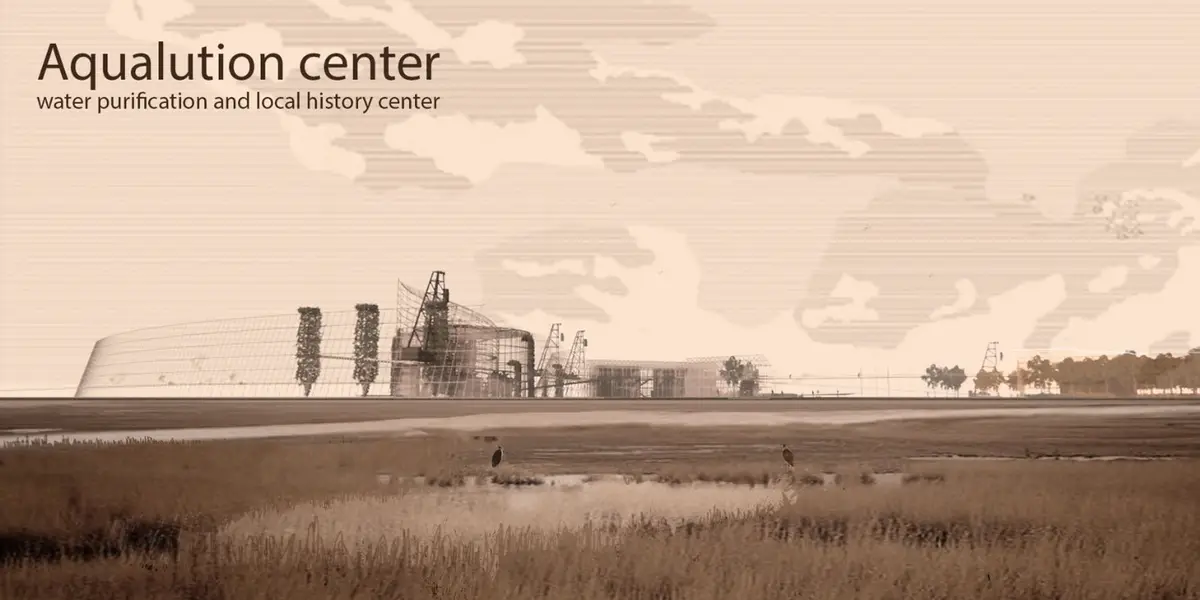
Aqualution Center: Turning Birmingham's Polluted Marshlands into a Water Purification Landmark
Filip Kostic reimagines cooling towers and factory skeletons as ecological infrastructure on the banks of the Tame River.


What happens when you take the architectural silhouette of the Industrial Revolution, the cooling towers and chimneys that once poisoned a river, and repurpose those forms as instruments of ecological repair? The Aqualution Center proposes exactly that: a water purification facility, bottling plant, greenhouse, and museum complex sited on Birmingham's degraded Tame River marshlands, where every building borrows its geometry from the industrial structures that caused the damage in the first place. It is architecture as remediation, using hyperbolic tower profiles and lightweight steel frames not to memorialize pollution but to actively reverse it.
Designed by Filip Kostic and shortlisted in the WIC competition, the project sits at the intersection of heritage interpretation and environmental infrastructure. Birmingham's role as a catalyst of the Industrial Revolution left centuries of ecological scarring along the Tame River and its surrounding wetlands. Rather than treating that history as something to demolish or ignore, Kostic's scheme absorbs it into a new programmatic framework: purification facilities that use marshland sand and native plants like birch for natural water filtration, paired with public spaces that turn the invisible science of water treatment into a visible, walkable experience.
Factory Silhouettes Recast as Ecological Infrastructure
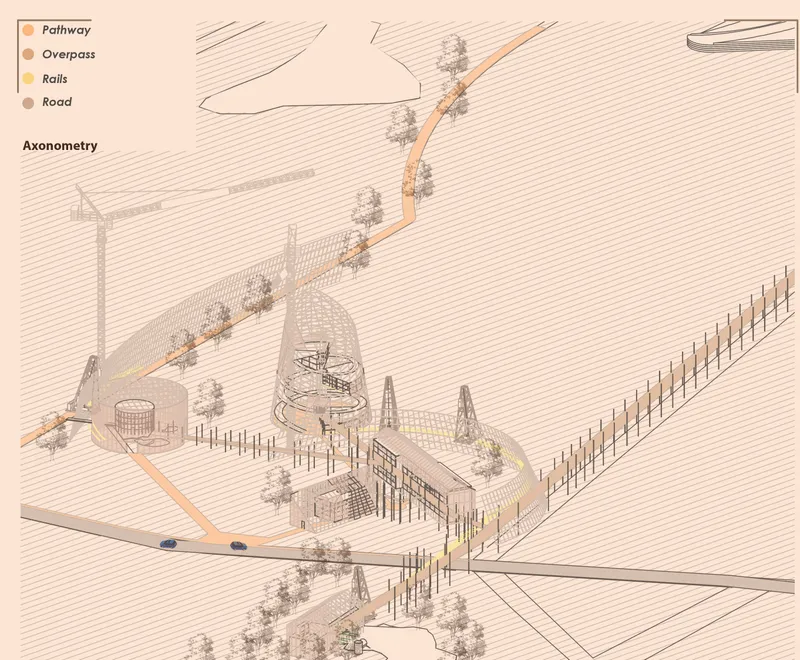
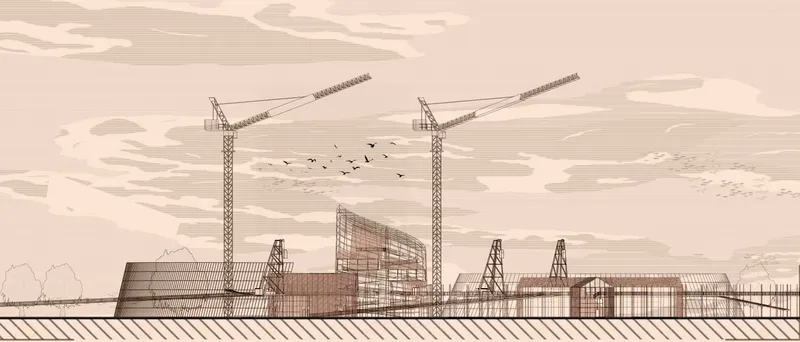
The axonometric and elevation drawings reveal a campus of domed and cylindrical volumes arranged along a winding pathway, their profiles unmistakably referencing cooling towers and industrial sheds. Overhead cranes appear in both drawings, a direct nod to the manufacturing landscape that once occupied these sites. But the context has shifted entirely: the cranes now read as sculptural markers rather than functional machines, and the clustered volumes house purification tanks, a greenhouse, and exhibition halls rather than furnaces. Birds populate the sky in the elevation, a small but pointed signal that the ecosystem is returning.
Kostic builds the structures from lightweight steel frames that echo the skeletal logic of historic factories while incorporating contemporary sustainable technologies. Transparent curtain walls and energy-efficient polycarbonate double facades wrap the frames, maximizing daylight penetration and controlling thermal performance. The result is a structural language that feels honest about its industrial ancestry without romanticizing it.
Elevated Pathways Over Restored Wetlands
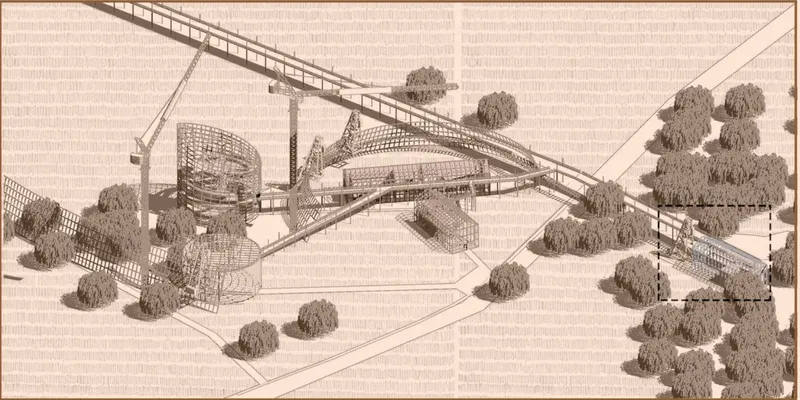
The aerial perspective reveals the full scope of the site strategy: curved volumes connected by an elevated rail line that threads above the restored marshland. These pedestrian platforms trace the patterns of historic industrial pathways, lifted off the ground to protect the fragile wetland ecology below. The move is both practical and symbolic. Visitors walk above the landscape they are learning to steward, tracing routes that once carried raw materials toward furnaces and now carry people toward an understanding of natural filtration processes. Scattered trees punctuate the terrain, evidence of a reforestation effort that works in tandem with the water purification program.
The Greenhouse Center: Industrial Geometry Nurturing Growth
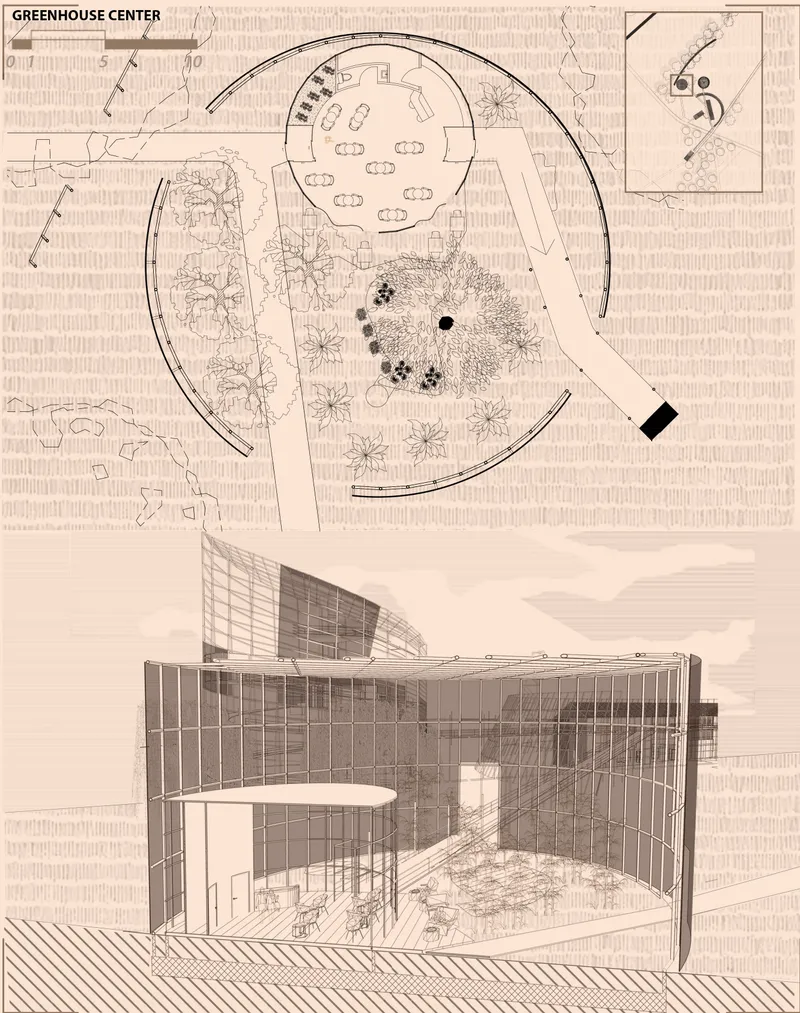
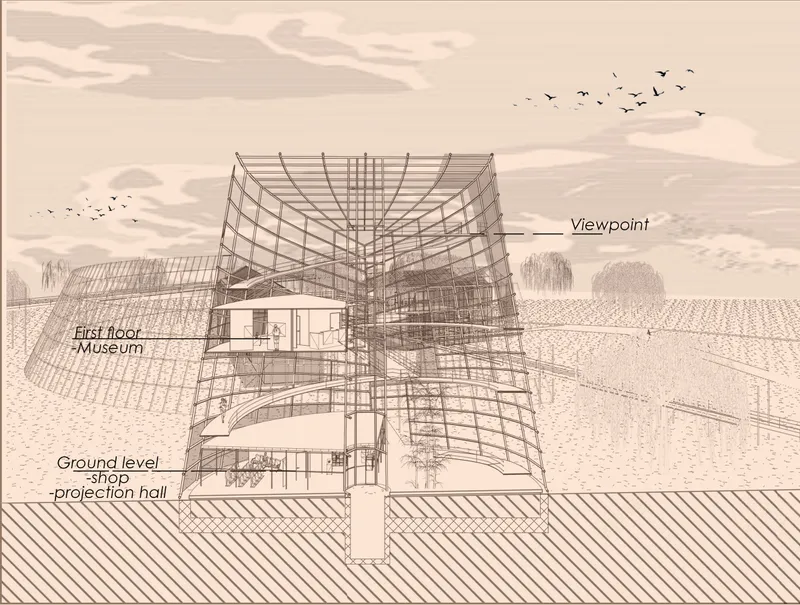
Plan and section drawings of the circular greenhouse center show a cylindrical volume with glazed curved walls enclosing a planted interior. The form continues the industrial architectural vocabulary, recalling gasholders or water tanks, but its contents are entirely organic. Inside, multi-level spaces accommodate planting beds and circulation routes that allow visitors to move vertically through layers of vegetation. The section drawing cuts through the curved glass structure to expose these interior terraces, demonstrating how the building negotiates grade changes while maintaining visual continuity with the landscape outside.
The greenhouse serves a dual role. It is a functional component of the ecological restoration program, nurturing native wetland species that support the natural water filtration process. And it is a public amenity, a space where community members encounter the biological mechanisms that make purification possible. The transparency of the glazed walls makes this interior world legible from outside, collapsing the boundary between infrastructure and exhibition.
Calibrating Transparency: Open Facades and Enclosed Museums
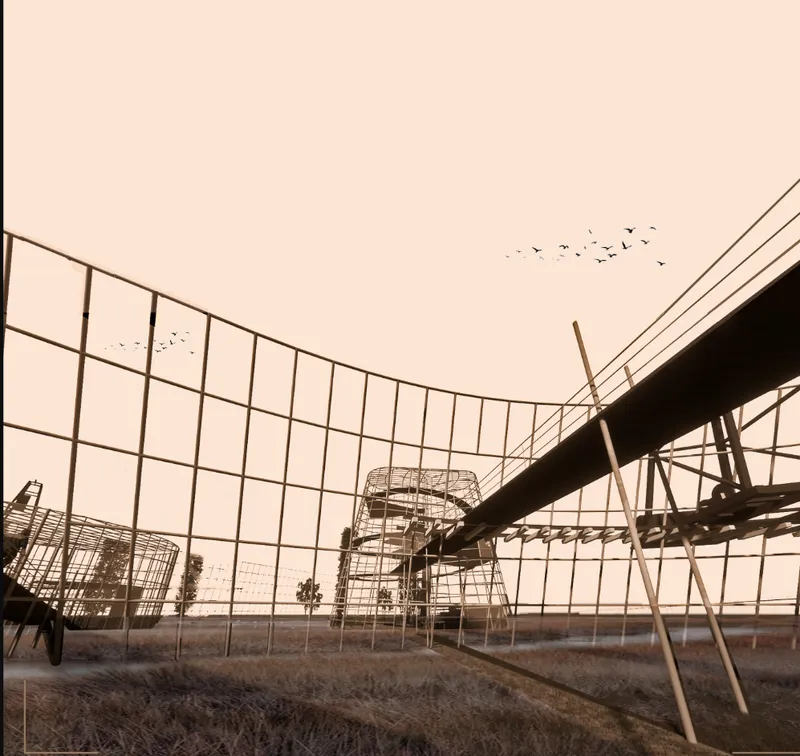
One of the project's more nuanced decisions is the differentiation of facade treatments according to program. The purification and bottling centers feature partially open facades that create a dialogue with the surrounding landscape, inviting the public to witness water's journey from natural filtration to bottling. The view through the curved glass facade toward spiral towers and the overhead rail demonstrates this openness: structure, sky, and infrastructure share the same frame. Meanwhile, the visitor center, housed in a dramatic hyperbolic tower with an immersive museum, projection hall, and panoramic viewpoint, is fully enclosed to protect historical artifacts and optimize conditions for multimedia exhibitions.
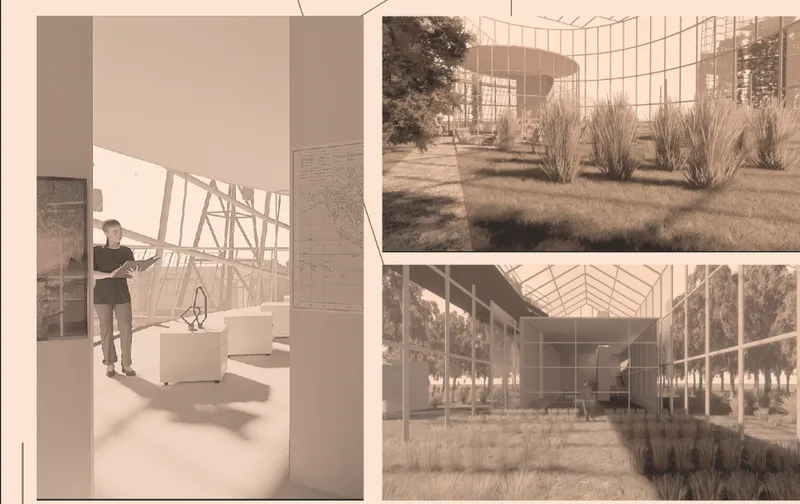
The rendered interior views and exterior perspectives in the final drawings reinforce this calibration. Glazed pavilions sit among ornamental grasses with their structural framing exposed, reading as honest about their construction and welcoming in their spatial atmosphere. The exposed steel members, far from feeling raw, carry the warmth of a design language rooted in local industrial memory. Every joint and connection becomes a small act of storytelling.
Why This Project Matters
The Aqualution Center refuses the easy binary between heritage preservation and environmental restoration. Most adaptive reuse projects pick one or the other: save the building, or clear the site and start fresh. Kostic's scheme does neither. It abstracts the formal language of Birmingham's industrial past, cooling tower profiles, factory skeletons, crane gantries, and redeploys those forms as the structural vocabulary for a functioning ecological facility. The history is not preserved in amber; it is put back to work, this time in service of the landscape it once degraded.
What makes the project particularly compelling as a competition entry is its ambition to operate at multiple scales simultaneously. At the urban scale, it proposes a new public destination that reconnects Birmingham to its riverfront. At the infrastructural scale, it delivers real water purification capacity through natural filtration systems. And at the architectural scale, it offers a material and spatial experience that teaches visitors about both the history of industrial exploitation and the science of ecological recovery. That layering of purpose, delivered through clear formal moves and honest material choices, is what elevates the Aqualution Center beyond a conceptual exercise into a credible proposition for post-industrial urbanism.
View the Full Project
About the Designers
Designer: Filip Kostic
Enter a Design Competition on uni.xyz
uni.xyz runs architecture and design competitions year-round that reward proposals with spatial conviction and real site intelligence.
Project credits: Aqualution Center by Filip Kostic WIC (uni.xyz).


Popular Articles
Popular articles from the community


David Ortega Stacks a Two-Story Mexico City Penthouse Around a Steel Stair and a Pergola-Shaded Roof Terrace
In Colonia Roma, a 300 m² penthouse uses oak joinery, a planted steel stair and a slatted roof pergola to make a new-build apartment feel like a house.

GROUP A Strips a 1969 Rotterdam Harbor Headquarters to Its Frame and Wraps It in Timber Louvers
In Rotterdam's M4H harbor district, Ferro Offices reuses a 1969 frame, adds one timber storey and reaches BREEAM-NL Outstanding.

Cube Design Draws an Ecological Corridor Between Two Shenzhen Hills with the Nankai Building
Beside Shenzhen's container docks, the Nankai Building pairs stacked balconies with a climbing green screen to connect two hillsides across its height.

Juan García Correa, John González and Claudia Rueda Sink a Circular Amphitheater into a Manizales Engineering Building
On the La Nubia campus in Manizales, Colombia, the S1 Building folds labs and offices into a hillside of ramped lawns that double as a campus route.

Similar Reads
You might also enjoy these articles


Vereda Arquitetos Renovates a 40-Square-Meter Apartment Inside Niemeyer's Copan Building
A compact unit in São Paulo's most iconic residential tower gets a material overhaul that pairs exposed concrete with bold blue Formica.

Shakur's House: Exposed Brick as an Interior Organiser in a 168 m² Mashhad Residence
Brick moves indoors in this Mashhad residence, where masonry walls, glass partitions and teal planes sequence a compact home without closing it off.

Day and Night Park: A Time-Based Urban Newsstand in Beijing
A temporary urban newsstand in Beijing blending travel, light, and reading through poetic colors, compact form, and community-focused design.

Modernist Patio Renovation in El Masnou, Barcelona by Oliver Segura Arquitectura + Cebrià Arquitectura
Modernist patio renovation blending tradition and innovation with a movable pool, leveled floors, and Catalan materials in El Masnou.


Comments (0)
Please login or sign up to add comments
No comments yet. Be the first to comment!