Reviving the Forgotten Coast: The Story Behind SARMAD Museum
Architecture is not only about the built form


Introduction
Architecture is not only about the built form; it is also about the forces—social, cultural, environmental, and emotional—that shape it. The “SARMAD Museum” is not just a design project; it is a narrative vessel anchored in Rasheed (Rosetta), Egypt. This city, once a thriving port and cultural melting pot, has receded into quiet anonymity. Through this project, the aim is to rekindle Rasheed’s identity by creating a cultural complex that celebrates its maritime legacy while addressing present-day issues and envisioning a resilient, hopeful future.
The idea for SARMAD was born from the layered reality of Rasheed. Its rich Ottoman architecture, its pivotal location where the Nile meets the Mediterranean, and its history of migration and boat craftsmanship inspired a project rooted in continuity and transformation. But the inspiration goes deeper—into materials shaped by nature: sand, water, wind, lava, and rock. These elements became metaphors throughout the design.
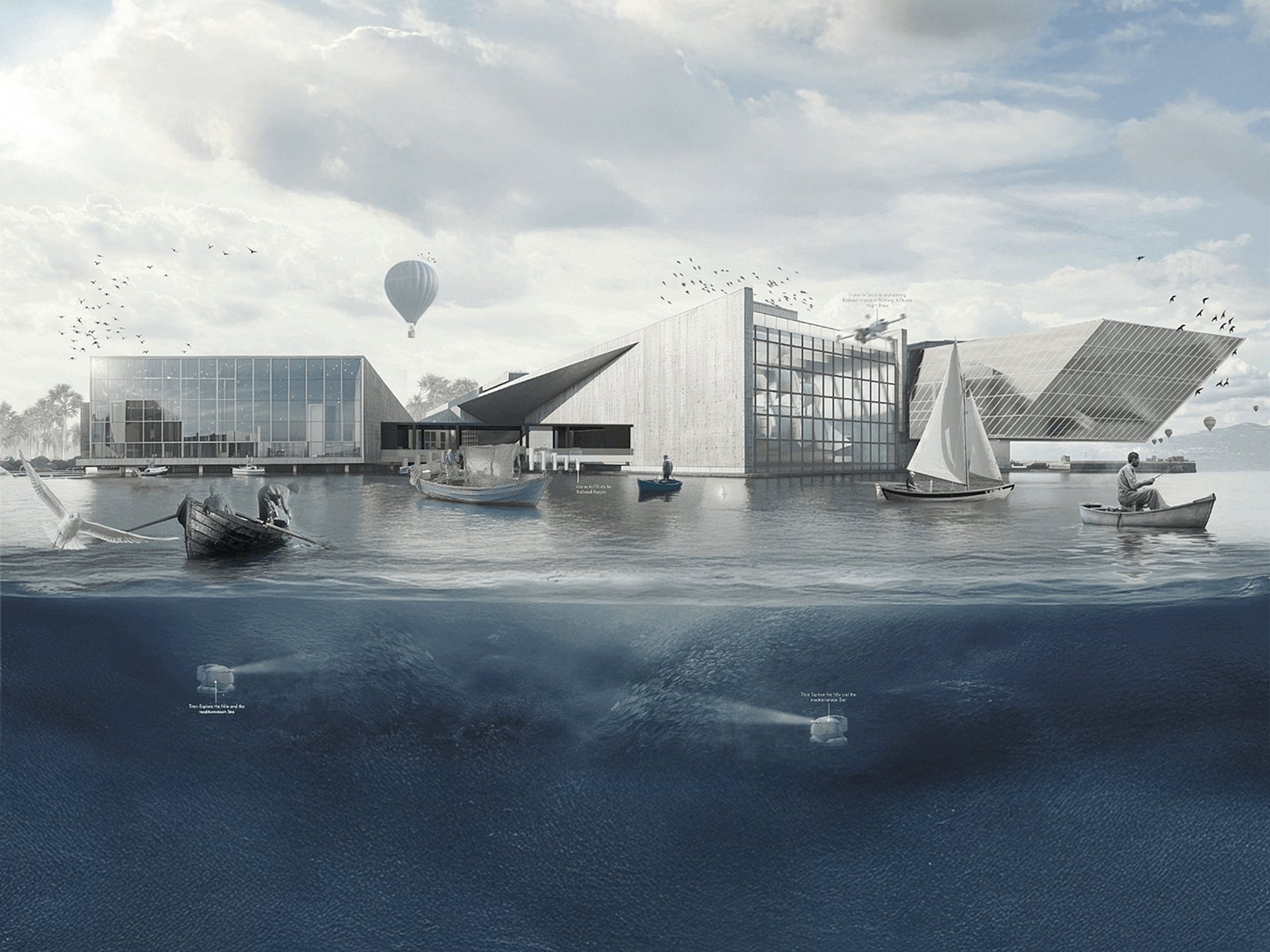
Wind informed the museum’s sail-like geometry, evoking Rasheed’s seafaring past. Sand and water—fluid, shifting, and elemental—guided material choices and spatial flow. Lava symbolized tension and transformation, present in the museum’s deconstructivist language. These themes became the grammar of a spatial story.
The Site and the Context
The site is a triangular plot at the very edge of land: where the Nile spills into the sea. It’s not just geographically symbolic; it’s culturally charged. Historically, Rasheed was a gateway to Africa, a borderland, a place where travelers arrived and departed. Today, the site sits neglected, partially reclaimed by wild vegetation and salt-swept wind.
This dual identity of the site: past prominence and present silence—created a tension that became central to the design. SARMAD is envisioned as a landmark that emerges from water and dissolves into sky, blurring lines between permanence and motion, land and sea, memory and future.
3. Key Design Questions Answered
What is the purpose of the project? To create a cultural and educational space that narrates the evolution of boat-making in Egypt, with layers addressing environmental concerns, socio-economic histories, and aspirations for sustainable futures.
Who is it for? For the people of Rasheed, first and foremost. But also for migrants, students, historians, and tourists: for anyone who seeks to understand the region’s past and participate in its regeneration.
What makes it unique? Its hybrid identity. SARMAD is part-museum, part-storytelling device, and part-laboratory for future solutions. The design is inspired by maritime forms, yet it avoids literal mimicry. It does not reconstruct Rasheed’s history as a static exhibit but reanimates it as a living continuum.
What challenges did the design respond to?
- Climate and flooding risk
- Neglected local crafts and economy
- Youth emigration and identity crisis
- The architectural void in Rasheed
How is sustainability addressed? Through passive ventilation, solar-integrated façades, use of local stone and reclaimed wood, and water-sensitive landscaping. But more importantly, by proposing a cultural sustainability: reviving a lost sense of place.
4. The Design Process
Conceptual Phase The initial sketches explored metaphors: drifting boats, breaking waves, fragmented coastlines. The idea of tectonic collision emerged—both as a spatial gesture and a socio-cultural one. Rasheed, after all, is a place of historical collision—between continents, empires, identities.
Form-Finding and Deconstructivism Instead of composing a singular, monumental building, the design fragments the museum into intersecting volumes—angled, misaligned, yet cohesive. Inspired by Deconstructivist principles (like those seen in works by Zaha Hadid or Daniel Libeskind), the architecture challenges symmetry, favoring complexity and movement.
Spatial Zoning The journey begins at an open-air court—symbolizing Rasheed’s public life. It progresses through five main exhibition halls:
- Origins: focused on ancient Nile boats, materials, and myths.
- Craftsmanship: showcasing tools, techniques, and stories of local shipwrights.
- Crossings: dedicated to migration, trade, and Rasheed’s diasporic connections.
- Resistance and Resilience: including stories of refugees, illegal migration, and political resistance through boats.
- Future Technologies Hall: imagining future mobility, ocean sustainability, and youth-led innovation.
Material and Atmosphere The materials mirror the themes: oxidized metal evokes time and weathering; translucent polycarbonate panels glow like sails at twilight; internal timber evokes boat ribs and craftsmanship. The atmosphere is immersive, guided by water sounds, filtered sunlight, and views toward the sea.
5. Theoretical Integration
The SARMAD project is not divorced from theory. It is a built response to ideas of spatial memory, borderlands, and nonlinear narrative architecture. Inspired by theorists like Edward Said (on identity and exile) and Bernard Tschumi (on event-space relationships), the museum unfolds like a cinematic sequence. Spaces do not follow a linear chronology but intersect and overlap, like memories do.
6. Conclusion: A Living Museum
SARMAD is not just a project, but a proposition—a way of re-seeing Rasheed not as a forgotten port but as a site of convergence and transformation. It is architecture as storytelling, memory as form, and space as resistance.
This journal, like the museum itself, aims to go beyond the image. It hopes to connect theory with application, memory with future, and word with design. For students, critics, or the casually curious, it is an invitation to dive beneath the surface and experience architecture as a cultural continuum.