

REWA: Riverfront Architecture That Treats Displacement as a Living Process
A rehabilitation framework for India's Narmada Valley villages reframes resettlement as continuity, not rupture, through adaptive civic space.


What happens when a village is not destroyed in a single catastrophic event but slowly, cyclically swallowed by rising reservoir waters over decades? The typical governmental answer is relocation: standardized housing plots, severed social networks, and a clean administrative line drawn between the old life and the new. REWA refuses that line. Situated in the dispute zone of Nisarpur in Madhya Pradesh's Dhar District, the project treats displacement along the Narmada River not as a singular moment of loss but as a prolonged temporal condition, and designs architecture that can absorb that condition rather than deny it.
Designed by Jane James for the UnIATA 2020 competition, REWA draws its programme directly from the lived realities of Nisarpur's villagers: their settlement patterns, occupational structures, cultural rituals, and deep relationship with the river. Rather than proposing a static resettlement layout, the project introduces adaptable spatial systems anchored by a reimagined marketplace that functions as both economic engine and social condenser. The result is a rehabilitation framework that sustains the essence of the old village in a fundamentally transformed landscape.
A Circular Courtyard Against the Fog of Displacement
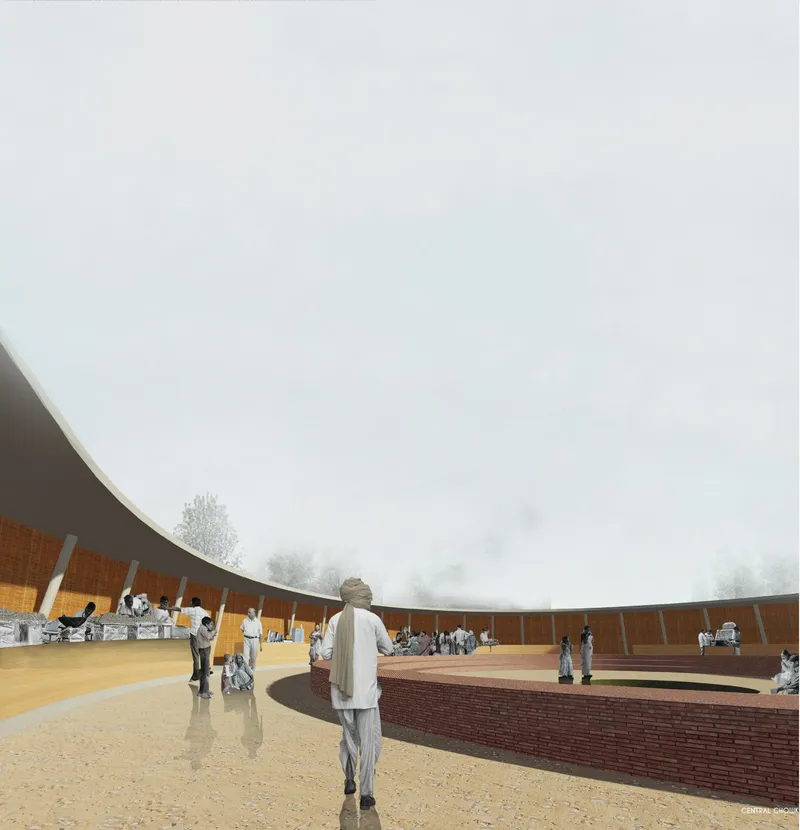
The project's spatial identity announces itself through a striking circular courtyard enclosed by red brick walls and sheltered beneath a sweeping white canopy. The form is deliberate: in a context where conventional resettlement colonies tend toward gridded anonymity, this courtyard establishes a center of gravity. It recalls the compact, walkable settlement logic of the original village, where living, working, trading, and social interaction all unfolded within a tight radius. The enclosing brick walls offer both threshold and enclosure, while the canopy hovers above like a broad sheltering gesture, permeable to air and diffused light.
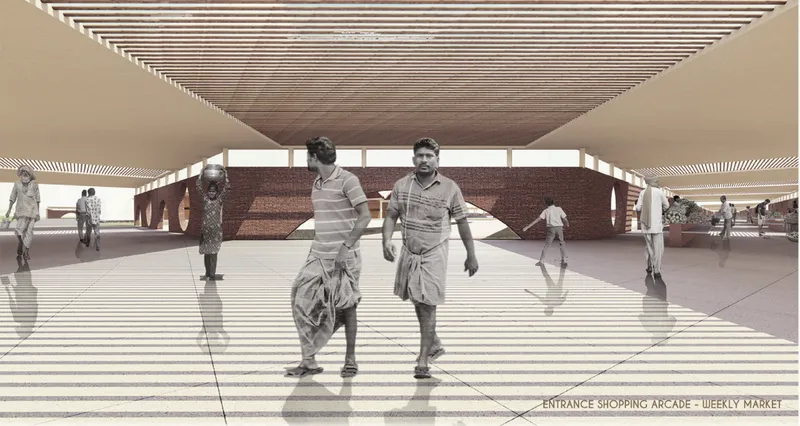
Adjacent to the courtyard, a covered plaza demonstrates REWA's commitment to porosity. A slatted timber ceiling casts striped shadows across the ground plane, modulating light and heat for pedestrians below. The effect is atmospheric but functional: these shaded circulation zones are designed to accommodate varying intensities of use across market days, non-market days, festivals, and seasonal fluctuations. The architecture does not prescribe a single mode of occupation; it provides the scaffolding for multiple modes to coexist.
Red Brick and Timber: A Material Language Rooted in Place
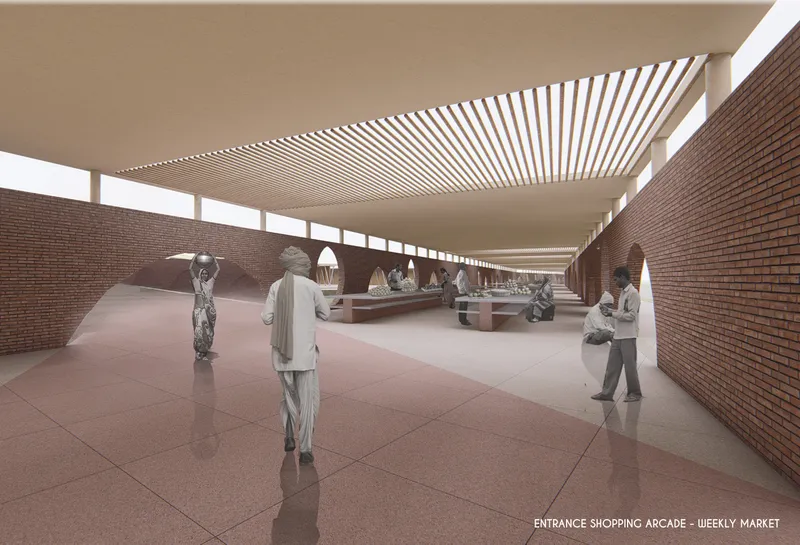
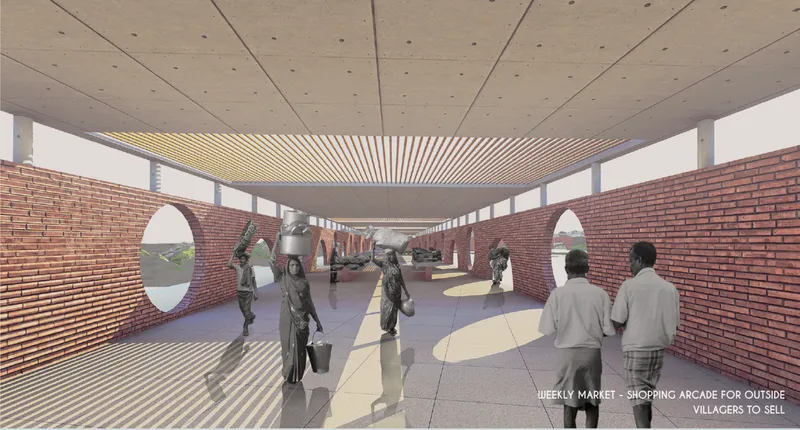
Walk through REWA's interior corridors and the material palette becomes immediately legible: red brick walls paired with timber slat ceilings that filter natural light into dappled patterns on the floor. The choice is not merely aesthetic. Red brick is locally available, thermally appropriate for Madhya Pradesh's climate, and carries a visual warmth that connects the new settlement to the earthen materiality of the Narmada Valley's vernacular construction. The timber slats serve a dual role, providing structural rhythm overhead while controlling solar gain through calibrated spacing.
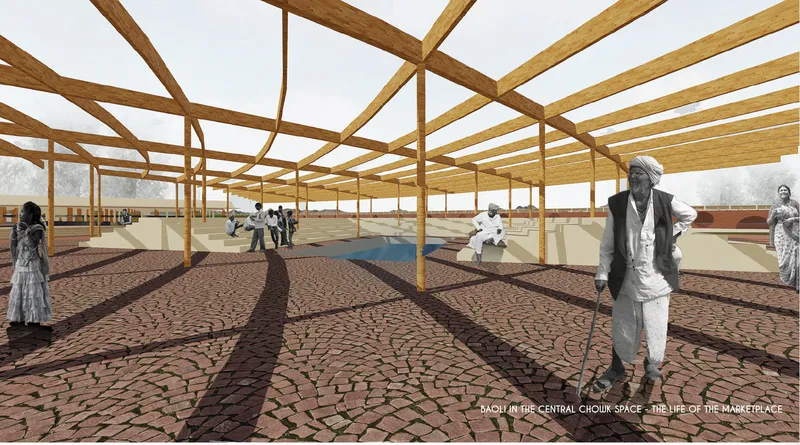
The open-air market space amplifies this language at a civic scale. Radiating timber beams fan outward above a patterned brick paving surface, defining a space that is clearly structured yet open to appropriation. On market days, this becomes the node of exchange and cultural visibility that Nisarpur's traditional bazaar always was, drawing people from surrounding settlements. On quieter days, the space recedes into a shaded courtyard for gathering and rest. The paving pattern itself suggests zoning without hard boundaries, a spatial strategy that mirrors the overlapping functions of the original village.
A Canopy That Hovers Between Shelter and Landscape
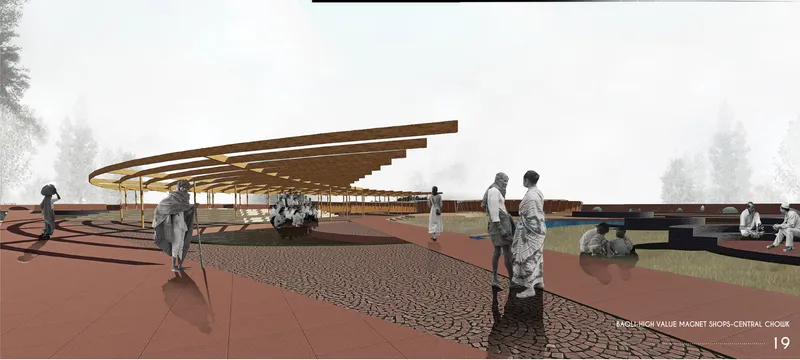
Seen from the exterior, the layered timber canopy structure reads as something between a building and a landscape intervention. It hovers over textured paving, its edges dissolving into distant tree lines rather than terminating in hard walls. This is architecture that understands its role in a rehabilitation context: it must provide legibility and civic presence without imposing the kind of institutional rigidity that alienates displaced communities. The canopy shelters without enclosing, organizes without dictating.
The arcade view through circular openings in the brick walls reinforces this balance between structure and permeability. These openings frame views, channel breezes, and create a rhythmic sequence of compression and release as one moves through the building. The effect recalls the spatial generosity of traditional Indian market arcades, where the boundary between inside and outside is always negotiable. In REWA, that negotiability is not a stylistic choice; it is a direct response to the social patterns of Nisarpur's villagers, whose daily life depends on fluid transitions between domestic, commercial, and communal space.
Water as Design Partner, Not Threat
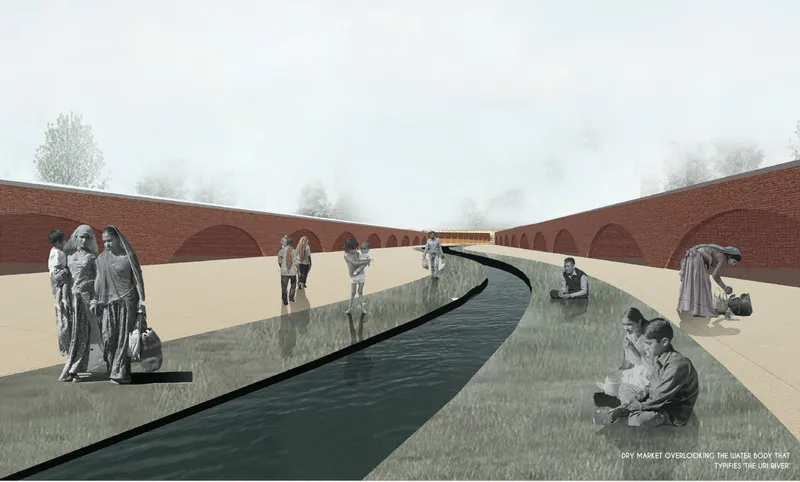
Perhaps the most conceptually loaded element of REWA is its treatment of water. A curving channel flanked by concrete walls runs through the site, bringing the presence of the river into the heart of the rehabilitation settlement. For a community defined by its relationship with the Narmada, whose spiritual rituals, livelihoods, and collective identity are inseparable from the river's cycles, this is not decorative landscaping. It is an act of spatial continuity. Water levels in the Narmada rise and recede seasonally, and the project's adaptable spatial systems acknowledge this cyclical change rather than designing against it.
The figures standing against the red brick wall beside the channel are telling. They occupy the space casually, as if the water feature were always there, always part of village life. That ordinariness is precisely the point. REWA does not memorialize the river in a monumental way; it reintegrates the river's presence into everyday spatial experience. The architecture becomes a medium through which the community's relationship with water can continue evolving rather than being abruptly severed by the dam.
Why This Project Matters
India's dam-led development has displaced millions. The standard response, resettlement colonies with standardized plot layouts, has been widely documented as producing social fragmentation, economic disconnection, and the quiet erasure of place-based identity. REWA challenges that paradigm by demonstrating that rehabilitation architecture can be specific, adaptive, and culturally grounded. By translating the settlement logic, market rhythms, and material culture of Nisarpur into a new spatial framework, the project makes a compelling argument that resettlement need not mean starting from zero.
What makes Jane James's proposal particularly significant is its refusal to treat displacement as a design problem with a fixed solution. The adaptable structures, the seasonal responsiveness, the reintroduction of water as a spatial element: these are strategies that acknowledge time as a design variable. Architecture here is not a container for a new life but a framework through which an ongoing life can continue to unfold. For the villages of the Narmada Valley, that distinction is everything.
View the Full Project
About the Designers
Designer: Jane James
Enter a Design Competition on uni.xyz
uni.xyz runs architecture and design competitions year-round that reward proposals with spatial conviction and real site intelligence.
Project credits: REWA – The Manifestations in Time by Jane James UnIATA 2020 (uni.xyz).



Popular Articles
Popular articles from the community


Riyadh For All: Intergenerational Urban Design for Active Aging in Rabat
Riyadh For All reimagines urban design in Rabat with intergenerational co-living, adaptive courtyards, and Moroccan cultural exchange today.

The Musturak Paradise: Senior Living Architecture for a Connected Future in Temara, Morocco
The Musturak Paradise reimagines senior living architecture in Temara via private homes, social spaces, culture, community, and shared care.

Conexión: Biophilic Design Reimagines High-Rise Living in Hong Kong
Conexión reimagines high-rise living in Hong Kong through biophilic design, green facades, shared spaces, daylight, water and nature within.

The Ocean Hive: Sustainable Architecture for a Self-Sufficient Civilization at Sea
The Ocean Hive imagines sustainable architecture at sea, where modular habitats, algae, wave power and ocean waste sustain a growing colony.


Similar Reads
You might also enjoy these articles
Sustainable Architecture Design: Embracing Nature and Modernity at Villa Solsidan
The article explores Villa Solsidan by AndrénFogelström, showcasing its sustainable architecture design and integration with the natural surroundings in Saltsjöbaden, Sweden.
Scientific and Educational Monitoring Center of the Yenisei, Krasnoyarsk
Architecture as an instrument for ecological research, education, and environmental awareness along Russia’s largest river.
Development of Andretta Artist’s Village, Palampur, Himachal Pradesh, India
Reimagining Andretta as a living cultural landscape where art, architecture, and community converge to shape a global creative village.
Street Children Rehabilitation Center: A Model of Social Architecture for Community Rehabilitation
An inclusive social architecture project that transforms streets into nurturing environments, restoring dignity, identity, and opportunity for vulnerable children.

Comments (0)
Please login or sign up to add comments
No comments yet. Be the first to comment!