
Saghan House
A Unique Compact House

About the Characters
The apartment has been designed keeping in mind three ladies. A single mother, her sister and her daughter.
- The mother is an IT professional who spends most of her day in office. In her free time, she likes to do photography.
- Her sister is a writer. She works from home and spends most of her time reading.
- The youngest, her daughter, is an architecture student. She goes to college and has friends over at home sometimes for group work. She enjoys baking in her free time.
- Another member of this family is their dog, who has a small, comfortable space in the writer’s room
What was the concept behind the project?
- For maximum utilization of space all the spaces designed have multiple uses. Most of the furniture is dynamic and can be used in multiple ways, and storage is integrated with the furniture wherever possible.
- Because the area is small, the entire unit has been designed with an open plan. This gives the user a perception of spaces flowing into each other.
- Spaces have been segregated as public, semi-private and private. Most parts of the house can be used as public zones but the three residents have their own private zones which can be closed off from the rest of the house when need be. Retractable panels have been provided where required to make these spaces private.
- The provision of double heighted spaces, full length windows and light colors make the house look larger than it actually is.
- The full length windows allow plenty of natural light and ventilation into the house.
- Indoor plants and a green wall in the balcony add to the natural setting of the house in addition to the windows.
What was the intent behind the organization of elements across various levels?
The spaces have been zoned keeping in mind various factors including heights, privacy and the usage of the space. The mezzanine levels have been designed considering the height of an average Indian woman (the writer). The lower level has been designed considering the fact that visitors could be taller. The mini theatre provided on the mezzanine level has the lowest ceiling height because this space is meant to be cozy with only floor cushions to sit on. The staircase to this space has also been separated from the one to the writer’s room to maintain privacy. Care has been taken to not waste any space while providing two staircases.
Details of all the units and furniture design
- Entrance and Kitchen Unit - This unit includes the entrance with coat hanger and shoe rack along with the mother’s wardrobe. The kitchen space within the unit consists of an induction plate, sink, microwave, ductless chimney, a refrigerator, pantry and a utility space with a dishwasher and washing machine. When closed, the kitchenette looks like any other storage space.
- Murphy bed Unit - This unit includes the Murphy bed for the mother aka the IT Professional, some storage and the retractable partition to make the mother’s sleeping space private. Along with this is the staircase connecting the mezzanine levels and a small seating space underneath it that can be used in multiple ways.
- Coffee table & kitchen counter - The coffee table has been designed in a way so that it can also be used as the kitchen counter by increasing the height(450mm and 900mm) of it. This table is expandable in both forms so that it doesn’t take up too much space when not in use, but can expand to double its width (300mm and 600mm) when required.
- Dining table - The dining table, like the coffee table is expandable (width- 600mm and 1200mm) with extra chairs stored as well for when the residents have visitors coming over for meals.
- Chairs - The chairs have an adjustable height (450mm to 600mm)
- Central Unit - The Central Unit can be used from both sides and on both levels. It works as a TV Unit and cupboard for the architect on the lower level. And as a projector screen with storage on one side and the writers cupboard and dressing on the other side at mezzanine level.
- Architect’s work desk - This has been designed in a way that it can be used as both a desk and a bed-table.
- Writer’s bedroom Unit - This unit includes the writer’s desk, storage, a French window seating and the retractable partition to make the sleeping space private. It also has space for the futon bed that has been provided for the writer and a bed for the dog under the window seating.
- Table in writer’s room - The table in the writer’s room has an adjustable height and can be used on the bed, on the sofa and on the window seat.
Extra Points to Mention
- The louvered sliding folding panels provide a visual barrier but allow flow of air, hence the central air conditioning still works when all spaces have been closed off from one another.
- Care has been taken so that even when all spaces are separated using panels, every part of the unit will have enough natural light and ventilation.
- When entering the house, you go through a very compact passage and suddenly entire a double-heighted space, because of which your first perception of the space is large.
How were the materials chosen?
- The interior design style adopted is Scandavian which is primarily characterized by the principles of minimalism, simplicity, and functionality.
- All the walls and large units have been given light colors so that they reflect more light and make the space look large. So that these light colors don’t make the space look too dull, a contrast is provided by adding blue to some of the décor. Some spaces like the reading area on the mezzanine floor have also been highlighted using dark colors on the wall.
- Railings in the apartment have been designed to not look very heavy and fit in perfectly with the rest of the furniture.
What is the future scope of the project?
The modular unit we have designed can be used in many different ways, especially in co-living complex setting, where individuals or groups of people come looking for quality living that is not very expensive. Co-living is the future of apartments in all the major cities and IT hubs in our country. This unit can act as a module which can be used as a part of various modular constructions across different cities.
Why co-living complexes - Today, the tall apartment-style buildings dominate the skyline of every urban city in our country (India), given the advantage of their easy and functional mass production. Besides, these cities are also overflowing with such apartments because of the changed lifestyle of the middle-class worker into a variety of individuals who are now engaged in occupations that are less permanent and more creative. These individuals are constantly on a move.
Consecutively, due to the ever-increasing costs of apartments and the lack of suitable rental options in these gateway cities, there is a growing gap between the supply and demand of housing for this young generation. At present, most of these demands are being met by the informal sector, for example, PGs, dorms, and even hostels with ill-designed accommodations and access to limited facilities coupled with the false perceptions perceived by the landlords and homeowners for those who are single or students. These are not a favorable choice for millennials, who prefer spending a little more money to enjoy better living standards, even if it is in a compact space.
Hence, the Co-living industry has evolved over a few years in India and have met this great demand perfectly by creating quality living spaces for young people and in the meantime have built great businesses opportunities as well. This industry is bound to drive the Indian rental market in the near future.



Popular Articles
Popular articles from the community


The Ocean Hive: Sustainable Architecture for a Self-Sufficient Civilization at Sea
The Ocean Hive imagines sustainable architecture at sea, where modular habitats, algae, wave power and ocean waste sustain a growing colony.

Riyadh For All: Intergenerational Urban Design for Active Aging in Rabat
Riyadh For All reimagines urban design in Rabat with intergenerational co-living, adaptive courtyards, and Moroccan cultural exchange today.

Conexión: Biophilic Design Reimagines High-Rise Living in Hong Kong
Conexión reimagines high-rise living in Hong Kong through biophilic design, green facades, shared spaces, daylight, water and nature within.

The Earth Pod: 3D Printed Homes for Resilient Refugee Communities
The Earth Pod reimagines refugee housing through 3D printed homes made from clay, combining resilience, self-sufficiency, and rapid shelter.

Similar Reads
You might also enjoy these articles

Day and Night Park: A Time-Based Urban Newsstand in Beijing
A temporary urban newsstand in Beijing blending travel, light, and reading through poetic colors, compact form, and community-focused design.

Modernist Patio Renovation in El Masnou, Barcelona by Oliver Segura Arquitectura + Cebrià Arquitectura
Modernist patio renovation blending tradition and innovation with a movable pool, leveled floors, and Catalan materials in El Masnou.

Alto Residencial Coop: Cooperative Housing Development in Santiago de Compostela by Carbajo Barrios Arquitectos
A linear cooperative housing complex blending white volumes and perforated metal façades, enhancing community living, natural light, privacy, and urban integration.
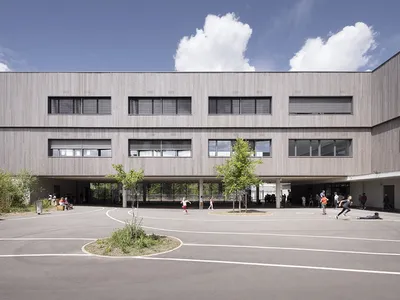
Vil Genis School by BPA ARCHITECTURE – Massy, France
Vil Genis School in Massy, France, features sustainable design, south-facing classrooms, community integration, accessible spaces, and modern educational architecture.


Explore Container House Competitions
Discover active competitions in this discipline




Challenge to reimagine the Iron Throne


Photograph architecture without architects


Illustrate the lost glory of Angkor Wat - Render Challenge


Design challenge to reuse E-waste
Comments (0)
Please login or sign up to add comments
No comments yet. Be the first to comment!