SECTIONS IN MODULES
a modulor bus stop design project


We are three friends who are architectural students from the same university in Turkey, Ankara. Our university is a city university, and it is located next to the center of the city. That’s why most of the students use public transformation to arrive there. On most of the regular days, we use the bus; therefore, we spend lots of time in the bus station. The main road to arrive at our university crosses through the open square called Güvenpark. In Güvenpark, people profiles are various. There are many students, older adults, and employees, such as people who work for government offices or private sectors. There are also many commercial areas near Güvenpark, so another people profile is those who want to shop in these stores. After all, we can say that Güvenpark is a cosmopolitan part of our city. Moreover, Güvenpark is the heart of the city because the pedestrian flow and the public transport network intersect at Güvenpark. You can always find a bus that can take you to wherever you want, in Güvenpark.
It was another day after the class, and we were returning to our houses. While we were waiting for the bus, we realized that most bus stations do not have any identity; they only act as shelters to create a simple space to wait for the bus. Also, we realized that many people face some problems at the bus stops. For instance, most of the time, students carry heavy bags, and they want to sit while they are waiting on the bus. However, when older adults come to the bus station, they allow these older adults to sit on the bus stop’s benches because of respect. Even though the students want to put their heavy bags on the benches after a very long tiring day, should they give other people space to sit? After all of these observations, we start thinking about what would happen if we design this bus stop. The bus stops are small-scaled constructions; however, their duties are more extensive than their sizes. They are an essential part of our daily lives, so why not design one.
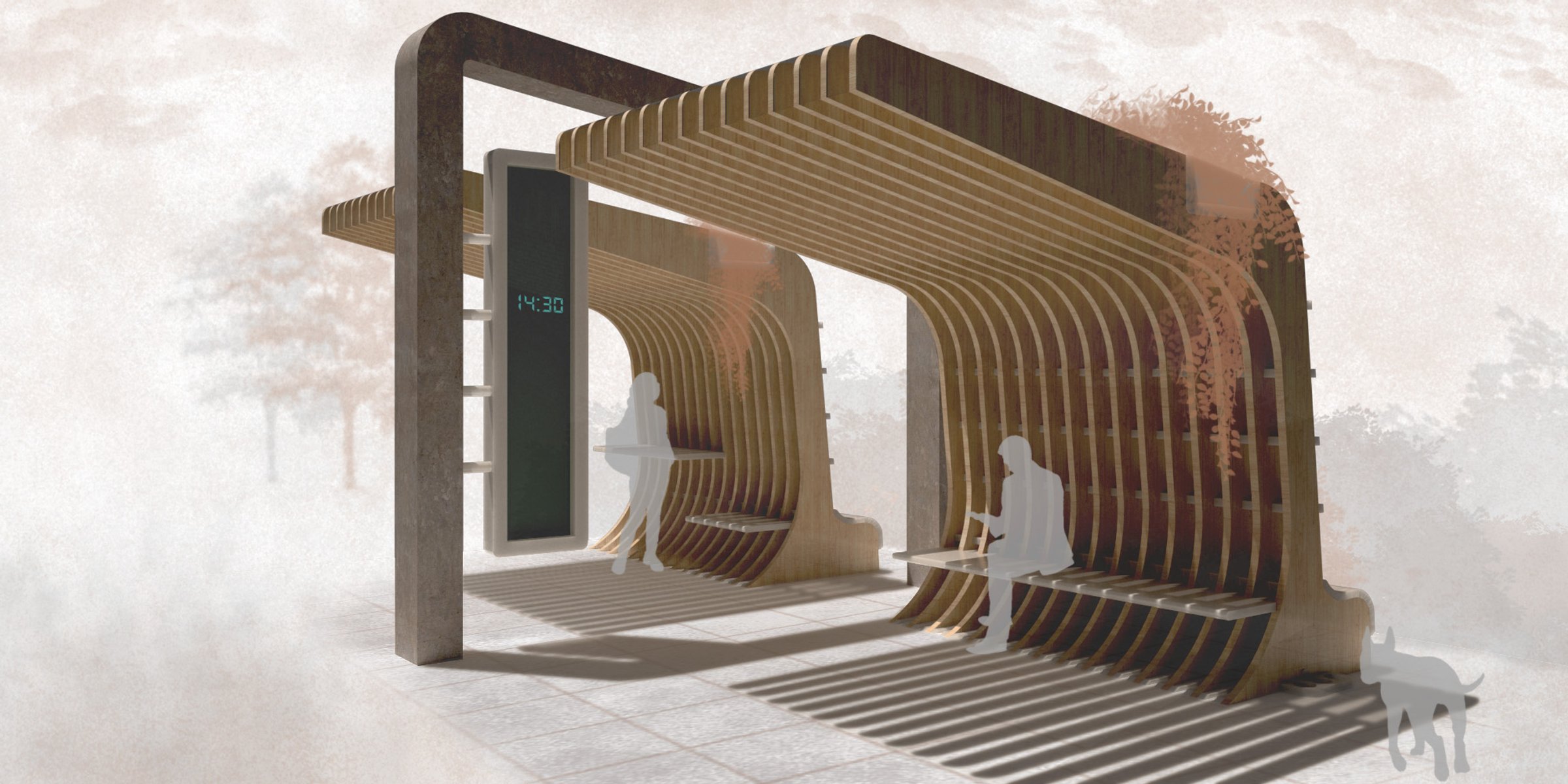
While we were starting our design, we imagined a bus stop, which is suitable for every occasion. That’s why our design keywords are adaptability, flexibility, and modularity. The needs of every neighborhood are different from one another. First of all, the people profile of each neighborhood can vary, so the bus stop has to serve different needs. Therefore, this bus stop should be a modular one rather than a massive one. With the idea of modularity, we can quickly achieve our initial design purpose. We used section operation to achieve modularity. We have a lot of sections, and they are adaptable for the work together. There are two reasons why we choose sectioning as a design operation. First of all, our design has curvilinear edges, and second of all, we want to use wood as a material. Besides, we want our design to work in harmony with nature, so it should be part of it.
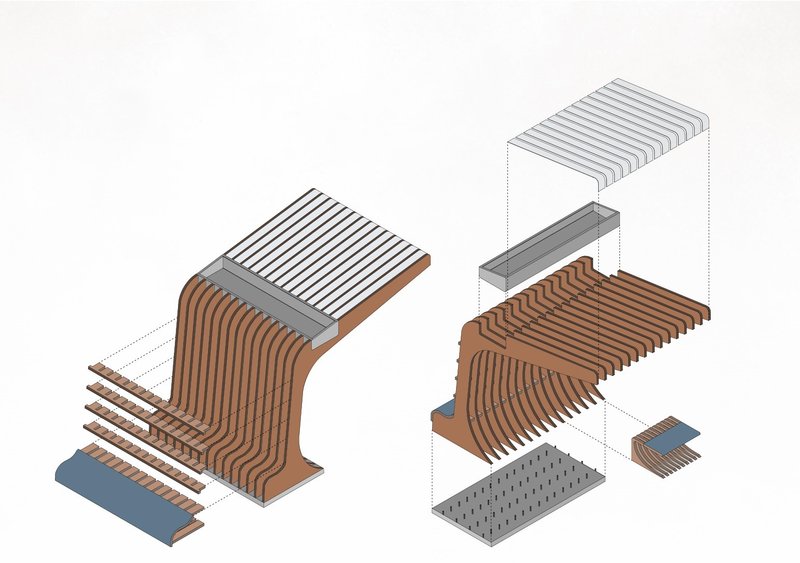
Similarly, we add some plants on the top of the bus stop. We use the top of the bus stop either as a small green area, so we use rainwater for our plants. Because of the sectioned wood panels, this bus stop constructs in the site easily. There are two types of panels: vertical ones and horizontal ones. The size of vertical panels is more significant than the horizontals because vertical ones are main panels. We use horizontal panels attach for vertical panels, and they work mainly for the structure. Moreover, you can add whatever you need into this design, as it is flexible. For example, in some parts of our city, most people use the bicycle to reach the bus stop because, in some cases, bus stops are far away from the residential settlements. That’s why they have to park their bikes at bus stops, and with this idea, we create additional bicycle parking in our bus station design.
As it was mentioned before, there are lots of students and older adults in the city center. We want to solve the heavy bags issue by adding a simple panel to our bus stop to put their heavy bags here waiting for the bus. Besides, there are many dogs and cats in Turkey that have to live in the streets, and most of the time, they need some food and clean water. We also consider them our user profile for our design, and we add some additional parts for them to reach food and water. Furthermore, we realized that the bus stop’s backside does not work efficiently, so we add a sitting area for more people, even those who don’t wait for the bus to sit in the seats.
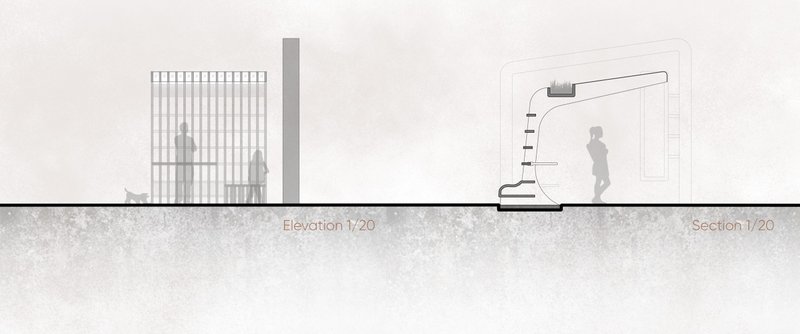
Also, we have reinforced concrete part in our design, which is used to separate the units. For some alternative scenarios, our bus stop design can come together with more than one unit according to the needs, and we use concrete parts to differentiate the units. Besides, this bus stop independently produces energy. There are some small solar panels on the top of the concrete part, so we do not have to consume city energy for digital screens and lamps.
To sum up, this bus stop will never get outdated in the future because it has a flexible design idea. It can adapt to every new situation. Solar panels may not be used for energy even someday, but this bus stop design will easily be attached to new units with different reused energy methods. It can improve itself because of the sectioned panels.