
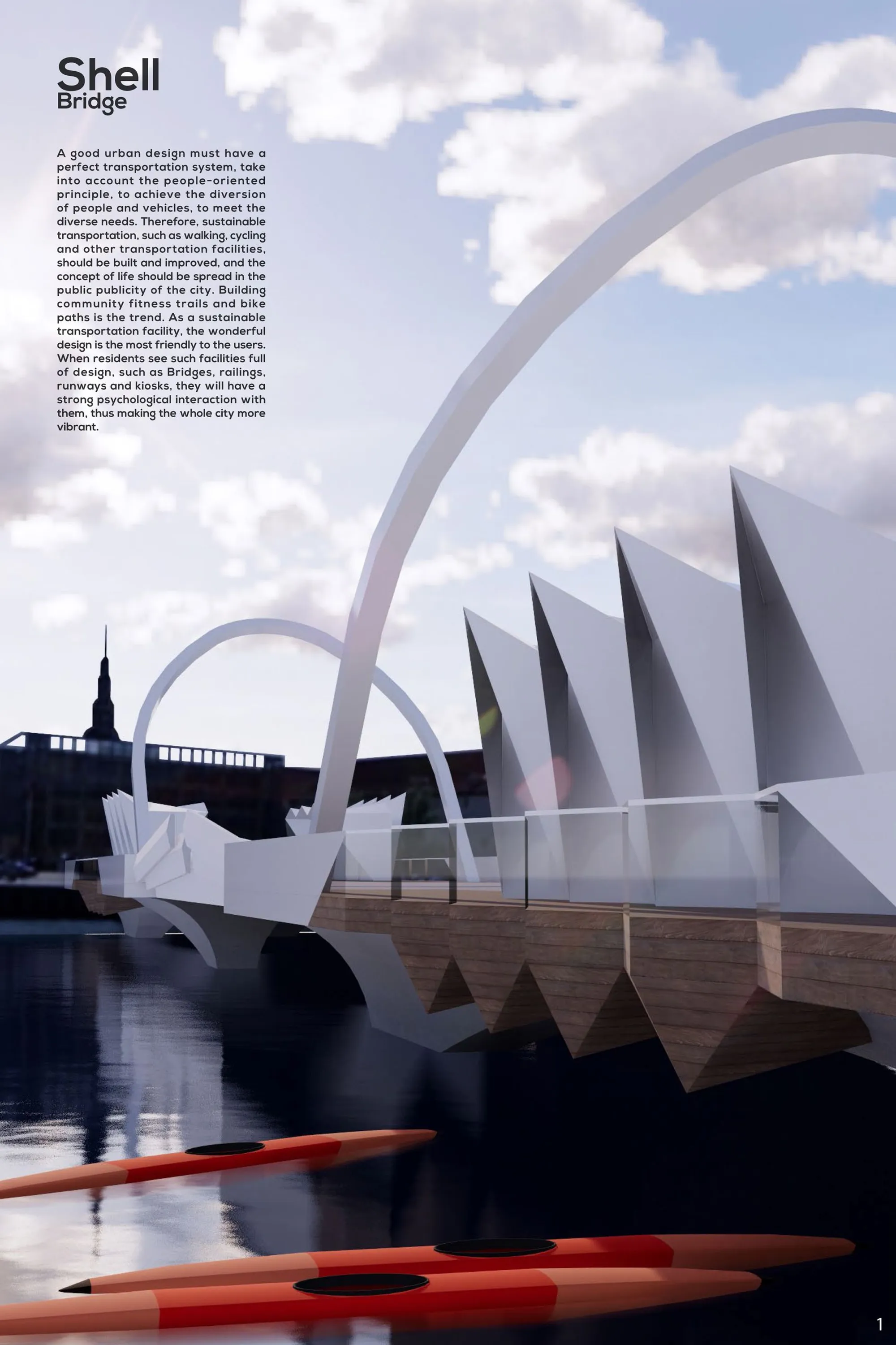
Shell Bridge: Cycling Infrastructure as Civic Architecture in Copenhagen
A biomorphic bridge fuses bicycle mobility, public programming, and shell-inspired structure to reimagine urban crossings as social destinations.


What if a bridge refused to be just a bridge? The Shell Bridge in Copenhagen takes that question seriously, proposing a crossing that doubles as a bike shop, a café, a conference center, and a piece of public sculpture. Inspired by the layered geometry of mollusk shells found along riverbanks, the design treats infrastructure as a civic stage: a place where daily commuters grab coffee at 9:00 am, where tourists pause at viewing platforms at sunset, and where the structure itself opens to let boats pass through like a slow mechanical performance.
The project is the work of designers Yuqing Zhang, Yuan Jiang, Jiaming Fan, and Zhiquan Zhu. Sited in a low-rise Copenhagen context, the bridge links urban districts previously separated by water, channeling the city's deep cycling culture into an architectural proposition that treats the bicycle not merely as transport but as a cultural lifestyle. The result is a hybrid space of transit, pause, and interaction.
Twin Arches Over Still Water
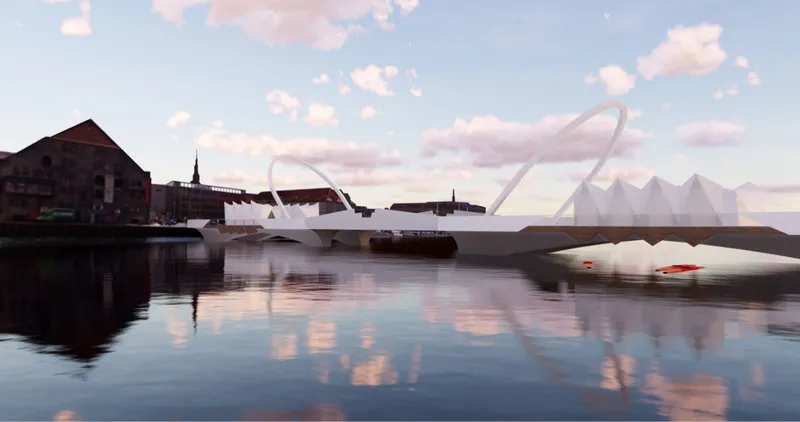
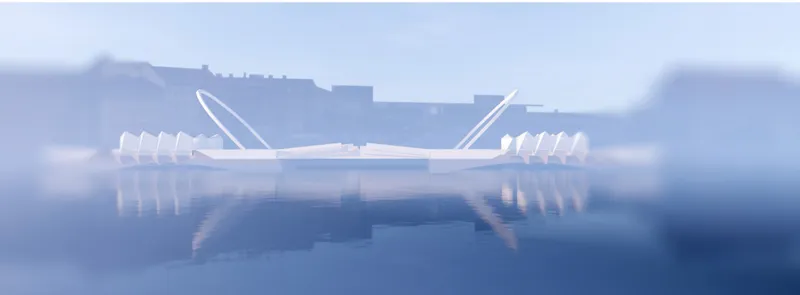
The bridge's structural identity comes from a pair of symmetrical arched supports that rise from the waterline, their curves echoing the protective form of a shell. Tensioned cables extend from the arches to suspend the deck, creating a visual rhythm that reads differently depending on the angle and the time of day. At dusk, the structure and its reflection merge into a single composition on the calm water surface, turning the bridge into a visual anchor for the surrounding cityscape.
This biomorphic approach is more than aesthetic play. The shell geometry provides layered strength suited to public infrastructure while allowing the profile to remain light and open. The soft curves blend into the waterline rather than imposing on it, a deliberate posture for a low-rise urban context where the bridge needs to connect districts without dominating them.
Programming a Bridge as a Neighborhood
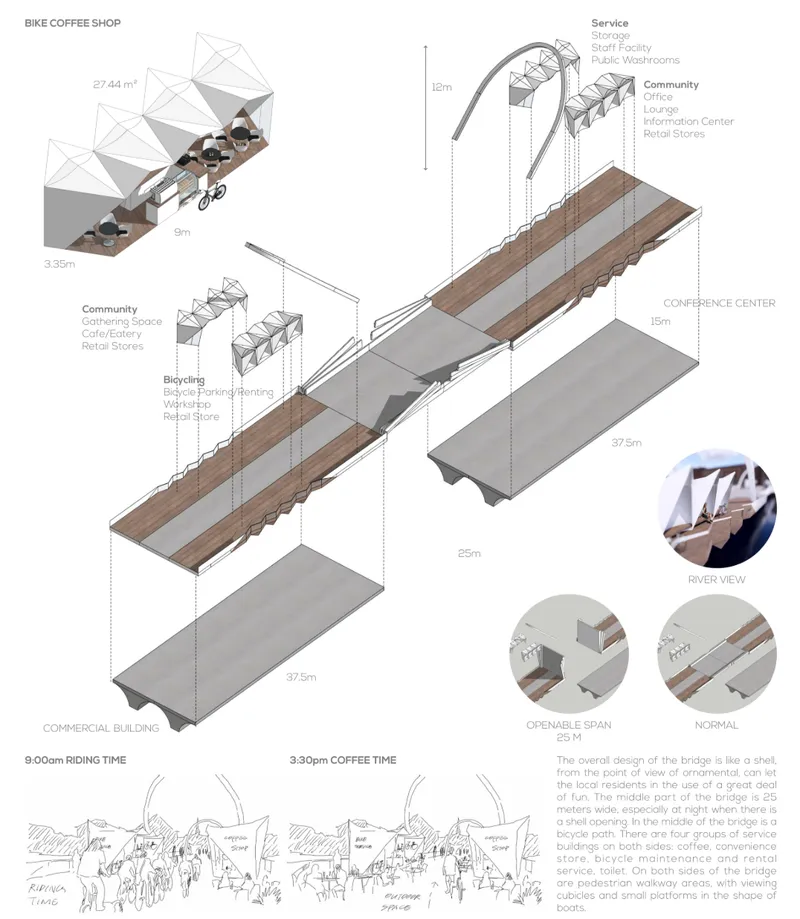
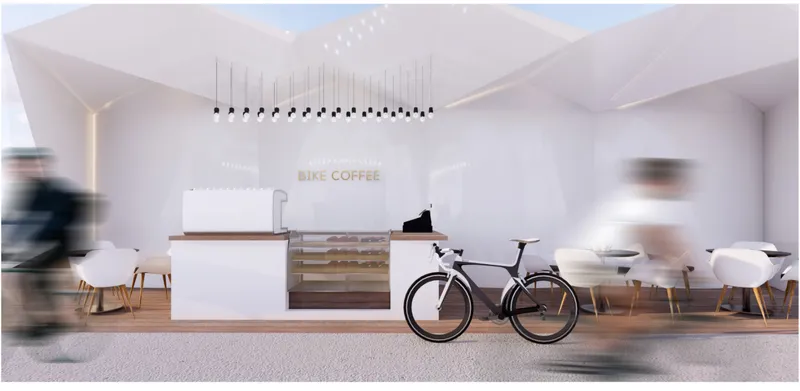
The axonometric breakdown reveals the ambition embedded in the deck. Shell-inspired pavilions house a bike coffee shop, rental stations, a conference center, and public washrooms, all distributed along the crossing to create a sequence of destinations rather than a single corridor. Dedicated cycling lanes run alongside pedestrian routes, making the bridge a true node for non-motorized transit. The programmatic diversity is what transforms the structure from a connector into a micro-district suspended over water.
Inside the café pavilion, the integration of cycling culture becomes tangible: a bicycle parked casually beside the counter beneath pendant lights, the space designed to welcome riders mid-commute without forcing them to dismount and leave their world behind. It is a small detail, but it signals the project's core conviction that infrastructure should serve the daily rituals of the people who use it, not just move them from one side to the other.
A Bridge That Performs After Dark
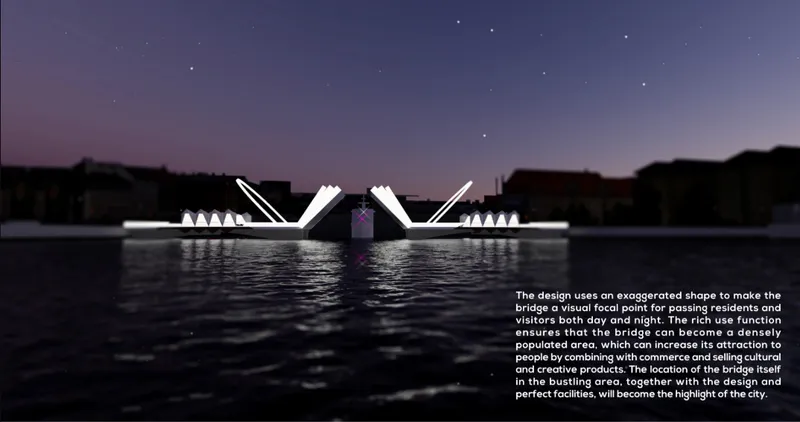
At twilight, the Shell Bridge shifts register entirely. Illuminated from within and below, the arched structure glows against a purple sky, its reflection doubling the effect on the water's surface. The designers have included openable segments that activate during maritime navigation, a kinetic feature that echoes iconic London bridges and turns the structure's daily operation into a spectacle. Day or night, the bridge is designed to be watched as much as walked across.
This performative quality is intentional. The design encourages citizens not just to cross but to linger, explore, and observe. By making the bridge visually compelling at every hour, the project extends its usefulness well beyond peak commute times, supporting the idea that public infrastructure should generate social life around the clock.
From Model to Manifesto
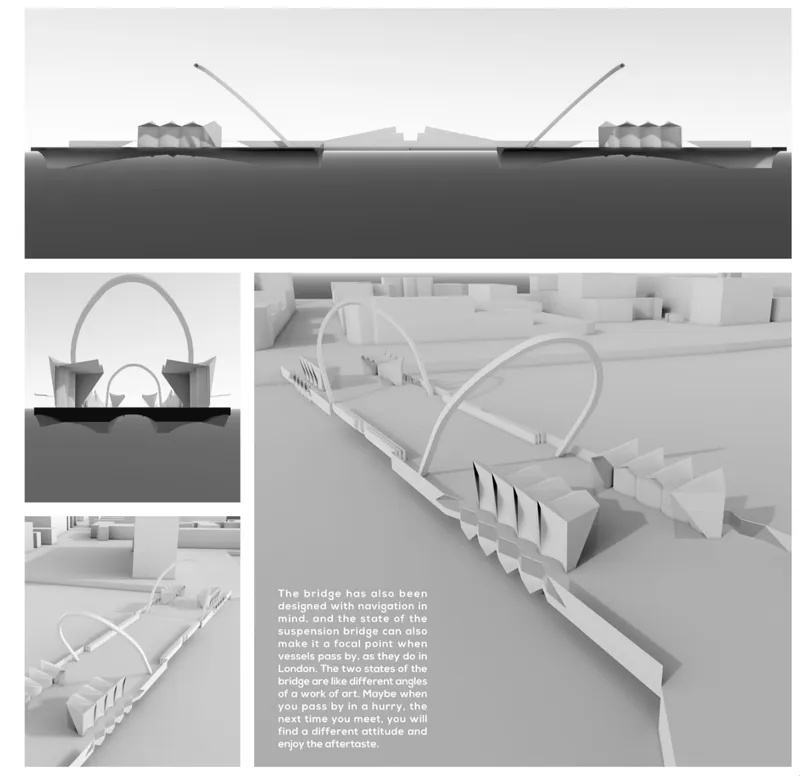
The physical model captures the project's proportions with clarity: the arched deck, the cable supports, and the shell pavilions all legible in elevation and aerial views. Seeing it at model scale reinforces how deliberately the designers calibrated the bridge's profile to sit within, rather than above, its low-rise surroundings. The structure heals an urban gap without creating a new visual barrier, a balance that many larger infrastructure projects fail to achieve.
Why This Project Matters
Shell Bridge proposes something increasingly rare in infrastructure design: emotional connection. By loading a crossing with cafés, bike services, conference rooms, and kinetic engineering, the project argues that bridges should be destinations, not thresholds. The biomorphic shell language gives the argument a formal coherence, tying protection, resilience, and nature into a single structural idea that reads at every scale from the cable detail to the city silhouette.
For Copenhagen, a city already synonymous with cycling culture, the Shell Bridge feels less like a provocation and more like a logical next step. Zhang, Jiang, Fan, and Zhu have sketched a future where the bicycle is not just tolerated by urban infrastructure but celebrated by it, where the act of crossing water becomes an occasion for community, commerce, and contemplation. That is a vision worth building toward.
View the Full Project
About the Designers
Designers: Yuqing Zhang, Yuan Jiang, Jiaming Fan, Zhiquan Zhu
Enter a Design Competition on uni.xyz
uni.xyz runs architecture and design competitions year-round that reward proposals with spatial conviction and real site intelligence.
Project credits: Shell Bridge by Yuqing Zhang, Yuan Jiang, Jiaming Fan, Zhiquan Zhu.



Popular Articles
Popular articles from the community


Riyadh For All: Intergenerational Urban Design for Active Aging in Rabat
Riyadh For All reimagines urban design in Rabat with intergenerational co-living, adaptive courtyards, and Moroccan cultural exchange today.

Conexión: Biophilic Design Reimagines High-Rise Living in Hong Kong
Conexión reimagines high-rise living in Hong Kong through biophilic design, green facades, shared spaces, daylight, water and nature within.

The Earth Pod: 3D Printed Homes for Resilient Refugee Communities
The Earth Pod reimagines refugee housing through 3D printed homes made from clay, combining resilience, self-sufficiency, and rapid shelter.

The Musturak Paradise: Senior Living Architecture for a Connected Future in Temara, Morocco
The Musturak Paradise reimagines senior living architecture in Temara via private homes, social spaces, culture, community, and shared care.

Similar Reads
You might also enjoy these articles

Day and Night Park: A Time-Based Urban Newsstand in Beijing
A temporary urban newsstand in Beijing blending travel, light, and reading through poetic colors, compact form, and community-focused design.

Modernist Patio Renovation in El Masnou, Barcelona by Oliver Segura Arquitectura + Cebrià Arquitectura
Modernist patio renovation blending tradition and innovation with a movable pool, leveled floors, and Catalan materials in El Masnou.

Alto Residencial Coop: Cooperative Housing Development in Santiago de Compostela by Carbajo Barrios Arquitectos
A linear cooperative housing complex blending white volumes and perforated metal façades, enhancing community living, natural light, privacy, and urban integration.
Vil Genis School by BPA ARCHITECTURE – Massy, France
Vil Genis School in Massy, France, features sustainable design, south-facing classrooms, community integration, accessible spaces, and modern educational architecture.


Explore Cycling Bridge Competitions
Discover active competitions in this discipline



Challenge to reimagine the Iron Throne


Photograph architecture without architects


Illustrate the lost glory of Angkor Wat - Render Challenge


Design challenge to reuse E-waste
Comments (0)
Please login or sign up to add comments
No comments yet. Be the first to comment!