SHELL-TER
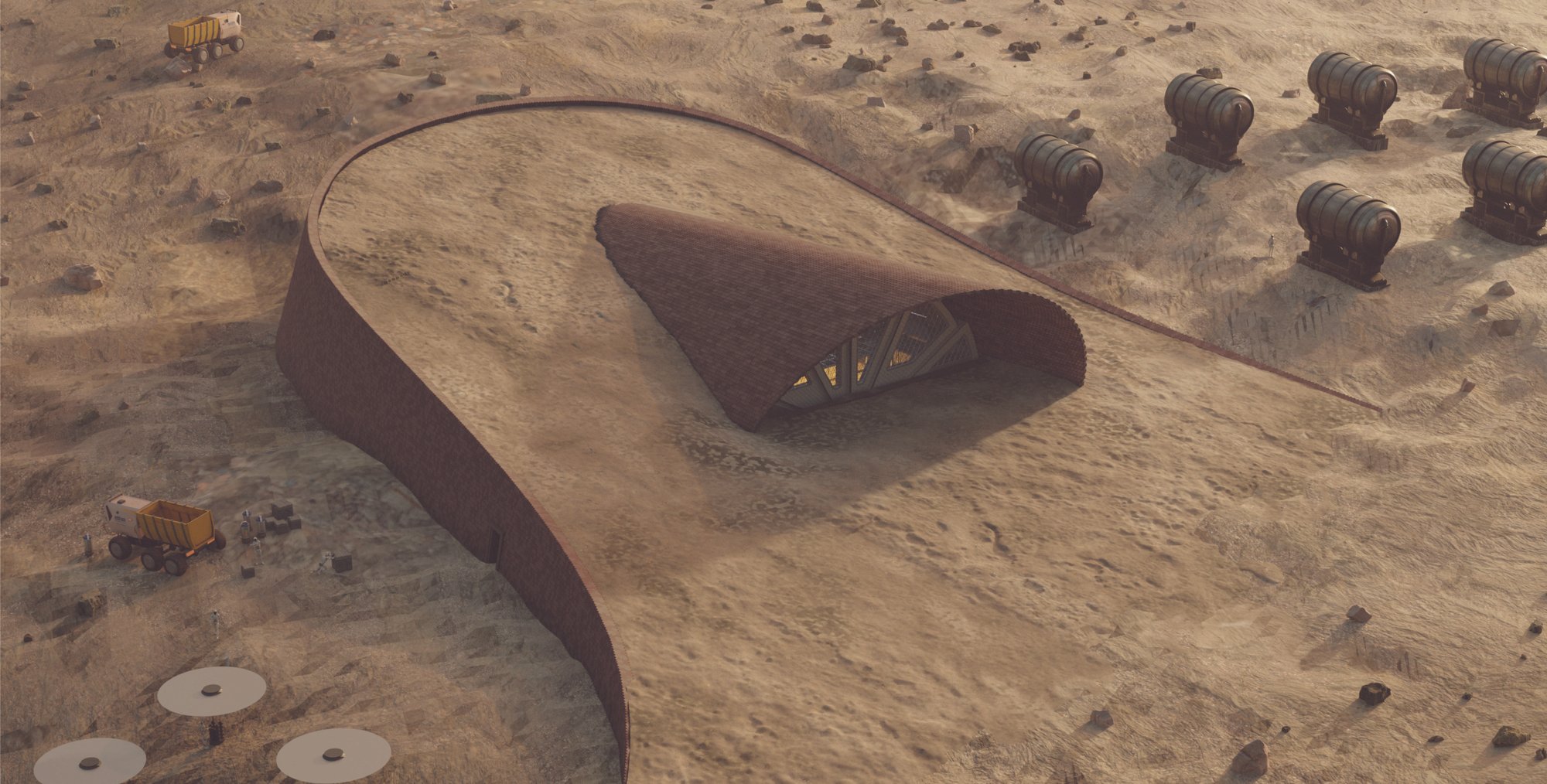
First Mars base placed at the bottom of the largest canyon in the solar system - Valles Marineris, located in its safest, water-rich place - Coprates Chasma. The base shape of the dune seamlessly merges into the local environment, allowing inhabitants to be in unity with nature. The memory of warm, sandy beaches motivates residents to further mental development and spiritual peace. The entire base seems to move along with the rest of the Martian regolith, and over time, through wind activity and regolith repositioning, the dune will take on previously unseen shapes, as the passage of time and the forces of nature slowly reveal.
The design of the Shell-ter Martian base was created using design thinking methodology. Our goal was not only to understand how an astronaut must function on Mars and provide him shelter from harsh conditions. During the adaptation of the base to the environment and its future inhabitants, many concepts came up. The whole process was iterative. We selected both the location and the external form of the base at the same time. Our first proposal was a towering base in the shape of a twisted cylinder on a surface near the equator. As we learned more about the conditions that the robotic base builders would face, we discarded this concept and moved to a lower form that would be more compatible with its environment. After considering elements such as the possibility of water extraction and radiation protection, we moved towards the Valles Marineris canyon, which, according to recent studies, may contain large deposits of water. Adopting a lower, more seamless form that harmonizes with its environment, we initially wanted to suspend the base at the edge of the canyon. However, this is not only technologically difficult but also puts the astronauts at risk, so in the final iteration the base was placed at the bottom of the crater. Finally, the base was placed in the safest place which fulfills the main purpose of the base as a shelter. In addition, to meet the needs of the Shell-ter customer, our goal was also to make him visually and spiritually comfortable and to remind him of his origins and heritage.
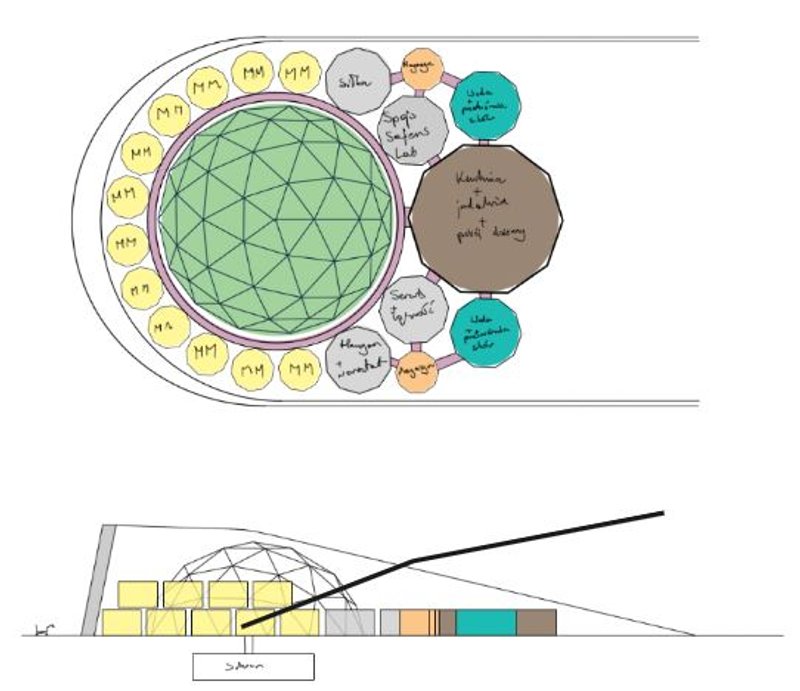
First sketches
The idea that guided us was to use technologies used on Earth: modular, simple, yet creating durable structures. The thought of providing security for the astronauts made us think of bunkers, shelters or basements. However we did not want to tire, overwhelm and cut off from sunlight the first Martian inhabitants. Our thinking then went back to the vaults and shelters of medieval castles and noble cathedrals that have survived to this day. So our choice fell on elements inevitably associated with "brick Gothic", or "shaped bricks", which form the retaining wall as well as the arched structures that protect the base modules.

Bricks with its modular positioning
Bricks are one of the oldest materials known to mankind used in construction, yet simple and modular. Their use in the base is not only a tribute to the technical thought that laid the foundations for the development of civilization, but also a reference to the heritage and traditions of Earth's builders, which in Shell-ter have been given a modern look. Regolith sintering technology was used to create the bricks. It is one of the latest technologies for forming various structures of complex shape using materials readily available on Mars. It is more effective, simpler method than traditional 3D printing. During the process, the robot directs the mirror that focuses the solar light in such a way that the focused beam hits the exact spot on the plate with regolith. Then, as the element is growing, new layers of regolith are added, which under the influence of focused sunlight merge with the structure. The entire process can be done by robots, which further speeds up and simplifies the creation of the base.
The next step was to take care of both Earth and Martian nature. We must remember the mistakes we have made that are devastating our planet in example global warming or excessive consumption of resources. To this end, we have decided to minimize the dimensions of each element that must be taken by rocket. This will result in logistical optimization (fewer rockets sent) and a reduction in the amount of fuel used. Our thinking morphed into a structure readily used by space agencies to unfold solar sails - origami, which later allowed each module of the base to be folded to minimal dimensions for transport.

Small module unfolding
Going further we had to take care of human relations and the development of human beings as social beings. Following the example of medieval settlements and cities, we chose the center of the base as a place to rest and meet, and around it we placed modules for living, working, laboratories, etc. Our center became the largest module with the shape of an arc, which has a large window allowing to see the beauty of Mars.
Site selection began with consideration of conditions on Mars. In order to preserve the mental health of the astronauts, we wanted a lot of sunlight, so the equatorial region was considered. Then we looked for sites with good radiation shielding and potentially large water resources that could be mined by ISRU machines. The Valles Marineris canyon, which stretches along the Martian equator for more than 3000km, can be 600km wide and has an average depth of 8km, proved to be an ideal site. The Coprates Chasma area (part of Valles Marineris), which is the deepest part of the canyon with depths of up to 11km, was selected as the ideal location for Shell-ter. The chosen location not only provides large water resources, but also through a thicker atmosphere than in other regions of Mars provides additional protection from radiation. For astronauts visual comfort the base was placed with the window facing along the canyon for full display of its vastness.
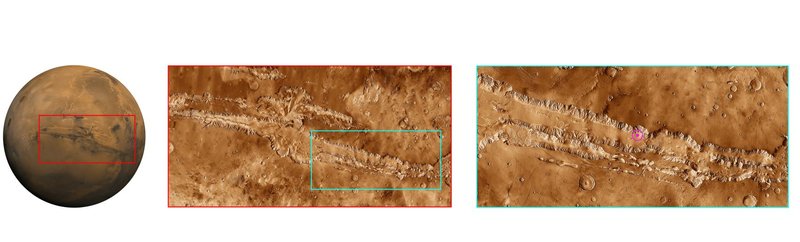
Location of Shell-ter base
While designing the base, we wanted to use seamlessly flowing forms that adapt to the environment. We did not want to disturb the beauty of Mars, in fact we wanted to take benefit of its nature, that is, its desert, dune-like appearance. As part of our plans, we designed a brick retaining wall around the modules as the face of the windswept dune. We then covered the entire base with regolith, which blends seamlessly into the Mars scenery. The entire base seems to move along with the rest of the Martian regolith, and over time, through wind activity and regolith repositioning, the dune will take on previously unseen shapes, as the passage of time and the forces of nature slowly reveal. The thick layer of regolith will also provide safety from micrometeorites and radiation, and the awareness of a strong, robust structure will provide mental peace for astronauts.
The entire base will be powered by NASA Kilopower generators. It is a non-renewable energy source based on a uranium-235 core, from which heat is converted into electricity. Its independence from sunlight and lack of need for fuel for the lifespan of its operation defines it as the best possible source of electricity on Mars. Its additional advantages are its small size and redundancy - if one of the generators fails, the Martian base can be powered through the remaining generators. NASA Kilopower can successfully produce 10kW of electricity and run continuously for 10 years.
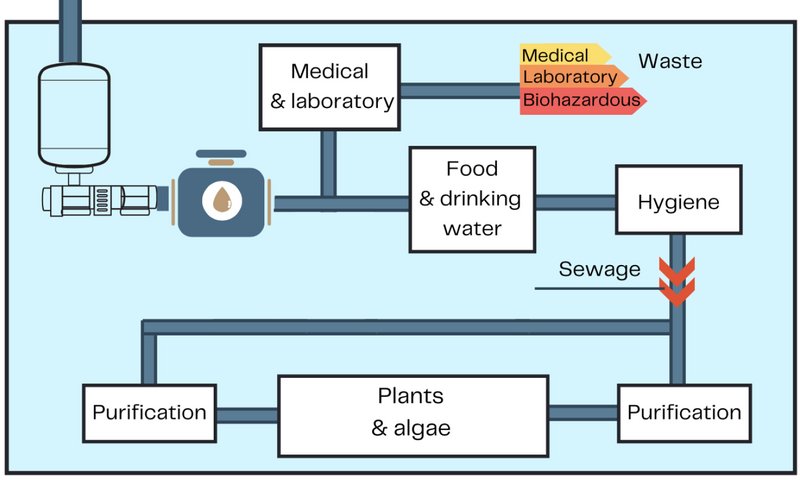
Another interesting solution is the use of a closed water cycle and cyanobacteria that decompose waste. The water cycle in the base consists of two loops. The first (open) loop contains water for laboratories, medical purposes, and food and drink preparation. Then, after the water is used for hygienic purposes, it goes into the second (closed) loop where it is purified and used to water plants and grow algae from which food can be produced. The solid waste produced by the astronauts is decomposed using cyanobacteria.
Shell-ter has great potential for further, expanded exploration of Mars. Over time, more dunes will be created and settled adjacent to water deposits in the canyons. A future sea of dunes inhabited by humans will offer hope for a symbiosis of technology and nature, and thus a better future for future generations.