
Shirakawa-go Cultural Centre - Report
The Shirakawa-go Cultural Centre embodies the traditions and history of the mountain village of Shirakawa-go and presents them in a fresh, new and contemporary manner.

The Shirakawa-go Cultural Centre is an important piece of Shirakawa-go’s puzzle that will ensure the future of the people. It utilizes the main aspects that cover the historical significance of Shirakawa-go. The cultural center showcases the village’s past in a new and contemporary manner. This manner helps to attract more people outside of the village and provide an incentive for the younger portion of the local population to remain in the village. With an increase in the village’s tourist business, it can help provide funds for the villagers to keep Shirakawa-go alive and provide a better future for the next generation.
The Centre provides all the facilities for educational and recreational purposes. It is divided into three separate buildings that are elevated on a plinth above the rice fields. The first building holds the exhibition hall where people can view Shirakawa-go’s artifacts, artwork, and other pieces that hold historical and cultural importance to the village. The second building is where the workshops and the café are placed. The workshops give visitors the experience of handcrafting traditional pieces with the provided tools and their bare hands. These pieces include painting Japanese paper fans and umbrellas and crafting iconic Sarubobo dolls, small faceless dolls commonly used as charms. These activities allow the visitors to understand firsthand at how the villagers treat their craft. The café gives them a direct connection to an area where they can rest and enjoy a spectacular view the village’s countryside. The third building serves as the Centre’s educational and administrative hub. It holds a library that hold every book needed to learn more about Shirakawa-go and Japan in general. A souvenir shop is there to sell gift and trinkets for memorable moments. All around the buildings are waiting areas surrounded by trees and planters for enjoying the views of Shirakawa-go’s mountains, forests, and fields. It is also built with steps that disappear into the water of the rice field so that visitors can get much closer and more personal with nature. Overall, the Shirakawa-go Cultural Centre is made for visitors to have an enriching and personal experience with the village in both nature and culture. This also applies to the materiality of the Centre.
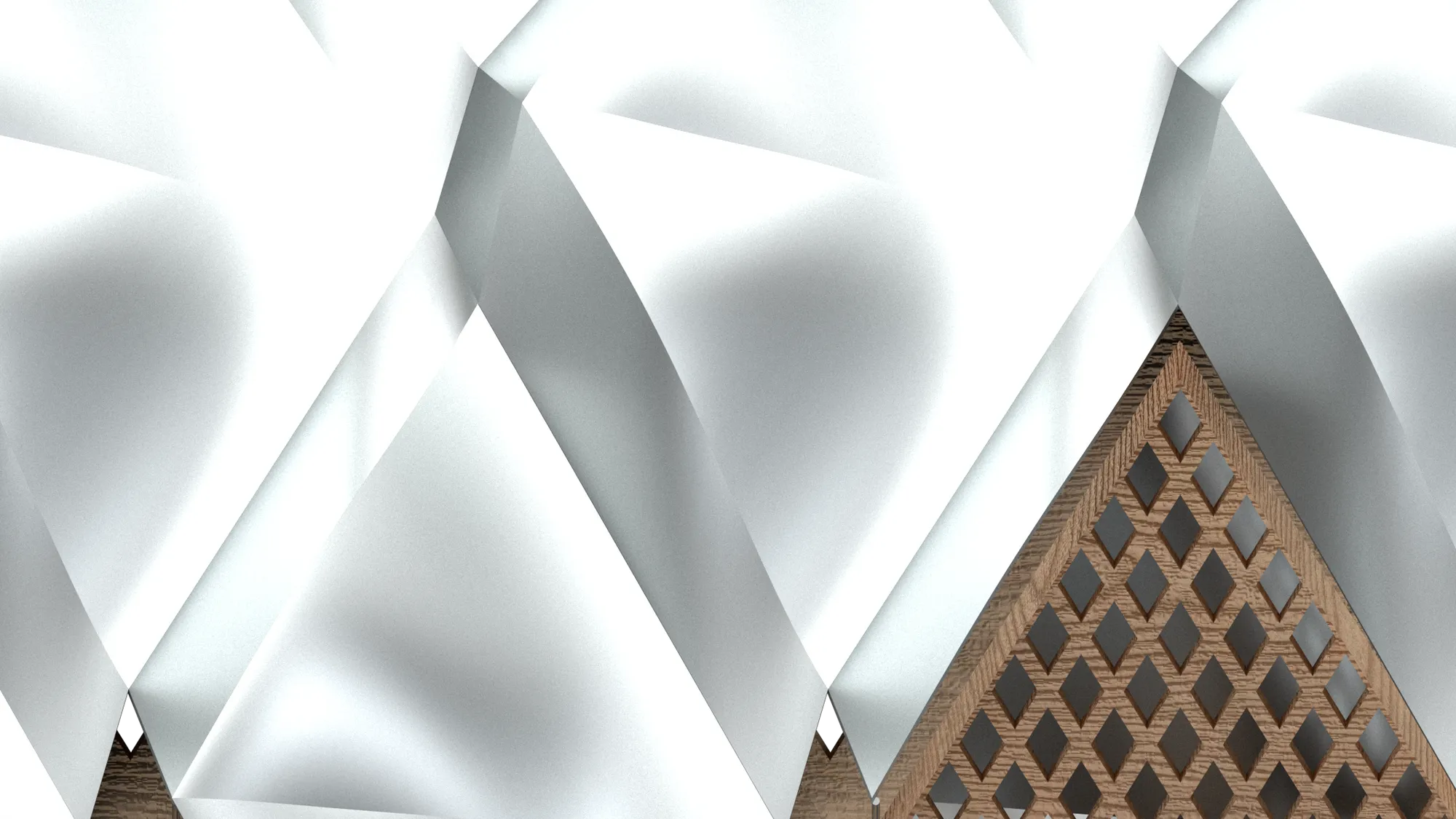
The entire being of the Shirakawa-go Cultural Centre is made up of three wooden shells shaped as vaults. These shells are made up of a repetitive network of adjacent modules. Each module is made up of a framed grill and a cover. The diamond shape of the module is inspired by the Gassho house and its reflection from a body of water in front of it. The module itself is made with a grill to accommodate natural lighting and ventilation for the interior spaces. However, certain external conditions such as heavy snow in winter were considered, and so some parts of the shell were fitted with modules that has solid wood centers, covered in two layers of glass, as a form of insulation. The shells use new material such as steel for the cover, which is made to resemble fish scales in a manner of flaring out to ensure easy sloping of natural materials such as snow or rain. However, some portions of the covering on each shell are made with perforations to allow sunlight to come through. These features allow the Shirakawa-go Cultural Centre to be sustainable, and the inspiration that brought forth this idea came from the Gassho house.
The Gassho house is an iconic feature of Shirakawa-go and serves as the main inspiration for the Shirakawa-go Cultural Centre. It is abundant in number across the historical district of the village, surrounded by miles of rice fields. Its most unique feature is its triangular thatching roof, which is made to protect against the heavy snow during winter. The house is commonly used for the village’s two main industries: silkworm farming, for the silk material to be used for fabrics, and gunpowder production, made from locally sourced materials. The unique design and deep history are what gives the Gassho houses their significance among the village, including its relationship with the site it was built on.
The landscape for the Shirakawa-go Cultural Centre was designed to reflect the Japanese aesthetical approach to nature and to adapt the Centre to the surrounding environment. The plinth is filled with cherry blossom trees, which is the most iconic tree in Japan. It can change its appearance with the seasons, especially in spring when its popular pink petals come into full bloom. This change of appearance allows the Centre to easily adapt to the site no matter what time of year it is. The rice fields of Shirakawa-go also play a part in the Centre’s design so that it could be more connected to the village. These plants are mostly placed on the planters that outline the entire plinth, behaving as a form of railing for safety reasons. As for the rice field that the Centre is situated on, the plinth is elevated nearly a meter over the field to preserve as much of the natural state of the site. All these natural elements that are included into the Centre’s design enable it to blend into the landscape as much as possible.
The Shirakawa-go Cultural Centre shows an insight into what the village can be in the future. Its fresh perspective upon centuries of traditions and culture can allow the younger locals and even tourists to understand and appreciate the village more. It brings an optimistic view of the upcoming future for the village.



Popular Articles
Popular articles from the community


Co-Life: Senior Housing Design That Reconnects Older Adults With the City
Co-Life reimagines senior housing design through healing gardens, shared streets, workshops, and a sustainable community across generations.

The Musturak Paradise: Senior Living Architecture for a Connected Future in Temara, Morocco
The Musturak Paradise reimagines senior living architecture in Temara via private homes, social spaces, culture, community, and shared care.

The Earth Pod: 3D Printed Homes for Resilient Refugee Communities
The Earth Pod reimagines refugee housing through 3D printed homes made from clay, combining resilience, self-sufficiency, and rapid shelter.

Lunar Spiral: Space Architecture Shaped by the Mathematics of the Universe
Lunar Spiral reimagines space architecture through Fibonacci geometry, lunar regolith, levitating habitats, and self-sustaining Moon living.

Similar Reads
You might also enjoy these articles

Day and Night Park: A Time-Based Urban Newsstand in Beijing
A temporary urban newsstand in Beijing blending travel, light, and reading through poetic colors, compact form, and community-focused design.

Modernist Patio Renovation in El Masnou, Barcelona by Oliver Segura Arquitectura + Cebrià Arquitectura
Modernist patio renovation blending tradition and innovation with a movable pool, leveled floors, and Catalan materials in El Masnou.

Alto Residencial Coop: Cooperative Housing Development in Santiago de Compostela by Carbajo Barrios Arquitectos
A linear cooperative housing complex blending white volumes and perforated metal façades, enhancing community living, natural light, privacy, and urban integration.
Vil Genis School by BPA ARCHITECTURE – Massy, France
Vil Genis School in Massy, France, features sustainable design, south-facing classrooms, community integration, accessible spaces, and modern educational architecture.

Explore Culture & Art Centre Competitions
Discover active competitions in this discipline




Bring back Drive In's


Design challenge to reuse E-waste
Comments (0)
Please login or sign up to add comments
No comments yet. Be the first to comment!