
Site Frames
Prefabricated Stage with Portable Memories


Bus stops, the pins nailed in a huge, rough and solid map as the symbol of the word “city”. Seemed to be aimlessly arranged, these facilities operate like tiny stage scenery, welcoming diverse actors in diverse scenes with diverse behaviours, no matter who the audience is and what happens in the very block they stage.
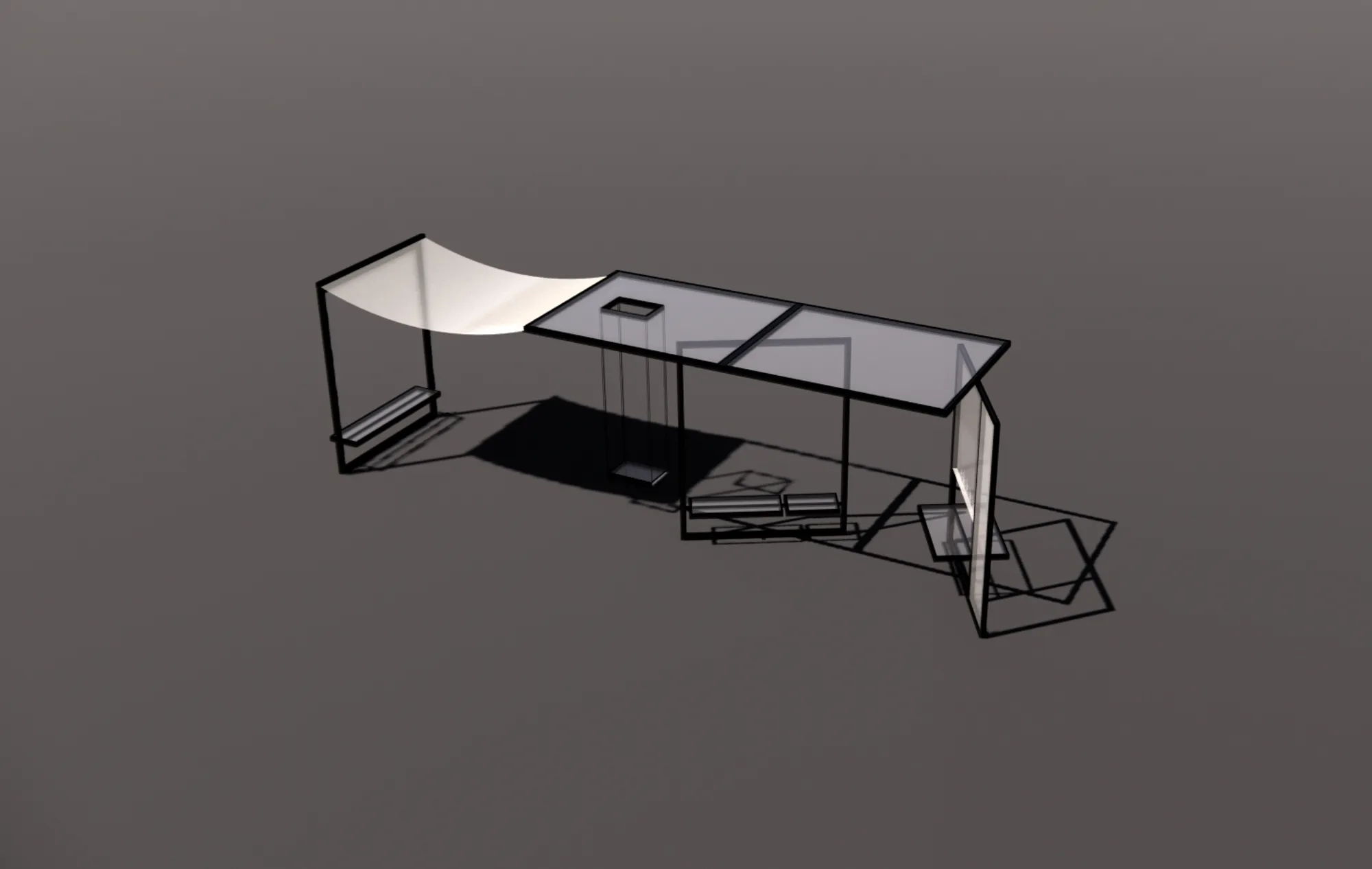
This prefabricated bus stop revealing the site spirit through customized materials, consists of a transparent frame system and an alternative fabric unit. It can offer spaces with different intimacy by rotating the vertical parts. As a special installation, this mobile bus stop also presents a certain meaning in praxiology and urban landscape ecology.
The conception is to make prefabricated bus stops in forms of 4 boards stacked together through movable fittings which are 3m in length, 2.5m in width and 10cm thick, the boards can be easily transported and take root in anywhere. The installation is just like unfolding a stack of cards, by truck cranes instead, and set them as the background of passers-by. By the simple action of smoothly rotating the perpendicular boards, the bus stop can offer spaces with different intimacy, which may create chances for people to communicate with each other.. Vertically combined, these boards form a group of view frames which define and highlight the very scene that the block or the city wants to present. The site along with the bus stop itself becomes a series of displays, abundant pieces of a personal collection owned by a naivete —— just like the merry-go-round fermented in Proust’s childhood memories. During the process, we continue focusing on the presenting function of each board, which works as an unique shot in the gallery of each bus stop unit. Thus we decide to bring the concept “transparency” into the board system, and transfer the boards into frames which represent “hollow” and “certainty” in the context of praxiology and urban landscape ecology. Wherever a bus stop is built, wherever the stage is —— they continuously exhibit dynamic micro-expressions of the site deconstructed from the behaviours of the users, the colors or forms of the blocks (etc.) through customized materials and coatings.
The mobile boards or “frames” can be added in terms of a single unit with no limitation on the same plane. Orderly arranged along the streets, the corridor of steel frames gives a sense of spirituality and encourages creativity. It offers a delicate balance and harmony for intimate relationships through those seats embedded in adjustable frames, which probably will create chances to let strangers get to know each other. During summer time, it can also be a great place for an ice cream stand. It can even be tented for a evening cocktail party. The standing zone under the hood fabric melting with the active space with the swing, creates a soft and multi-meaning place for families.Here, the traditional concept of family disintegrate. One happens to be here becomes a member of a bigger community, the city.
Almost every elements of the bus stop, from the seats to the boards, are foldable. Though the folding function is not quite that necessary for a prefabricated facility aiming at mass production, we hold on to this idea, hoping to retrieve something which is gradually fading out in the post industrialized society that we are trapped in. The seat board returns to its original embedded position when people stand up and leave the seat. The “fold” action in this process reveals the metaphor of another action related to “keep” or “hold” with a strong sense of self-protection: the seat wrapped up a certain feature set of the person who had just left, then deposited the very piece into a private bank of memories. Similarly, the mobile board system also holds a memory gallery of a certain site in the city. With the repeating transporting and unfolding process in unpredictable spaces, the bus stop is more likely to be a “collecting installation” while spreading its abundant accumulation of the so-called “genie loci” along its moving track. Served as the pollinators of the city, the mobile bus stop is on a “mission”, gathering different sensations of different sites. The integration of a certain cultural spirit should blossom thanks to the recording of the context. And so does the city.



Popular Articles
Popular articles from the community

AL-JANNAH: Sustainable Architecture and Permaculture for Afghan Widows
AL-JANNAH uses sustainable architecture and permaculture to create resilient oasis of housing, learning, work and renewal for Afghan widows.

Co-life: Sustainable Architecture for Age-Friendly Community Living
Co-life reimagines sustainable architecture for seniors through courtyards, rammed earth, shared gardens, and spaces designed for belonging.

The Ocean Hive: Sustainable Architecture for a Self-Sufficient Civilization at Sea
The Ocean Hive imagines sustainable architecture at sea, where modular habitats, algae, wave power and ocean waste sustain a growing colony.

The Earth Pod: 3D Printed Homes for Resilient Refugee Communities
The Earth Pod reimagines refugee housing through 3D printed homes made from clay, combining resilience, self-sufficiency, and rapid shelter.

Similar Reads
You might also enjoy these articles

Bao Huynh Watercolor Atelier: A Serene Art Retreat in Hội An
Bao Huynh Watercolor Atelier in Hội An blends multifunctional art spaces, sustainable design, local materials, and family-friendly living in a serene environment.

Atelier Macri Concept Store Interior Design by CASE-REAL
Atelier Macri store features a "ko" counter, walnut wood details, cork displays, blending retail, gallery, and seamless customer experiences.

Manuel Vargas Izquierdo Stadium and High-Performance Sports Center: Architectural Excellence in Jalpa de Méndez
The Manuel Vargas Izquierdo Stadium blends sustainable design, inclusive sports facilities, and cultural-inspired architecture, revitalizing Jalpa de Méndez’s public spaces.

KAKR Buluh Awar Hall: Revitalizing Community and Ecology Through Bamboo Architecture
Community built bamboo hall revitalizes Buluh Awar village, empowering youth, restoring ecology, celebrating vernacular craftsmanship through sustainable architecture and culture.

Comments (0)
Please login or sign up to add comments
No comments yet. Be the first to comment!