
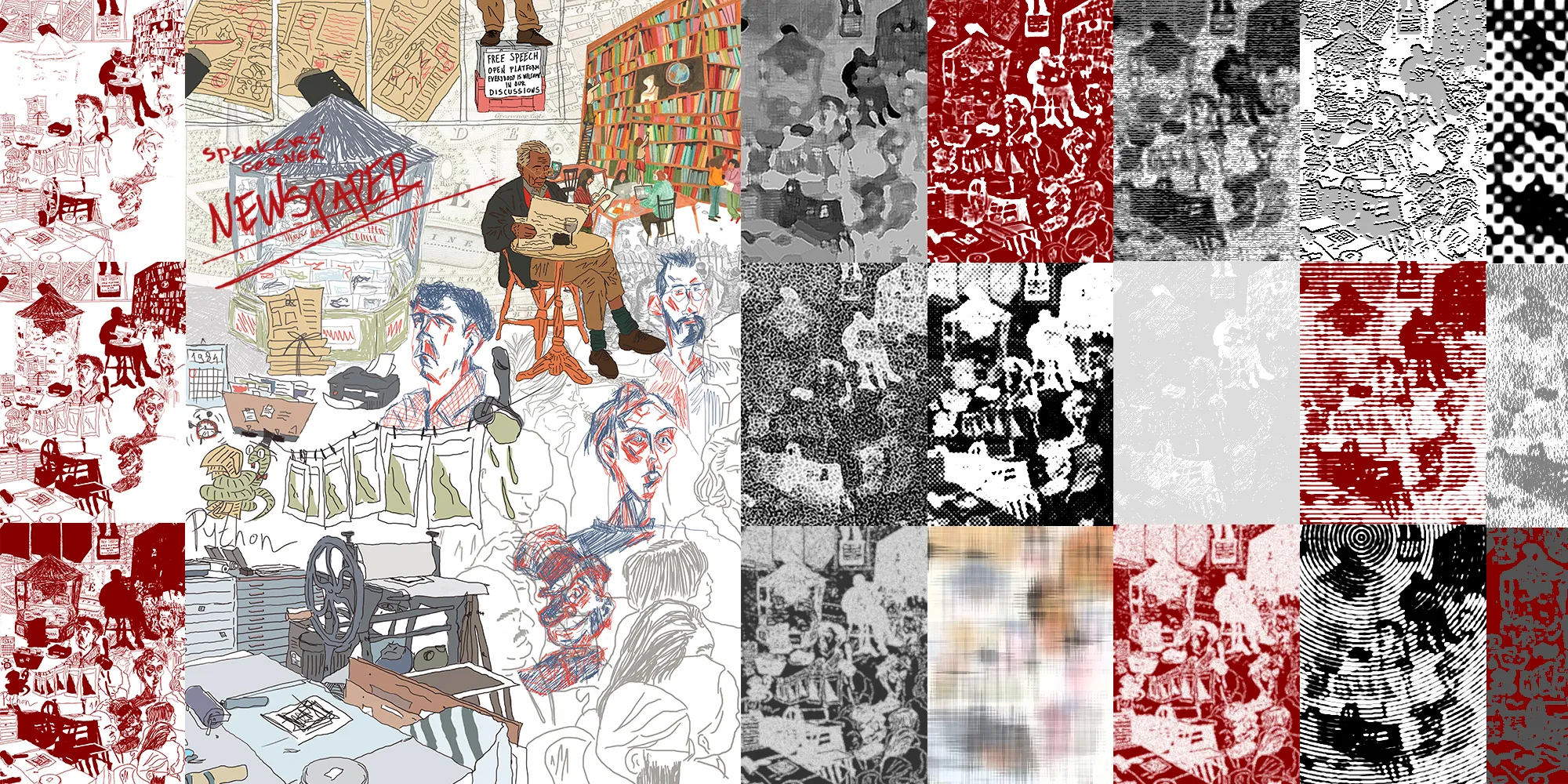
SPEAKERS’ CORNER NEWSPAPER
freedom of speech available to all
The concept of this project has originated from a comprehensive exploration of the history of illustration and its evolution in the context of the United Kingdom. In the UK, since the introduction of the Gutenberg press, illustration has served as a means to critique society, social structures, and the dynamics between authority and the populace. This rich history provides a solid foundation for addressing the designated theme of the competition. The proposed idea involves establishing an underground newspaper production within the confines of Hyde Park in London, with a specific emphasis on traditional printing methods such as woodcuts, linocuts, and engravings. An integral facet of this newspaper production is the principle of freedom of speech. Any individual gaining access to the printing press would have the opportunity to contribute articles and illustrations to the newspaper. This approach ensures a platform where diverse opinions from various perspectives can find expression. Consequently, the newspaper becomes a form of provocation, introducing a new realm and a fresh mode of communication between conflicting ideologies, exemplified by the extreme left and right. Concerning the spatial programmatic solution, the idea is to design a space that reflects the process of creating a newspaper. There would be a public square that gathers users and features a newspaper kiosk. Additionally, there would be space dedicated to education and workshops (workshops, redaction, pressroom) where materials for the newspaper would be created and collected.
When discussing the organization of elements at the architectural level, the idea was to design a space that would portray an old-fashioned printing process in a new way. The project should be executed as cost-effectively as possible - final finishes should be basic, with exposed block walls and concrete floors. Ultimately, this should be a functional space designed for artists to personalize. Details are included here to make a difference and elevate the project from a purely functional space to one that exudes joy and architectural style. Through the design process, this project has undergone several phases: from the initial stage involving rough schematic representations of spatial program solutions on paper to a more sincere approach and better focus on the essence of the project - the creation of traditional printing.
On the lower floor, the space is mostly left as an open plan with smaller rooms on the sides, providing specialized areas for various printing techniques. It also includes a small classroom for school groups. In the drawings, I depicted a large open space with the intention of dividing it into smaller studio areas - I provided drawings and details on how the space could be organized. The large opening cuts through the entire building, allowing it to come alive with activities inside. From above, with a glass roof, one can capture a view of the gallery/ramp, reception, lobby, and work in the large shared printing space; from below, conversations between working artists can be heard. It provides a sense of community even on the calmest days, with a layout that offers spaces for interaction.
The printmaking building is highly specialized, tailored to accommodate all types of printing processes, from lithography to screen printing; from relief to intaglio. It provides a space for individual artists to practice and for groups to learn together. Additionally, I envisioned dedicated spaces to facilitate etching, stone lithography, screen cleaning, aquatint, storage, exhibition, and educational areas, as well as rooms for framing, individual studios, offices, and communal spaces. One striking feature connecting the workshops and the square are manually operated elevators located on the southern side of the project. These elevators can be operated by hand, so in the event of someone attempting to sabotage the print shop and cut off its power, it can still continue delivering newspapers.
The steel structure and industrial style of this building are intended to embody the industrial spirit within spaces that are otherwise predominantly white, as this "hole in the wall" produces underground newspapers. Imagined on the beams and columns are postcards, sketches, and inspirational clippings from various newspapers, affixed to the steel with magnets.
In the creation of the architecture, the focus has been placed on what already "exists" in the location or at least in the culture. Massive steel beams, raw concrete floors, and concrete walls are covered with a sleek steel framework lattice. This design choice aims to showcase an integration of the industrial character of the space with elements inspired by the cultural significance of the underground newspapers, creating a visually dynamic and contextually rich environment.
The lattice structure is intriguing as it serves as both the roof for the workshops on one side and the floor of a square adjacent to Speakers Corner on the other side, promoting a culture of reading, information, and the development of critical thinking. This aspect becomes exceptionally significant when considering the organization of elements at the site level, reflecting the influence of Speakers Corner and inviting people to engage in dialogue, especially between the public and government representatives. In this way, I aimed to emphasize the importance of the specific location, creating a design that not only accommodates industrial activities but also fosters a space for public discourse, underscoring the cultural and civic significance of the site.
The square is bordered by a café on the north side and grandstands on the east and west sides, providing additional storage space not only for workshop events but also for the square itself. The envisioned design allows for the square to be multifunctional, capable of transforming into a space with stalls covered by movable awnings or various public grandstands. Some of these grandstands could cater to:
Art and Social Activism: Art often serves as a means of expression and a call for social change. Through artistic workshops, participants can explore topics such as human rights, social justice, and political activism, creating artworks that express their views on political issues.
Politics and Artistic Freedom: Workshops can delve into the theme of artistic freedom and the limitations placed on artists in different societies. Participants can discuss censorship and restrictions on artistic expression.
Historical and Political Context of Artistic Periods: Workshops can focus on various artistic periods and how political events and social changes shaped the artworks of that time. For example, analyzing the impact of the political situation on painting during the Rococo or Expressionist eras.
Politics and Cultural Diversity: Art workshops can promote understanding of cultural diversity and inclusivity. Participants can work on projects that explore and promote different cultures and perspectives.
Politics and Urbanism: Workshops can explore the theme of urbanism and challenges in cities, including topics such as planning, sustainability, and resource management.
Politics and the Environment: Participants can use art to explore and express their views on issues related to environmental protection, climate change, and sustainability.
Art History and Political Propaganda: Workshops can include the analysis of political propaganda and how artists throughout history have used art to influence public opinion.
Connecting artistic content with politics within this square can help in understanding complex political issues, promote dialogue, and encourage critical thinking. It also empowers participants to use art as a means of expressing their political views and advocating for societal changes.
In its entirety, this project is not just a space for newspaper printing but also a platform for reviving tradition, fostering dialogue, and developing critical thinking, contributing to enriching the cultural scene and societal engagement in the United Kingdom.
The "Underground Newspaper" project significantly contributes to the promotion of freedom of speech, emphasizing the vitality of diverse opinions. This initiative not only provides a physical space for creating newspapers but also empowers individuals to freely express their ideas, viewpoints, and critiques.
In the simplicity of its concept, the project poses a crucial question: How to revive freedom of speech? The answer lies in practicality - enabling everyone to participate in the printing process and contribute to enriching the content of newspapers. Here, freedom of speech is not only theoretically supported but actively practiced.
The project particularly underscores the importance of diversity of thought. Through an inclusive approach, space is opened for different perspectives, creating a wealth of ideas. In a time when societies face polarization, these Newspapers become a meeting place and a catalyst for dialogue, fostering diversity of thought.
Its significance is also reflected in the transformation of the cultural landscape. Situated in Hyde Park, the project becomes a central gathering place where communities can exchange ideas and encourage dialogue. Through this physical manifestation of freedom of speech, the project becomes a platform that supports the fundamental values of democracy.


Popular Articles
Popular articles from the community


The Musturak Paradise: Senior Living Architecture for a Connected Future in Temara, Morocco
The Musturak Paradise reimagines senior living architecture in Temara via private homes, social spaces, culture, community, and shared care.

Play: Fragments of Their World
Familiar architecture becomes modular playground design, creating safe spaces where displaced children can learn, connect, imagine and play.

Riyadh For All: Intergenerational Urban Design for Active Aging in Rabat
Riyadh For All reimagines urban design in Rabat with intergenerational co-living, adaptive courtyards, and Moroccan cultural exchange today.

Conexión: Biophilic Design Reimagines High-Rise Living in Hong Kong
Conexión reimagines high-rise living in Hong Kong through biophilic design, green facades, shared spaces, daylight, water and nature within.

Similar Reads
You might also enjoy these articles

Day and Night Park: A Time-Based Urban Newsstand in Beijing
A temporary urban newsstand in Beijing blending travel, light, and reading through poetic colors, compact form, and community-focused design.

Modernist Patio Renovation in El Masnou, Barcelona by Oliver Segura Arquitectura + Cebrià Arquitectura
Modernist patio renovation blending tradition and innovation with a movable pool, leveled floors, and Catalan materials in El Masnou.

Alto Residencial Coop: Cooperative Housing Development in Santiago de Compostela by Carbajo Barrios Arquitectos
A linear cooperative housing complex blending white volumes and perforated metal façades, enhancing community living, natural light, privacy, and urban integration.

Vil Genis School by BPA ARCHITECTURE – Massy, France
Vil Genis School in Massy, France, features sustainable design, south-facing classrooms, community integration, accessible spaces, and modern educational architecture.
Explore Urban Design Competitions
Discover active competitions in this discipline




Challenge to reimagine the Iron Throne


Photograph architecture without architects


Illustrate the lost glory of Angkor Wat - Render Challenge


Design challenge to reuse E-waste
Comments (0)
Please login or sign up to add comments
No comments yet. Be the first to comment!