
Sprout from Sprawl
Sprawl the Programs, Sprout of Communication
Why Did We Only Buy Products in the Market?
Over the past centuries, cities have continued to divide and concentrate. These cities are divided into functional units, and buildings under them are also divided into functional units and exist independently. The same goes for markets and agriculture. Various processes such as markets for sale, farmland for agriculture, and research institutes for development are scattered in cities, so it is impossible to imagine different fields in each building. Going to the market does not allow us to experience more than just "purchase activities" of products delivered from farmland. The fact that users cannot experience it has caused a situation in which they cannot think about the processes and efforts behind agriculture, research needs, and natural disasters. Consumers are just consumers, and producers are just producers themselves.
Producers and Consumers Now Do Not exist in Themselves.
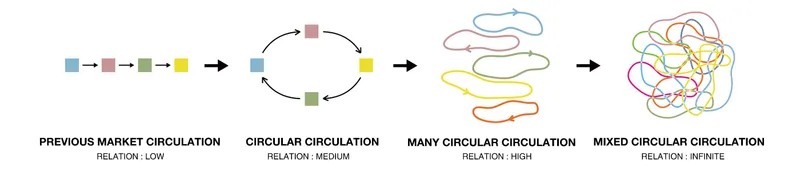
We gather parts of the agricultural circulation structure that have been scattered sporadically to attract attention again to various agricultural factors. Various programs, including start-up companies, agricultural research institutes, experiential learning centers, packaging facilities, and restaurants across the industrial structure of agriculture and markets, will be opened to meet the needs of the city. Therefore, consumers do not exist here only as consumers. They experience sales, experiences, etc. as well as purchasing. They can even participate directly in the process of producing goods. For example, people who just ate impulsively in restaurants now feel the importance of agriculture by cooking, experiencing, and eating on farmland. And they can interact with startups and research institutes based on their own experiences. Is there a better way to be interested in the field than to participate directly in this process?
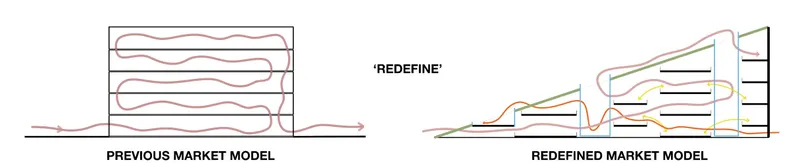
Also, gathering various programs in one place does not just narrow the space of the physical dimension, but narrows the gap between the relationships in which they operate. Programs gathered in one place have industrial benefits because the meeting itself has free mutual communication. Furthermore, industrial circulation structures overlap and mix, causing another relationship. This results in random encounters, configurations, and ultimately synergies that were not found in the existing model. Various results from continuous communication and interest could not be expected in any existing model.
Unchanging principles and Rational Approaches that can be Applied in the future.
Our buildings apply to any future industrial change. As has been the case for the past centuries, the elements that make up a single agricultural cycle have continuously changed. Programs disappear because they are not needed, and sometimes they are created anew. Nevertheless, the fact that continued to be maintained is that all industries have been closely connected, communicated, and operated. The fact that various programs existed for a long time and that they have been mixed and interacted proves that our buildings can work the same way in the future.
All we have to do is change the program of the building to meet the needs of the times. Therefore, we have deployed modules of various sizes and locations for each program to fit its purpose, and users can borrow where they need them and build an industry there. No matter what program comes in, they will communicate freely and create infinite synergy as they overlap and mix.
Design to Maximize the Concept.
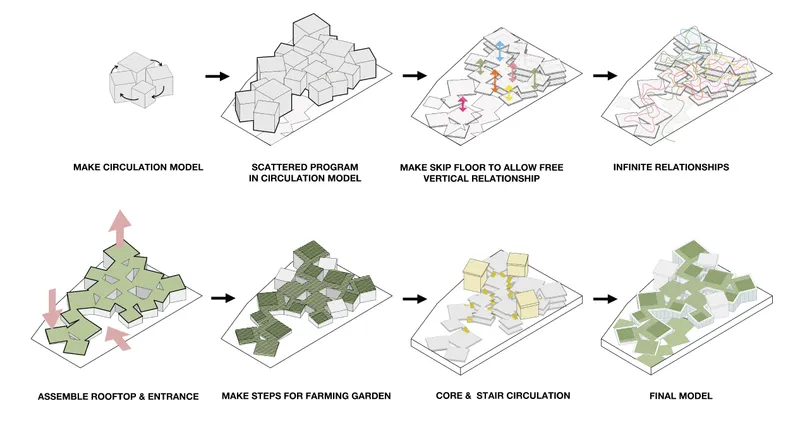
The design proceeded linearly reflecting our thoughts. As mentioned above, programs are variable and changeable. So we designed a module that could accommodate them. Various sizes were planned based on the most efficient square shape. Each of them will accommodate a variety of industries and operate reasonably in all cases.
Each module made is scattered randomly (in the line of active communication) on the ground. In addition, the modules are placed in a skip floor manner for vertical exchange. As a result, one module can freely move all adjacent modules. In addition, it was visually freely opened by using minimal glass if necessary without providing a separate wall. They emphasize exchange and movement in a dynamic and free form. This breaks down the consumer-buyer relationship and creates synergy between industries.
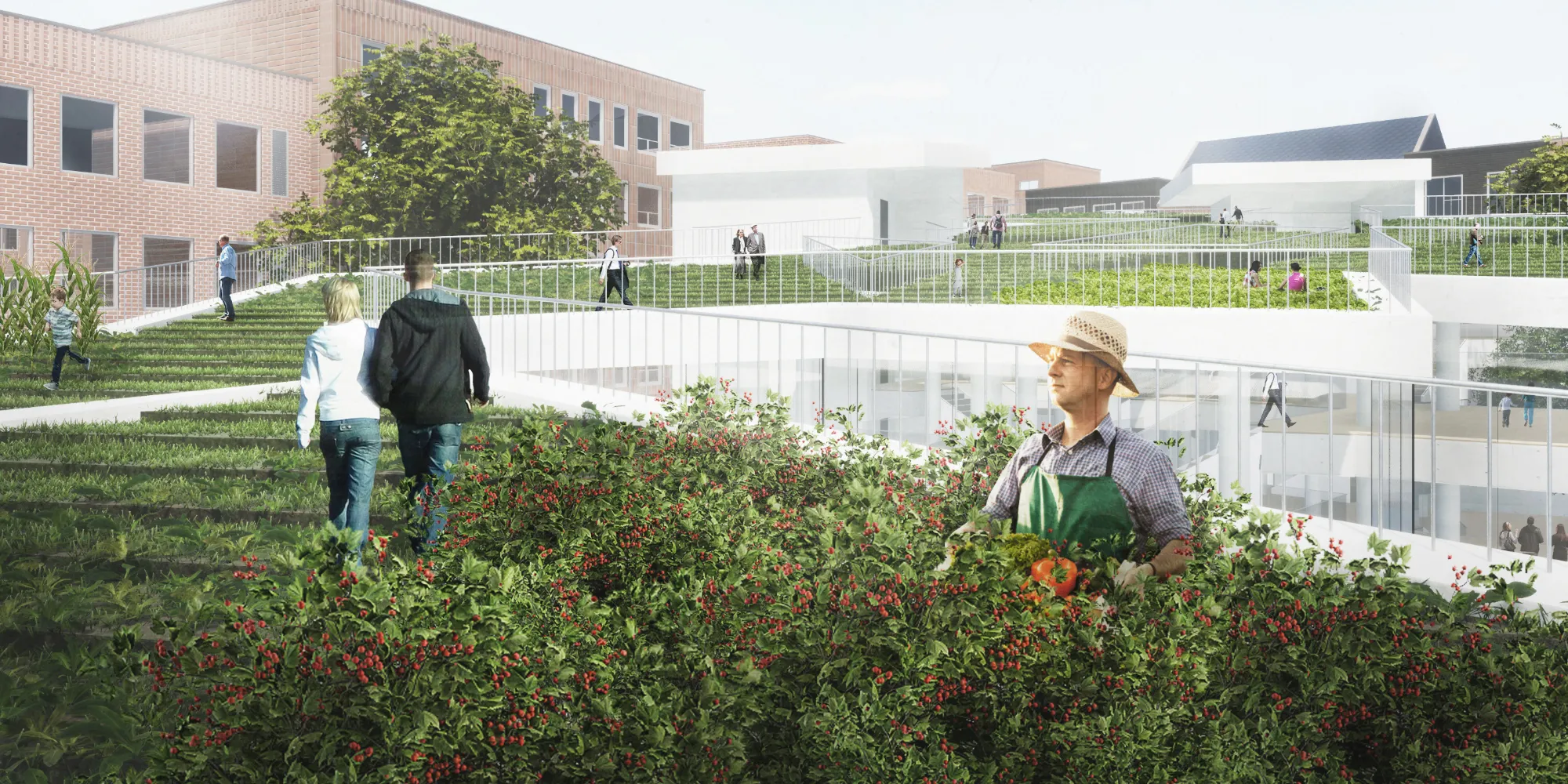
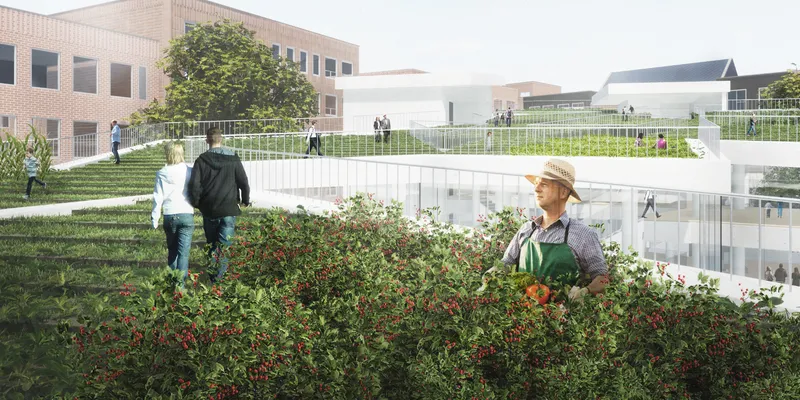
The rooftop of all modules is used as a garden. The rooftop is connected as one from the first floor to the top floor through a slope, so anyone can freely access it from the first floor. The connected and stretched rooftop is used for various purposes according to the needs of users. It transforms for various purposes such as farmland, performances, and meetings. The rooftop enriches the activities of the module below and makes the building's programs connected and active in that it can go down to the building below at any time.
Design completion could be achieved by using various shapes of the previously planned modules. From basic building modules to land patterns and landscaping, the previously planned square modules were used to make them consistent. As a result, a variety of randomly rotated square sloping hills facing the entrance offer an enchanting landscape.
Sprout from Sprawl
So far, we have lived in a world created by such an efficiency-seeking industrial structure. In a market that emphasizes only fragmentary purchases, people simply comfortably and impulsively consumed agricultural products. They simply buy passively in the structure created by the industry without knowing exactly where agriculture takes place or what food they consume. Our team noted that all of these problems stem from selective experiences arising from fragmented industrial structures. Our design presents a small world that can solve these problems. In it, people have various experiences and exchanges that are different from the past. We look forward to bringing together each field of agriculture scattered sporadically through our design like a sprout, just like the title of the contest, "Sprout from Sprawl."


Popular Articles
Popular articles from the community


Hill & Cross Opera: Sculptural Opera House Architecture Shaped by Tallinn’s Landscape and Identity
Hill & Cross Opera reimagines opera house architecture in Tallinn through its sculptural hill, civic plaza, glass wave and a luminous cross.

Riyadh For All: Intergenerational Urban Design for Active Aging in Rabat
Riyadh For All reimagines urban design in Rabat with intergenerational co-living, adaptive courtyards, and Moroccan cultural exchange today.

The Earth Pod: 3D Printed Homes for Resilient Refugee Communities
The Earth Pod reimagines refugee housing through 3D printed homes made from clay, combining resilience, self-sufficiency, and rapid shelter.

Co-life: Sustainable Architecture for Age-Friendly Community Living
Co-life reimagines sustainable architecture for seniors through courtyards, rammed earth, shared gardens, and spaces designed for belonging.


Similar Reads
You might also enjoy these articles

The Rhythm of Seasons
A Farmers' Market Connecting Nature and the City


More Than a Building-Designing a Living System
More Than a Building-Designing a Living System
Base Beyond
DESERT COMPOUND ARID: TOURISM OF ABSENCE AND ABUNDANCE

Explore Urban Sprawl Competitions
Discover active competitions in this discipline




Challenge to reimagine the Iron Throne


Photograph architecture without architects


Illustrate the lost glory of Angkor Wat - Render Challenge


Design challenge to reuse E-waste
Comments (0)
Please login or sign up to add comments
No comments yet. Be the first to comment!