
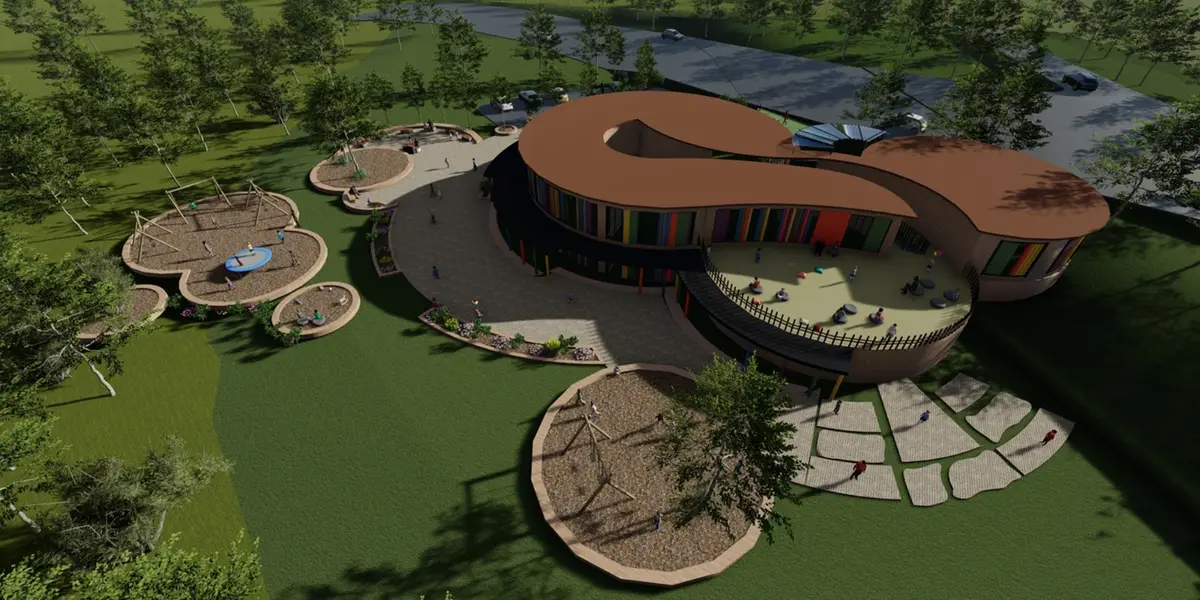
Supergarten
In the transition from the city, which has this feature, to the kindergarten garden, it was aimed to provide a

WELLINGTON, NEW ZEALAND
After the major earthquake (s) that occurred; The city was designed as a garden-city built with parks.
In the transition from the city, which has this feature, to the kindergarten garden, it was aimed to provide a
garden-kindergarten union and the landscape progressed in that direction. Wellington has a mild sea
climate and is the windiest city in the world, due to its location, the wind from the south reaches the
children on the upper floor and a playground is provided from the middle to the back.
● What was the concept behind the project?
Children who are curious about the first interactions of out-of-home learning and the learning areas of life;
Using this sense of curiosity (with reference), while transitioning to different learning spaces, it has been
provided with spaces that teach certain aspects of life in each element and solve this in playgrounds.
Method (Shapes) of Managing Feelings of Curiosity Consciously;
Stairs: When passing to the art room, which consists of spaces that can be transformed according to
the abilities and interests of the children; The ladder, which seemed boring and dangerous for children,
was brought together with nature thanks to the material (glass) used on the facade, and a transition was
made to another learning space.
Terrace: It was desired to create a project focused on development and transformation in a wider
period of time and as a solution to this; The art room, which includes transformable art forms, and the
circulation area and terrace, which are fun for children, unlike normal solutions between all spaces.
Landscape: With the material texture that will be safe for children and simple directional movements, it
is aimed to distribute the crowded children groups to the playgrounds, and the colors used in each small
playground unit allow children to freely determine their own games.
● What was the intent behind the organization of elements across various levels (Architectural, Site,
Urban)?
Our aim in this project design; To create environmentally friendly frameworks by integrating science, art,
creativity and physical forms used in the education and training of children with the natural environment,
to make nature and architecture feel to all kinds of people, to increase accessibility, to design taking into
account the axes of the project location.
● Which methods of design investigation?
While the architecture of the kindergarten creates a safe space for children, we set out to investigate
the question of "how to increase the sense of exploration and curiosity in children" and developed smallscale solutions that only serve one function, and large and medium-sized solutions with more than one
function have been found. Studies have been conducted to prove how well we can use the imagination of
children in these functions and manage them, especially in today's changing times.
● How many iterations were tried to arrive at the final outcome?
While the solutions found continue on small playgrounds and surfaces; It was approached with the
concern of learning areas open to development and transformation over time. These small playgrounds
and surfaces have grown from place to place and have been reflected in circulation areas, semi-open
spaces and landscaping.
● How was the programme condensed into final?
The ideas considered by analyzing the users and the land were formed. A synthesis was created in line
with the findings obtained as a result of the analysis, and the problems and potentials affecting the
design were found. It was thought that it would be much more efficient to be inspired by nature for the
education and training of young users, and this was used in every step of the design. The trees in the
field were preserved and an organic form was emphasized according to the axes of the field. This
organic form has created a natural circulation area and the training units needed are designed like a
pocket opening to nature. Thus the constructed form itself has become a teacher of various aspects of
life.
●How was a specific objective attempted to be met?
A mass is designed for children to be inspired by nature and get the most out of it. Along with common
usage areas, convertible multi-purpose spaces have been defined for programs such as science and art
units. For example, multi-purpose hall, art class, common event area and terrace. In addition to all this,
natural materials that are suitable for children's health were used, using the characteristics of the
sustainable context.
●How will the project transform with the passing time? etc.
The location of the building has been respected to nature. The building is aligned according to the
position of the trees on the land, common areas, terraces and walkways are designed. Thus, the areas
here were transformed into spaces that can host different units in the future. As an example, a terrace
where children can exhibit their activities outdoors and socialize has been designed.

Popular Articles
Popular articles from the community


U.GA Architects Wraps an Oval Rooftop Pool in Curved Board-Formed Concrete on Busan's Jeollidan-gil
In Busan's Jeonpo-dong, a 454 m² mixed-use block stacks a neighborhood facility, guest rooms and an oval rooftop pool inside spiraling concrete walls.

Cube Design Draws an Ecological Corridor Between Two Shenzhen Hills with the Nankai Building
Beside Shenzhen's container docks, the Nankai Building pairs stacked balconies with a climbing green screen to connect two hillsides across its height.

GROUP A Strips a 1969 Rotterdam Harbor Headquarters to Its Frame and Wraps It in Timber Louvers
In Rotterdam's M4H harbor district, Ferro Offices reuses a 1969 frame, adds one timber storey and reaches BREEAM-NL Outstanding.

David Ortega Stacks a Two-Story Mexico City Penthouse Around a Steel Stair and a Pergola-Shaded Roof Terrace
In Colonia Roma, a 300 m² penthouse uses oak joinery, a planted steel stair and a slatted roof pergola to make a new-build apartment feel like a house.

Similar Reads
You might also enjoy these articles


Vereda Arquitetos Renovates a 40-Square-Meter Apartment Inside Niemeyer's Copan Building
A compact unit in São Paulo's most iconic residential tower gets a material overhaul that pairs exposed concrete with bold blue Formica.

Shakur's House: Exposed Brick as an Interior Organiser in a 168 m² Mashhad Residence
Brick moves indoors in this Mashhad residence, where masonry walls, glass partitions and teal planes sequence a compact home without closing it off.

Day and Night Park: A Time-Based Urban Newsstand in Beijing
A temporary urban newsstand in Beijing blending travel, light, and reading through poetic colors, compact form, and community-focused design.

Modernist Patio Renovation in El Masnou, Barcelona by Oliver Segura Arquitectura + Cebrià Arquitectura
Modernist patio renovation blending tradition and innovation with a movable pool, leveled floors, and Catalan materials in El Masnou.

Explore Forest Garden Competitions
Discover active competitions in this discipline


Challenge to reimagine the Iron Throne

Photograph architecture without architects

Illustrate the lost glory of Angkor Wat - Render Challenge

Design challenge to reuse E-waste
Comments (0)
Please login or sign up to add comments
No comments yet. Be the first to comment!