
The City Link: A Copenhagen Bridge That Refuses to Be Just Infrastructure
A 100-meter drawbridge on Copenhagen's waterfront merges cycling lanes, glazed pavilions, and a counterweight mechanism into genuine public space.


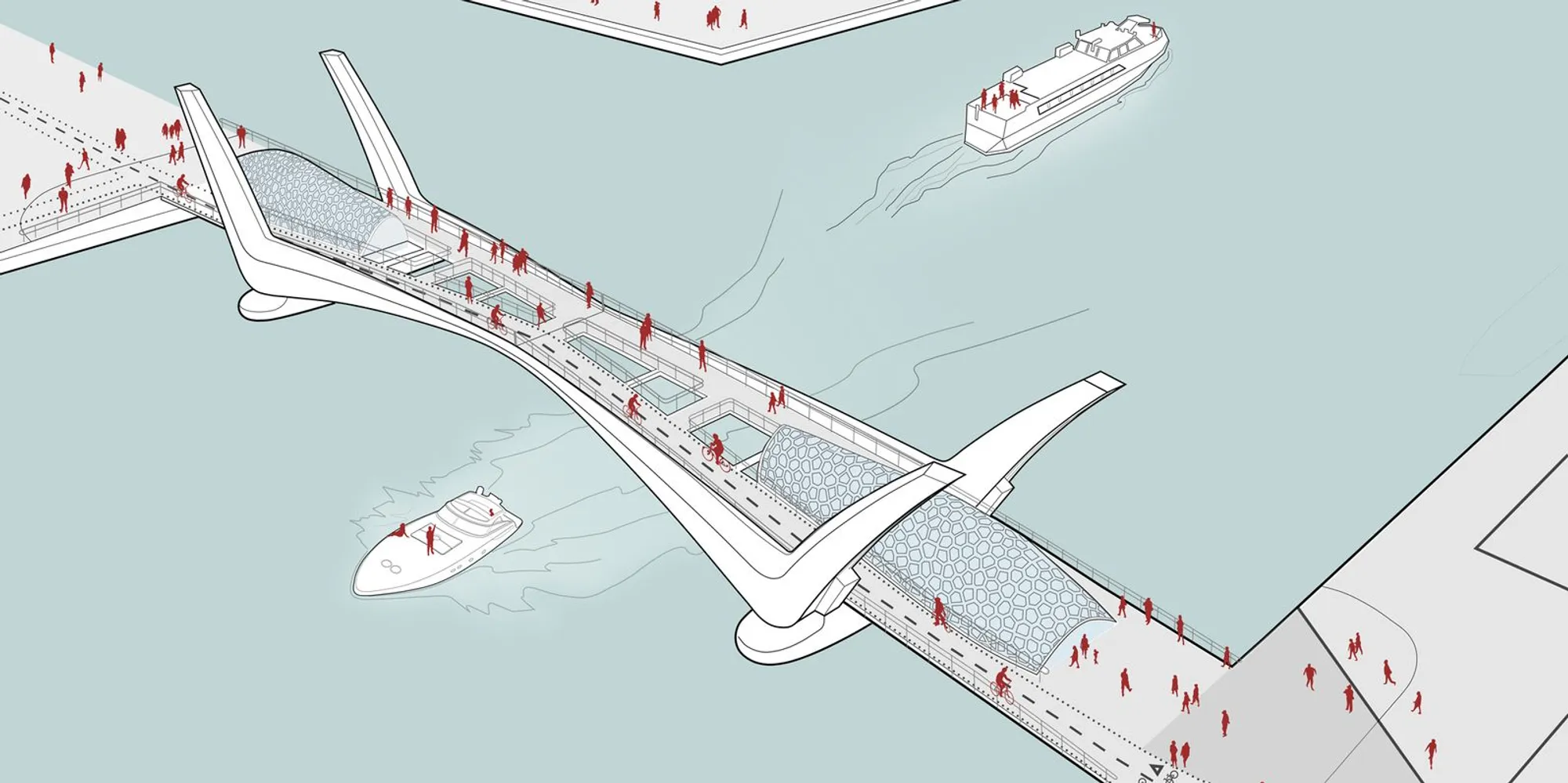
A bridge that opens for ships should not need to apologize for existing the rest of the time. That conviction drives The City Link, a proposal for the Tordenskjoldsgade crossing in Copenhagen that treats the 100-meter span as occupied territory: a surface for cycling, lingering, drinking coffee, and getting a bicycle repaired, all while framing the harbor it straddles. The drawbridge mechanism, two identical L-shaped elements with vertical counterweights, is the structural engine of the design, but the real ambition sits on the deck, where glazed pavilions and carefully zoned lanes turn transit into civic life.
Designed by Alexander Strugach and published on uni.xyz, the project positions itself within Copenhagen's broader push toward pedestrian and bicycle-oriented infrastructure. The site sits on the city's historic waterfront, a context that demands restraint: surrounding scales, promenade alignments, and harbor sightlines all constrain what a new structure can reasonably do. Strugach's response is to complement rather than compete, letting structural clarity and programmatic generosity stand in for monumental gesture.
Reading the Waterfront at 100 Meters
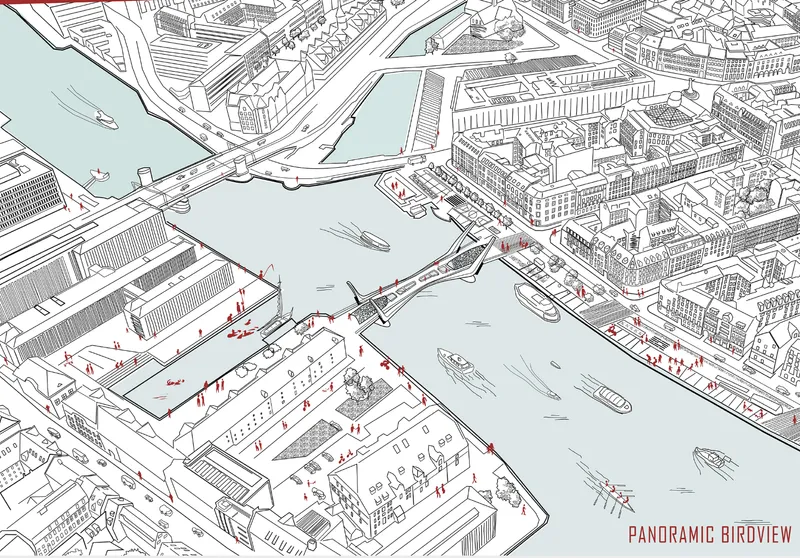
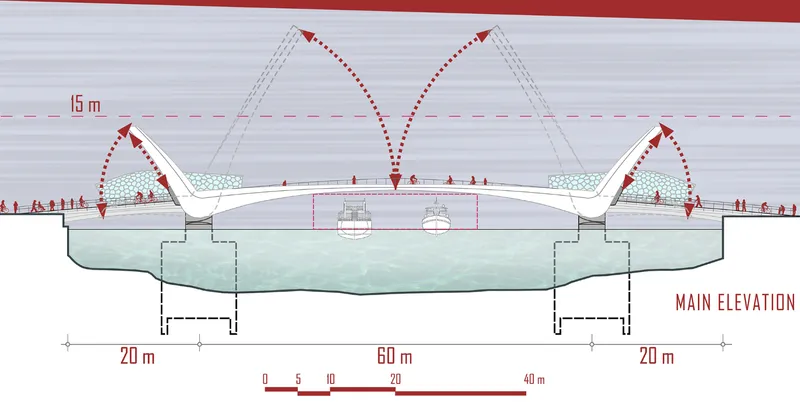
The axonometric view reveals how the bridge slots into the existing urban fabric: waterfront buildings, parallel promenades, and boat traffic all continue uninterrupted, the new span reading as a logical extension of land rather than an interruption of water. The 60-meter central opening span, flanked by two 20-meter side spans, keeps the structural footprint compact enough to avoid overwhelming the harbor section. In the elevation drawing, the L-shaped halves and their cable-stay geometry become legible. When closed, the profile stays low and lightweight; when raised, each half pivots upward with its counterweight, clearing the channel for maritime traffic without the visual bulk of a conventional bascule bridge.
The Deck as Destination, Not Corridor
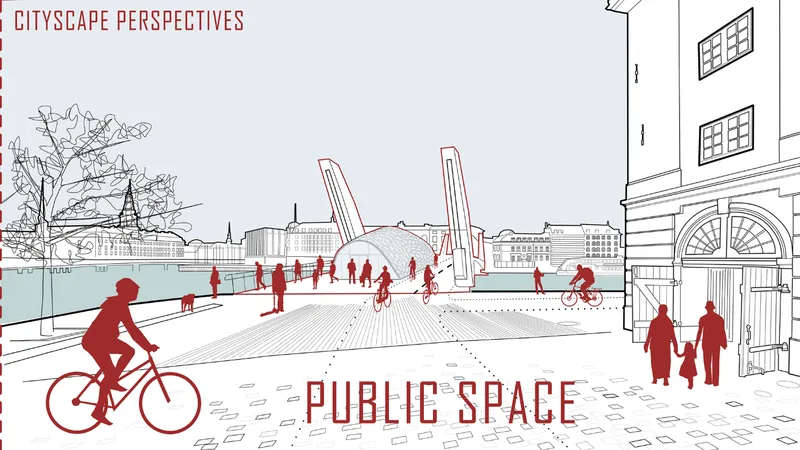
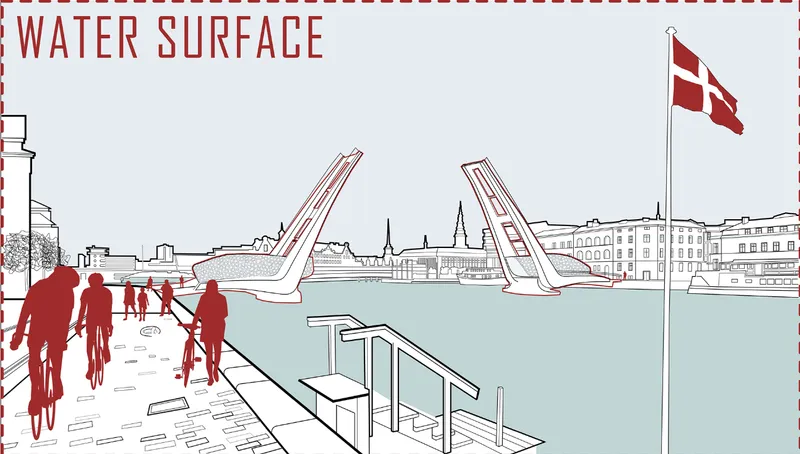
Two perspective sketches capture the experience at deck level. In the first, cyclists and pedestrians share a generous plaza that extends toward the open bridge beyond, the raised halves framing sky and water in a way that turns waiting into spectacle rather than inconvenience. In the second, a waterfront promenade connects directly to the bridge, with tilted pylons marking the transition from land to span. Integrated glazed pavilions house a café and a bicycle workshop, programs chosen to anchor daily use rather than occasional tourism. The subdivision of the deck into distinct zones, walking, cycling, pausing, ensures that no single mode of movement dominates, a principle that reflects Copenhagen's mature understanding of shared urban surfaces.
Celebrating Water Rather Than Crossing It
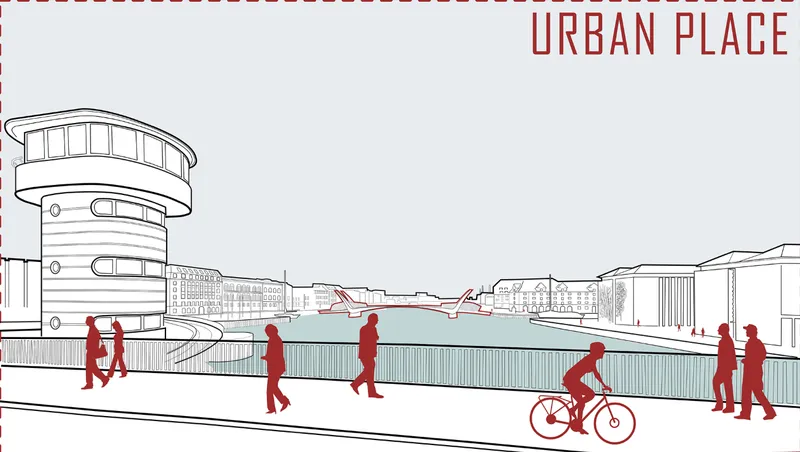
From the waterfront plaza, the bridge reads less as an obstacle spanning the harbor and more as a frame that draws attention to the water itself. The curved building edge in the foreground anchors the pedestrian realm on land, while the bridge beyond extends that realm over the channel. When the drawbridge opens, the visual dialogue between urban life and maritime movement intensifies: the raised structure becomes a sculptural event, momentarily reshaping the skyline and reminding the city that its harbor is alive. Strugach positions this interplay as the project's core identity, arguing that the act of crossing should be experiential, not merely functional.
From Drawing to Model: Testing the Idea Physically
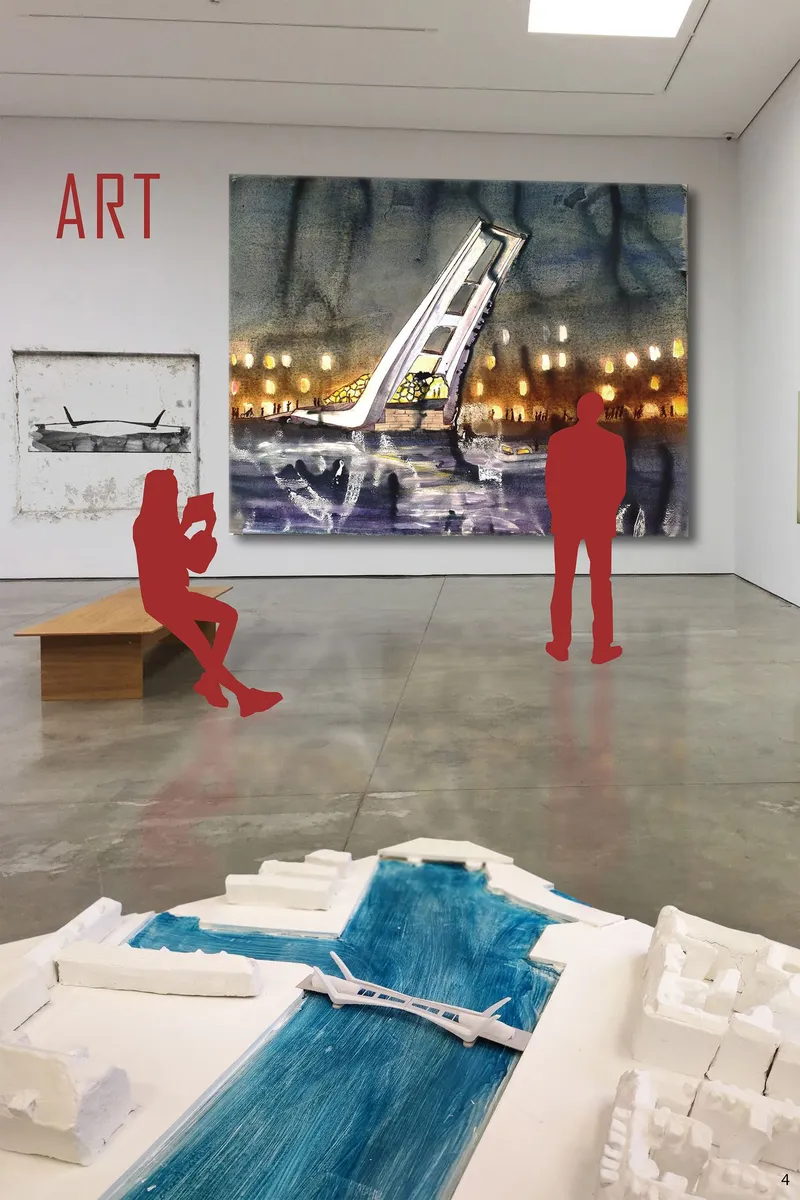
A physical massing model displayed in a gallery setting confirms that the proportions hold at scale. The model strips away atmospheric rendering to expose the fundamental geometry: the balance between the central span and its flanking segments, the relationship of deck width to pylon height, the clearance envelope for vessels. Presenting the work in this format signals a commitment to structural honesty that runs through every phase of the project, from concept sketch to three-dimensional verification.
Why This Project Matters
Copenhagen has spent decades proving that cycling infrastructure can reshape a city. The City Link extends that argument from the lane to the bridge, proposing that even a drawbridge, a type usually defined by mechanical necessity, can carry public life. By embedding pavilions, workshop space, and generous pedestrian zones into a span that must also open for ships, Strugach challenges the assumption that movable bridges are inherently hostile to anything beyond vehicular throughput.
The project's real contribution is its refusal to separate engineering logic from civic ambition. The counterweight mechanism is not hidden; it shapes the elevation. The glazed pavilions are not afterthoughts; they occupy the structural bays. Every design decision serves both function and public experience, a synthesis that remains rare in bridge design worldwide. For a waterfront city still evolving its relationship with the harbor, that synthesis is exactly the kind of infrastructure worth building.
View the Full Project
About the Designers
Designer: Alexander Strugach
Enter a Design Competition on uni.xyz
uni.xyz runs architecture and design competitions year-round that reward proposals with spatial conviction and real site intelligence.
Project credits: The City Link" Tordenskjoldsgade København Bridge by Alexander Strugach.




Popular Articles
Popular articles from the community


Hill & Cross Opera: Sculptural Opera House Architecture Shaped by Tallinn’s Landscape and Identity
Hill & Cross Opera reimagines opera house architecture in Tallinn through its sculptural hill, civic plaza, glass wave and a luminous cross.

Co-life: Sustainable Architecture for Age-Friendly Community Living
Co-life reimagines sustainable architecture for seniors through courtyards, rammed earth, shared gardens, and spaces designed for belonging.

The Ocean Hive: Sustainable Architecture for a Self-Sufficient Civilization at Sea
The Ocean Hive imagines sustainable architecture at sea, where modular habitats, algae, wave power and ocean waste sustain a growing colony.

Lunar Spiral: Space Architecture Shaped by the Mathematics of the Universe
Lunar Spiral reimagines space architecture through Fibonacci geometry, lunar regolith, levitating habitats, and self-sustaining Moon living.


Similar Reads
You might also enjoy these articles
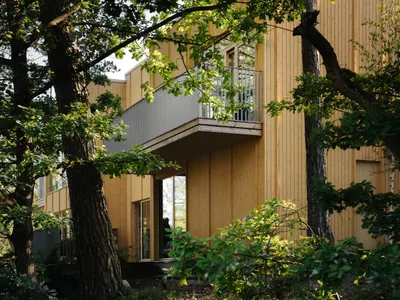
Sustainable Architecture Design: Embracing Nature and Modernity at Villa Solsidan
The article explores Villa Solsidan by AndrénFogelström, showcasing its sustainable architecture design and integration with the natural surroundings in Saltsjöbaden, Sweden.
Scientific and Educational Monitoring Center of the Yenisei, Krasnoyarsk
Architecture as an instrument for ecological research, education, and environmental awareness along Russia’s largest river.
Development of Andretta Artist’s Village, Palampur, Himachal Pradesh, India
Reimagining Andretta as a living cultural landscape where art, architecture, and community converge to shape a global creative village.
Street Children Rehabilitation Center: A Model of Social Architecture for Community Rehabilitation
An inclusive social architecture project that transforms streets into nurturing environments, restoring dignity, identity, and opportunity for vulnerable children.
Comments (0)
Please login or sign up to add comments
No comments yet. Be the first to comment!