
THE CLUSTER
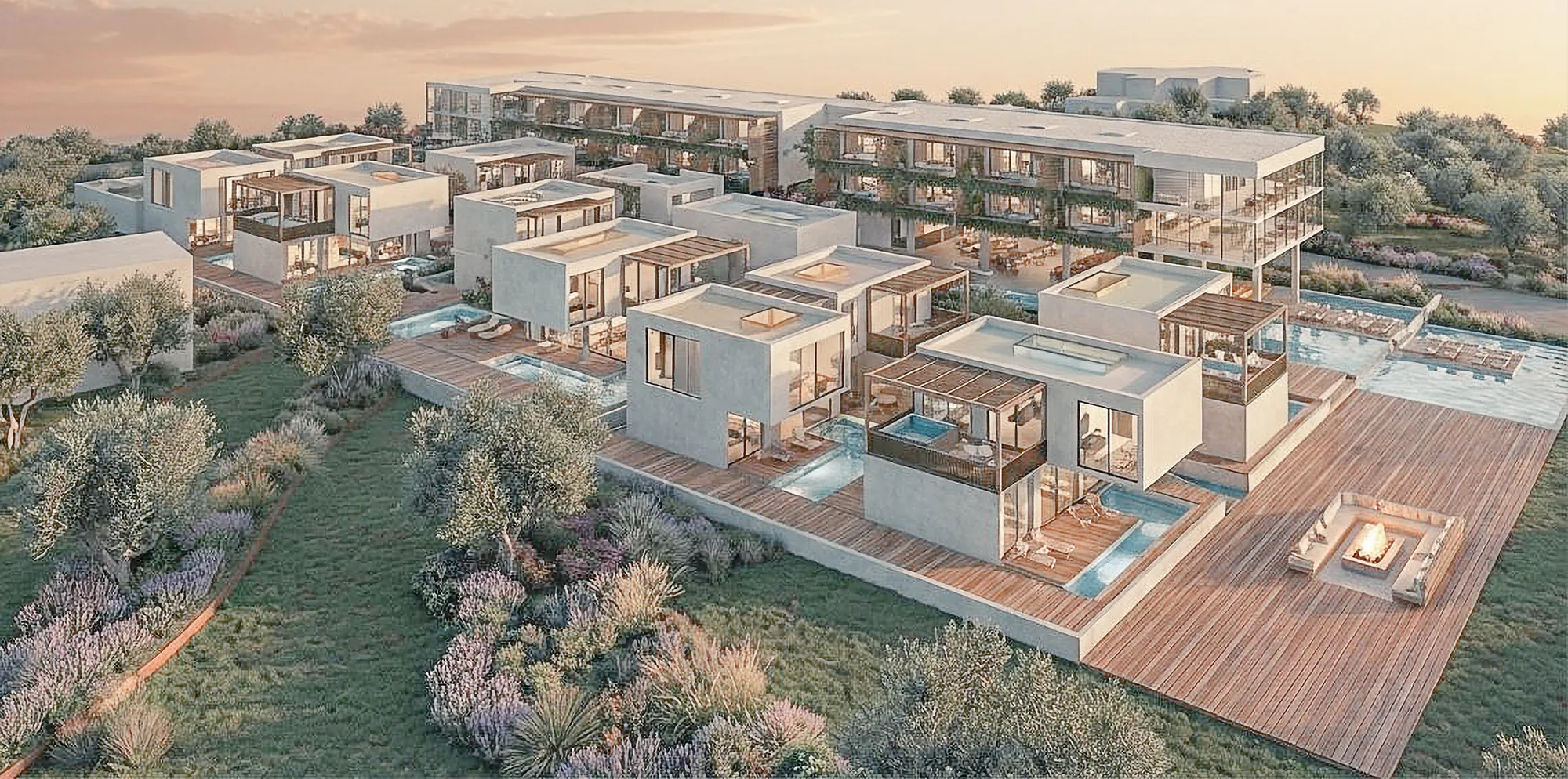
Reinterpreting Andalusian heritage, The Cluster creates a resilient post-pandemic habitat. By replacing enclosed corridors with open-air streets, it ensures natural ventilation and safe interaction.

A Resilient Habitat The design of "The Cluster" addresses a critical challenge: How can a holiday village respond to the post-pandemic urgency for health without losing the warmth of community? The answer was found in the local fabric. Moving away from the air-conditioned hotel block, the project deconstructs the mass into a porous organism, creating a healthy, nature-focused habitat that honors the region's history.
Morphology of the Wind: Passive Performance This fragmentation is a calculated response to the climate. The staggered arrangement of the independent living modules creates a network of "interstitial spaces"—modern interpretations of narrow Calles (streets). These corridors are engineered to trigger the Venturi effect, accelerating the prevailing winds to naturally cool the public realm. As the breeze flows through the site, the private courtyards evolve into "Bio-Pockets." Wrapped in layered vegetation, these zones ensure that while the wind is shared, privacy remains absolute.
The Social Anchor & Materiality Anchoring this dispersed settlement is the Main Building. Unlike a static monument, its ground floor serves as a permeable, unifying social interface that dissolves the boundary between the interior and the landscape. Here, a tactile dialogue of materials emerges: the cool, reflective White Plaster—a respectful nod to the local "White Villages"—contrasts with the warmth of Natural Wood shading elements. This duality creates a sensory balance between protection and openness. Inside, the atmosphere is sculpted by light. Referencing Gaudi’s structural color, contemporary Stained Glass elements act as "Atmospheric Modulators," filtering the harsh Mediterranean glare into a therapeutic, shifting mosaic of soft colors.
Landscape as a Healing Machine The project’s most radical stance is its generosity towards the earth. Minimizing its footprint far below the permitted density, the design surrenders the majority of the land to nature. This open space is activated by the "Permaculture Path." More than a circulation route, this is an active infrastructure for healing. Through a phytoremediation system utilizing Phragmites (reeds) and aromatic plants, greywater is recycled on-site to replenish cooling pools. This transformation turns the daily act of walking from a commute through a sterile corridor into a restorative journey through a living, breathing ecosystem.




Popular Articles
Popular articles from the community


The Musturak Paradise: Senior Living Architecture for a Connected Future in Temara, Morocco
The Musturak Paradise reimagines senior living architecture in Temara via private homes, social spaces, culture, community, and shared care.

Play: Fragments of Their World
Familiar architecture becomes modular playground design, creating safe spaces where displaced children can learn, connect, imagine and play.

Hill & Cross Opera: Sculptural Opera House Architecture Shaped by Tallinn’s Landscape and Identity
Hill & Cross Opera reimagines opera house architecture in Tallinn through its sculptural hill, civic plaza, glass wave and a luminous cross.

Lunar Spiral: Space Architecture Shaped by the Mathematics of the Universe
Lunar Spiral reimagines space architecture through Fibonacci geometry, lunar regolith, levitating habitats, and self-sustaining Moon living.
Similar Reads
You might also enjoy these articles
The Rhythm of Seasons
A Farmers' Market Connecting Nature and the City

More Than a Building-Designing a Living System
More Than a Building-Designing a Living System
Base Beyond
DESERT COMPOUND ARID: TOURISM OF ABSENCE AND ABUNDANCE





Comments (4)
Please login or sign up to add comments
congrats 🥂
Wonderful
Ich habe noch nie ein so schönes Projekt gesehen.
Çok faydalı bir proje olmuş tebrikler