

The Culture Wall
The design of The Oasis Cultural Center in Marocco.
The Marrakesh of the future is not only modern, but also a reference to the culture and traditions of the place. This connection manifests itself in many aspects. The shape of the building is reminiscent of the Moroccan architecture and refers to the city of Tinghir, whose image is included in the visualization of the exhibition venue. Tinghir is a city that forms the gateway to a gorge with 300 meter high walls. The four blocks of varying heights reflect the buildings there, which are stacked on top of each other and look like the designed building.
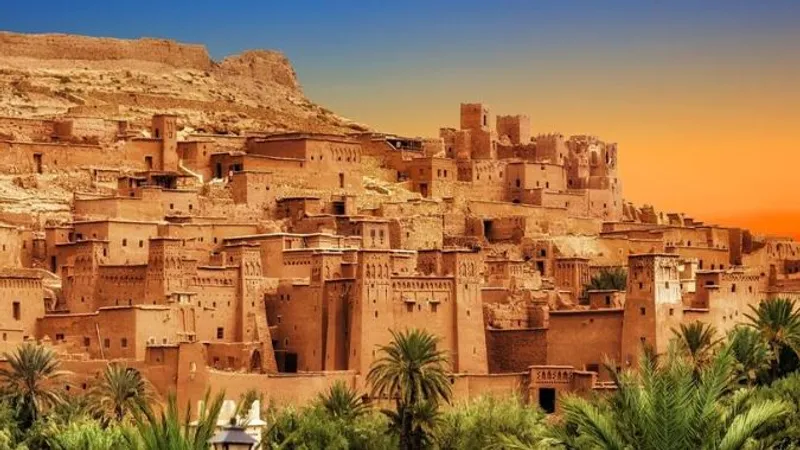
The culture wall is supposed to give the impression of a building emerging from the ground and immersed in greenery. The final shape is a process of "cracking" of a simple cuboid from which some parts were removed and others moved. In the middle, in reference to traditional building, a patio was created.
These "cracks" are called walls for a reason, the wall in the Moroccan tradition is something that divides, in the modern approach we try to get rid of this thinking. We are creating a wall, which tries to direct us to something, these walls from the underground square open onto part of the designed environment and from the perspective of a person walking into the building they "invite" to the exhibition part.
The designed building is supposed to refer to the very concept of an oasis, an oasis is a place with water as its center and greenery as its surroundings. The Culture wall is a place where the center is the exhibition - the most important part of the building, and the buildings around it are its complement. Four buildings of different heights, each of which is a separate unit, and what connects them is an underground exhibition. Exhibitions have been organized in each of the buildings, and the link is a multifunctional square, which can also become an exhibition area, depending on the needs.
Morocco is famous for its narrow streets, tight passageways and alleys, part of the character of this country I decided to transfer to the development of the plot. Each of the buildings has a separate entrance, and the front entrance leads to their main entrances. Two axes were designed on the two extreme sides of the plot, which lead visitors to the central point of the project - the underground square and exhibitions. I have not forgotten about the disabled either. In the axis going through the middle of the plot, there is an elevator, thanks to which one can get to the exhibition level. The axis through the middle has its continuation on the other side of the plot, it is a place where you can admire beautiful views. The surroundings of each building were designed so that the building could "go out", creating its functional continuation in the land development. The rest of the site is complemented by greenery and water tanks to cool off during hot temperatures.
Known colloquially as the "Red City" because of the predominance of red sandstone architecture, Marrakech is full of mosques, palaces and markets surrounded by old fortified city walls. The façade is a combination of local red sandstone and perforated metal. The interior of the building reflects modern architecture and the aforementioned "cracks" are highlighted with perforated metal in traditional Moroccan patterns. The patterned perforations of the façade allow diffused natural light to enter the interior while blocking out unwanted sunlight.
These walls have been dubbed walls, in which the arched holes cut into them provide a place to display elements of art, architecture, and Moroccan culture from individual rooms. In this way, the entire patio between the buildings along with the walls became a place to exhibit art.
The modernity of the building is reflected in the ecological solutions used. The local material used - red sandstone, will allow to reduce delivery costs and minimize carbon footprint. Green roofs have been designed on the roofs, and plants placed at the façade create rain gardens, which are watered thanks to recycled water. The building also has natural ventilation, which is provided by triangular holes in the building that allow warm air to be exhausted to the outside. The tallest building, it is also the most exposed building, the design uses photovoltaic glass - glass with a quantum coating that not only generates electricity but also protects against harmful UV radiation. Local raw materials were used, such as natural clay made from locally fired limestone and natural plasters from the area.
The simple division of the buildings-each building has a different function-makes it more accessible and legible for visitors. At the same time, their layout and main entrances mean that there is something going on in every part of the site; there is no "dead" space that is left unused.
The design of The Culture Wall will grow in value with time because it is not just a modern block, but an architecture that carries more than that. It is an example that can be used for descendants to learn about Moroccan culture and tradition. What is modern now will also become tradition and culture in the future, and the building will symbolize a certain period in Moroccan tradition.



Popular Articles
Popular articles from the community


Co-life: Sustainable Architecture for Age-Friendly Community Living
Co-life reimagines sustainable architecture for seniors through courtyards, rammed earth, shared gardens, and spaces designed for belonging.

The Ocean Hive: Sustainable Architecture for a Self-Sufficient Civilization at Sea
The Ocean Hive imagines sustainable architecture at sea, where modular habitats, algae, wave power and ocean waste sustain a growing colony.

Hill & Cross Opera: Sculptural Opera House Architecture Shaped by Tallinn’s Landscape and Identity
Hill & Cross Opera reimagines opera house architecture in Tallinn through its sculptural hill, civic plaza, glass wave and a luminous cross.

Conexión: Biophilic Design Reimagines High-Rise Living in Hong Kong
Conexión reimagines high-rise living in Hong Kong through biophilic design, green facades, shared spaces, daylight, water and nature within.
Similar Reads
You might also enjoy these articles

Day and Night Park: A Time-Based Urban Newsstand in Beijing
A temporary urban newsstand in Beijing blending travel, light, and reading through poetic colors, compact form, and community-focused design.

Modernist Patio Renovation in El Masnou, Barcelona by Oliver Segura Arquitectura + Cebrià Arquitectura
Modernist patio renovation blending tradition and innovation with a movable pool, leveled floors, and Catalan materials in El Masnou.

Alto Residencial Coop: Cooperative Housing Development in Santiago de Compostela by Carbajo Barrios Arquitectos
A linear cooperative housing complex blending white volumes and perforated metal façades, enhancing community living, natural light, privacy, and urban integration.

Vil Genis School by BPA ARCHITECTURE – Massy, France
Vil Genis School in Massy, France, features sustainable design, south-facing classrooms, community integration, accessible spaces, and modern educational architecture.

Explore Cultural Center Competitions
Discover active competitions in this discipline




Challenge to reimagine the Iron Throne


Photograph architecture without architects


Illustrate the lost glory of Angkor Wat - Render Challenge


Design challenge to reuse E-waste
Comments (0)
Please login or sign up to add comments
No comments yet. Be the first to comment!