
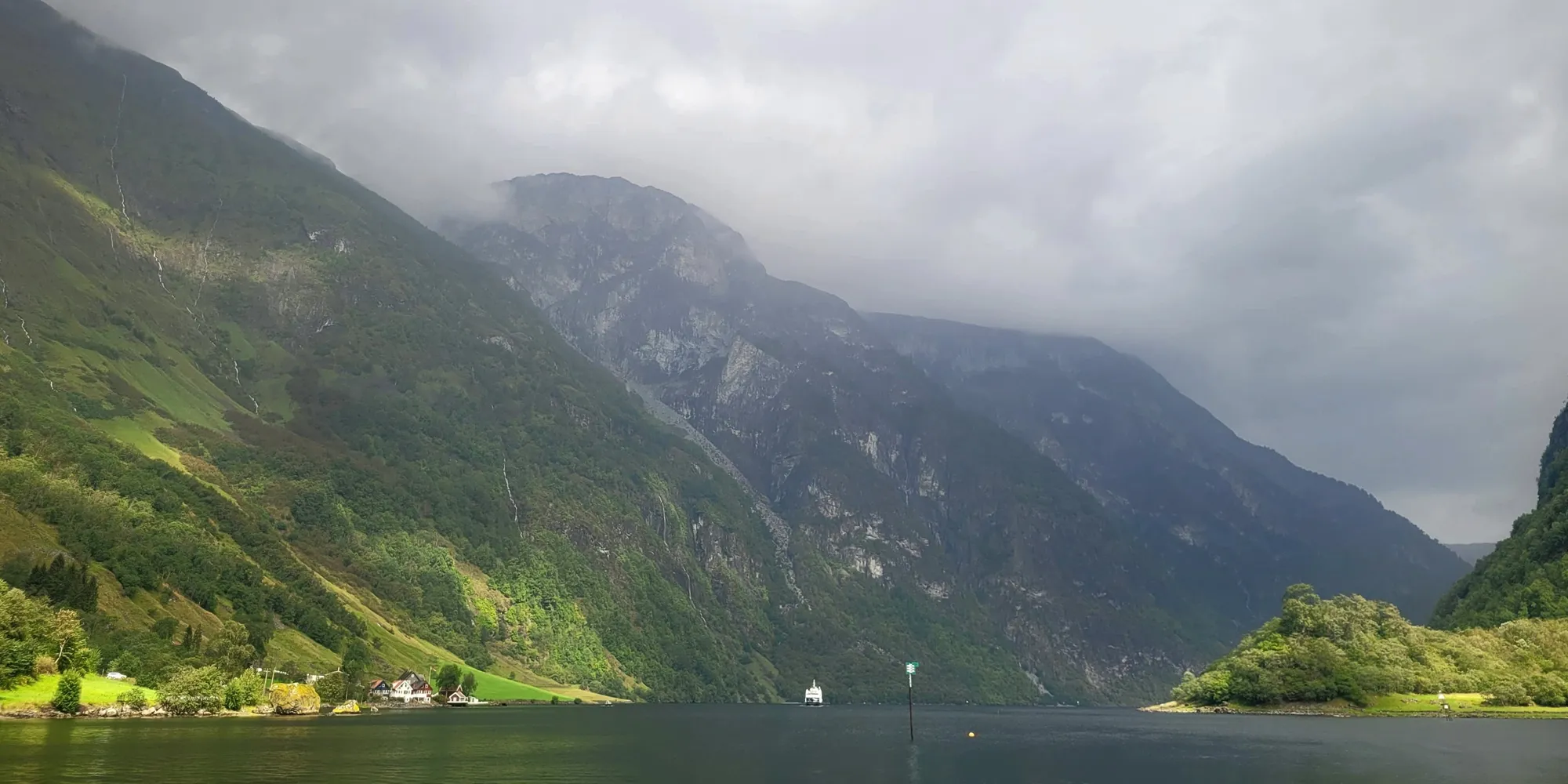
THE HYGGE PATH
A sustainable and self-sufficient escape and wellness retreat in Nærøyfjord – a response to the challenges of contemporary architecture and the environment.

Contemporary Environmental Challenges and the Role of Architecture and Construction
In the era of escalating climatic crisis, modern societies confront increasingly acute environmental pressures. Among the key sectors exerting substantial influence on the natural environment is architecture and construction. It is estimated that about 37% of global carbon dioxide emissions originate from the production of construction materials, their transportation, and the processes of building and operating structures. Such a significant share of emissions attributed to the construction industry positions it as a critical area demanding urgent interventions to mitigate negative impacts on the climate.
Concurrently, intensive and often uncontrolled urbanization drives the transformation of natural terrains—frequently of high ecological value—to accommodate infrastructure and socioeconomic development. These interventions degrade ecosystems, erode biodiversity, and further intensify greenhouse gas emissions. The deleterious consequences of these practices pose a profound challenge for contemporary architecture, whose imperative becomes the implementation of sustainable principles to curtail the environmental footprint of construction.
Current policies and regulations concerning zero‑emission buildings, though progressive, tend to focus predominantly on reducing operational emissions. They often neglect the substantive impact of the full life cycle of a building, including material extraction, manufacturing, transportation, construction, and eventual demolition. Moreover, the effects of land occupation and irreversible landscape transformation are frequently under-addressed. Even the most advanced legal frameworks cannot fully eliminate the environmental degradation inherently associated with the creation and use of built environments.
As noted by Dr. Piotr Wróbel, the prevailing paradigm of sustainable development—understood as the continuation of existing trajectories with minor adjustments—no longer suffices. There is a growing recognition of the need for more comprehensive, regenerative strategies that not only minimize harm but actively support the restoration and enhancement of natural ecosystems. Architecture, in this context, must evolve from being a passive emitter to an active agent in environmental and social transformation.
Local Challenges and Context: The Nærøyfjord Case
These global concerns are magnified in ecologically sensitive and culturally significant locations such as Norway’s Nærøyfjord valley. Recognized as a UNESCO World Heritage site since 2005, the area is distinguished by its exceptional natural beauty and rich biodiversity. However, the region’s residents face substantial environmental and social challenges.
Due to steep slopes and the risk of avalanches, access to the area remains limited, leading to social isolation and economic constraints. Moreover, the growing influx of tourists, while economically beneficial, places added stress on the local environment and infrastructure. Residents experience depopulation and a weakening of traditional cultural ties, compounded by the absence of inclusive public spaces for community gathering or mental health support.
In light of these interrelated challenges—both ecological and societal—an architectural response must be grounded in an intimate understanding of place. It must address environmental fragility while simultaneously fostering human wellbeing and social cohesion.
A Holistic Architectural Response: Regenerative Retreat in the Fjord Landscape
As a response to these complex, overlapping needs, a concept was developed for a sustainable renewal and retreat center situated within the Nærøyfjord region. The architectural vision is deeply rooted in respect for the natural landscape, local cultural identity, and the psychological needs of its users.
From the outset, the design concept was guided by a principle of maximum preservation and minimal disturbance of the site’s topography. The composition of the project follows the contour lines of the terrain, enabling the built structures to integrate organically into the surrounding environment. This approach reduces the need for intrusive earthworks and supports both ecological stability and aesthetic harmony.
The spatial layout of the development has been fully adapted to the area’s specific climatic and environmental conditions. This enhances the durability and resilience of the structures while ensuring their functional performance in a dynamic alpine context. The project's architectural expression is intentionally subdued, designed to blend naturally into the terrain rather than assert itself. It aims to complement, rather than compete with, the landscape.
At the core of the project is a three-story central retreat and renewal facility, supplemented by a greenhouse that serves both therapeutic and self-sufficiency purposes. The greenhouse not only provides a calming, sensory-rich environment but also contributes to local food production and educational programming.
Scattered throughout the site are small, freestanding cabins—minimalist shelters designed for solitude, privacy, and a deeper engagement with the natural world. These units are carefully positioned in accordance with the terrain, offering guests immersive, low-impact accommodations that encourage individual reflection and reconnection with nature.
Integral to the overall master plan is a network of pedestrian pathways that connect various programmatic elements: the main building, the cabins, the greenhouse, and key landscape features such as observation decks, rest terraces, and contemplative zones. These paths are designed with accessible gradients, allowing people of all physical abilities to engage with the mountainous terrain without exclusion.
Moreover, the site includes a small-scale dairy cabin located near facilities for the care and grazing of goats, which reflect the agricultural heritage of the region. The inclusion of pastures and local production is not only symbolic but also functional—reinforcing the project’s commitment to circular economy principles and local resilience.
The architectural concept was developed with a comprehensive awareness of the environmental, cultural, and social context. Each design decision was informed by an intent to create a space that adds value to its setting—rather than burdening it. The retreat center seeks to be an exemplar of harmonious coexistence between built form and natural landscape, embodying a spatial model that supports human wellbeing while respecting the delicate balance of the fjord ecosystem.
The design prioritizes the real, identified needs of users—both residents and visitors. It provides a space for silence, healing, and connection. Shared areas foster community, while private zones support personal regeneration. The immediate proximity to nature is not a backdrop but an active participant in the therapeutic process.
Conclusion
This project presents a nuanced, integrated approach to contemporary architectural practice in the age of climate urgency. It not only addresses global concerns—such as emission reduction, ecosystem preservation, and resource stewardship—but also responds to the specific needs and identities of a local community.



Popular Articles
Popular articles from the community


The Ocean Hive: Sustainable Architecture for a Self-Sufficient Civilization at Sea
The Ocean Hive imagines sustainable architecture at sea, where modular habitats, algae, wave power and ocean waste sustain a growing colony.

The Musturak Paradise: Senior Living Architecture for a Connected Future in Temara, Morocco
The Musturak Paradise reimagines senior living architecture in Temara via private homes, social spaces, culture, community, and shared care.

The Earth Pod: 3D Printed Homes for Resilient Refugee Communities
The Earth Pod reimagines refugee housing through 3D printed homes made from clay, combining resilience, self-sufficiency, and rapid shelter.

Play: Fragments of Their World
Familiar architecture becomes modular playground design, creating safe spaces where displaced children can learn, connect, imagine and play.


Similar Reads
You might also enjoy these articles

The Rhythm of Seasons
A Farmers' Market Connecting Nature and the City

More Than a Building-Designing a Living System
More Than a Building-Designing a Living System
Base Beyond
DESERT COMPOUND ARID: TOURISM OF ABSENCE AND ABUNDANCE

Explore Nordic Sustainable Architecture Competitions
Discover active competitions in this discipline




Challenge to reimagine the Iron Throne


Photograph architecture without architects


Illustrate the lost glory of Angkor Wat - Render Challenge


Design challenge to reuse E-waste
Comments (0)
Please login or sign up to add comments
No comments yet. Be the first to comment!