

The Mangrove Society
Discovering a new breed of habitat on the move.

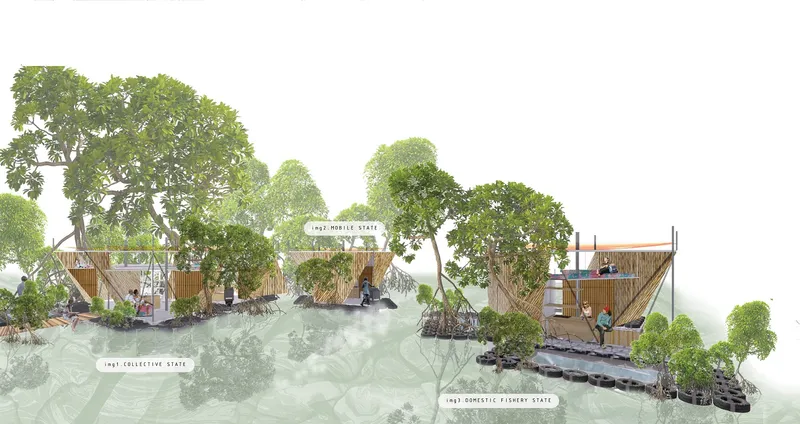
A nomad does not run from place to place but makes a home wherever they land. This is the ethos of the mangrove society - a hodgepodge of fisherman, farmers, and coastal inhabitants displaced by rising sea levels and the destruction of the coastal habitats that once protected their lands. Rudely awakened to the essential bond between humans and their ecosystems they now travel along the shorelines of sinking lands in their floating mangrove houses. As they move from site to site following fish, fleeing storms, and claiming government carbon credits for reforestation they carry with them their mobile oyster farms, shrimp nurseries, fisheries, and bakeries that thrive on the mangrove nurseries that moor them. After longer periods of settlement, the mangroves mature and are detached and replaced to repopulate and reclaim coastal areas while providing opportunities for home or path extensions. When the home moves out it leaves the part of itself behind and slowly brings roots to the mangrove society’s dream of one day returning to their ancestral lands once again protected by the branching embrace of the grandmother mangroves.
Why the Mangrove?
Mangroves are one of the highest sequesters of CO2 since their roots buried in anaerobic mud take centuries to decay. One acre of mangrove sequesters as much as 10 acres of rainforest. Many governments already fund programs to reforest their mangroves in exchange for CO2 credits but given the rapid growth and resilience of this ecosystem, we anticipate many more governments will follow suit in the near future.
Mangroves also perform valuable ecosystem services as one of the most diverse ecosystems where much young fish, reptiles, and birds find safety before venturing out into the sea. They provide a constant source of food for subsistence communities as well as luxury dining, offering food like oysters and clams. When harvested sustainably mangrove wood burns at uniquely high temperatures making it perfect for baguette bakeries (as is common in Senegal) or even a small ceramics industry. The plant itself can be used in baking as its fruit is often used in countries like Indonesia for its chocolaty flavor. In addition to fostering a lifestyle of subsistence and resilience – the mobile mangrove society could also easily become a flourishing economy in its own right, attracting both locals and tourists.
Mangroves defend against erosion, rising sea levels, and extreme weather events like hurricanes, monsoons, and tsunamis through their unique ability to absorb massive amounts of wind and water force by spreading their roots in soft unstable mud. In so doing they protect coastal areas stretching miles inland and over years start reclaiming arable back from the sea. A healthy mangrove community can make countries more resilient to climate change disasters.
The Fishery and Rice Paddy
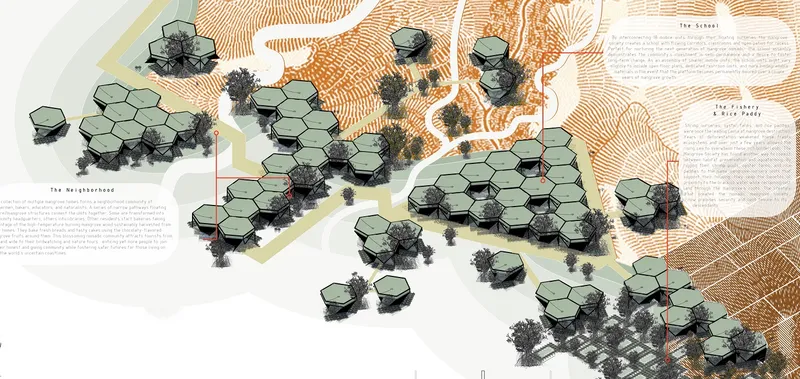 Aerial View
Shrimp nurseries, oyster farms, and rice paddies were once the leading cause of mangrove destruction. Years of deforestation weakened these fragile ecosystems and over just a few years allowed the rising sea to overwhelm these rich borderlands. The Mangrove Society has found another way to coexist between habitat preservation and aquafarming. By rigging their shrimp pools, oyster farms, and rice paddies to the same mangrove-nursery units that support their housing, they reap the benefits of proximity to the brackish water while reclaiming lost land through the mangrove’s roots. The lifestyle that created the nomadic mangrove society, now promises security and land tenure to its descendants.
The School
By interconnecting 18 mobile units through their floating nurseries the mangrove society creates a school with flowing corridors, classrooms, and open patios for recess. Perfect for nurturing the next generation of mangrove nomads- the school assembly demonstrates the community’s investment in semi-permanence and a desire to foster long-term change. As an assembly of smaller mobile units, the school units might vary slightly to include open floor plans, dedicated restroom units, and more biodegradable materials in the event that the platform becomes permanently moored over a couple of years of mangrove growth.
The Home
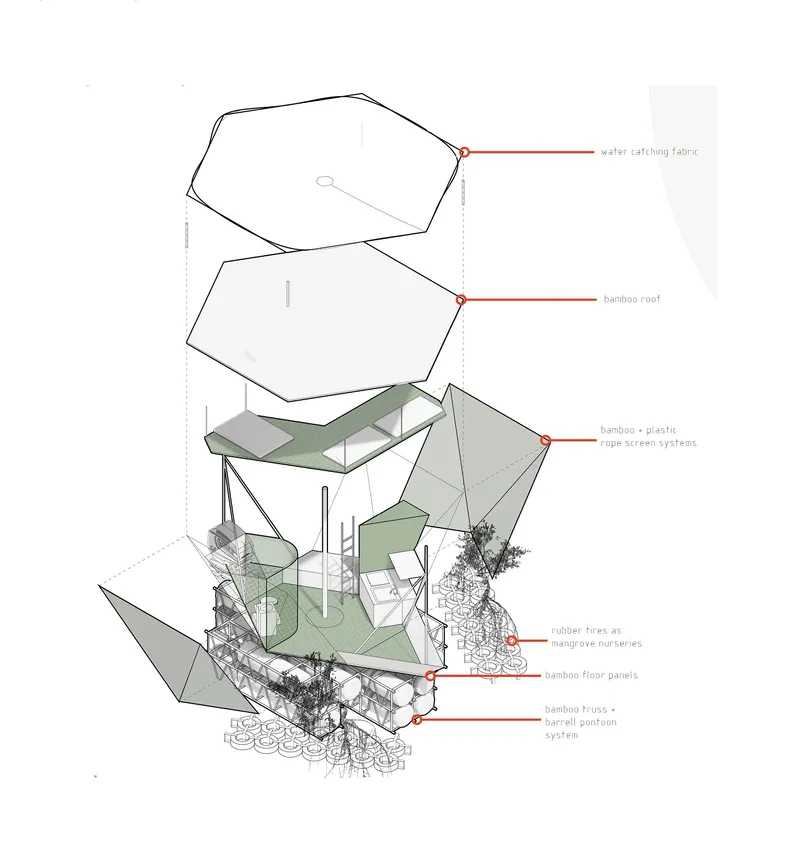 Exploded View
The Mangrove home is a lightweight deployable bamboo structure. In mobile form, the home floats along coastlines on a truss-pontoon system powered by a traditional boat motor. In a static state, the home is moored to its site by the growing roots of its mangrove nursery that protect it from harsh coastal conditions. The screen walls offer various social configurations but can easily be closed up at night for safety. The small 10m2 space includes a rainwater collection system on the roof that stores water for the small kitchen which in turn feeds water into the bathroom and the compostable toilet. A cozy common space for the family to eat and relax lies under a canopy of 3 beds and dividing storage, with additional storage located under the floor of the home.
The Neighborhood
A collection of multiple mangrove homes forms a neighborhood community of fishermen, bakers, educators, and naturalists. A series of narrow pathways floating on tire/mangrove structures connect the units together. Some are transformed into community headquarters, others into libraries. Other residents start bakeries taking advantage of the high-temperature burning mangrove wood sustainably harvested from their homes. They bake fresh bread and tasty cakes using the chocolaty-flavored mangrove fruits around them. This blossoming nomadic community attracts tourists from far and wide to their birdwatching and nature tours – enticing yet more people to join their honest and giving community while fostering safer futures for those living on the world’s uncertain coastlines.

Popular Articles
Popular articles from the community


Hill & Cross Opera: Sculptural Opera House Architecture Shaped by Tallinn’s Landscape and Identity
Hill & Cross Opera reimagines opera house architecture in Tallinn through its sculptural hill, civic plaza, glass wave and a luminous cross.

Co-life: Sustainable Architecture for Age-Friendly Community Living
Co-life reimagines sustainable architecture for seniors through courtyards, rammed earth, shared gardens, and spaces designed for belonging.

Co-Life: Senior Housing Design That Reconnects Older Adults With the City
Co-Life reimagines senior housing design through healing gardens, shared streets, workshops, and a sustainable community across generations.

The Earth Pod: 3D Printed Homes for Resilient Refugee Communities
The Earth Pod reimagines refugee housing through 3D printed homes made from clay, combining resilience, self-sufficiency, and rapid shelter.

Similar Reads
You might also enjoy these articles

Day and Night Park: A Time-Based Urban Newsstand in Beijing
A temporary urban newsstand in Beijing blending travel, light, and reading through poetic colors, compact form, and community-focused design.

Modernist Patio Renovation in El Masnou, Barcelona by Oliver Segura Arquitectura + Cebrià Arquitectura
Modernist patio renovation blending tradition and innovation with a movable pool, leveled floors, and Catalan materials in El Masnou.

Alto Residencial Coop: Cooperative Housing Development in Santiago de Compostela by Carbajo Barrios Arquitectos
A linear cooperative housing complex blending white volumes and perforated metal façades, enhancing community living, natural light, privacy, and urban integration.

Vil Genis School by BPA ARCHITECTURE – Massy, France
Vil Genis School in Massy, France, features sustainable design, south-facing classrooms, community integration, accessible spaces, and modern educational architecture.


Explore Mangrove Forest Competitions
Discover active competitions in this discipline




Challenge to reimagine the Iron Throne


Photograph architecture without architects


Illustrate the lost glory of Angkor Wat - Render Challenge


Design challenge to reuse E-waste
Comments (0)
Please login or sign up to add comments
No comments yet. Be the first to comment!