

The Next Frontier in Architecture: 10 Cutting-Edge Space Architecture Design Concepts for the Future
Exploring cutting-edge space architecture designs, this article highlights how they may shape humanity's future in space and advance us towards a Type 1 civilization.


As humanity stands on the brink of a new era in space exploration, the role of space architecture becomes pivotal in shaping our future beyond Earth. This specialized field, a blend of art and science, ventures into the unknown, crafting habitats and structures not just for survival, but for thriving in extraterrestrial environments. The convergence of innovative design concepts with futuristic technologies heralds a new dawn for human habitation in space, where every architectural plan holds the potential to redefine our life in the cosmos. This shift from terrestrial to celestial architecture isn't just about building; it's about envisioning and realizing a sustainable and adaptable future for humanity among the stars.
In this article, we delve into 10 cutting-edge design concepts that stand at the forefront of space architecture. Each concept represents a unique fusion of visionary ideas and practical solutions, addressing the challenges of living in space with ingenuity and foresight. From self-sustaining lunar habitats to modular interstellar cruisers, these futuristic designs not only cater to the functional needs of space dwellers but also reflect the boundless potential of human creativity. As we embark on this journey through the most innovative concepts in space architecture, we invite you to imagine the possibilities that lie in the vast expanse of space — a realm where architecture transcends traditional boundaries and becomes a key player in the grand human adventure beyond Earth.
The Evolution of Space Architecture
Space architecture, a discipline that once dwelled in the realm of science fiction, has matured into a crucial field for humanity's future. Over the decades, it has transitioned from rudimentary concepts to sophisticated design concepts, mirroring the advancements in technology and our growing aspirations in space exploration. This journey has not only expanded our understanding of living and working in space but has also paved the way for futuristic architectural solutions that challenge and redefine the conventional norms of design and construction. The evolution of space architecture reflects a tapestry of innovation, courage, and unyielding curiosity, marking the transformation of once distant dreams into tangible realities.
Key Milestones in the Evolution of Space Architecture:
- The Era of Conceptualization: Early 20th century visionaries like Konstantin Tsiolkovsky and Wernher von Braun conceptualized space stations and lunar bases.
- The Space Race and Cold War: The 1950s to 1970s saw the development of the first manned spacecraft and space stations, like the USSR's Salyut and USA's Skylab.
- Shuttle Era and Modular Design: The 1980s and 1990s highlighted the use of reusable space shuttles and modular space station designs, epitomized by the Mir Space Station and later the International Space Station (ISS).
- Private Sector Involvement: The early 21st century witnessed increasing participation from private entities like SpaceX and Blue Origin, introducing innovative designs and commercial viability in space architecture.
- Sustainable and Self-Sufficient Designs: Recent years have focused on developing sustainable and self-sufficient habitats, essential for long-duration missions to Mars and beyond.
- Futuristic and Revolutionary Concepts: Present-day research delves into revolutionary concepts like 3D printed lunar habitats, artificial gravity structures, and deep space exploration vessels, setting the stage for the next leap in space architecture.

The Ark of Knowledge
The Ark of Knowledge represents an ambitious vision within the realm of space architecture, aiming to be more than a habitat—it's an embodiment of human culture and legacy. It's a futuristic design concept that addresses the dire need for an alternative living space for humanity as Earth's environmental conditions become increasingly precarious. This design concept envisions a space-based repository that not only preserves the physical essence of humanity but also its intellectual and cultural patrimony.
Potential Applications:
- A safe haven for humanity as Earth faces critical environmental challenges.
- A living library preserving the vast spectrum of human knowledge.
- A hub for continuous scientific exploration and cultural development in space.
What Stands Out:
- Innovative Life Support Systems: Utilizes closed-loop ecosystems for sustainability.
- Cultural Preservation: Dedicated spaces for archiving human history and knowledge.
- Adaptive Modularity: Designed to expand and evolve with its community.
- Self-Sustaining Ecosystem: Integration of agricultural zones and renewable energy sources.
- Artificial Gravity: Incorporation of rotating structures to simulate gravity, enhancing long-term habitability.
Challenges:
- Construction Complexity: The intricate design demands advanced engineering and space construction techniques.
- Resource Allocation: Requires a sustainable sourcing strategy for materials, possibly from in-situ resources like lunar or asteroid mining.
- International Collaboration: Success depends on unprecedented global cooperation in space endeavors.
- Psychosocial Factors: Long-term isolation and microgravity effects on human health must be mitigated.
- Technological Reliability: Continuous operation of life-support and artificial gravity systems without fail is critical.

MANHATTAN n.2
MANHATTAN n.2 draws inspiration from the historical Biosphere 2 experiment, aiming to create a self-sustaining space ecosystem that addresses previous shortcomings in volume and ecological complexity. This space architecture project stands as a microcosm of New York City, complete with its own Central Park and Fifth Avenue, reimagined for a space-faring society. This design concept extrapolates the urban experience into the cosmos, offering a blend of social, cultural, and natural environments in a self-contained space habitat.
Potential Applications:
- A self-sustaining ecological system that could support long-term space habitation.
- A model for large-scale space habitats that mimic complex urban ecosystems.
- An architectural framework that could facilitate the social and cultural dynamics of city life in space.
What Stands Out:
- Urban and Nature Integration: Emulates a bustling metropolis with green spaces, mirroring the iconic Manhattan.
- Biospheric Complexity: Designed to support a diverse array of life forms and ecological interactions.
- Social Infrastructure: Includes cultural, educational, and recreational facilities to maintain community well-being.
- Scaled Ecological Systems: Features a fully operational, scaled-down version of Central Park for ecological balance.
- Innovative Material Use: Utilizes in-situ resource utilization for construction, minimizing dependency on Earth.
Challenges:
- Ecological Balance: Maintaining a balanced and functional ecosystem within a closed environment is highly complex.
- Psychological Adaptation: Ensuring the mental health of inhabitants in a replicated urban setting, far from Earth.
- Technical Feasibility: Overcoming engineering challenges related to building large-scale structures in space.
- Resource Efficiency: Achieving self-sufficiency in terms of energy, food, and water within the habitat.
- Scalability: Designing the habitat to be scalable to accommodate growth without compromising system integrity.
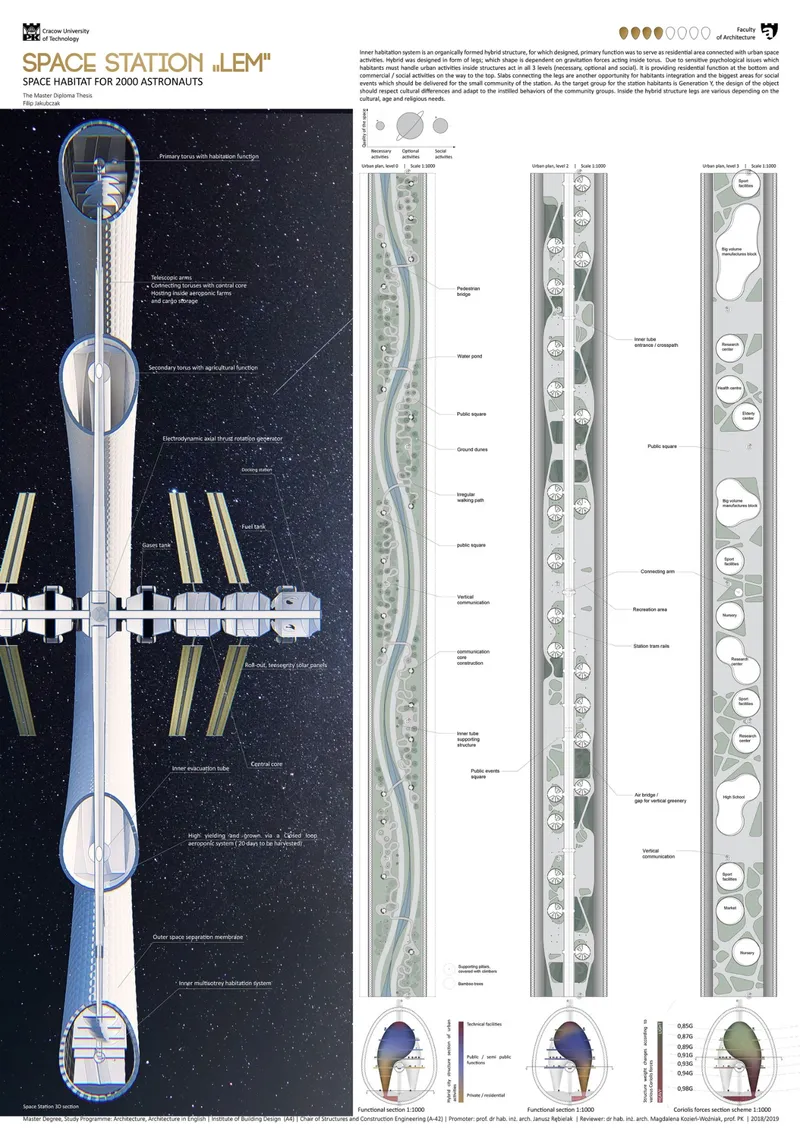
SPACE STATION LEM
SPACE STATION LEM is a visionary project in space architecture, designed to be a self-sustaining habitat for 2000 astronauts, with the scalability to eventually accommodate up to 10,000 individuals. This station is planned as humanity's first large-scale communal space, which will serve as a launchpad for future missions, potentially becoming a cornerstone for interplanetary travel and a hub for space tourism and recreation.
Potential Applications:
- A major hub for staging and supporting deep space exploration missions.
- A space tourism destination offering a unique recreation experience.
- A research and development platform for advanced space technologies.
What Stands Out:
- Scalable Habitat: Designed for an initial population of 2000, with the ability to expand as needed.
- Self-Sustaining Ecosystem: Incorporates closed-loop life support systems for long-term sustainability.
- Innovative Design: Utilizes a torus shape to create artificial gravity, enhancing the comfort of its inhabitants.
- Multipurpose Use: Equipped for scientific research, residential living, and recreational facilities.
- Collective Endeavor: Symbolizes the unified effort of Earth’s nations towards space colonization.
Challenges:
- Engineering Scale: Building a habitat of this magnitude in space presents numerous engineering challenges.
- Resource Management: Efficiently managing resources for a large population in a closed system is complex.
- Human Factors: Ensuring the psychological well-being of a large crew in the confined space of a station.
- Safety Protocols: Developing robust safety and emergency response systems for a large habitat.
- Economic Viability: Balancing the costs of construction and maintenance with the potential revenue from research and space tourism.

A'ARU 1.0
A'ARU 1.0, inspired by ancient Egyptian mythology and the concept of the afterlife, is a transformative space architecture project designed as a space colony for 21,120 occupants. It reimagines the journey beyond life as a continuation into space, with a habitat that is not only self-sustaining but fully adaptable to human needs. Its design integrates solar power, water recycling systems, and agricultural areas to maintain a self-sufficient community, while the structure itself is influenced by the celestial forms of Anubis and Horus, symbolizing eternal life beyond Earth.
Potential Applications:
- A fully-fledged community for long-term space habitation.
- A center for cultural continuity and the preservation of human heritage.
- An advanced research and education hub for space sciences.
What Stands Out:
- Cultural Heritage Integration: Design inspired by Egyptian mythology, providing a cultural narrative.
- Sustainable Living Systems: Incorporates solar energy and water recycling for autonomy.
- Artificial Gravity: Hexagonal districts on a rotating rail to simulate gravity.
- Scalable Design: Accommodates a large population with expansion capabilities.
- Comprehensive Facilities: Equipped with medical, educational, and recreational facilities.
Challenges:
- Cultural Adaptation: Balancing the integration of cultural elements with the functional demands of space living.
- Technical Execution: Realizing the complex design with current space construction technologies.
- Psychosocial Well-being: Fostering a sense of community and well-being in a replicated celestial environment.
- Resource Management: Ensuring the colony's closed-loop systems operate efficiently at scale.
- Maintenance and Upkeep: Keeping the sophisticated habitat systems in optimal condition in the harsh environment of space.
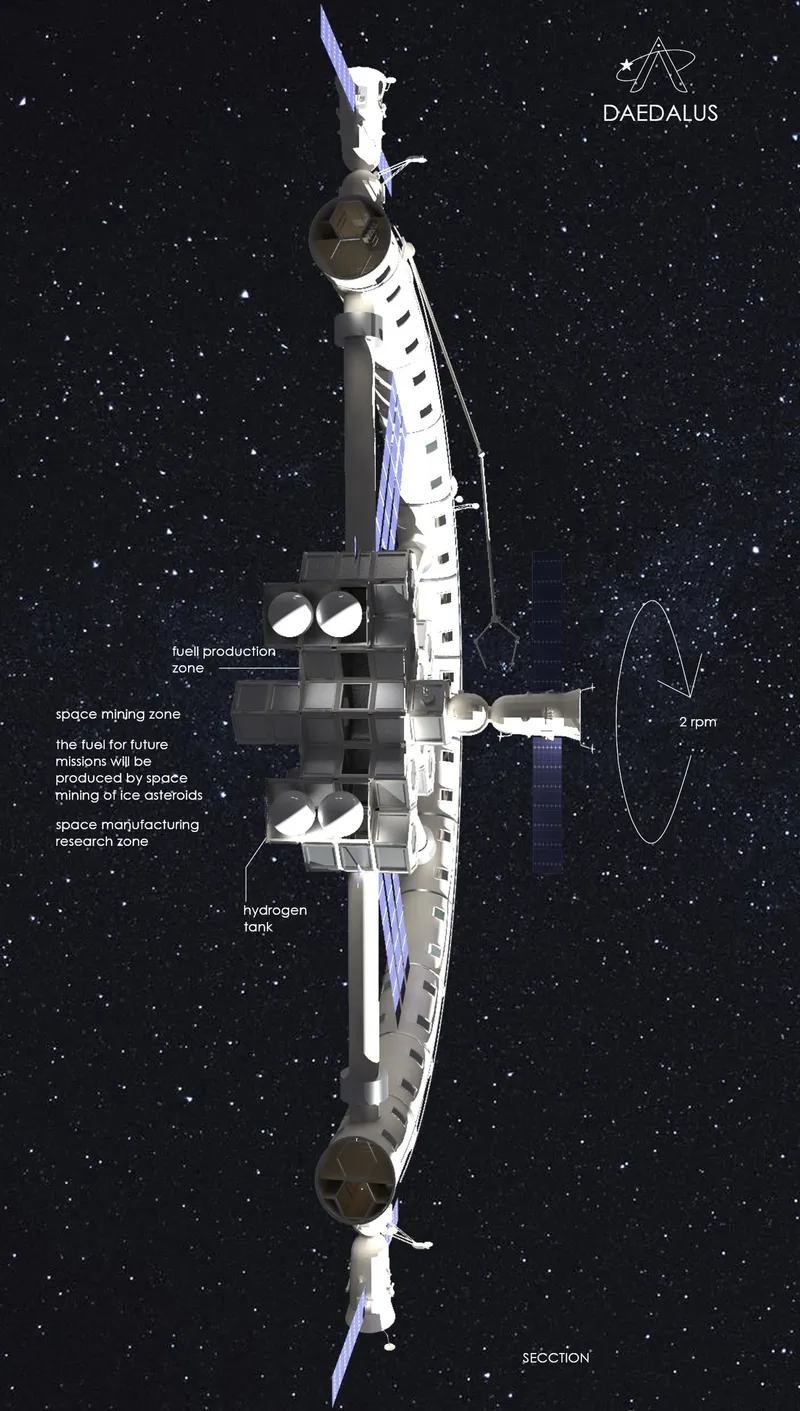
DAEDALUS STATION
DAEDALUS STATION is designed as an innovative space station that marks the beginning of self-constructing habitats in space. It's envisioned to serve as the blueprint for future space structures that can autonomously expand and recycle their materials, making the station a sustainable venture. The design reflects a commitment to recycling and scalability, crucial given the prohibitive costs of transporting materials to space. The station will leverage in-situ resource utilization for its construction materials, aligning with the sustainable practices needed for long-term space habitation.
Potential Applications:
- A foundational platform for the construction of future space habitats.
- A research center for space manufacturing and material recycling technologies.
- A strategic outpost for space mining operations and resource processing.
What Stands Out:
- Self-constructing Capabilities: Incorporating robotic systems for station growth and self-repair.
- Resource Efficiency: Designed to utilize space mining resources, minimizing reliance on Earth-based materials.
- Sustainable Design: Emphasizes recycling and reusability in its construction and operation.
- Artificial Gravity: Utilizes centrifugal force to create a gravity-like environment for its inhabitants.
- Scalable Architecture: Structured to allow for expansion as the station's needs and population grow.
Challenges:
- In-Situ Resource Utilization: Developing effective methods for mining and processing materials in space.
- Automated Construction: Ensuring reliability and precision in robotic building processes.
- Life Support Sustainability: Creating a closed-loop life support system that can support a growing population.
- Energy Efficiency: Managing the station's energy needs with a consistent and reliable power supply.
- Space Debris Mitigation: Designing safeguards against potential hazards from space debris during construction and operation phases.

NEW HOUSTON
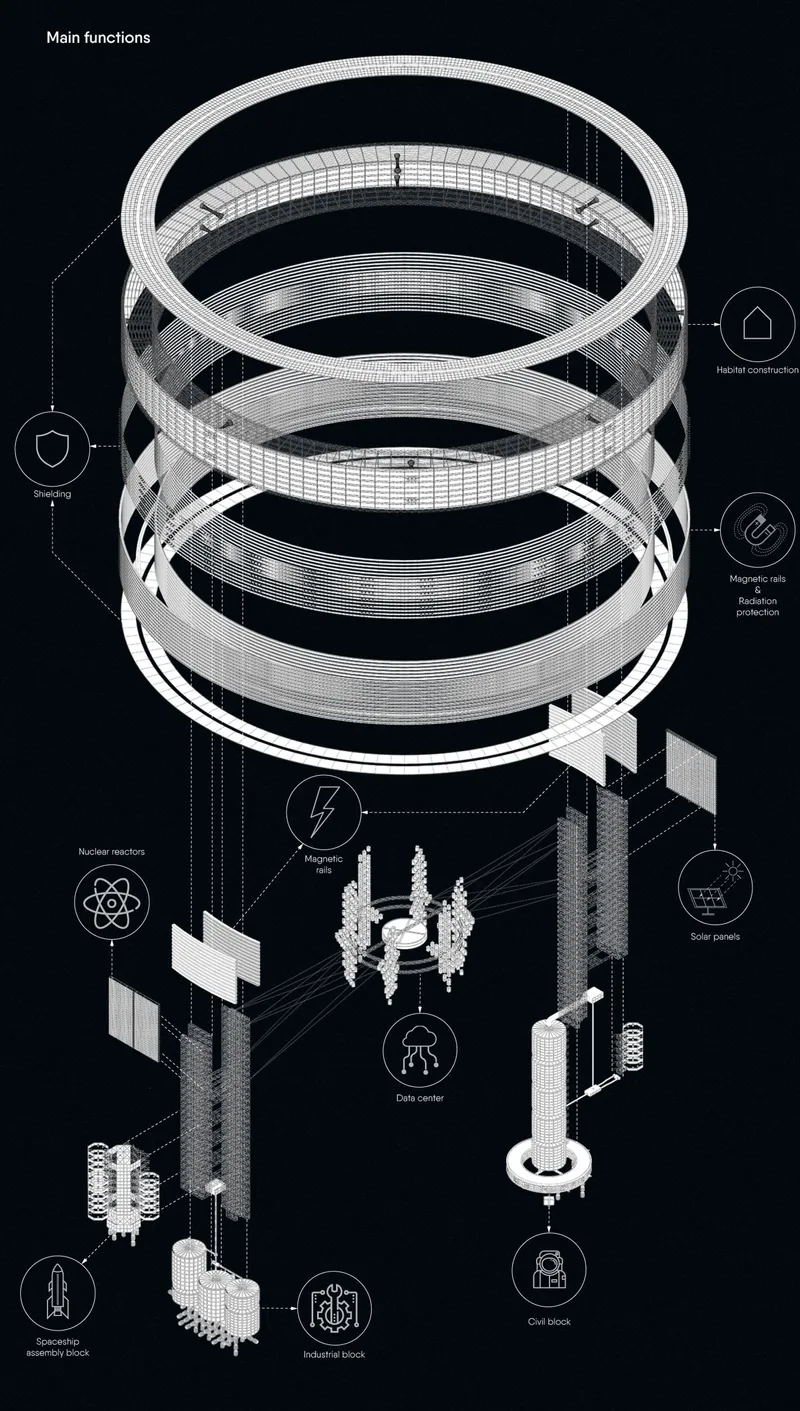
NEW HOUSTON is an ambitious space architecture project slated for completion in 2040, representing humanity's leap towards becoming an interstellar species. It's a space settlement that stands as the culmination of numerous experiments and models, designed to be self-sufficient and to serve as a new home for humans beyond Earth. NEW HOUSTON is conceived as a multi-layered structure, each with distinct functions ranging from scientific research to residential living, all shielded from cosmic rays and other space hazards.
Potential Applications:
- A self-reliant habitat for long-duration space residence.
- A research complex for advancing space living technologies.
- A launchpad for deep space exploration and asteroid mining missions.
What Stands Out:
- Autonomous Support Systems: The settlement will be equipped with life support systems capable of sustaining human life independently from Earth.
- Layered Structure: It has a unique layered design that segregates different functional areas for efficiency and safety.
- Advanced Energy Solutions: Features an energy core that harnesses nuclear fusion, aiming for high energy efficiency.
- Scalable Design: Planned to allow for future expansion and integration of new technological advancements.
- Protective Shell: Designed with a protective outer layer to shield against space radiation and debris.
Challenges:
- Sustainable Life Support: Developing robust systems capable of supporting a large population in the harsh environment of space.
- Energy Consumption: Managing the high energy demands of a self-sustaining space settlement.
- Material Transportation: Innovating cost-effective ways to transport or locally source construction and living materials.
- Human Adaptability: Ensuring the psychological and physiological well-being of residents in a closed space environment.
- Maintenance and Repair: Establishing automated maintenance protocols for the settlement's infrastructure.
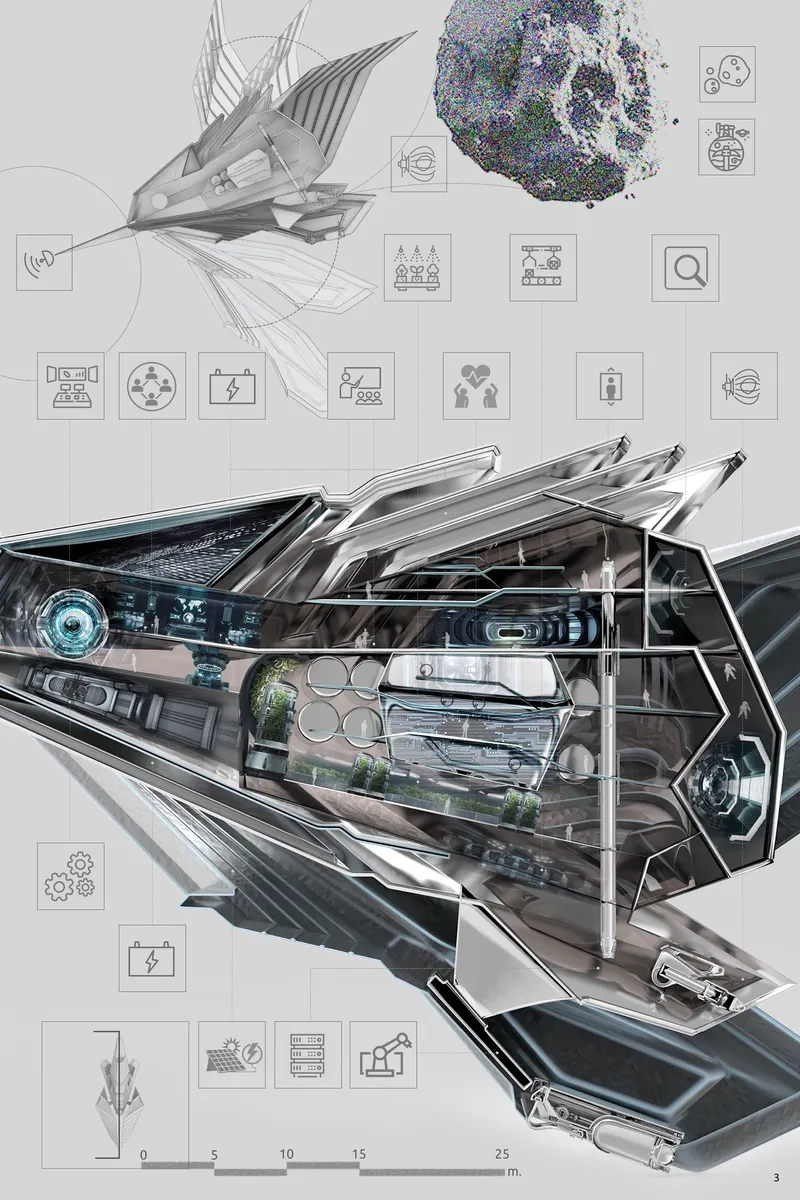
FAITH V.1.0
FAITH V.1.0 is a visionary space architecture concept that epitomizes the harmonious blend of sustainability and technology. This design is driven by renewable energy harnessed from planetary bodies and the sun, embodying a future where human survival aligns with smarter, nature-conscious methods. The project is a testament to the potential of redirecting human ingenuity from destructive tendencies to innovative preservation and life-supporting techniques in space environments.
Potential Applications:
- A model for sustainable living in extraterrestrial environments.
- A research hub for the development of advanced life support systems.
- A beacon for ecological awareness and renewable energy utilization in space.
What Stands Out:
- Renewable Energy Integration: Utilizes solar energy to power all on-board systems and machinery.
- Biomimicry Design: Inspired by the natural behavior of leaves, with solar panels that adjust direction for optimal energy absorption.
- Advanced Materials: Incorporates cutting-edge materials like Graphene + Perovskite + Silicon to maximize solar conversion efficiency.
- Self-sustaining Ecosystem: Capable of producing food and oxygen through integrated life support systems.
- Adaptive Construction: Features a spacecraft design that is responsive to environmental conditions and energy requirements.
Challenges:
- Efficient Energy Conversion: Mastering the conversion efficiency of solar panels to meet the high demands of space habitation.
- Durability in Space: Ensuring the longevity and resilience of materials exposed to the harsh conditions of space.
- Complex System Integration: Seamlessly integrating various subsystems to support life and machine operations.
- Thermal Management: Maintaining an optimal internal temperature despite variable solar radiation intensities.
- Wireless Energy Transfer: Developing reliable methods for transmitting energy wirelessly within and possibly to/from the spacecraft.
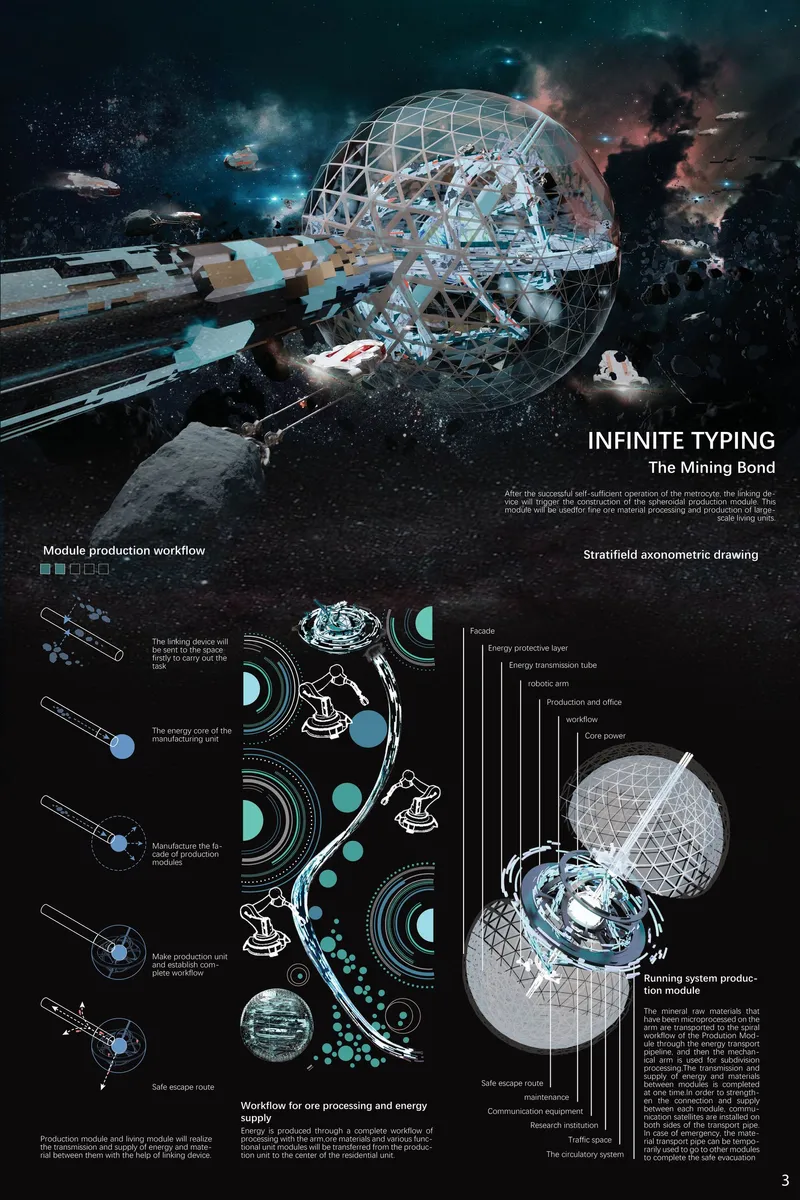
Infinite Typing
Infinite Typing is an avant-garde space architecture initiative that transcends the traditional boundaries of habitat design. It embodies a modular approach to space colonization, reflecting the perpetual growth and adaptability of human ingenuity. This project showcases a dynamic proliferation strategy akin to the expansive nature of water molecules, presenting a sustainable solution for expanding human presence in space.
Potential Applications:
- Scalable space mining complexes that adapt to the dynamic needs of interstellar resource extraction.
- Autonomous growth of space habitats, facilitating the expansion of human civilization beyond Earth.
- Integrated life-support systems that can evolve with technological advancements and population demands.
What stands out:
- Iterative Proliferation: The concept of modular expansion allows for an organic growth of the space complex.
- Dual-Module System: Specialized habitat and production modules cater to diverse needs, including mining and habitation.
- Linking Mechanism: A connecting device ensures seamless energy and material transmission between modules.
- Water Molecule Prototype: The project's structure mimics the natural efficiency and simplicity of molecular bonds, promoting cohesion and adaptability.
Challenges:
- Resource Allocation: Managing the logistics of materials and energy in the vastness of space presents a logistical challenge.
- Technological Synchronization: Ensuring that all modules communicate and function harmoniously requires advanced AI systems.
- Adaptability: The system must be resilient to the unpredictable nature of space environments and resources.
- Human Factors: Considering the psychological impact of living in a continuously expanding and changing environment is crucial.

THE FORGE
THE FORGE is a visionary space architecture project, designed as a self-sustaining asteroid mining station strategically positioned in the asteroid belt. The station embodies a systematic approach to settlement design that integrates both building and urban planning principles. With a focus on adaptability and growth, the project utilizes an aggregated system governed by complex spatial rules, allowing for dynamic configuration in a four-dimensional space setting. The design aims to create a thriving community of asteroid miners by facilitating efficient resource extraction, processing, and habitat construction directly in space.
Potential Applications:
- Mining and resource extraction from asteroids.
- Research and development in space manufacturing and processing technologies.
- Habitat for a growing community of space professionals and support staff.
What stands out:
- Iterative Proliferation: The station is designed for organic growth, similar to the expansion of a living organism.
- Dual-Module System: It comprises specialized modules for habitat and production, addressing various space occupancy needs.
- Linking Mechanism: A unique device facilitates the seamless transfer of energy and materials between modules.
- Water Molecule Prototype: The layout and expansion strategy are inspired by the efficient and cohesive structure of water molecules.
Challenges:
- Resource Allocation: Effective distribution of materials and energy in the vastness of space is a significant logistical challenge.
- Technological Synchronization: Ensuring that all station modules communicate and function together seamlessly necessitates advanced AI systems.
- Adaptability: The station must remain flexible and resilient in the face of the unpredictable and harsh space environment.
- Human Factors: The psychological and social impacts of living in an ever-changing and isolated space environment must be carefully managed.

ORIGIN OF CIVILIZATION
ORIGIN OF CIVILIZATION is a visionary space architecture concept that marks a significant milestone in humanity's quest for interstellar expansion. Set to be established in the asteroid belt, this project is a confluence of residential and mining modules that can be assembled with remarkable flexibility. Leveraging state-of-the-art reusable rocket technology, the individual modules are propelled into orbit for assembly, serving as a prelude to their journey towards the asteroid belt where they will perform a myriad of functions ranging from habitation to resource extraction.
Potential Applications:
- Pioneering step in off-world colonization efforts.
- Hub for deep space exploration, with potential to serve as a staging ground for missions to the outer solar system.
- Research and development center for advanced space resource utilization techniques.
What Stands Out:
- Modular Flexibility: The project employs a modular design approach, allowing for adaptable configuration and expansion.
- Reusable Rocket Launch: Emphasizes sustainability through the use of reusable rocket technology for module transportation.
- Strategic Location: Positioned in the asteroid belt, it capitalizes on proximity to vast resources for mining and construction.
- Innovative Assembly: Features an innovative in-space assembly method, setting the foundation for autonomous construction techniques.
Challenges:
- Logistical Coordination: The complexity of coordinating multiple module assemblies in space presents significant challenges.
- Sustainable Life Support: Establishing a reliable life support system that can function effectively in the isolated environment of the asteroid belt.
- Resource Processing: Developing efficient methods for processing and utilizing asteroid materials for construction and sustenance.
- Adaptability to Space Conditions: Designing the modules to withstand the harsh conditions of space, including radiation, micro-meteoroids, and vacuum.
As we edge closer to a future where space becomes our next frontier, integrating advanced technologies is not just an option but a necessity for space architecture. The design concepts mentioned thus far are ambitious, and their successful implementation hinges on the seamless integration of cutting-edge technologies across various fields such as artificial intelligence, biotechnology, robotics, and material science.
Artificial Intelligence (AI)
AI will play a pivotal role in space habitats, automating systems management, enhancing decision-making processes, and ensuring operational efficiency. In environments where every second counts, AI could predict and prevent potential system failures, provide intelligent resource management, and ensure the well-being of occupants through constant monitoring and adaptive environmental control.
Biotechnology
Biotech innovations could revolutionize life support systems in space. Genetically engineered plants might provide more efficient oxygen production and waste recycling, while advances in synthetic biology could lead to the development of bio-based materials, reducing the need for cargo shipments from Earth and improving the sustainability of space habitats.
Robotics
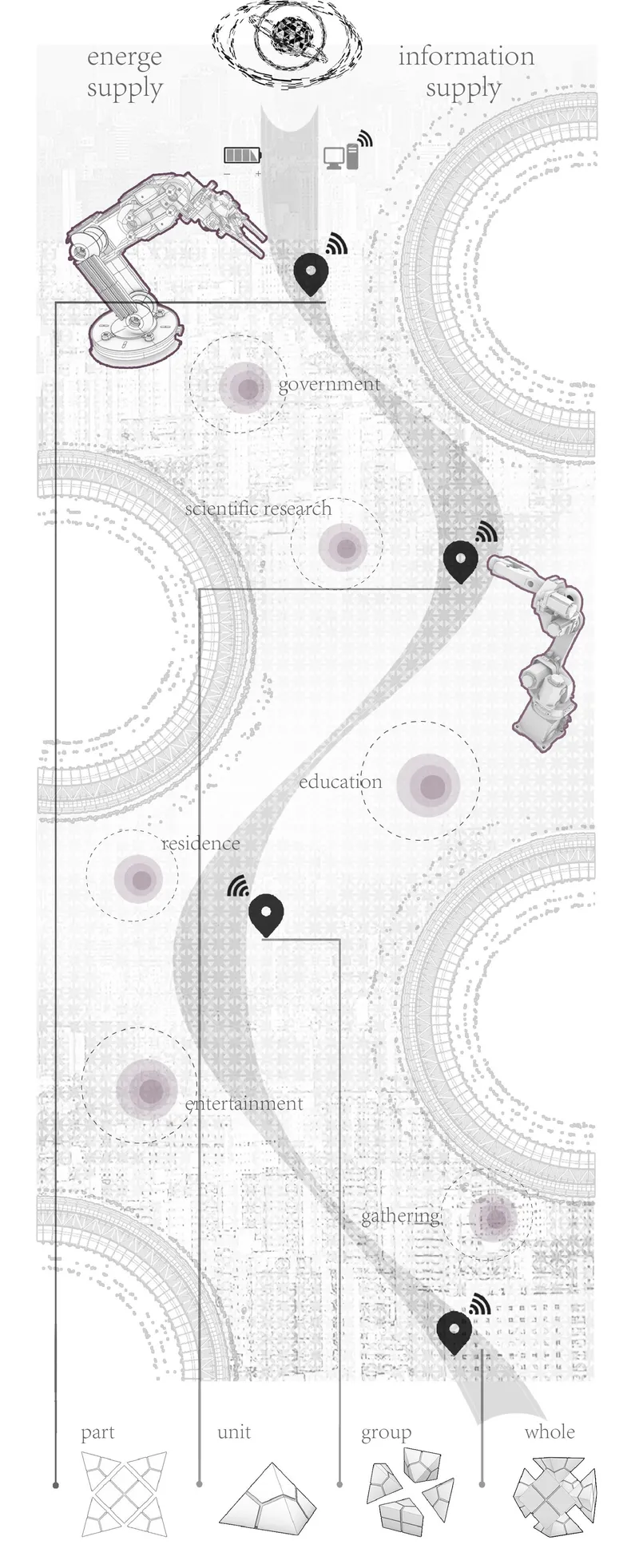
Robotic technology will be essential for construction and maintenance in the harsh space environment. Autonomous robots, capable of self-repair and adaptation to the unpredictable conditions of space, could construct habitats, mine resources, and perform extravehicular activities, greatly reducing the risks to human life.
Material Science
Advancements in material science will enable the creation of new compounds and smart materials that are lighter, stronger, and more adaptable to the vast temperature extremes and radiation levels found in space. These materials could self-heal, change properties in response to environmental stimuli, and reduce the need for maintenance.
The integration of these technologies also presents unique challenges. AI systems must be designed to handle the isolation and lag in communication inherent in deep space missions. Biotechnological solutions must be carefully controlled to prevent unanticipated interactions with the closed ecosystems of space habitats. Robotic systems require a level of autonomy and decision-making capability that is still in development, and new materials must be tested extensively to ensure their performance in space.
Sustainability and Resource Management
The visionary space architecture concepts put forward recognize sustainability as a cornerstone, particularly critical in the resource-constrained expanse of space. These designs incorporate closed-loop systems for recycling water, air, and waste, while harnessing renewable energy sources such as solar power, to ensure long-term habitability without the constant need for Earth-based resources. In-situ resource utilization (ISRU) is another key strategy, wherein materials from asteroids or lunar regolith are processed for construction and life-support, minimizing the ecological footprint and enabling the habitats to self-sustain. Furthermore, the modular and scalable nature of these habitats allows for incremental growth and adaptability, ensuring that resource management remains efficient as the population and operational needs evolve. Through these integrated approaches, the space habitats are designed not just to survive, but to thrive in a manner that respects the delicate balance of space ecosystems.
Future Prospects of Space Architecture
The trajectory of space architecture is bound to the stars, with its future rooted in the boundless possibilities that lie in the vast expanse of the cosmos. As technological advancements in AI, quantum computing, and materials science continue to accelerate, they will undoubtedly catalyze an era of space habitats that are not only self-sufficient but also capable of self-expansion and self-repair. This progression will see space architecture evolve from static designs to dynamic ecosystems that can autonomously adapt to the needs of their inhabitants and the challenges of the space environment. The next frontier will likely witness the emergence of smart habitats that can preemptively respond to internal and external stimuli, ensuring optimal living conditions for spacefarers. As humanity inches closer to realizing interstellar travel, the role of space architecture in creating sustainable off-world communities will be paramount, setting the stage for the colonization of other planets and moons.

The concepts explored herein represent more than mere habitats; they are the seeds of future civilizations, poised to germinate in the fertile ground of space. By harnessing the power of innovation and sustainability, these designs lay the groundwork for a future where humanity is not confined to Earth's boundaries. As we contemplate the shift towards becoming a Type 1 civilization—capable of harnessing planetary resources and energy—these architectural marvels signify the first steps in that transformative journey. Through the lens of these habitats, human activities in space will not only encompass exploration and mining but will also extend to encompass culture, science, and community living. The legacy of these space architecture concepts will be measured by their ability to support the thriving interplanetary societies of tomorrow, marking a monumental leap in human evolution and the eventual mastery over our solar system.

As we venture into the realms of space architecture and the potential of human life on other planets, we extend a special invitation to join the Red Planet Renaissance – Martian Habitat Design Challenge. This challenge is an exhilarating opportunity for architects, designers, and visionaries to contribute to the pioneering efforts of establishing habitats on Mars. By participating, you’ll not only be engaging with a topic at the forefront of architectural innovation but also be part of a community shaping the future of extraterrestrial living. Whether you’re a seasoned professional or an aspiring student, your ideas and designs could play a crucial role in this audacious journey to the Red Planet. We encourage you to bring your creativity and expertise to this challenge, helping to turn what once seemed like science fiction into a reality. For more details and to participate, please visit Red Planet Renaissance – Martian Habitat Design Challenge. Join us in this exciting endeavor and help design the future of Martian habitats.


Popular Articles
Popular articles from the community


Juan García Correa, John González and Claudia Rueda Sink a Circular Amphitheater into a Manizales Engineering Building
On the La Nubia campus in Manizales, Colombia, the S1 Building folds labs and offices into a hillside of ramped lawns that double as a campus route.

David Ortega Stacks a Two-Story Mexico City Penthouse Around a Steel Stair and a Pergola-Shaded Roof Terrace
In Colonia Roma, a 300 m² penthouse uses oak joinery, a planted steel stair and a slatted roof pergola to make a new-build apartment feel like a house.


The Amber Palace Opera: A Geological Fiction Surfaces on Tallinn's Baltic Waterfront
Pierre Brillard reimagines a Baltic legend as a public landscape, opera house, and waterfront promenade rooted in Tallinn's coastal identity.

Cube Design Draws an Ecological Corridor Between Two Shenzhen Hills with the Nankai Building
Beside Shenzhen's container docks, the Nankai Building pairs stacked balconies with a climbing green screen to connect two hillsides across its height.

Similar Reads
You might also enjoy these articles
Juan García Correa, John González and Claudia Rueda Sink a Circular Amphitheater into a Manizales Engineering Building
On the La Nubia campus in Manizales, Colombia, the S1 Building folds labs and offices into a hillside of ramped lawns that double as a campus route.

Arealis Brasil Wraps a São Paulo Office for Everis's Creative Arm Around a Glowing Curved Counter
In Brooklin Paulista, a 300 m² office for the creative agency Chazz uses timber, metal mesh and ribbed green glass to blur workspace and pub.

LT2A and OPEN Architectes Thread a Brick and Glass High School Through a Wooded Belgian Campus
In Braine-l'Alleud, a 3,000 m² wing for Collège Cardinal Mercier pairs pale brick with a glazed colonnade, deferring to a small chapel and a dense wood.

Atelier Diving Bell Stitches a Hangzhou Food Court Together with a Louvered Steel Canopy
In Hangzhou's Liangzhu Culture Village, a 1,400 m² food court renewal uses canopies, tree benches and props to turn a passage into a place.

Comments (0)
Please login or sign up to add comments
No comments yet. Be the first to comment!