The Thinkable
The Thinkable believes that the school is not only a place for learning but also for character and personality building.
PRINCIPLES
Most education systems in the world today have become standardized in order to accommodate the vast population to which they must cater. While this allows for greater reach, the system has not kept up with the times. We are currently living in the “Information Age” where anyone with an electronic device and an internet connection can attain the knowledge they need in an instant. The current high schoolers are adept with using smartphones and devices as per their needs. Previously, school was the focal point of learning and education, and it was one of the most important aspects of any person's life. Where does the school fit now that information is freely available? Except for a graduation certificate, can the school provide anything more?
The Thinkable believes that the school is not only a place for learning but also for character and personality building. Currently, most schools offer after-school activities that are voluntary but they do not help the students in real-life circumstances. Looking through various schooling systems around the world, a modified Gurukul system originated from ancient India seems closest to the ideal system of schooling in this age. The Thinkable is based on the principles of a discussion-based learning environment that incorporates real-world building skills into the curriculum and the spaces it provides.
HOLISTIC LEARNING
Thinkable, in addition to the core curriculum, promotes a student's physical and mental development. A residential quarter is provided within the school which allows for one grade at a time to stay back and learn to be independent by themselves. The batch staying back would be provided with rooms, a shower facility, and a common room but would also be responsible for the same space rooms. This encourages them to learn communication skills which are valuable as an adult early, in school.
A total of 150 students would stay back along with 5 faculty members for a week every month. During this time, the main intention goal for the students is to learn to schedule their days, discipline and learn time management take charge of their lives, and lead healthy lifestyles. Students would be expected to keep their rooms clean, make their beds in the morning, and clean up after themselves. In addition to encouraging dependency among a peer group, the collective responsibility shouldered by the students would embody a sense of community within them.
DESIGN
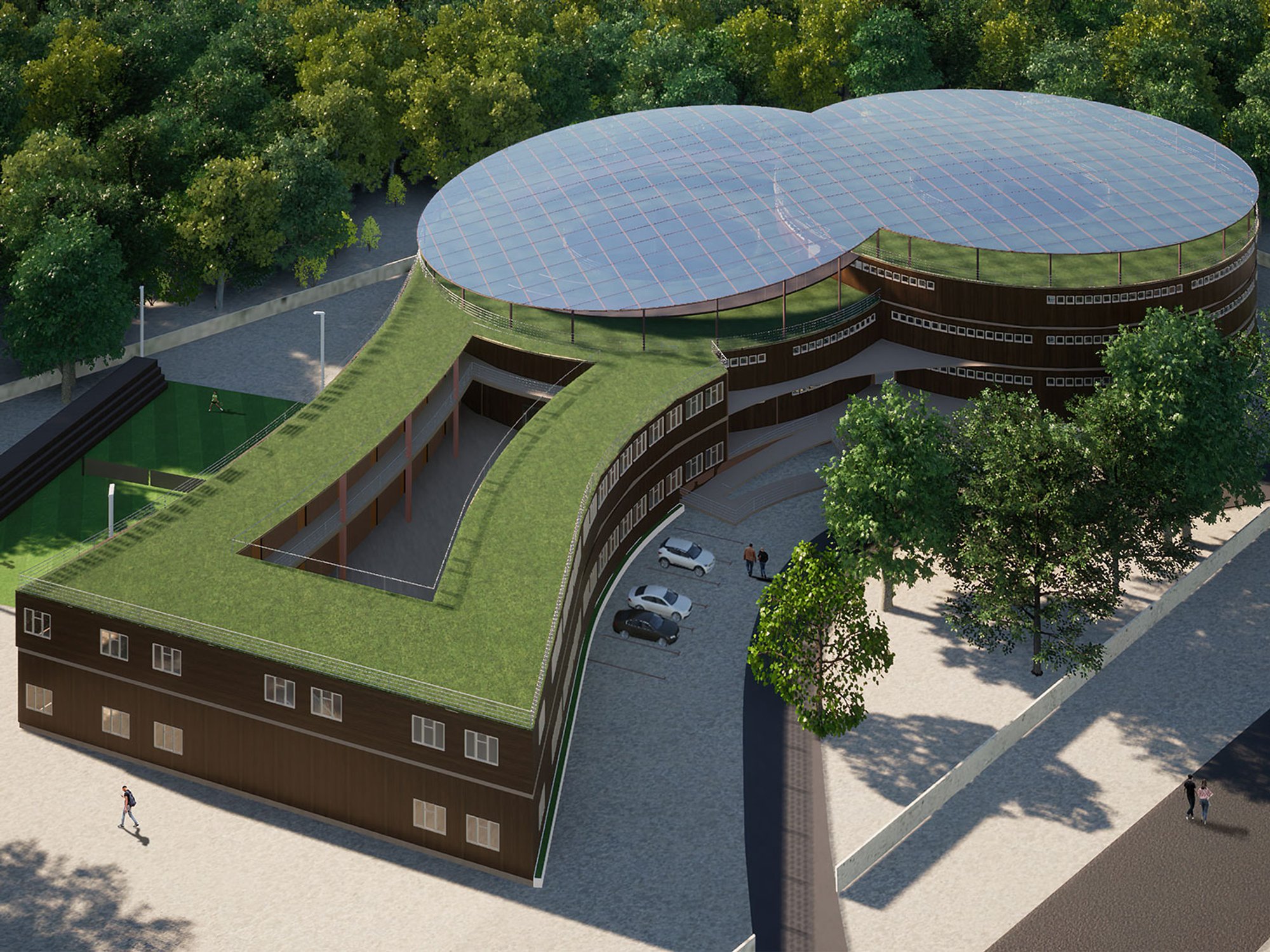
The design of the school itself is such that it is facing inwards, towards the discussion spaces. The language of the school allows for free-flowing spaces directed towards the center of activity, the courtyards at the center of the built forms. These courtyards can be viewed by the students at all levels allowing them to interact with each other and build connections with each other.
Opting for 3 courtyards instead of one single large courtyard allows for more enclosed and intimate spaces to be created within each courtyard. It also allows for multiple discussions to happen simultaneously without interfering with each other. The courtyard spaces themselves can transform into different sorts of spaces as per need and convenience. For example, it becomes a meditation space for the students in the morning, an exercise (Yoga) space during the PE period, and exhibition or gathering spaces during special occasions.
Apart from the courtyards and the classroom, there are a few spill-over places located at all levels for the students to congregate and claim as their own. These areas are available for use by the students as they see fit, whether it be for discussion, conversation, or playing games during break or before and after school. These areas also make it possible to lower classroom noise levels and the amount of traffic in the hallways.
The design of the classrooms is also purposefully looking inward towards the courtyards. The windows along the exterior walls of the classroom are provided higher to avoid the disturbance of the main road or the activities happening outside of the school. While the inner wall is a curtain wall that provides visual interaction between the classroom and interior spaces.
Within the classrooms, the students take the lead on which discussion should be taken or which topics they were interested in learning more about. The professors would be in charge only as supervisors to guide them along the correct path or show them different approaches and perspectives to any given topic.
WORLD PHILOSOPHY AS A WAY OF CHARACTER DEVELOPMENT
Think School and Life Skills are two of the essential disciplines that are proposed as a part of the holistic learning ideology. Think School will involve most of the students being taught ethics (moral philosophy) and conscience thinking in various real-life situations. While Life Skills would involve learning how to do taxes, investments, bank systems, and monetary management. These skills combined would prepare the students to enter society without being lost or clueless in their decision-making further on in their lives.
Another additional subject “History of the World” is added to the curriculum to expose the students to the diversity of society. The topics included would be languages, cultures, political aspects as well as local and global histories of different regions. With exhibitions and cultural exhibits would be happening every so often within the school, this exposes the students to various cultures and helps them in keeping an open mind to different people in society.