

The Tree House
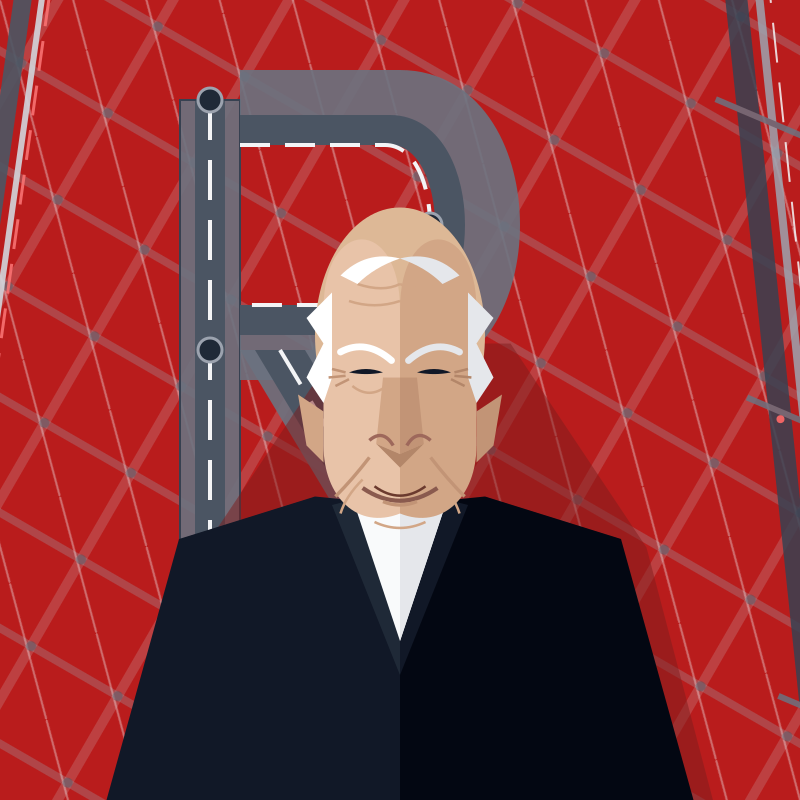
Apartment complex made out of rammed earth that represents Bolgatanga's community-driven culture in a modern way.
Introduction
Located in Bolgatanga, Ghana, our Community Housing will set a new standard of living in the region and provide a source of inspiration by showcasing locally sourced building materials in an innovative and modern way.
Objectives
When researching the people's daily life in Bolgatanga, it was evident above all else they are community-focused and hard-working people. This project reflects this nature and its values. People can have a space of celebration, work, and rest through this design. Bolgatanga is expecting rapid population growth, leading the country to the need for the construction of appropriate buildings to accommodate the people. Through sustainable methods, this project creates communal housing that reflects the country's beliefs, its connection to nature, and more, while reducing the resident's carbon footprint.
Program
This project accommodates 30-40 families. The housing is divided into singles, doubles, and families. Each one of these spaces has a communal area which includes the kitchen, living room, and communal bathrooms. Along the building, there will be several enclosed communal areas that have classrooms to offer courses on reading, writing, and arithmetic, study rooms, agricultural classes, and more. Open spaces will have seating areas, and their function will be determined by the user. From our research, it is estimated that the spaces will be used for basket weaving, festivities, getting together, and more.
The circulation of the building is divided into public and private. The public goes around the whole building starting with the three courtyards created, and the private connects every resident of the complex as these paths connect across the living spaces. The vertical circulation of the complex was placed in critical spaces: the courtyards and access from the main road. Each set of stairs has two options depending on which experience the user wants: slow stairs if the person wants to enjoy the view, and fast stairs if the person desires a quick route to their destination. The stairs will be supported by trusses that function not only as the structure keeping them suspended but also as the railings.
Construction
For the structure of the building, the Earth blocks will sustain most of the weight by placing load-bearing walls across the building. These walls consist of two bricks facing each other, with concrete poured in the center of them. Trusses wrap around these areas where more support is necessary, creating an intricate pattern and working as a screen to protect the earth and give support. Half of the year in Bolgatanga the weather is dry, which causes a lot of issues for the residents of the city. The building aims to harvest rainwater during the rainy season so that it can be reused by the building’s residents throughout the rest of the year. This system consists of several gutters lining the roof along the three inward looking spaces which takes the water down via a pipe and funnels it into a tank below the ground.
Environment
The building’s shape aims to create an organic pattern, mimicking the shape of a tree, connecting the project to nature. The walls of this complex are made from a mixture of earth, straw, and water shaped into blocks. The material also functions as a wall system for housing because of its thermal mass capacities. Bolgatanga’s average temperature ranges from 67 F to 101 F. This, combined with overhanging roofs, cross ventilation systems, and porous bricks lowers the temperature of the interior spaces exponentially.
Combining locally found materials with modern engineering techniques allows for ease of construction and ease of maintenance. The use of Earth construction allows for the integration of insulation into the construction due to the material's properties. These properties include its thermal conductivity. Earth construction also considers the environmental considerations of the location by allowing ease of access to the dirt necessary to create the structures. The materials are eco-friendly and do not require trucking to deliver them, which will reduce the harmful emissions of CO2. There are other factors that help with the natural ventilation of the building such as the roof, the placement of porous bricks, and the location of each individual residential space. The cloud-like form made with steel sheathing and trusses to hold its mass is slightly offset from the third floor, allowing the interior spaces to breathe and release hot air while accepting incoming breezes from all sides. Its shape was determined as a result of the need to allow sunlight inside the complex and also provide shade.
Results
By resorting to more sustainable building techniques, like rammed earth construction, it is possible to mitigate these impacts by reducing thermal discomfort without air conditioning systems, adapting to the local weather, and reducing the emission of transportation by using local products, plus it is fire-resistant, controls the noise, the moisture and more.

Popular Articles
Popular articles from the community


Manzana Morphosis: Stretching Barcelona's Grid into a Living Landscape for 2050
A radical reworking of the Eixample manzana turns density into a tool for generous public space, vertical ecology, and environmental performance.
Faces of the Soviet Avant-Garde: Turning Moscow's Street Names into an Open-Air Museum
A network of sculptural installations across a Moscow residential district transforms forgotten architect names into spatial encounters with cultural memor
Opera by the Sea Estonia: Three Shells Dissolving Architecture into Tallinn's Coastline
A winning opera house proposal replaces monumental form with interconnected shells that blur the boundary between building, park and Baltic Sea.

Singing Woman: Contemporary Architecture Inspired by Estonia’s Voice and the Sea
Singing Woman turns Estonia’s song culture into flowing opera house architecture, blending public life, landscape, sea, and national memory.

Similar Reads
You might also enjoy these articles

The Amber Palace Opera: A Geological Fiction Surfaces on Tallinn's Baltic Waterfront
Pierre Brillard reimagines a Baltic legend as a public landscape, opera house, and waterfront promenade rooted in Tallinn's coastal identity.
Dynamic Modules Shelter: A Telescopic Ring for Mountain Pilgrimage
A circular modular framework of steel, bamboo, and fabric grows vertically with demand, wrapping communal ground in adaptable shelter.
Singing Woman: Contemporary Architecture Inspired by Estonia’s Voice and the Sea
Singing Woman turns Estonia’s song culture into flowing opera house architecture, blending public life, landscape, sea, and national memory.
HYPERBLOCK: Flexible Urban Design for Barcelona’s Future City
HYPERBLOCK reimagines Barcelona as flexible urban design, layering density, daylight, public space and adaptable housing above Cerdà’s grid.

Explore African Architecture Competitions
Discover active competitions in this discipline


Challenge to reimagine the Iron Throne

Photograph architecture without architects

Illustrate the lost glory of Angkor Wat - Render Challenge

Design challenge to reuse E-waste
Comments (0)
Please login or sign up to add comments
No comments yet. Be the first to comment!