
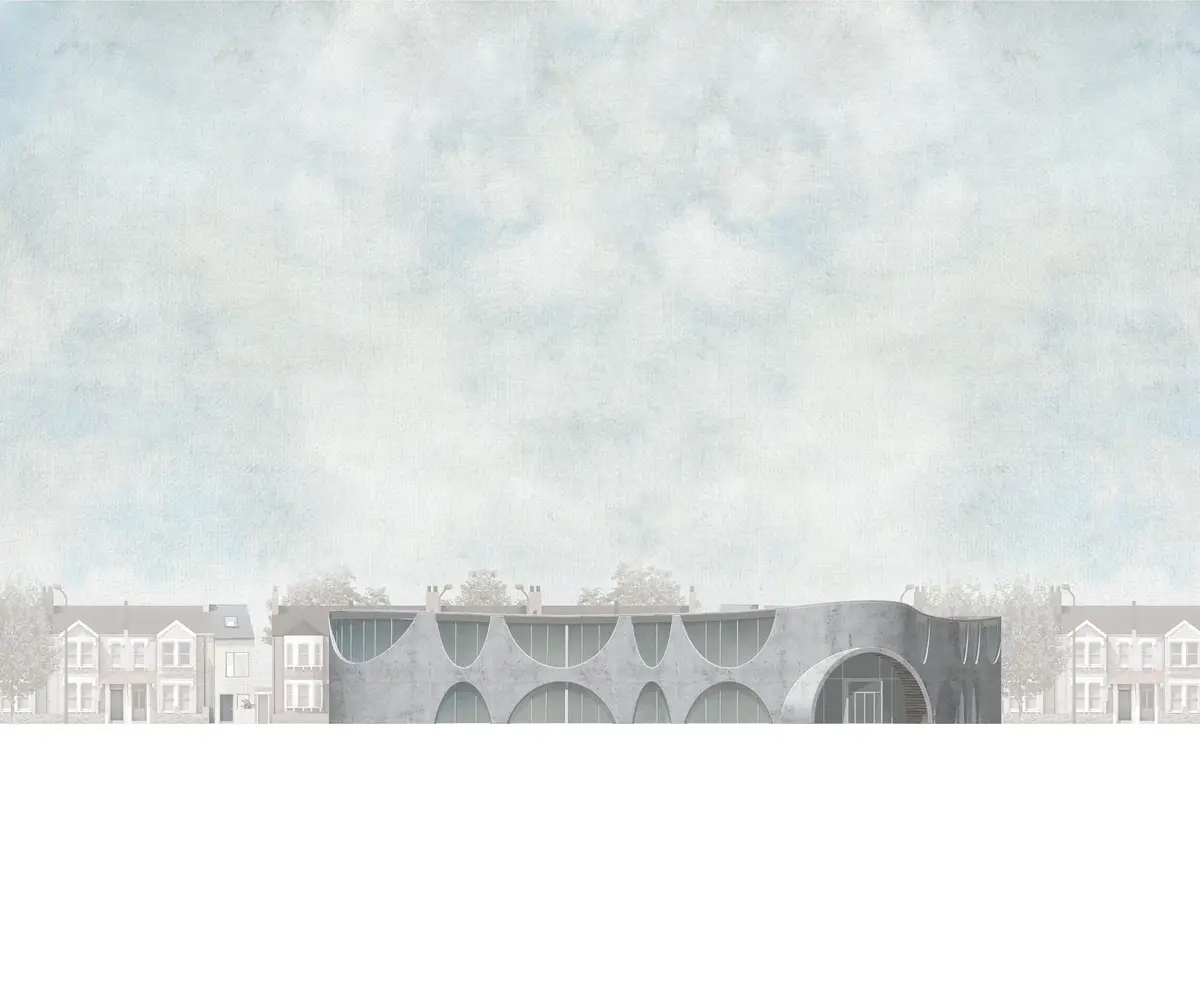
Project for Live Laugh Love: A Therapeutic Community Center on Edinburgh's Canaan Lane
A curved, courtyard-centered building designed to promote healing, inclusivity, and intergenerational connection in South West Edinburgh.


Architecture rarely gets credit for the quiet work it does on human emotion. A well-placed window, a courtyard that gathers strangers into conversation, a building form that refuses rigid geometry in favor of something softer: these are design decisions with psychological consequences. Project for Live Laugh Love takes that premise seriously, proposing a community center in Edinburgh whose every curve, opening, and planted surface is calibrated to support mental wellness and social cohesion.
Designed by Глазьева Вера and published on uni.xyz, the project sits on Canaan Lane in Edinburgh's Morningside district, a site surrounded by an Old Age Home, a Blind School, and a Primary School. That adjacency is not incidental. It makes the building a natural crossroads for intergenerational exchange, positioning therapeutic architecture precisely where its benefits can reach the most vulnerable and the most receptive members of a community.
Curved Walls and Arc Windows That Welcome the Street
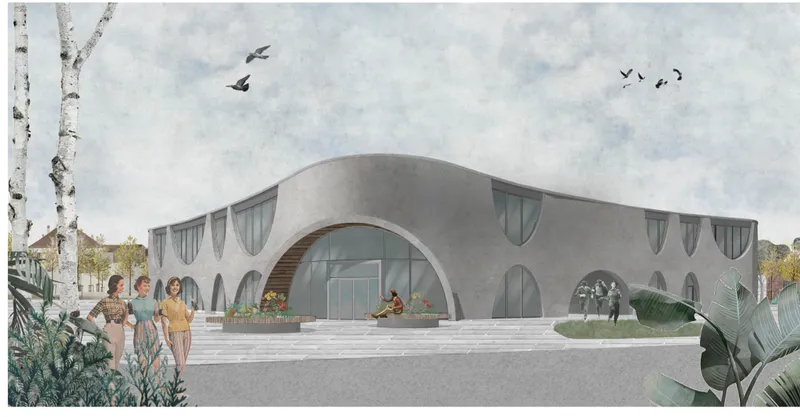
The exterior rendering reveals a building that refuses to turn its back on its neighborhood. Its organic, flowing form emerges from the contours of the site, producing a sculptural silhouette that reads less as a civic institution and more as an extension of the landscape itself. Large arc windows punctuate the curved walls, pulling daylight deep into the interior. In therapeutic design, natural light is not ornamental; it directly influences mood regulation and mental clarity. The paved plaza in front draws people in with its openness, while the arched openings create a visual rhythm that suggests welcome without the formality of a monumental entrance.
A Site Shaped by Its Neighbors
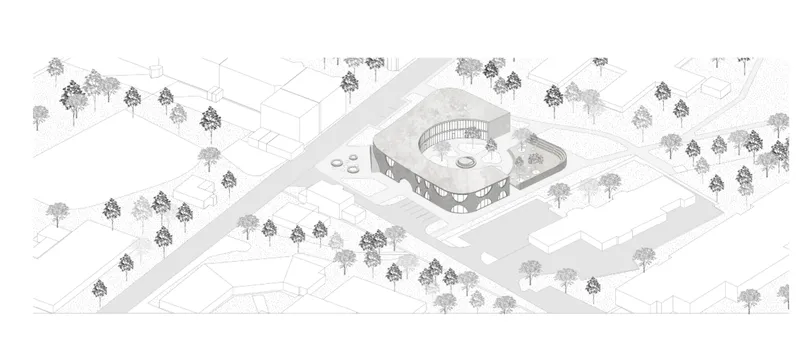
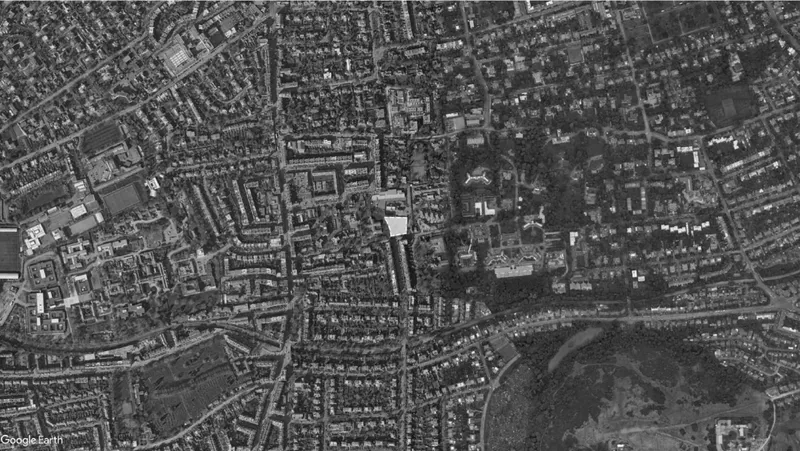
The axonometric drawing makes the building's site strategy legible. Canaan Lane's calm residential streets and generous green zones form the backdrop, and the building's footprint responds to this context by preserving and amplifying the surrounding landscape. Trees line the pathways, and generous setbacks maintain the neighborhood's intimate character. The satellite view of the surrounding Morningside district confirms the density of the residential fabric: rows of stone-built blocks, tight streets, and limited public gathering space. Against that context, the project's open green zone and central amphitheater fill a genuine gap in the urban tissue.
Accessibility is treated as a foundational requirement rather than an afterthought. Ample parking and clear, intuitive pathways ensure the facility is navigable for individuals with mobility challenges, families, and older adults arriving from the neighboring institutions. The building does not impose itself on the land; it settles into it, making arrival feel gradual rather than abrupt.
A Circular Courtyard as Spatial and Symbolic Nucleus
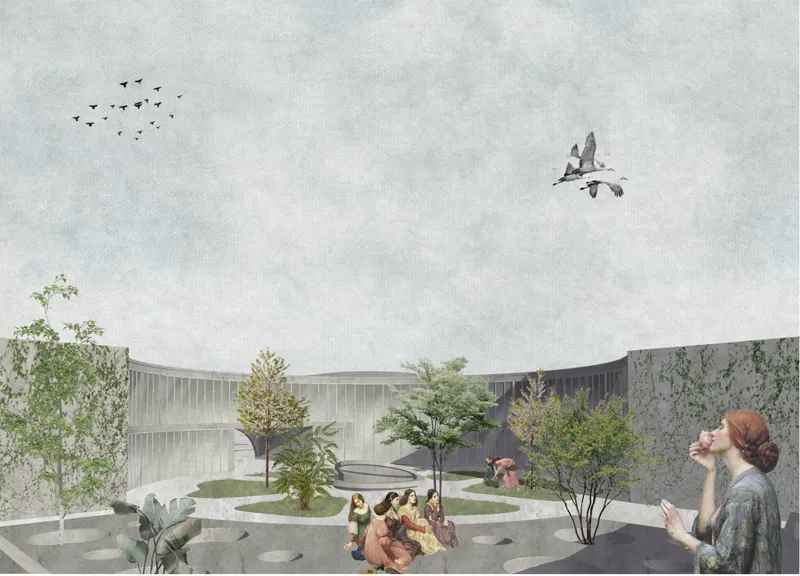
The interior courtyard is the project's emotional center. Circular planters hold young trees, and the space opens to the sky, letting weather and light become active participants in the experience. People stand, sit, and move through the courtyard in the rendering, each finding their own way to occupy the space. The circular plan recalls universal archetypes: a sun, a tree trunk, a campfire ring. Connection radiates outward from this core, facilitating chance encounters, artistic exchange, and spontaneous conversation.
An open-air amphitheater embedded within the green zone extends this communal logic outdoors, offering an adaptable setting for public gatherings, informal lectures, cultural performances, or quiet solitude beneath the trees. The internal layout orbits the courtyard, meaning every programmatic space maintains a visual or physical relationship with this planted heart. The result is a building that gently encourages exploration without disorientation, a quality especially important for visitors from the adjacent Blind School and Old Age Home.
Form as a Mirror of Healing's Non-Linear Path
The building's irregular yet harmonious silhouette is not arbitrary. Its sculptural form reflects human individuality and the complex, non-linear journey of healing. Walls curve and shift, avoiding the predictability of right angles, which in turn communicates adaptability, diversity, and emotional depth. The architecture is designed not for perfection but for authenticity, mirroring the people it serves, each of whom arrives with their own story, challenges, and trajectory toward well-being. Whether someone enters seeking quiet reflection, community connection, or creative inspiration, the space meets them without judgment.
Why This Project Matters
Therapeutic architecture is often discussed in the context of hospitals and clinics, places where healing is the explicit program. What makes Project for Live Laugh Love compelling is its insistence that a community center, a building with no clinical mandate, can and should contribute to emotional well-being. Siting it between an Old Age Home, a Blind School, and a Primary School turns that ambition into something concrete: a building that serves people at the extremes of age and ability, gathering them into a shared landscape.
Глазьева Вера's proposal demonstrates that therapeutic design is not about adding wellness features to an otherwise conventional building. It is about letting the therapeutic intention shape every decision, from the curved plan to the arc windows to the circular courtyard. The result is a space that slows time, restores balance, and offers a new model for how public architecture in a residential neighborhood can actively support human flourishing.
View the Full Project
About the Designers
Designer: Глазьева Вера
Enter a Design Competition on uni.xyz
uni.xyz runs architecture and design competitions year-round that reward proposals with spatial conviction and real site intelligence.
Project credits: Project for Live Laugh Love by Глазьева Вера.


Popular Articles
Popular articles from the community


U.GA Architects Wraps an Oval Rooftop Pool in Curved Board-Formed Concrete on Busan's Jeollidan-gil
In Busan's Jeonpo-dong, a 454 m² mixed-use block stacks a neighborhood facility, guest rooms and an oval rooftop pool inside spiraling concrete walls.

David Ortega Stacks a Two-Story Mexico City Penthouse Around a Steel Stair and a Pergola-Shaded Roof Terrace
In Colonia Roma, a 300 m² penthouse uses oak joinery, a planted steel stair and a slatted roof pergola to make a new-build apartment feel like a house.

GROUP A Strips a 1969 Rotterdam Harbor Headquarters to Its Frame and Wraps It in Timber Louvers
In Rotterdam's M4H harbor district, Ferro Offices reuses a 1969 frame, adds one timber storey and reaches BREEAM-NL Outstanding.

Architekt Andreas Gruber Scatters 23 Dark Timber Chalets Across a South Tyrolean Forest Edge
In Molini di Tures, Amonti Chalets breaks a resort into a hamlet of gabled timber houses, with parking, storage and services pushed into the slope.

Similar Reads
You might also enjoy these articles


Vereda Arquitetos Renovates a 40-Square-Meter Apartment Inside Niemeyer's Copan Building
A compact unit in São Paulo's most iconic residential tower gets a material overhaul that pairs exposed concrete with bold blue Formica.

Shakur's House: Exposed Brick as an Interior Organiser in a 168 m² Mashhad Residence
Brick moves indoors in this Mashhad residence, where masonry walls, glass partitions and teal planes sequence a compact home without closing it off.

Day and Night Park: A Time-Based Urban Newsstand in Beijing
A temporary urban newsstand in Beijing blending travel, light, and reading through poetic colors, compact form, and community-focused design.

Modernist Patio Renovation in El Masnou, Barcelona by Oliver Segura Arquitectura + Cebrià Arquitectura
Modernist patio renovation blending tradition and innovation with a movable pool, leveled floors, and Catalan materials in El Masnou.

Explore Public Health Competitions
Discover active competitions in this discipline

Challenge to design locus for the upliftment of human rights

Design challenge to reuse E-waste
Comments (0)
Please login or sign up to add comments
No comments yet. Be the first to comment!