
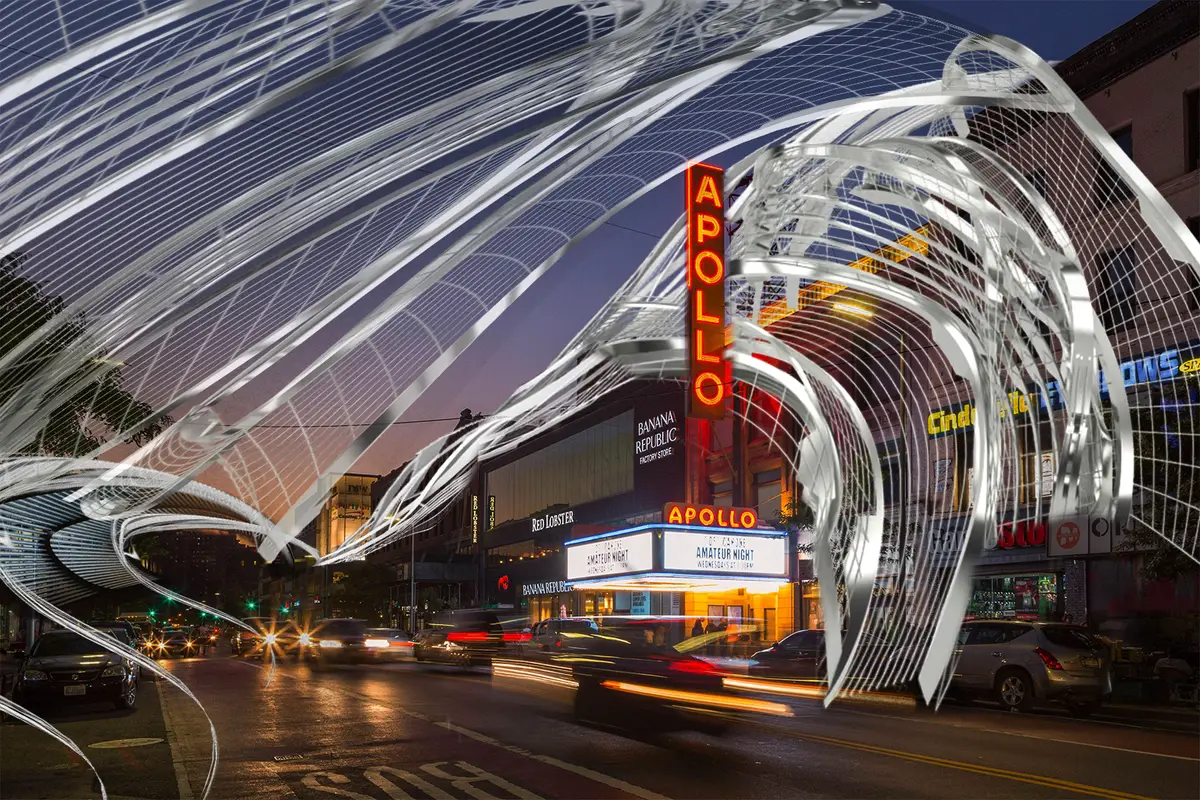
Threaded City
Weaving Culture, Movement, and Memory Across Harlem

This proposal reimagines Harlem as a network of interlaced programmatic ribbons—each thread a spatial system for culture, housing, economy, mobility, and wellness. Inspired by jazz’s improvisational structure, the design stitches together East Harlem, Central Harlem, and Morningside Heights into a rhythmic, inclusive, and adaptive urban fabric.
Rooted in both historical memory and future speculation, Threaded City integrates adaptive technologies like AI-responsive infrastructure, water-capture ribbons, and mobility-on-demand systems. Designed to confront climate vulnerability—particularly the site's flood risks—the proposal threads resilience into daily life, transforming Harlem into a dynamic ecosystem where equity, culture, and innovation coalesce.
At its heart, Threaded City is a community-first vision. The project recognizes Harlem's rich legacy as a global center for Black culture, art, and music, while addressing long-standing issues of environmental injustice, mobility barriers, and fragmented development. The programmable ribbon systems respond to the site’s evolving needs: cultural ribbons provide stages, galleries, and makerspaces; housing ribbons introduce resilient, modular living options; mobility ribbons weave multimodal transit, connecting neighborhoods previously divided by the FDR Drive. A deliberate focus on pedestrian bridges and underpasses stitches Harlem back to the East River waterfront, a relationship historically severed by infrastructure and environmental degradation.
Music functions as both a metaphor and a programmatic anchor for Threaded City. Like the syncopated rhythms of Harlem’s jazz legends, the project celebrates improvisation, resilience, and community storytelling. Central to this is the Apollo Resonance Amphitheater, a new waterfront performance venue that echoes the historic Apollo Theater’s cultural legacy. The amphitheater is designed as a soundscape in motion: flexible performance zones, acoustic membranes, and interactive sound gardens invite residents and visitors to participate in the continual evolution of Harlem’s musical identity. Public spaces throughout the ribbons incorporate busking spots, outdoor recording booths, and AI-curated musical performances that adapt to weather, time of day, and community use patterns.
Sustainability is embedded not as a layer, but as a structure. Threaded City addresses rising environmental risks—particularly coastal flooding—through a network of resilient mechanisms:
Water Capture Ribbons: Curved tensile canopy elements integrated into the Housing and Wellness Ribbons collect rainwater and funnel it into underground greywater tanks. This harvested water supports public gardens, cooling mist systems, and non-potable uses, reducing strain on the municipal system.
Wind-Activated Ribbons: Lightweight, kinetic fins attached to selected ribbons generate small-scale wind power, visualizing Harlem’s natural breezes and contributing renewable energy for community spaces.
Tidal Energy Systems: Micro water turbines placed along the waterfront capture kinetic energy from tidal movements, supporting lighting and infrastructure for pedestrian bridges and waterfront parks.
ThreadWeaver: A infrastructure systems builder, ThreadWeaver constantly monitors water, energy, and mobility flows, redistributing resources dynamically to optimize resilience, accessibility, and environmental performance.
The overall phasing strategy reflects Harlem's evolving needs across time horizons—2050, 2070, and 2100—responding to projected climate pressures, demographic shifts, and economic changes. Early phases prioritize reinforcing existing community anchors: NYCHA housing upgrades, school partnerships, and micro-economy incubators. Later phases introduce more experimental forms like AI-generated housing modules, climate-adaptive transit hubs, and automated urban agriculture clusters. Flexibility is built into every layer: spaces are designed to change function over days, seasons, and decades.
Importantly, Threaded City resists top-down master planning in favor of a participatory, evolving structure. Community councils, cultural committees, and youth-led initiatives inform how spaces are programmed, modified, and maintained. This collaborative framework echoes the improvisational ethos of Harlem’s cultural history—where creation and adaptation are collective acts of resilience.

Popular Articles
Popular articles from the community


Cube Design Draws an Ecological Corridor Between Two Shenzhen Hills with the Nankai Building
Beside Shenzhen's container docks, the Nankai Building pairs stacked balconies with a climbing green screen to connect two hillsides across its height.


Opera on the Sea: Driftwood Logic Shapes a Timber Opera House on Estonia's Coast
Trevor Orgill's opera house translates the entangled drift of floating timber into a civic building where wood, water, and music converge.

Singing Woman: An Opera House That Performs Before the Curtain Rises
Ovidiu Cristian Pavel's conceptual opera house translates Estonia's choral identity into a sculpted waterfront landmark facing the Baltic Sea.

David Ortega Stacks a Two-Story Mexico City Penthouse Around a Steel Stair and a Pergola-Shaded Roof Terrace
In Colonia Roma, a 300 m² penthouse uses oak joinery, a planted steel stair and a slatted roof pergola to make a new-build apartment feel like a house.

Similar Reads
You might also enjoy these articles

Vereda Arquitetos Renovates a 40-Square-Meter Apartment Inside Niemeyer's Copan Building
A compact unit in São Paulo's most iconic residential tower gets a material overhaul that pairs exposed concrete with bold blue Formica.

Shakur's House: Exposed Brick as an Interior Organiser in a 168 m² Mashhad Residence
Brick moves indoors in this Mashhad residence, where masonry walls, glass partitions and teal planes sequence a compact home without closing it off.

Day and Night Park: A Time-Based Urban Newsstand in Beijing
A temporary urban newsstand in Beijing blending travel, light, and reading through poetic colors, compact form, and community-focused design.

Modernist Patio Renovation in El Masnou, Barcelona by Oliver Segura Arquitectura + Cebrià Arquitectura
Modernist patio renovation blending tradition and innovation with a movable pool, leveled floors, and Catalan materials in El Masnou.

Explore Feeding the City Competitions
Discover active competitions in this discipline


Challenge to reimagine the Iron Throne

Photograph architecture without architects

Illustrate the lost glory of Angkor Wat - Render Challenge

Design challenge to reuse E-waste
Comments (0)
Please login or sign up to add comments
No comments yet. Be the first to comment!