
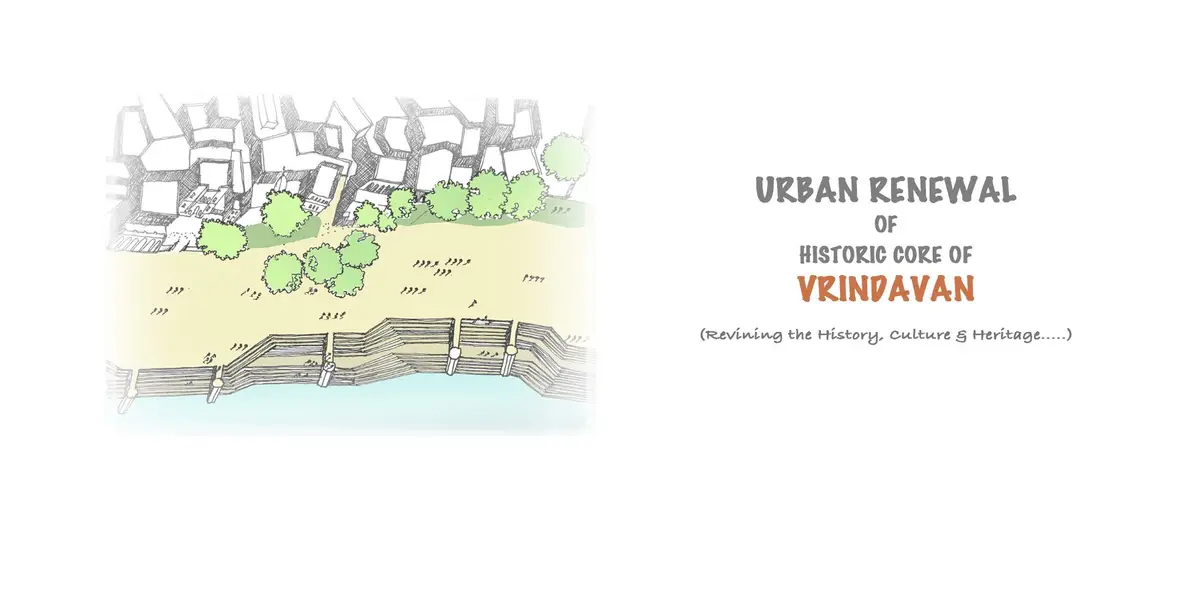
Urban Renewal Of Historic Core Of Vrindavan
Reviving Vrindavan’s sacred urban fabric through heritage conservation, riverfront renewal, and community-led sustainable development.


Urban renewal in historic cities requires a delicate balance between preservation and progress. The thesis project Urban Renewal of the Historic Core of Vrindavan by Neha Goyal Tater explores how a sacred town: deeply rooted in mythology, ecology, and pilgrimage, can be revitalized without losing its spiritual and cultural essence.
Vrindavan, one of North India’s most significant pilgrimage destinations, attracts millions of visitors annually. With over 5,500 temples and a historic riverfront along the Yamuna, the town embodies layers of religious, ecological, and socio-cultural history. However, rapid urbanization, uncontrolled tourism, environmental degradation, and infrastructural stress have gradually eroded its historic identity.
This research proposes a comprehensive urban renewal and heritage conservation model for the historic core of Vrindavan: one that restores ecological systems, strengthens community life, and enhances the pilgrim experience while safeguarding sacred landscapes.
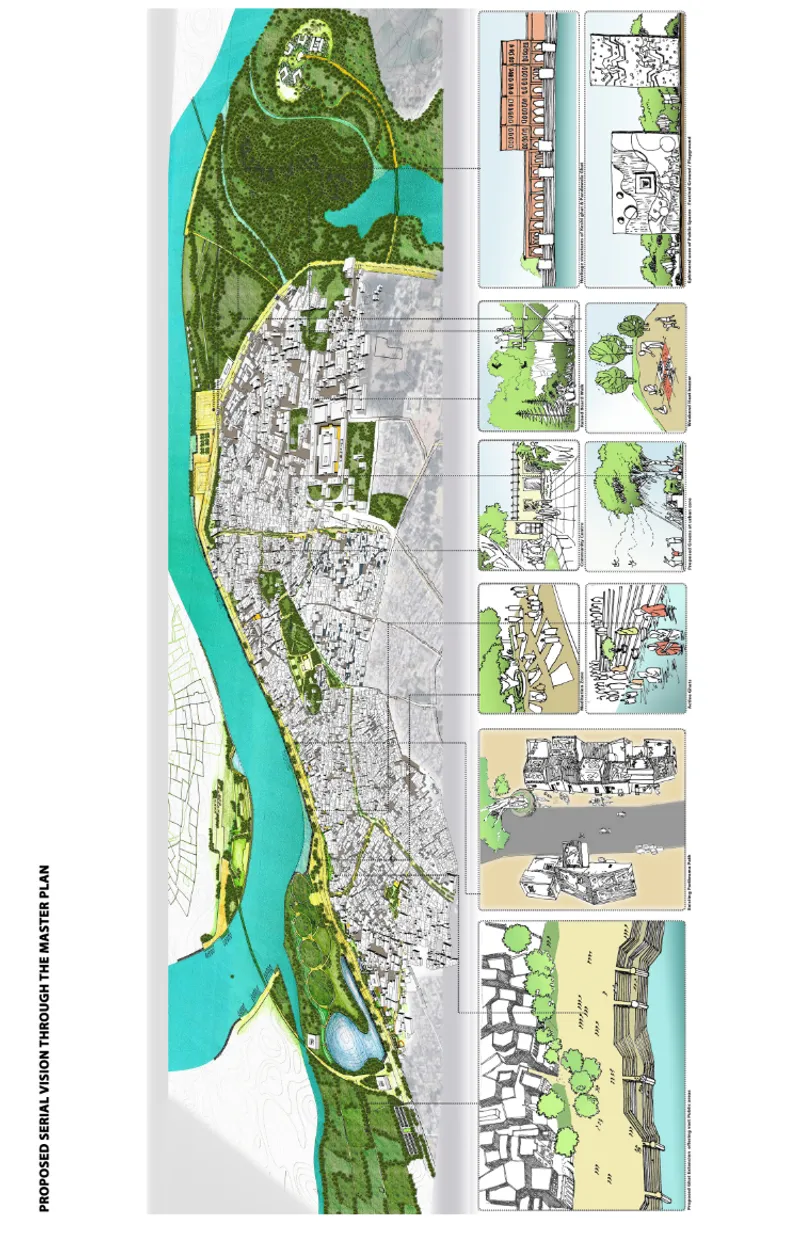
Understanding Vrindavan: Ecology, Morphology, and Mythology
Historic Identity: Water + Forest + Temples
Historically, Vrindavan was defined by three interconnected components:
- The Yamuna River and its ghats
- Sacred groves (Upvan / Nikunj)
- Temple clusters and pilgrimage routes
The early settlement patterns were shaped by topography and hydrology. Undulating terrain, water channels, and sacred forests influenced the placement of temples and residential clusters. Pilgrim routes followed ecological contours rather than imposed grids, resulting in an organic urban morphology.
Over centuries, from the 16th century temple-building era under Mughal patronage to post-independence growth, the city evolved from a forested spiritual landscape into a dense pilgrimage town. However, this transformation came at a cost:
- Fragmented river edges
- Loss of sacred groves
- Encroached ghats
- Congested streets
- Commercialized temple corridors
The historic core has gradually lost its spatial legibility and ecological coherence.
Major Urban Challenges in the Historic Core
The thesis identifies critical issues affecting Vrindavan’s heritage urban fabric:
1. Disappearing Ecological Systems
- Thickets replaced by built mass
- Polluted Yamuna river edge
- Loss of kunds (traditional water tanks)
- Disconnected drainage systems
2. Tourism Influx & Congestion
- Overcrowded temple streets
- Informal vending encroachments
- Lack of pedestrian priority
- Inadequate wayfinding and amenities
3. Underdeveloped Infrastructure
- Poor sanitation and waste management
- Insufficient public facilities
- Derelict housing stock
- Absence of structured hawker zones
4. Fragmented Heritage Protection
Despite ASI-protected monuments, uncontrolled development in surrounding areas diminishes the aesthetic and cultural integrity of the historic core.
These conditions highlight the urgent need for a strategic heritage-led urban renewal framework.
Research Methodology: Multi-Scalar Urban Analysis
The project adopts a three-tier research methodology:
Macro Scale (Regional Context)
- Ecological mapping of Yamuna floodplains
- Urban growth patterns
- Demographic trends
Meso Scale (Historic Core)
- Built form analysis
- Street structure mapping
- Pilgrim route documentation
- Activity mapping
Micro Scale (Block Level Interventions)
- Street sections
- Signage conditions
- Encroachment analysis
- Built-use transformation
This layered approach ensures that the proposed urban renewal model is rooted in both spatial logic and socio-cultural realities.
Urban Renewal Strategy: Three Key Sub-Projects
The proposed model unfolds through three interconnected sub-projects that combine heritage conservation, ecological restoration, and community strengthening.
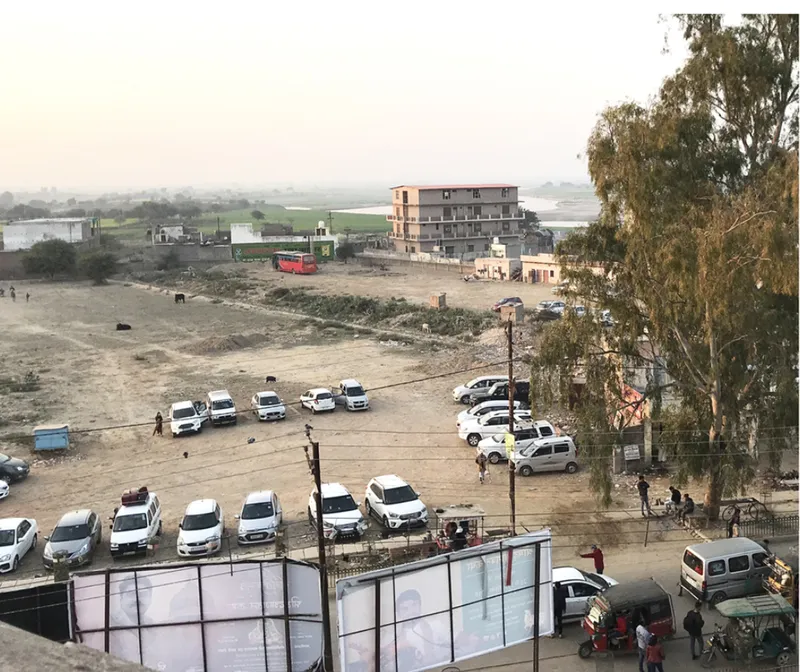
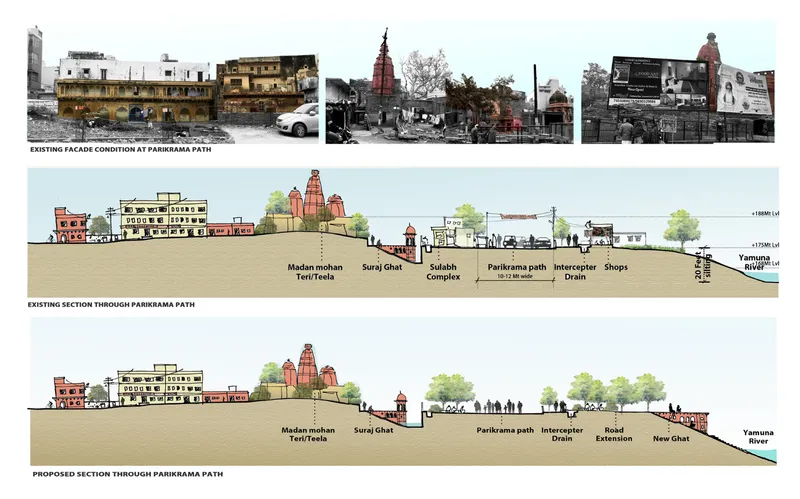
Sub-Project 1: Re-appropriating the Fragmented River Edge
The Yamuna waterfront once served as the spiritual threshold of Vrindavan. Today, it is underutilized and disconnected.
Key interventions include:
- Restoration of ghats as cultural nodes
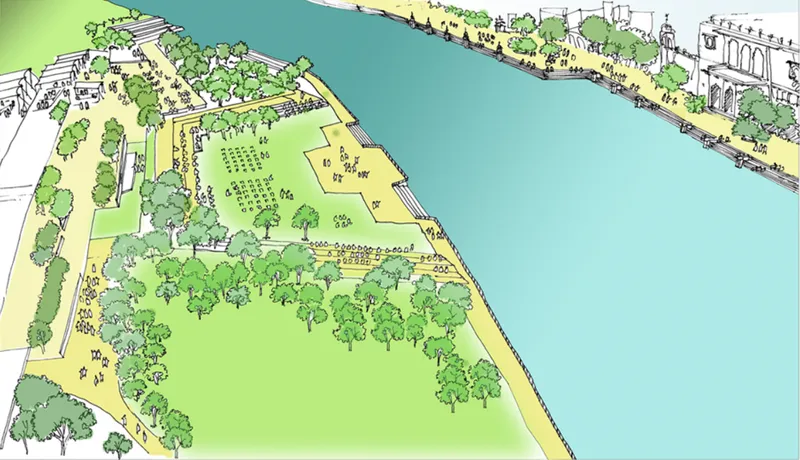
- Development of pedestrian-friendly river promenades
- Creation of green riparian buffers
- Reclaimed land activation through plazas and public spaces
- Alternative mobility through jetties and water transport
This strategy transforms the waterfront into an ecological and cultural spine, reinforcing the sacred relationship between river and town.
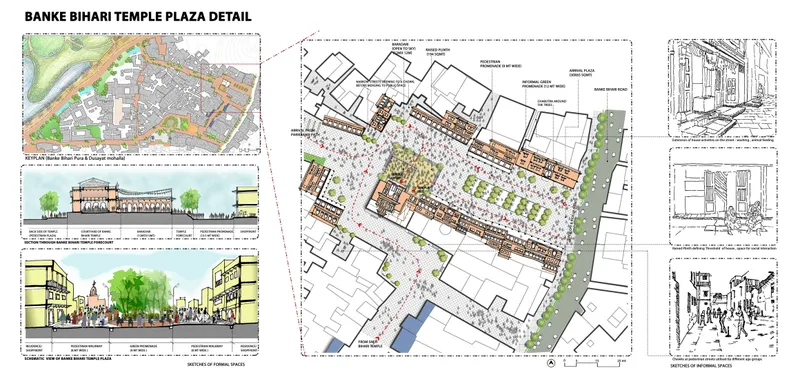
Sub-Project 2: Re-Interpreting Temple Precincts & Community Interfaces
Temple areas are heavily commercialized yet lack structured public space.
Proposals include:
- Dedicated hawker zones
- 500m walkable pilgrimage loops
- Street redesign prioritizing pedestrians
- Social & environmental plug-in spaces
- Heritage-sensitive signage systems
- Adaptive reuse of derelict structures
The objective is to reconnect temples with their surrounding neighborhoods, restoring both spatial dignity and community ownership.
Sub-Project 3: Recreation of Upvan Legacy, Site as Ecosystem
Vrindavan’s identity is deeply tied to sacred groves (Upvan). Their disappearance has disrupted ecological and mythological continuity.
Interventions focus on:
- Wetland creation for water filtration
- Native tree plantation
- Bio-filtration basins along the river
- Interpretative ecological trails
- Amenity zones within walking distance
This ecological restoration strengthens resilience against flooding while reviving the mythological landscape of Krishna’s narratives.
Built Form & Urban Morphology Revitalization
The historic core exhibits a high built density with limited open spaces. Streets range from narrow internal lanes to commercial temple roads heavily encroached by vendors and hoardings.
The renewal model proposes:
- Clear pedestrian-priority streets
- Defined multi-modal corridors
- Improved public realm design
- Reinforced edges along religious landmarks
- Open space insertion in dense clusters
Rather than imposing new geometries, the design respects the organic morphology and enhances its functional clarity.
Community-Centric Heritage Conservation
Urban renewal in sacred towns must prioritize residents alongside pilgrims.
The project emphasizes:
- Livelihood support for hawkers & cottage industries
- Cultural craft promotion
- Infrastructure upgrades in residential mohallas
- Integration of intangible heritage (music, rituals, crafts)
By strengthening local communities, the historic core gains economic resilience and social continuity.
A Holistic Model for Sustainable Urban Development
This thesis reframes urban renewal of historic cities as an integrated process rather than isolated beautification. It demonstrates how:
- Ecology informs urban morphology
- Heritage drives economic regeneration
- Pilgrimage routes shape public realm design
- Community participation ensures long-term sustainability
The proposed framework can serve as a replicable model for other religious settlements facing similar pressures of tourism and modernization.
The central research question, Is it possible to retain the uniqueness of a historic core while planning for its future?, is answered through a sensitive, multi-layered strategy.
By reconnecting water, forest, and temples; by restructuring circulation; by revitalizing ghats and sacred landscapes; and by empowering local communities, the project by Neha Goyal Tater presents a compelling vision for the sustainable urban renewal of Vrindavan’s historic core.
In doing so, it restores not only physical space, but also the spirit of place.


Popular Articles
Popular articles from the community


ALGAL REALM: A Bio-Integrated Lunar Habitat Design for Life Beyond Earth
ALGAL REALM reimagines lunar habitat design with algae-powered life support, 3D-printed regolith, and vertical living for a lunar future.

The Ocean Hive: Sustainable Architecture for a Self-Sufficient Civilization at Sea
The Ocean Hive imagines sustainable architecture at sea, where modular habitats, algae, wave power and ocean waste sustain a growing colony.

Co-Life: Senior Housing Design That Reconnects Older Adults With the City
Co-Life reimagines senior housing design through healing gardens, shared streets, workshops, and a sustainable community across generations.

Little Red Riding Hood: Architectural Design as a Journey Through Fear, Light, and Storytelling
Little Red Riding Hood reimagines the fairy tale through architectural design shaped by fear, light, scale, memory, uncertainty, and choice.

Similar Reads
You might also enjoy these articles

Eco Chapel: A Green Architecture Pavilion Designed in Symbiosis with the Forest
Eco Chapel uses green architecture to weave prayer, learning and reuse into a forest pavilion shaped by modular hexagonal canopies for life.
Kaffeebühnen: Coffee Shop Architecture Designed as a Civic Stage Between Vienna’s City and Park
Kaffeebühnen turns coffee shop architecture into a civic stage, linking Vienna’s park edge, urban life, warm timber yards, and coffee craft.
Healing Façade: Sustainable Architecture for Reforestation, Community, and Sacred Ecology in Ethiopia
Healing Façade reimagines sustainable architecture as a living wall that restores soil, catches water and renews Ethiopia's forest churches.


Urban Forest: A Vertical Ecosystem for 5,000 Workers in Singapore's Changi Business Park
Radially stacked pods and layered green decks turn a 7-acre plot into 47 acres of ecological workspace projected for 2040.

Comments (0)
Please login or sign up to add comments
No comments yet. Be the first to comment!