WOMB: A Climate Responsive Architecture for Childcare in New Delhi
A climate-responsive daycare that nurtures children like nature nurtures life—an embodiment of the ‘Form Follows Climate’ philosophy.


Project by Abdul Bari and Vinay Kaushal
Shortlisted Entry | UNIATA '22
In the heart of New Delhi, a city defined by its extreme climatic variations, WOMB Daycare Centre stands as a model of climate responsive architecture — a building that listens, adapts, and evolves with its environment. Conceived by Abdul Bari and Vinay Kaushal, this project draws inspiration from the nurturing form of a womb — a natural system that sustains and protects life through dynamic responsiveness.
The concept transforms this biological metaphor into architectural language. The daycare moulds itself around sunlight, air movement, and human comfort, embodying the idea that architecture should not resist nature but harmonize with it.
Concept Development: The Womb as a Living Form
The design emerged from a simple question — how can architecture nurture life like a mother’s womb? The answer came through form follows climate thinking. By studying the sun’s path across five distinct Indian seasons — winter, summer, monsoon, autumn, and spring — the architects identified shaded and sunny zones, creating a zoning map that guided form, orientation, and materiality.
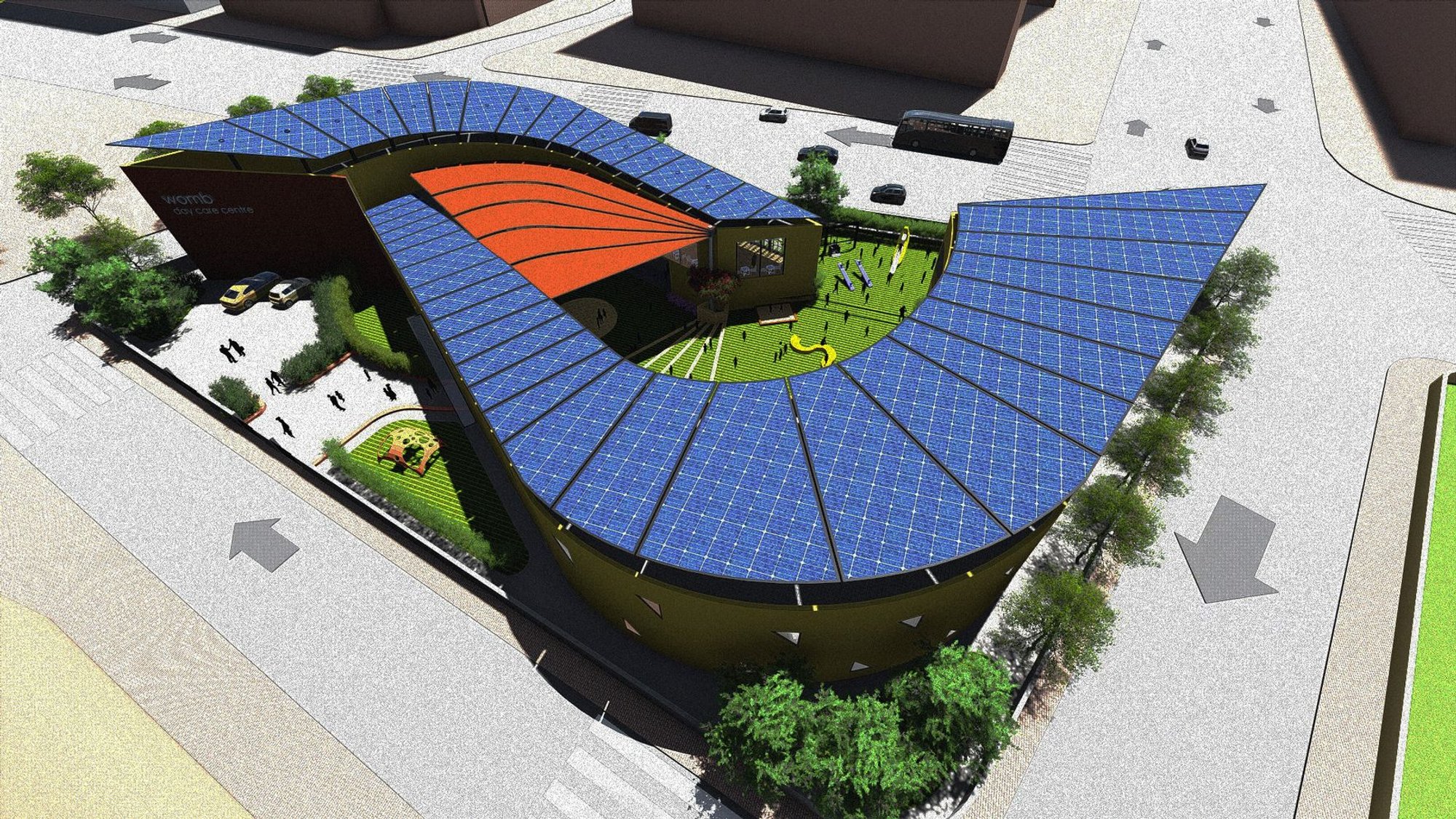
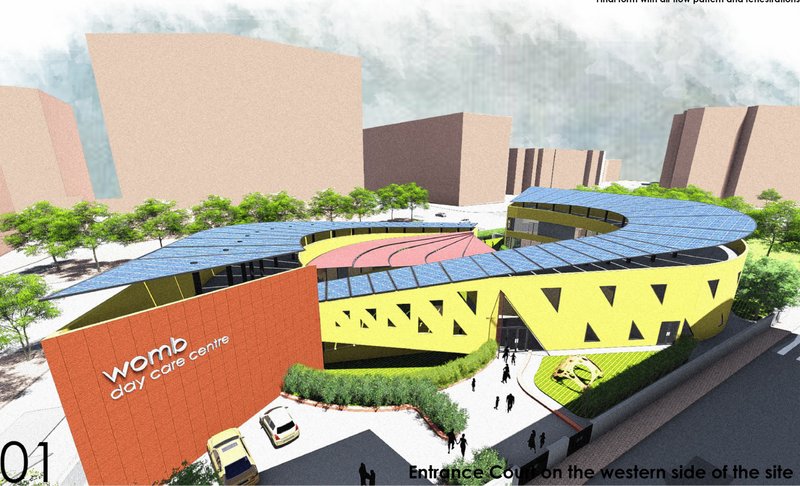
Two boomerang-shaped blocks envelop a central courtyard, mimicking the protective gesture of a mother’s hands cradling her child. These forms are positioned based on shadow analysis to maximize solar exposure in winter and shade in summer. The building breathes — allowing air to circulate naturally through courtyards, open corridors, and porous facades.
In its very essence, WOMB becomes a metaphor — the architecture itself is an organic entity that nurtures, protects, and evolves.
Site Strategy and Form Evolution
Located in New Delhi’s semi-arid climatic zone, the building’s orientation along the north-south axis ensures optimal light and thermal comfort. Early massing iterations explored open and enclosed configurations before evolving into a curvilinear form that maximizes solar gain and airflow.
- North façade: Glazed openings for controlled daylight and minimal glare.
- South façade: Reduced openings to limit heat gain.
- Courtyard: Acts as a thermal regulator and social hub.
- Vegetation and Screens: Filter air and block harsh sun.
The design demonstrates that sustainable architecture is not merely about adding green technologies but about shaping space that intuitively responds to the environment.
Passive and Active Climate Strategies
The WOMB daycare integrates both passive and mechanical systems to enhance thermal performance and user comfort.
Passive Techniques:
- Smaller southern openings minimize solar ingress.
- Courtyard planning promotes cross ventilation and light diffusion.
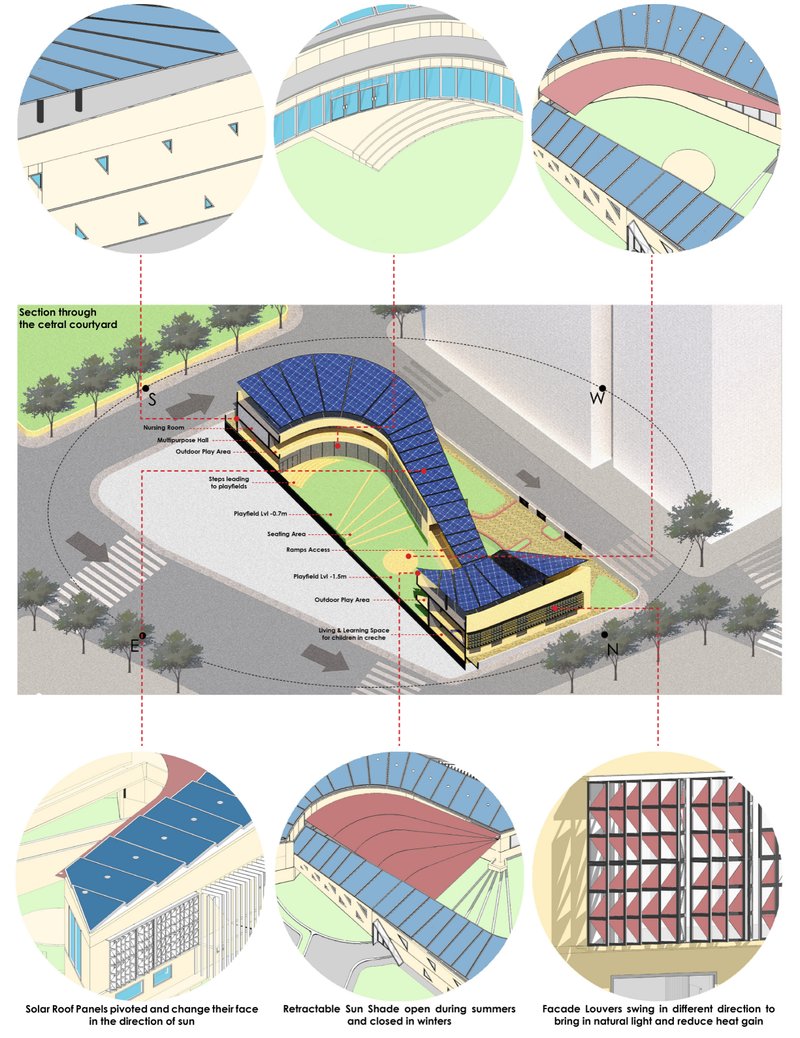
- Retractable sunshade operates seasonally — open in winter, closed in summer.
- Facade louvers adjust orientation to balance daylight and thermal comfort.
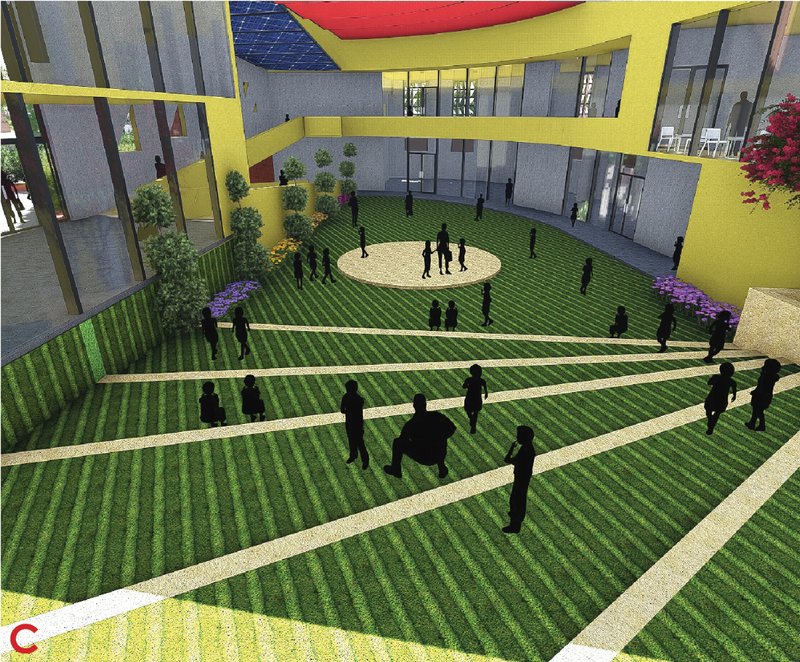
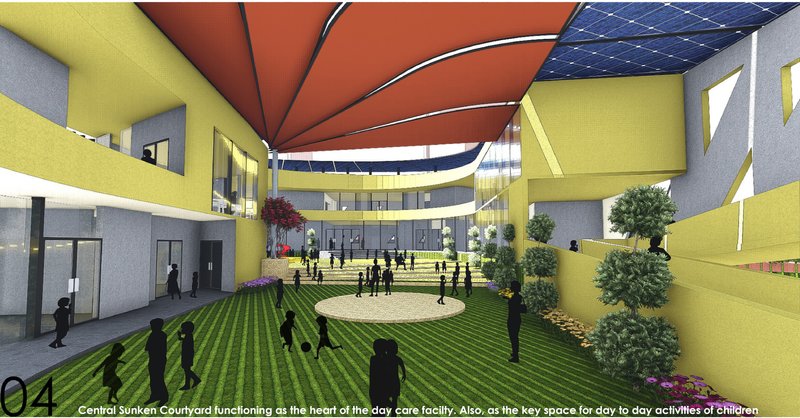
- Sunken playfields improve microclimate and create tiered play levels.
- Tensile roof system for adaptable shading based on solar angle.
Active Systems:
- Photovoltaic glass panels harness solar energy for operational efficiency.
- Sunken courtyard ventilation enhances air circulation and reduces dependency on mechanical cooling.
Each strategy is tuned to the temperate, sub-tropical climate of Delhi, making the building a benchmark in energy-efficient childcare architecture.
Functional Zoning and Spatial Experience
The facility is divided into two main zones — the Creche Block and the Daycare Block, designed for children aged 3 months to 7 years.
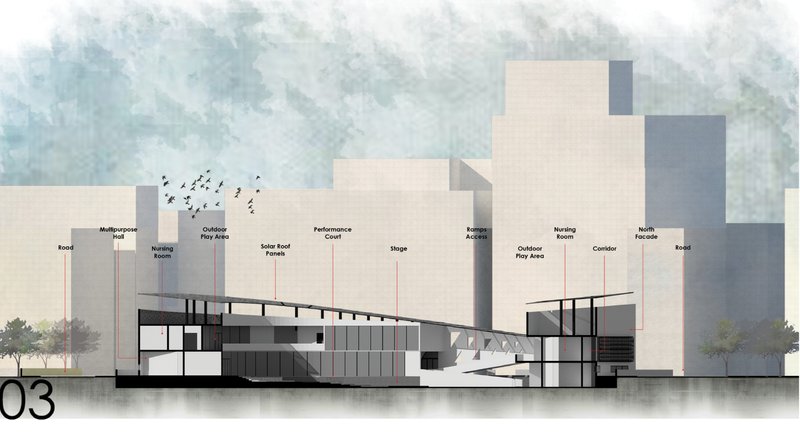
- Creche (north block): Sunken into the ground for thermal comfort and easy ramped access for toddlers.
- Daycare (south block): Accommodates older children with larger play areas and learning spaces.
- Central courtyard: Functions as the heart of the design — a safe, shaded play zone that visually and spatially connects all spaces.
The architecture evolves with the child’s growth — from enclosed, secure spaces for infants to open, interactive courtyards for older children.
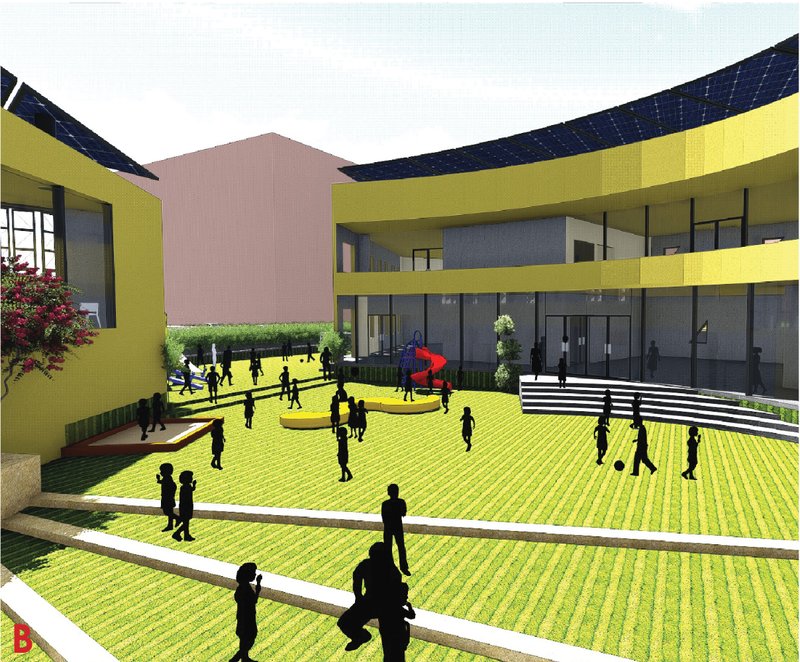
Hierarchy of Courtyards and Outdoor Learning
The project introduces a hierarchy of courtyards to create distinct experiences for different age groups:
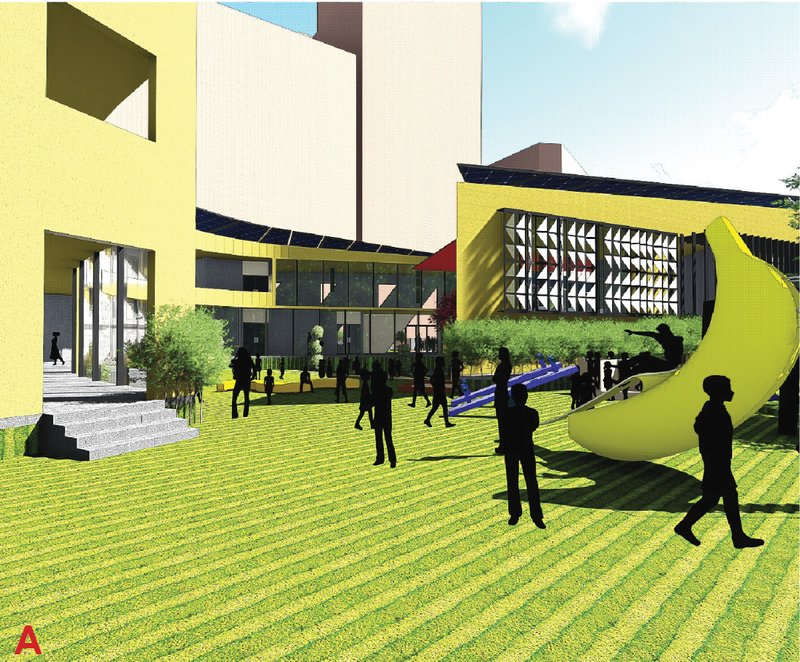
- Level -1.5m: Playfield for 5–7-year-olds with swings and open play areas.
- Level -0.7m: Performance court for interactive activities.
- Level -0.45m: Outdoor play area for toddlers.
Each courtyard acts as a microclimate — cooler, shaded, and vibrant — allowing children to engage freely while remaining protected from Delhi’s heat.
Materiality and Façade Design
The facade’s triangular perforations serve as dynamic light filters, transforming harsh sunlight into soft illumination. The building envelope, in yellow and red tones, symbolizes warmth, care, and vitality.
Sustainable features include:
- Solar-responsive roof panels that pivot based on sun direction.
- Photovoltaic glass surfaces for energy harvesting.
- Movable louvers for adaptive shading and aesthetics.
- Natural vegetation barriers for cooling and visual softness.
Interior Spaces: Comfort, Play, and Learning
The interiors echo the project’s nurturing philosophy. Playrooms and sleeping areas are directly connected to outdoor spaces, encouraging fluid movement between built and open environments.
- Vibrant colors and child-friendly furniture create stimulating environments.
- Sleeping rooms adjoin every activity space, ensuring safety and rest.
- Multipurpose halls and cafeteria spaces foster community interaction and learning through play.
The design balances functionality and sensory comfort, integrating daylight, scale, and texture in a manner that children can intuitively engage with.
Embodiment of the ‘Form Follows Climate’ Philosophy
“Form Follows Climate” — a reinterpretation of the modernist maxim — defines the essence of WOMB. Instead of a static structure, the building moulds itself with the changing seasons. It grows, shades, breathes, and glows — much like the living systems it draws inspiration from.
In doing so, the project transcends function. It becomes a living organism, teaching children the relationship between human life and natural systems from their earliest years.
Architecture as a Nurturing Force
The WOMB Daycare Centre is not just a building — it is a philosophy of care translated into form. Through its climate-responsive architecture, it redefines how educational and childcare facilities can coexist with the environment.
By blending science, empathy, and sustainability, the project by Abdul Bari and Vinay Kaushal sets a precedent for bioclimatic design — one that nurtures both the child and the planet.