

Wudang Mountain Visitor Center by Moguang Studio: A Seamless Blend of Architecture and Nature
Wudang Mountain Visitor Center blends concrete architecture, natural light, and reflective surfaces, creating a multifunctional public space harmonizing with the landscape.


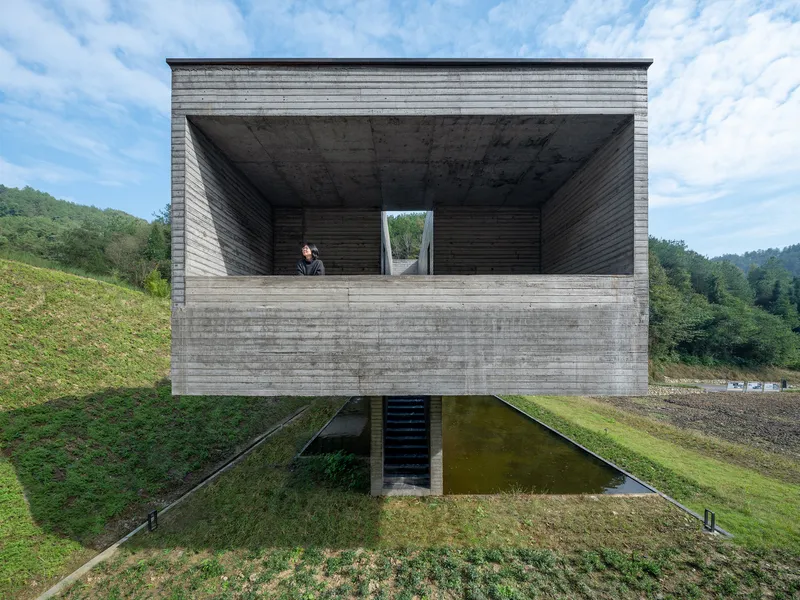
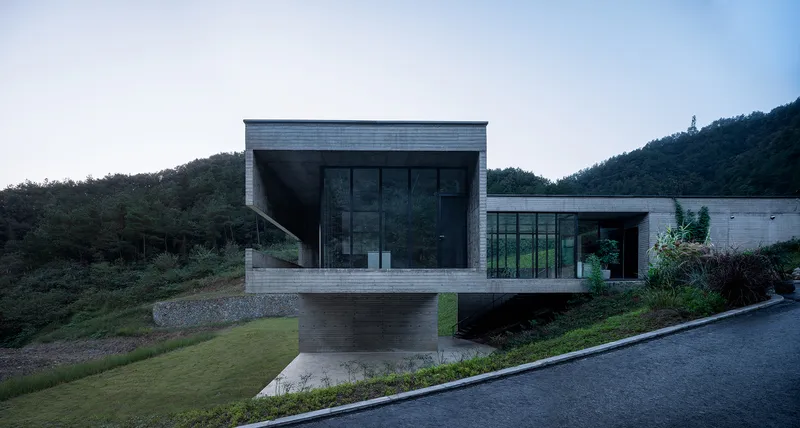
Moguang Studio’s Wudang Mountain Visitor Center is a striking architectural intervention in Longwanggou Village, Shiyan. Commissioned in the winter of 2023, this public facility was designed to complement a planned guesthouse district while providing multifunctional amenities including a café, light dining areas, a kitchen, and meeting rooms. Situated adjacent to the Danjiangkou Reservoir, the site had been previously leveled into artificial terraces, disrupting the valley’s original continuity and rice paddies.

Design Inspiration and Concept
The project’s conceptual spark came from an unexpected source: a temporary blue construction barrier. Its corrugated panels slicing across the sloped terrain evoked the land art installations of Christo and Jeanne-Claude. Moguang Studio extended this gesture by transforming the visitor center into a linear architectural intervention, both framing distant views and functioning as a dynamic gallery space.
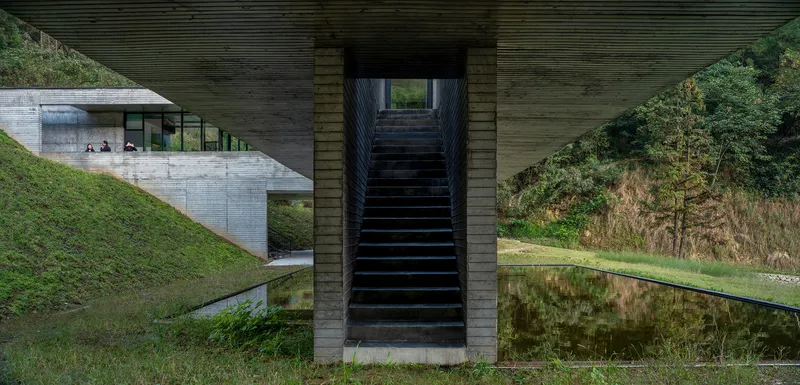
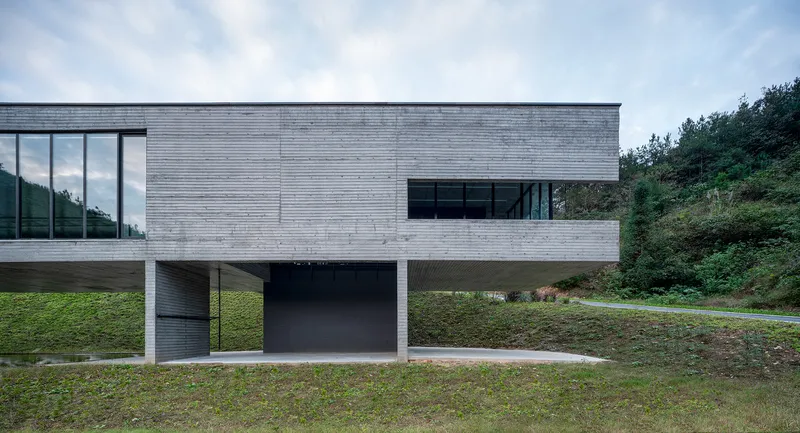
Facing budget constraints, the architects employed 150mm-wide prefabricated wooden planks as concrete formwork, producing a surface with pronounced grain, rhythm, and directional flow. This subtle texturing softens the abstraction of the solid concrete volumes, balancing minimalism with tactile warmth.
Spatial Organization and Light
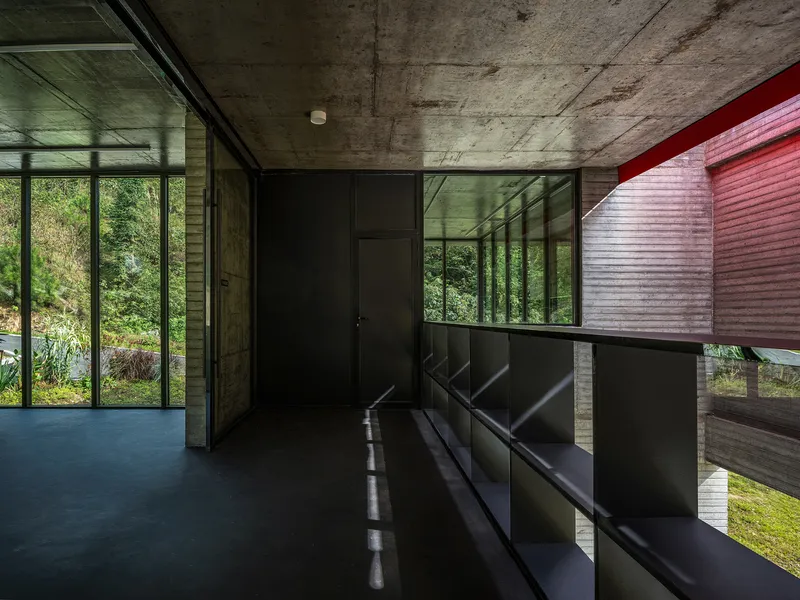
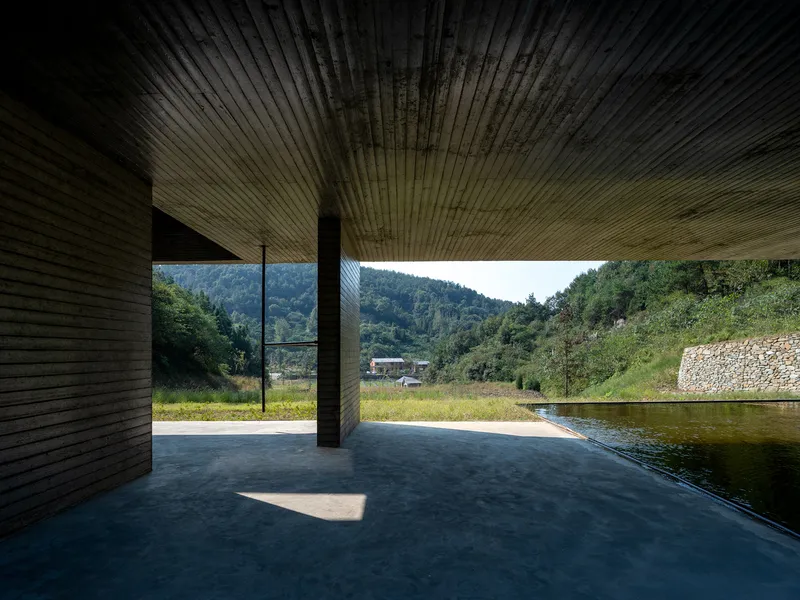
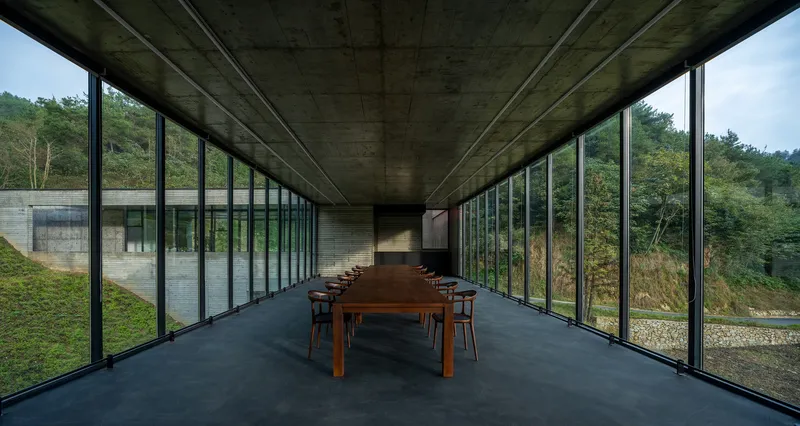
The building is punctuated by three strategically placed light courts, aligned along circulation routes. The centerpiece, the Vertical Light Court, is a seven-and-a-half-meter cube linking the restaurant, kitchen, and meeting spaces horizontally while connecting visitors vertically to sky and ground. Natural light modulates interior spaces, shifting throughout the day to fragment and enrich the visitor experience. Epoxy flooring in concrete tones reinforces the sense of material unity throughout the interior.
Structural Innovation
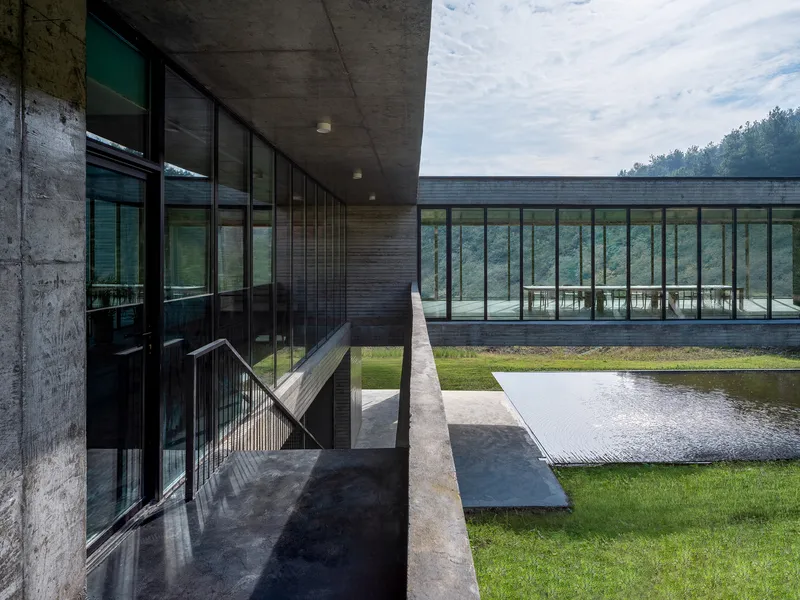
To achieve a sense of suspension and a column-free, open interior, the design features ribbed concrete slabs forming a three-dimensional tubular system. Structural loads are efficiently transferred through end staircases, side walls, and staggered partitions to a raft foundation. Long vertical windows, paired with motorized openings, provide cross-ventilation while mitigating the visual mass of concrete. Exposed beams house MEP systems, their heaviness counterbalanced by an ultra-thin mirrored reflective water surface on the roof, echoing the distant reservoir and creating a poetic dialogue with the surrounding mountains.


Materiality and Experience
The concrete shell, cast in a single continuous pour, incorporates slightly cambered roof and floor slabs to balance structural forces. The result is a building that reads as both an inhabitable gallery and a geometric bridge, responding thoughtfully to the modified terrain while asserting a quiet yet commanding presence in the natural landscape. Visitors experience a seamless interplay between geometry, light, and nature, making the Wudang Mountain Visitor Center a compelling example of contemporary Chinese architecture.
All photographs are works of Qingshan Wu


Popular Articles
Popular articles from the community


David Macias Steps a Doorless Stone and Plaster House Down a Tropical Colombian Hillside
In the humid hills of Colombia, Threshold House replaces the front door with an open void and terraces its 850 m² down the slope instead of fighting it.

Cube Design Draws an Ecological Corridor Between Two Shenzhen Hills with the Nankai Building
Beside Shenzhen's container docks, the Nankai Building pairs stacked balconies with a climbing green screen to connect two hillsides across its height.

longwave studio Reorganizes a 112 m² Tainan Apartment Around the Daily Routines of a Family and Two Cats
In Tainan, Taiwan, birch plywood, rust-red furniture and a freestanding plaster wall link arrival, storage, work and family life in one apartment.

LT2A and OPEN Architectes Thread a Brick and Glass High School Through a Wooded Belgian Campus
In Braine-l'Alleud, a 3,000 m² wing for Collège Cardinal Mercier pairs pale brick with a glazed colonnade, deferring to a small chapel and a dense wood.

Similar Reads
You might also enjoy these articles


Hodi-Mandai Geram
Project Function: Preservation and revitalization of the Intangible heritage and socio-spatial identity of the Hodi by Housing, Cultural Memory Center, Sacred Grove, landscape, local tourism economy


Olio Towers: A Mid-Rise for Performers That Fuses Housing, Rehearsal, and Stage
Located blocks from Houston's Theater District, this modular tower stacks living units around a central performance atrium.

Oasis: Modular Green Housing Carved into Dhaka's Urban Fabric
A shortlisted Plugin Housing entry reclaims unauthorized settlements in Dhaka with stepped concrete volumes, green roofs, and ventilation-driven design.

Black Hole: A Floating Megastructure for the Post-Physical Era
Emiliano Mazzarotto envisions a spherical, self-scaling arena where e-sports, digital hotels, and holographic stadiums replace traditional public space.

Explore Architecture Competitions
Discover active competitions in this discipline

Challenge to reimagine the Iron Throne

Photograph architecture without architects

Illustrate the lost glory of Angkor Wat - Render Challenge

Design challenge to reuse E-waste
Comments (0)
Please login or sign up to add comments
No comments yet. Be the first to comment!