
azade hosseini
Journals 1

Neighbourhoods that can grow with its inhabitants
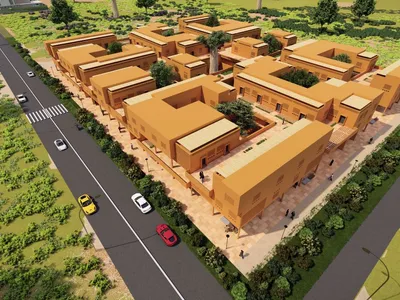
In designing a residential complex with the ability to grow with the residents, we were looking for a plan that could meet the cultural, social, climatic and sustainable development needs. We first studied the geography, climate, economy, culture and indigenous architecture in detail, then peruse history of housing of the area. A Senegalese house is a house formed around a central courtyard; Family members gather under the shade of a tree to talk, eat, drink tea or do other daily chores. Open space is very important for the people of this region. Also, the public spaces of this area are being destroyed and Very little space is available for group activities. On the other hand, due to the lack of suitable open spaces, city faces the problem of occupying sidewalks with a lot of home-based business activities. As a designer, we were looking for spaces that residents could organize based on their needs for group activities; Due to the limited area of the site compared to the large number of units and very high density, we were looking for a solution that, in addition to meeting the cultural and social needs of the residents, would provide the maximum units needed. We considered this residential complex as an urban fabric. our concept is a cohesive and modular network that intertwines public and private spaces, open and semi-open spaces. In this sense, the roof of the units plays the role of communication spaces of the upper floor and in some units the roofs have become more private collective spaces, which has led to the maximum and optimal use of all spaces. the sociality of the collection was important to us and we tried to achieve optimal and desirable proximity too. We reached 6-meter modules by considering the communication spaces, pause and suitable distance to provide light to the units. To achieve optimal and desirable proximity, we evaluated the units by different layouts using simulations in Design Builder software and reached the most optimal layout in terms of energy consumption and proper use of daylight. All communication units and spaces were simulated in the software so that all spaces had adequate daylight. Circulations are not just spaces to cross, but semi-open spaces that residents can organize them according to their needs. The complex consists of one large central courtyard in the center of which is a baobab tree and 8 smaller private courtyards that are connected to each other and the units are formed around these courtyards. Our concept for the development of the complex is Semi-open space between the units that are currently used as terraces. In the future, according to the needs of the residents, these spaces can be turned into closed spaces and provide more rooms for the units. Modular design, in addition to low cost and ease of construction, allows the units to be easily integrated and turned into larger units. Due to the climatic conditions of this region, the main need is shading and shaded spaces, for this reason, we tried to make social spaces, and communication spaces; semi-open and roofed and due to high humidity and the need for natural ventilation, with the help of simulation of external air flow in Design Builder software, we designed communication axes such as wind tunnels in the direction of wind flow. In order to benefit from natural ventilation and cool air, and we designed the roof of some parts with two shells. The design of local gardens in this complex allows residents to grow crops on a small scale, and the design of suitable spaces for home business in the southwestern part of the site, which is also related to the neighborhood, can be a good answer to the problem of occupying sidewalks with activities. Home business is due to the lack of suitable spaces. In this design, we have chosen to use eco-friendly materials because the use of indigenous materials in the region is effective in reducing environmental pollution and energy consumption, and will cause architectural harmony and adaptation to the region's climate. Attention to architecture and sustainable development are influential factors in this design Due to the geographical location of the region, environmental sustainability is very important. One of our goals has been to design a residential complex that is compatible with the climate and nature. In this design, an attempt has been made to reduce the possible damage to the environment as much as possible and to use the existing and renewable energies of the area for the comfort of the residents. Also, social sustainability and achieving successful and sociable social spaces and a set compatible with the context and identity of the region are other goals of our design; Architecture that, in addition to meeting the needs of residents, arises from the culture and life and customs of the people of this region and is not alien to it.