
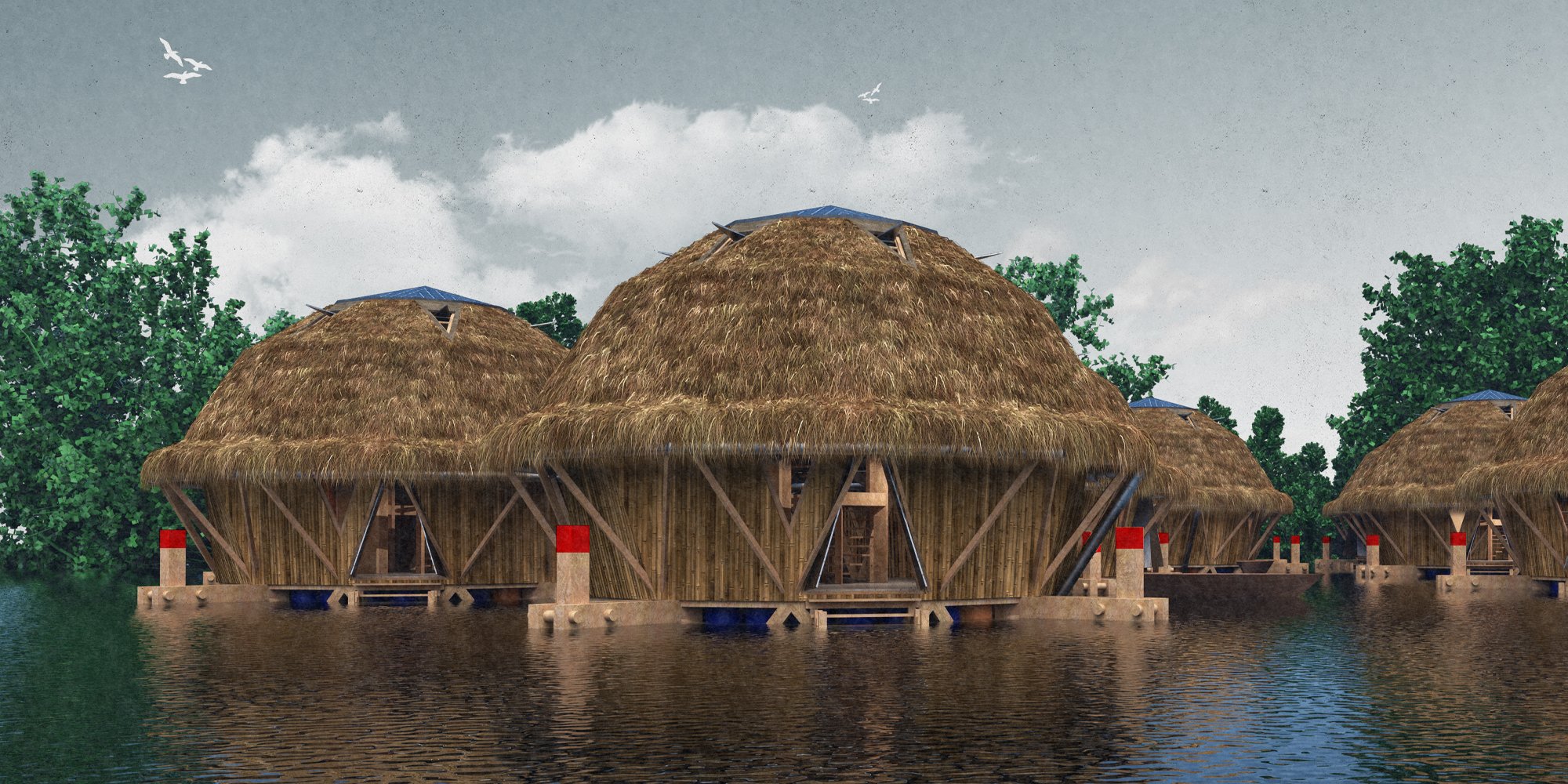
FLOAT
Reinterpreting standard cyclone shelter typology for rural areas in Bangladesh
Project Media
Image available to members
Cover
1/5
Image available to members
Site
2/5
Image available to members
Main Unit Concept
3/5
Image available to members
Construction and types
4/5
Image available to members
Renders
5/5

Project Score


Explore Sustainable Design Competitions
Discover active competitions in this discipline




Hosted by UNI
The International Standard for Design Portfolios
Prize Pool:USD 500
Registration ends: June 30, 2026
Submission ends: July 1, 2026
Worldwide


Hosted by UNI
The Global Benchmark for Architecture Dissertation Awards
Prize Pool:USD 1,000
Registration ends: June 30, 2026
Submission ends: July 1, 2026
Worldwide


Hosted by UNI
The Global Benchmark for Graduation Excellence
Prize Pool:USD 2,500
Registration ends: June 30, 2026
Submission ends: July 1, 2026
Worldwide

Hosted by UNI
Challenge to visualize a collision of the future and past
Prize Pool:USD 7,000
Regular registration: August 30, 2026
Submission ends: September 1, 2026
Worldwide

Similar Projects
Discover related projects you might like








Comments (3)
Please login or sign up to add comments
The shape is too complex and therefore does not improve habitability or make it a faster answer: on the contrary. We consider that the Miesian principle of "Less is more" is, in these cases (cyclone shelters), extremely valid.
The proposal is deeply argued and seriously analyzed. The connections between materials (local and possible to use with low costs and maximum effect), space and function doubled by the volatile nature of stability (floating) are praiseworthy assets. The functions need to be refined in relation to the centralized space.
Concept / Idea [8/10] Analysis of natural conditions, such as climate (wind, solar, heat). Adaptation to local conditions: Well taken into consideration. Adaptability to various locations, scales, and topographies reasonable./ Feasibility of the idea: Commendable./ Use of local materials, techniques, labour skills: Well considered. All materials are locally available, and techniques introduced are locally familiar./ Waste management & sanitation: Recycling of waste materials is given adequate attention. Sanitation is considered to reasonable extent./ Ecological consideration: Excellent./ Flooding: Realistic and simple structural solution. / Design Output [7/10] Structural clarity and feasibility: Well considered. The structure is rather complicated with various panel sizes, but on the other hand, it provides durability and flexibility at the same time. The use of local materials and techniques that are familiar to local workmen is crucial, and very well taken into account./ Architectural quality: The proposal provides flexibility but the dome structure with a heavy thatch roof lacks elegance./ Presentation [9/10] Clarity and quality of images, detailing and overall layout: Commendable./ Clarity of textual material, narratives, justification of design choices: Commendable./ 0 Spaces/Design Programme [9/10] Site plan, logistics: Natural conditions, flexibility and scalability well considered./ Consideration of local socio-cultural features: Well considered. Gender balance and different needs acknowledged./ Community engagement, communal spaces: Good. Opportunities provided for communal meetings, and various activities./ Privacy: The unites provide adequate privacy./ Safety: The site plan allows escape routes. All organic materials may cause a fire risk at times./ Adaptability to changing conditions over time: Flexibility provided. Local materials allow easy repair of worn-out structures.