SPONTANEOUS
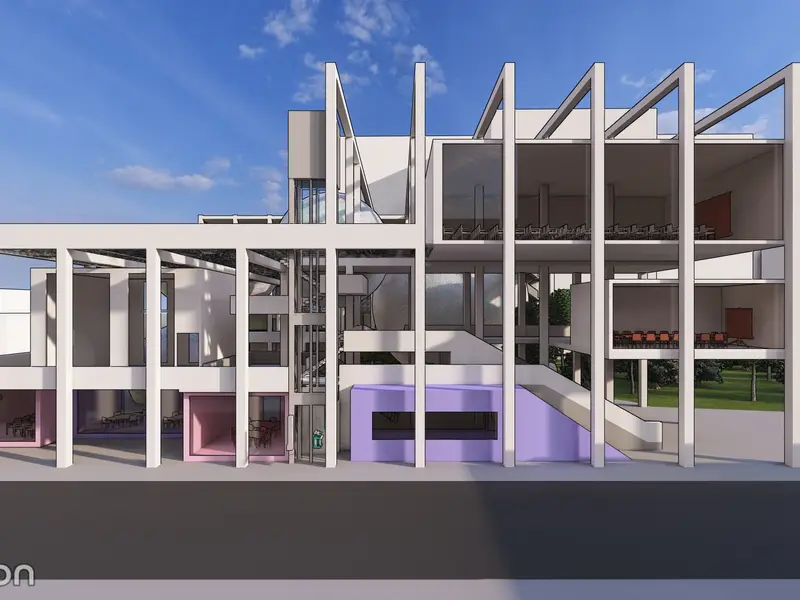
There are basically two states of the game. The first of these can be defined as a fictional game and the other as a spontaneous game. While fictional games are usually played according to a game rule or accompanied by a game leader, spontaneous games are games that occur spontaneously among children. Both types of games are very useful methods for children. However, since spontaneous games can develop children’s imagination at any time, they are very important for developing the intelligence of children, especially our target audience, children between the ages of seven and fourteen. In order to develop children’s creativity, children need to be given space. Rather than giving these areas a fixed function, attention should be paid to ensuring that they provide different opportunities for children. While designing our structure, we basically depicted the spontaneous space that develops in the middle with the separation of two masses. While some fixed functions, such as lessons, take place in these two main masses, we designed the spheres in the middle area as an area where children can create spontaneous games using their imagination. It is formed by the combination of spheres that spontaneously manifest themselves in the space created by the disintegration of these two main masses, and ramps that can make those spheres most functional. Since the building was designed based on the climate of the Philippines, it has a generally permeable language. By extending the green area on the east side of our building to the interior of the building, we aimed to remove the ground floor of our building almost completely, as a solution to the problem of scarcity of green areas, which is very rare in the Philippines, and separate half of the building trace into green space, while the other half establishes integrity with the pavement. While we placed the building at the angle where it could receive the sun most efficiently according to its functions, we aimed to break the unwanted sun thanks to the platforms. In order to make the tropical climate that dominates the Philippines more spacious in our building, we gave the openings of our building based on the wind direction.



Similar Publications
Discover more publications you might be interested in

Lesser-Known Architects: Analyzing the Contributions and Underrepresentation of Female Arc

PARAMETRICISM IN ARCHITECTURE

STREETS FOR PEOPLE REIMAGINE STREETS AS SAFE, HEALTHY AND HAPPY PUBLIC SPACES

SHIKOR - The Presence of Absence (Sir Jagadish Chandra Bose Center for Scientific Research

Modular dormitory design

The Smart Bin
Explore Floor Plan Competitions
Discover active competitions in this discipline


Challenge to reimagine the Iron Throne

Photograph architecture without architects

Illustrate the lost glory of Angkor Wat - Render Challenge

Design challenge to reuse E-waste
Comments (0)
Please login or sign up to add comments
No comments yet. Be the first to comment!